Gathering the Sun; an Alphabet in Spanish and English Alma Flor Ada

            This book beautifully illustrates and honors the people who work hard in the fields to bring food to our tables.  Each letter of the alphabet is a poem in both Spanish and English

Materials

  •  Many alphabet letters
  • White construction paper
  • Oil pastels/conte crayons
  • Several pieces of produce or recipes that are made with produce

Vocabulary

  •             Harvest (to pick produce)
  •             Produce (fruits and vegetables)
  •             Farm Worker (person who works on a farm picking produce).
  •             Customer (buys the produce and eats it)
  •             Store Keeper (the person who cleans and sells the produce).

Before Reading the Story

            Look through the book and decide which pages you would like to share with the children, this may not be the best suited book to read through complete with young children. When you pick the pages you want to read, or talk about, note the alphabet letter that is represented. Ask the children if they can think of other words that begin with the letter.

Literacy/Phonological Awareness; shows growing awareness of beginning and ending sounds in words.
Reading the Story

            Use the book to promote conversations with the children.  (Letter /D/.  Ask the children if the can tell what the farm workers are picking.  Have the children ever tasted peaches?  What are those things that the men are standing on?  What other kinds of fruits grow from trees?  Etc.

Approaches to Learning/Initiative & Curiosity; grows in eagerness to learn about and discuss a growing range of topics, ideas, and tasks. AND Language Development/Speaking & Communicating; develops increasing abilities to understand and use language to communicate information, experiences, ideas, feelings, opinions, needs, questions; and for other varied purposes.

After Reading the Story

            Make a note to the children on all the pages where people are working in the fields and they are wearing hats.  Ask the children why they think the workers are wearing hats.  Discuss with the children how important it is to protect your body from the sun when you are picking produce.  What other ways do people protect their skin?  When are other times when it is important to protect your skin from the sun’s rays?

Physical Health & development/Health Status & Practices; builds awarenss and ability to follow basic health and safety rules such as fire safety, traffic and pedestrian safety, and responding appropriately to potentially harmful objects, substances, and activities.

Discovery

            Bring in several produce or recipes that uses produce to prepare with the children.  Try something using prickly pear, mango,  or a salsa recipe to carry the theme of the story. Have a taste test and make a graph of those that liked the produce and those that did not like the produce.

Mathematics/Patterns & Measurement; begins to make comparisons between several objects based on a single attribute. AND Social & Emotional Development/Self-Concept; begins to develop and express awareness of self in terms of specific abilities, characteristics, or preferences.

Music and Movement

            Sing Where oh Where are all the Children, sung to Way down yonder in the paw paw patch. https://www.youtube.com/watch?v=7LHZSPZZCWU which begins at 3.10 minutes into the video.

Where oh where are all the children,

Where oh where are all the children?

Where oh where are all the children?

Way down yonder in the _____patch.

Picking ______, put them in the basket,

Picking ______, put them in the basket.

Picking _____, put them in the basket,

Way down yonder in the _____ patch.

(Have the children pick different produce and then pretend to pick it accordingly.

Picking strawberries, put them in the basket

Picking apples drop them in the bucket).

Science/Scientific Knowledge; expands knowledge of and abilities to observe, describe, and discuss the natural world, materials, living things, and natural processes.

Sing a song in English and Spanish such as Hello/Hola https://www.youtube.com/watch?v=hqx2phxn_cM

Hello, hello, hello and how are you?

I’m fine, I’m fine, and I hope that you are too.

Hola, hola, hola y como estas?

Usted es bien, bien, y__________

Creative Arts/Music; participates with increasing interest and enjoyment in a variety of music activities, including listening, singing, finger plays, games, and performances.

            Sing Dig a Little Hole, https://www.youtube.com/watch?v=sOJLPw2WJtM

You dig a little hole

Plant a little seed

Pour a little water

Pull a little weed

Chase a little bug

Hey ho there he goes

Give a little sunshine

Watch it grow, grow, grow.

Science/Scientific Knowledge; expands knowledge of and abilities to observe, describe, and discuss the natural world, materials, living things, and natural processes.

Blocks

            At clean up have the children pretend that the blocks that they have built with are potatoes and have them pick the potatoes and put them in the boxes (the shelves).

Creative Arts/Dramatic Play; shows growing creativity and imagination in using materials and in assuming different roles in dramatic play situations.

Art

            Ask each child to name a favorite piece of produce.  Draw a simple shape of their produce on white construction paper.  Have the children color their produce in using oil pastels/conte crayons.  After they have colored their produce in, have them use water colors and wash over the entire page.  When it is dry cut out the piece of produce and mount it to a dark piece of construction paper.  This can make a very stunning piece of artwork.  Label the produce in both English and Spanish.

Creative Arts/Art; gains ability in using different art media and materials in a variety of ways for creative expression and representation.

Sand and Water

            Add magnetic alphabet letters into the sand today. Give the children small spades or spoons to scoop out the letters and name. (I have taken a cookie sheet and traced around all my magnetic letters so that the children can match them by shape). Ask your children to name the letters that they have found. Can they think of a word that begins or ends with that letter sound?

Literacy/Alphabet Awareness; shows progress in associating the names of letters with their shapes and sounds. AND Literacy/Phonological Awareness; shows growing awareness of beginning and ending sounds in words.
Library and Writing

            Collage with alphabet letters.  Can you find the letters in your name?  Can you spell a word from the story?

Literacy/Alphabet Awareness; identifies at least 10 letters of the alphabet, especially those in their own name.

            Write a letter to a farm worker thanking him or her for all the good things that you eat.  Find a local farm or produce stand where you can send it.

Literacy/Early Writing; develops understanding that writing is a way of communicating for a variety of purposes.

Dramatic Play

            Set up a produce stand.  Bring in several baskets and have the children sort the plastic fruits and vegetables.  Add some prices, paper bags, aprons,  and a cash register. 

Social & Emotional Development/Knowledge of Families & Communities. develops growing awareness of jobs and what is required to perform them.

Math and Manipulatives

            Give the children alphabet letters.  Make a large Venn diagram on a piece of paper.  Ask the children to sort the letters by those with curved lines and those with straight lines. (If you do not have enough letters, you can make them by cutting out many 1/2 inch squares and writing the letters on them).

Mathematics/Geometry & Spatial Sense; shows growth in matching, sorting, putting in a series, and regrouping objects according to one or two attributes such as color, shape, or size.

Outdoor Play

            In Mexico parties often include a piñata.  Bring in a piñata or hang a pillowcase filled with scrunched newspaper , a tether ball, or a stuffed animal from a tree .  The children can practice hitting at it with a plastic wiffle bat or stick.

Physical Health & Development/Gross Motor Skills; demonstrates increasing abilities to coordinate movements in throwing, catching, kicking, bouncing balls, and using a slide and swing.

Transitions

            Name a letter sound and ask each child to make a word that begins with that letter sound.  Older children can be challenged to think of words that end with the letter sound.

Literacy/Phonological Awareness; shows growing awareness of beginning and ending sounds in words.
Big Red Barn, by Margaret Wise Brown

What do farm animals do all day? This book is a nice introduction to farm animals and the barn.

Materials

  • Small amount of hay or grass.
  • Large box to make a barn, or a sheet to cover the table to make a barn,
  • Several jars of bubbles and bubble wands (bubble wands can be made by bending pipe cleaners)

Vocabulary

  • Weather Vane (A device that sits on top of a barn and points the way the wind is blowing)
  • Tomcat (a big Daddy cat)

Before Reading the Story

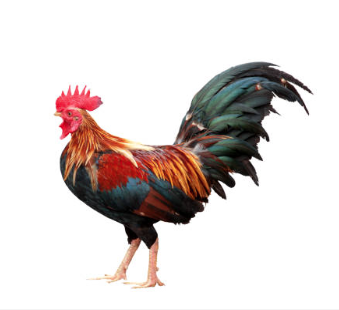
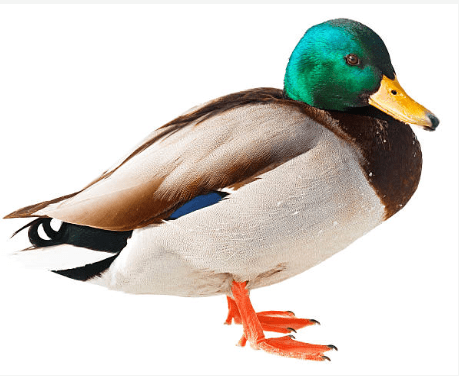
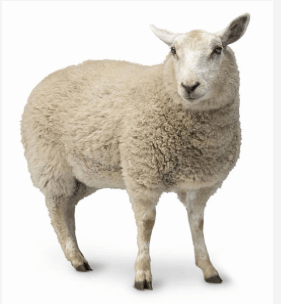
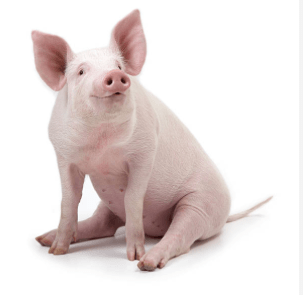
Ask the children to name all the farm animals that they can think of. Write all the answers on a large piece of paper.

Social & Emotional Development/Knowledge of Families & Communities; begins to express and understand concepts and language of geography in the contexts of the classroom, home, and community. AND Approaches to Learning/Reasoning & Problem-Solving; develops increasing abilities to classify, compare, and contrast objects, events, and experiences.

Reading the Story

Show the children the weather vane and explain that it tells which way the wind is blowing. When you get to the page that talks of the sheep and the goat making noises in their throat, ask the children if they know what kind of noise they make.

Science/Scientific Knowledge; expands knowledge of and abilities to observe, describe, and discuss the natural world, materials, living things, and natural processes.

After Reading the Story

Tell the children that you are going to guess farm animals. Say “I see a /g/ pause /oat/. That makes a goat! Now I see a /sh/ pause /eep/. That makes a _____. See if the children can make a farm animal by saying the first letter sound and then adding the rest of the letter sounds. Ask the children if they can recall the animal that was up during the night.

Literacy/Phonological Awareness; shows growing awareness of beginning and ending sounds of words.

Discovery

In the story the animals were out and about during the day. Which was the only animal that was up in the night? Discuss with the children what they do during the day and the night. Make a Venn diagram that shows the differences and similarities of the day and the night.

Mathematics/Patterns & Measurements; begins to make comparisons between several objects based on a single attribute. Approaches to Learning/Initiative & Curiosity; grows in eagerness to learn about and discuss a growing range of topics, ideas, and tasks.

Music and Movement

Teach the children the Baby Animal Song, to the tune of My Eyes are Little Windows

I had a cute cabalito/pony

My Dad he gave to me,
But now he is a caballo/horse
He grew so big you see.
I had a cute cerditto/piglet
My Dad he gave to me,
But now he is a cerdo/pig
He grew so big you see.
Careritto/lamb-cernero/sheep
Pantorrilla/calf-pantorro/cow
Pollita/chick-pollo/chicken

Language Development/Speaking & Communicating; uses an increasingly complex and varied spoken vocabulary.

Blocks

Ask the children to build a barn and add any farm animals you have.

Social & Emotional Development/Cooperation; shows increasing abilities to use compromise and discussion in working, playing, and resolving conflicts with peers.

Art

Use red finger paint today. Show the children how to make a barn in the paint(using a square and a triangle for the basic structure).  Encourage the children try to make farm animals also.

Creative Arts/Art; progresses in abilities to create drawings, paintings, models, and other art creations that are more detailed, creative, or realistic.

Library and Writing

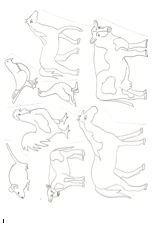
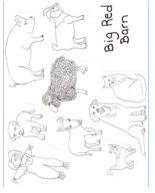
Make a copy of the animal picture cards and cover with contact paper. Add a small piece of Velcro and the children can use these on the flannel board to make a farm scene. Encourage them to tell a story as they play.

Literacy/Book Knowledge & Appreciation; demonstrates progress in abilities to retell and dictate stories from books and experiences; to act out stories in dramatic play; and to predict what will happen next in a story.

Sand and Water

Add hay to the table today and let the children scoop it into buckets. If you do not have hay, use grass. Give the children shovels, tongs, and measuring cups to experiment picking up the hay/grass and putting it into a bucket.

Physical Health & Development/Fine Motor Skills; develops growing strength, dexterity, and control needed to use tools such as scissors, paper punch, stapler, and hammer.

Dramatic Play

Use a sheet to cover the dramatic table to make a ‘barn’. Make sure you can easily observe inside the barn. Or if you have room, use a box. You could take it outside and let the children paint it red the day before.

Creative Arts/Drama; shows growing creativity and imagination in using materials and in assuming different roles in dramatic play situations.

Math and Manipulatives

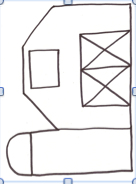
Make several copies of the barn picture and color them different colors. The children can then use small cubes, chain links, etc to match the color object onto the correct color barn.

Mathematics/Geometry & Spatial Sense; shows growth in matching, sorting, putting in a series, and regrouping objects according to one or two attributes such as color, shape,or size.

Outdoor play

Ask the children if they remember what the weathervane is used for. Then ask them if they can think of another way to tell which way the wind is blowing. Bring out the bubbles and let the children blow bubbles into the wind and away from the wind, what happens?

Science/Scientific Skills & Methods; begins to use senses and a variety of tools and simple measuring devices to gather information, investigate materials, and observe processes and relationships.

Transitions

Dismiss the children by asking does this animal live on a farm? Name animals that do and do not live on a farm. The children respond yes or no. You can also have the children make the animal sound.(growl-no, meow-yes).

Approaches to Learning/Reasoning & Problem Solving; develops increasing abilities to classify, compare, and contrast objects, events, and experiences.

Dear Parents, today we read a story about animals who live on the farm. You can play a simple game called, ‘does it or does it not live on a farm’. Then begin naming animals and see if your child can recall if it lives on a farm or not. Let your child have a turn asking you about some animals.

 Accompanying Book, Farm Animals, by Wade Cooper

Resources

Screen Shot 2018-08-10 at 9.10.07 AM
Screen Shot 2018-08-10 at 9.09.40 AM
Screen Shot 2018-08-10 at 9.11.06 AM

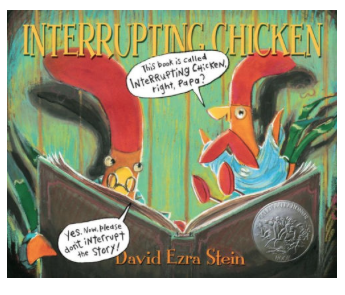
Interrupting Chicken, by David Ezra Stein

Little Red Hen cannot help but interrupt her bedtime stories. Find out how this changes the way the stories are told.

Materials

  • Collection of different kinds of bird feathers.
  • Cracked corn
  • Collection of feathers
  • Pictures to go with song I Had a Little Rooster

Vocabulary

  • Interrupt (to break into a conversation or to barge in)

Before Reading the Story

Talk about night time rituals.  When you get ready for bed what are some of the things that you do?  (brush teeth, take bath/shower,/wash my face/kiss good night/read stories.  Ask the children to raise their hand if a parent reads to them before bed.  Make a list of the children’s favorite stories.  Ask each child to name any favorite stories they may have.  “Our Favorite Books”  Brenda likes Chicka Chicka Boom Boom, Mark likes Mike Mulligan and the Steam Shovel

Literacy/Book Knowledge & Appreciation; progresses in learning how to handle and care for books; knowing to view one page at a time in sequence from front to back; and understanding that a book has a title, author, and illustrator.

Reading the Story

At each point where little red chicken interrupts and the story ends abruptly, ask the children if they liked that story, why or why not?

Social & Emotional Development/Self-Control; develops and understanding of how their actions affect others and begins to accept consequences for their actions.

After Reading the Story

Give examples of when to not interrupt.  The teacher is talking to everybody about what they are doing today.  You mom is on the telephone and you want to tell her something.  Talk about when it is ok to interrupt and when it is not.  Is it ok to interrupt when you are tired? If the house is on fire? You have to go to the bathroom? Someone made a face at you? Your friend is hurt and bleeding? Talk about how it makes you feel when you are interrupted. Talk about how to interrupt if you must (excuse, begging your pardon).

Approaches to Learning?Reasoning & Problem Solving; grows in recognizing and solving problems through active exploration, including trial and error, and in interactions and discussions with peers and adults. AND Social & Emotional Development/Self-Control; develops and understanding of how their actions affect others and begins to accept consequences for their actions.

Little Chicken just wanted to help the characters in the stories that her father was reading. Ask the children if they ever felt like they wanted to help someone out? Let them talk about their experiences.

Social & Emotional Development/Self-Control; develops growing understanding of how their actions affect others and begins to accept the consequences of their actions.

Discovery

Put out a variety of tools (scissors, pencil, phone, spoon, etc.  Ask the child which tool you would use to put food in your mouth, write your name etc.

Language Development/Listening & Understanding; understands an increasingly complex and varied vocabulary.

If you are lucky enough to have a collection of feathers, put it out with a magnifying glass for the children to examine today. Can they find two that match? Do any of the feathers have a pattern on them?

Science/Scientific Skills & Methods; develops increasing ability to observe and discuss common properties, differences, and comparisons among objects and materials.

Music and Movement

The Interrupting Song https://www.youtube.com/watch?v=AifKm6TsWJA

Sing This Is The Way We…. To the tune of Here We Go Round the Mulberry Bush. https://www.youtube.com/watch?v=FTgxW32ie5E

This is the way we scratch for worms, scratch for worms, scratch for worms. This is the way we scratch for worms so early in the morning. This is the way we peck for food, sit on our eggs, flap our wings, fly away.

Creative Arts/Music; Participates with increasing interest and enjoyment in a variety of music activities, including listening, singing, finger plays, games, and performances.

Relax with soft music.  Let whole body relax.  Pick up a child’s arm and let it fall, was it relaxed?  Like a rag doll.

I had a little rooster https://www.youtube.com/watch?v=fBUg0HvWYx0

Art

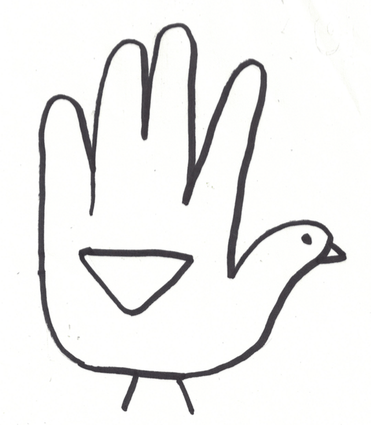
Trace around each child’s hands and show them how they can turn them into chickens.

Physical Health & Development/Fine Motor Skills; progresses in abilities to use writing, drawing, and art tools, including pencils, markers, chalk, paint brushes, and various technology.

Use feathers at the easel for paint brushes today.

Creative Arts/Art; gains ability in using different art media and materials in a variety of ways for creative expression and representation.

Sand and Water

Fill the table fill of a chickens favorite food, cracked corn. Use it to scoop and pour.

Library and Writing

Have child draw a picture.  Then ask them to tell you about their picture.  Write their dictation onto a piece of paper and staple it to their picture.

Literacy/Early Writing; begins to represent stories and experiences through pictures, dictation, and in play.

In the story, father rooster began reading three stories.  If you have these books in your school, add them to the center for the children to look at and ask you to read (Hansel and Gretel, Little red Riding Hood, Chicken Little)

Literacy/Book Knowledge & Appreciation; shows growing interest in reading-related activities, such as asking to have a favorite book read; choosing to look at books; drawing pictures based on books; asking to take books home; going to the library; and engaging in pretend reading with other children.

Dramatic Play

At nap time today make sure the children have access to books.  Let them use this prepping for naptime to read stories (to each other or to a stuffed animal.

Literacy/Book Knowledge & Appreciation; shows growing interest in reading-related activities, such as asking to have a favorite book read; choosing to look at books; drawing pictures based on books; asking to take books home; going to the library; and engaging in pretend reading with other children.

Bring in night time ritual materials for the children to play night time.  (blanket, box for bed, books, dressup pj’s, stuffed animals

Creative Arts/Dramatic Play; participates in a variety if dramatic play activities that become more extended and complex.

Math and Manipulatives

Play any board game or card game that you and your children are familiar with.  The idea is to practice taking turns.

Social & Emotional Development/Cooperation; develops increasing abilities to give and take in interactions; to take turns in games or using materials; and to interact without being overly submissive or directive.

Outdoor Play

Any game or activity where you stress the importance of taking turns.

Social & Emotional Development/Cooperation; develops increasing abilities to give and take in interactions; to take turns in games or using materials; and to interact without being overly submissive or directive.

Transitions

Tell the children that you are going to practice taking turns to go to the next activity. Ask the children to show you that they are ready. Call on those that you feel are ready and ignore those who are not following your rules. When all the children who did as they were asked have gone to the next activity, ask the remaining children why they are still sitting on the carpet? Remind them again to show you what they need to be doing. Call them as they follow the directions to go to the next activity. Keep reminding and calling children until everyone has moved. (I have the children sit with hands in their laps and mouths zipped closed).

Social & Emotional Development/Self-Control; develops growing understanding of how their actions affect others and begins to accept the consequences of their actions.

Resources

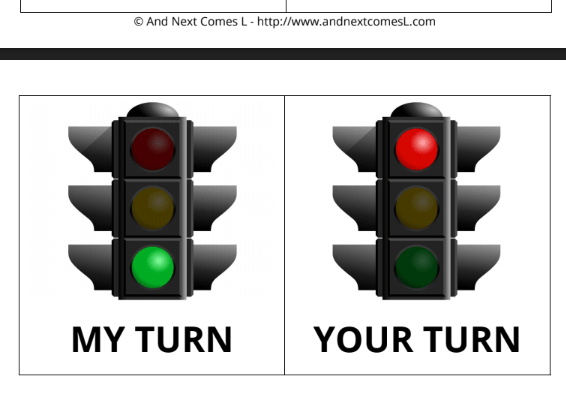
Use as a visual to help children learn to wait their turn.
handprint chicken