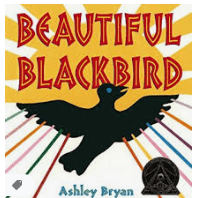
Beautiful Blackbird, by Ashley Bryan    

All the birds want to be beautiful like black bird who generously shares his color with them.

Materials

  • Roll of crepe paper
  • A whisk, hand eggbeater, slotted spoon, different tools to make bubbles in water.
  • Several large stiff feathers to use as paint brushes

Vocabulary

  • Arcs (curves and semicircles)
  • Festival (party or celebration)
  • Mirrored (reflected)
  • Beautiful (how lovely someone or something is)

Introducing the Story

Play a color game such as; If you are wearing _____clap your hands, if you are wearing ________green stomp your feet.

Language Development/Listening & Understanding; shows progress in understanding and following simple and multiple-step directions.

Or have snips of paper in several colors (one for each child). Give each child a snip of paper and the child must go and find an object in the room that color. Make sure whatever game you play that black is included.

Mathematics/Geometry & Spatial Sense; shows growth in matching, sorting, putting in a series, and regrouping objects according to one or two attributes such as color, shape, or size.

Reading the Story

Read this book ahead of time so that you have the rhythm of the story as you read. When you get to the page where Blackbird shares his color, tell the children that he is being a beautiful friend by sharing all his color.

Language development/Listening & Understanding; demonstrates increasing ability to attend to and understand conversations, stories, songs, and poems.

After Reading the Story

Ask the children what it is that all the birds wanted from black bird? (His color black).   Why do you think they wanted some black of their own? (They thought it was beautiful). Do you think it was fair that Black Bird shared some of his with all the other birds? (Yes, he was being a good friend). Ask the children if they know what beautiful means? Let them give their thoughts (Beautiful is really pretty like a shiny necklace. Beautiful is my stuffed doggie. My Mommy says my smile is beautiful.). Then tell the children that every person in the whole wide world has something that is beautiful about them. Sometimes it is on the outside like lovely curls and sometimes it is on the inside like when someone always shares and is kind. Let the children comment upon this idea. If they do not, you can tell one thing beautiful about all the children in the group. (Roger has a beautiful smile and Alison is beautiful because she is so gentle with her baby sister and other little children.). Make sure to include both inward and outward beauty for everyone throughout the day. (Sean, that is beautiful how you mixed those colors on your painting, you are an artist. Paula, that was so thoughtful and beautiful for you to share your book with Ryan).

Literacy/Book Knowledge & Appreciation; shows growing interest and involvement in listening to and discussing a variety of fiction and non-fiction books and poetry.

Music and Movement

Take the words to the dance in the book and turn it into a barnyard type call and dance.

Beak to beak, peck, peck, peck
Spread your wings, stretch your neck.
Tip tap toe to the left, spin around
Toe tap tip to the right, stroke the ground.
Wings flip-flapping as you glide,
Forward and backward in a snow claws slide.

Language Development/Listening & Understanding; shows progress in understanding and following simple and multiple-step directions. AND Creative Arts/Movement; shows growth in moving in time to different patterns of beat and rhythm in music.

Sing Two Little Blackbirds

Two little blackbirds sitting on a hill,                                     
(Children hold up 1 finger on each hand)
One named Jack and one named Jill.                                         
(Wiggle left finger, wiggle right finger)
Fly away Jack, fly away Jill                                                         
( Put 1 finger behind back, then the other)
Come back Jack, come back Jill.                                                 
(Bring 1 finger forward, then the other)

Next add 2 fingers to each hand and count. Sing about 4 blackbird, then 6 blackbirds, 8, and then 10

Mathematics/Numbers & Operations; develops increased abilities to combine and name “how many” concrete objects.

Discovery

Fill 5 plastic cups with a small amount of paint; red, blue, yellow, white, and brown. Put out white paper and brushes. Challenge the children to mix colors to make new colors. Can they make black? Pink? Green? Purple? What happens when you add more white to your color?

Science/Scientific Skills; begins to participate in simple investigations to test observations, discuss and draw conclusions, and form generalizations.

Blocks

Challenge the children to build a nest and then pretend to be birds.

Approaches to Learning/ Reasoning & Problem-Solving; develops increasing ability to find more that one solution to a question, task, or problem.

Art

Put out black paint and feathers for brushes at the easel today. You can cut out simple bird shapes from colored construction paper.

Creative Arts/Art; gains ability to use different art media and materials in a variety of ways for creative expressions and representation.

Sand and Water

In the story, blackbird stirred his brew in the medicine gourd. Put water into the table today with things to stir; a whisk, a hand mixer, a slotted spoon. Let the children add soap to stir around and make bubbles.

Social & Emotional Development/Self-Control; demonstrates increasing capacity to follow rules and routines and use materials purposefully, safely, and respectfully.

Library and Writing

Tell the children that in the story today, blackbird said color on the outside is not what’s on the inside. You don’t act like me. You don’t eat like me. You don’t move and groove your feet like me. And in our class, you don’t have the same name as me. Give the children paper and pencils/markers to practice writing their names. Put out name tags so the children can see their name as they copy the letters. For older children, encourage them to also copy the name of their friends.

Literacy/Alphabet Knowledge; identifies at least 10 letters of the alphabet, especially those in their own name. Literacy/Early Writing; progresses from using scribbles, shapes, or pictures to represent ideas, to using letter-like symbols, to copying or writing familiar words such as their name.

Dramatic Play

In the story, the birds gathered for a festival. Put out crepe paper and masking tape so the children can begin to decorate for a festival in the dramatic center.

Creative Arts/Dramatic Play; participates in a variety of dramatic play activities to become more extended and complex.

Math and Manipulatives

Make a ‘Which is our favorite color’ chart and then survey the children to see which is their favorite color. After all the children have been surveyed, you can use your chart to see which color was most favored in your classroom, which color was nobody’s favorite, count how many marks each color has. Write the number on the chart.

Mathematics/Patterns & Operations; begins to make comparisons between several objects based on a single attribute.  AND Mathematics/Numbers & Operations; begins to make use of one-to-one correspondence in counting objects and matching groups of objects.

Outdoor Play

Pretend to be birds and fly about the play yard. Can the children fly fast? Slow? Fly very low to the ground? On their tiptoes? Use the edge of the sandbox to perch as though on a branch, pretend to fly down and eat insects and gather together in a nest for the night.

Science/Scientific Knowledge; expands knowledge of and abilities to observe, describe, and discuss the natural world, materials, living things, and natural processes.

Transitions

Send the children off to the next activity by colors. If you are wearing black, line up. If you are wearing green, line up, etc..

Language Development/Listening & Understanding; understands an increasingly complex and varied vocabulary.

Resources

Dear Parents, today we read a story about how birds got black markings on their bodies. Take your child for a black walk about your house or property. How many black items can they find?
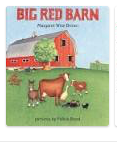
Big Red Barn, by Margaret Wise Brown

What do farm animals do all day? This book is a nice introduction to farm animals and the barn.

Materials

  • Small amount of hay or grass.
  • Large box to make a barn, or a sheet to cover the table to make a barn,
  • Several jars of bubbles and bubble wands (bubble wands can be made by bending pipe cleaners)

Vocabulary

  • Weather Vane (A device that sits on top of a barn and points the way the wind is blowing)
  • Tomcat (a big Daddy cat)

Before Reading the Story

Ask the children to name all the farm animals that they can think of. Write all the answers on a large piece of paper.

Social & Emotional Development/Knowledge of Families & Communities; begins to express and understand concepts and language of geography in the contexts of the classroom, home, and community. AND Approaches to Learning/Reasoning & Problem-Solving; develops increasing abilities to classify, compare, and contrast objects, events, and experiences.

Reading the Story

Show the children the weather vane and explain that it tells which way the wind is blowing. When you get to the page that talks of the sheep and the goat making noises in their throat, ask the children if they know what kind of noise they make.

Science/Scientific Knowledge; expands knowledge of and abilities to observe, describe, and discuss the natural world, materials, living things, and natural processes.

After Reading the Story

Tell the children that you are going to guess farm animals. Say “I see a /g/ pause /oat/. That makes a goat! Now I see a /sh/ pause /eep/. That makes a _____. See if the children can make a farm animal by saying the first letter sound and then adding the rest of the letter sounds. Ask the children if they can recall the animal that was up during the night.

Literacy/Phonological Awareness; shows growing awareness of beginning and ending sounds of words.

Discovery

In the story the animals were out and about during the day. Which was the only animal that was up in the night? Discuss with the children what they do during the day and the night. Make a Venn diagram that shows the differences and similarities of the day and the night.

Mathematics/Patterns & Measurements; begins to make comparisons between several objects based on a single attribute. Approaches to Learning/Initiative & Curiosity; grows in eagerness to learn about and discuss a growing range of topics, ideas, and tasks.

Music and Movement

Teach the children the Baby Animal Song, to the tune of My Eyes are Little Windows

I had a cute cabalito/pony

My Dad he gave to me,
But now he is a caballo/horse
He grew so big you see.
I had a cute cerditto/piglet
My Dad he gave to me,
But now he is a cerdo/pig
He grew so big you see.
Careritto/lamb-cernero/sheep
Pantorrilla/calf-pantorro/cow
Pollita/chick-pollo/chicken

Language Development/Speaking & Communicating; uses an increasingly complex and varied spoken vocabulary.

Blocks

Ask the children to build a barn and add any farm animals you have.

Social & Emotional Development/Cooperation; shows increasing abilities to use compromise and discussion in working, playing, and resolving conflicts with peers.

Art

Use red finger paint today. Show the children how to make a barn in the paint(using a square and a triangle for the basic structure).  Encourage the children try to make farm animals also.

Creative Arts/Art; progresses in abilities to create drawings, paintings, models, and other art creations that are more detailed, creative, or realistic.

Library and Writing

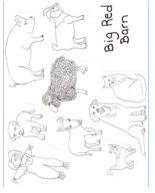
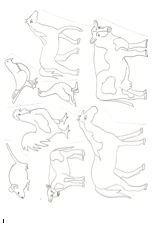
Make a copy of the animal picture cards and cover with contact paper. Add a small piece of Velcro and the children can use these on the flannel board to make a farm scene. Encourage them to tell a story as they play.

Literacy/Book Knowledge & Appreciation; demonstrates progress in abilities to retell and dictate stories from books and experiences; to act out stories in dramatic play; and to predict what will happen next in a story.

Sand and Water

Add hay to the table today and let the children scoop it into buckets. If you do not have hay, use grass. Give the children shovels, tongs, and measuring cups to experiment picking up the hay/grass and putting it into a bucket.

Physical Health & Development/Fine Motor Skills; develops growing strength, dexterity, and control needed to use tools such as scissors, paper punch, stapler, and hammer.

Dramatic Play

Use a sheet to cover the dramatic table to make a ‘barn’. Make sure you can easily observe inside the barn. Or if you have room, use a box. You could take it outside and let the children paint it red the day before.

Creative Arts/Drama; shows growing creativity and imagination in using materials and in assuming different roles in dramatic play situations.

Math and Manipulatives

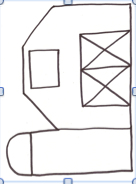
Make several copies of the barn picture and color them different colors. The children can then use small cubes, chain links, etc to match the color object onto the correct color barn.

Mathematics/Geometry & Spatial Sense; shows growth in matching, sorting, putting in a series, and regrouping objects according to one or two attributes such as color, shape,or size.

Outdoor play

Ask the children if they remember what the weathervane is used for. Then ask them if they can think of another way to tell which way the wind is blowing. Bring out the bubbles and let the children blow bubbles into the wind and away from the wind, what happens?

Science/Scientific Skills & Methods; begins to use senses and a variety of tools and simple measuring devices to gather information, investigate materials, and observe processes and relationships.

Transitions

Dismiss the children by asking does this animal live on a farm? Name animals that do and do not live on a farm. The children respond yes or no. You can also have the children make the animal sound.(growl-no, meow-yes).

Approaches to Learning/Reasoning & Problem Solving; develops increasing abilities to classify, compare, and contrast objects, events, and experiences.

Dear Parents, today we read a story about animals who live on the farm. You can play a simple game called, ‘does it or does it not live on a farm’. Then begin naming animals and see if your child can recall if it lives on a farm or not. Let your child have a turn asking you about some animals.

 Accompanying Book, Farm Animals, by Wade Cooper

Resources

Screen Shot 2018-08-10 at 9.10.07 AM
Screen Shot 2018-08-10 at 9.09.40 AM
Screen Shot 2018-08-10 at 9.11.06 AM

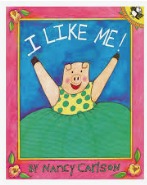
I Like Me! , by Nancy Carlson

Materials;

  • Several towels to dry wet baby dolls
  • Spinning hand tops (if you do not have these, there are several ways to make them simply on YouTube).

Introducing the Story

Show the children the front of the book and tell them the name of the story is I Like Me! Ask the children if they can think of some things that they like about themselves. Let the children share their ideas and then read the story.

Literacy/Book Knowledge & Appreciation; shows growing interest and involvement in listening to, and discussing a variety of fiction, non-fiction, and poetry. AND Social & Emotional Development/Self-Concept; begins to develop and express awareness of self in terms of specific abilities, characteristics, and preferences.

Reading the Story

This simple text requires an upbeat reading.

After Reading the Story

Tell the children that in the story Pig cheered herself up when she felt sad. Ask the children what they think they can do to help cheer themselves or a friend up when they feel sad?

Social & Emotional Development/Social Relationships; progresses in responding sympathetically to peers who are in need, upset, hurt, angry; and in expressing empathy or caring to others. AND Social & Emotional Development/Self-Concept; begins to develop and express awareness of self in terms of specific abilities, characteristics, and preferences.

Music and Movement

Pretend to wash hands with the children. What do we do first? What do you do next? Then what? What do you do last? Go through your hand washing procedure with the children as you all pantomime what to do.

Physical Health & Development/Health Status & Practices; shows growing independence in hygiene, nutrition, and personal care when eating, dressing, washing hands, brushing teeth, and toileting

Discovery

Introduce spinning hand tops. These take some practice to be able to get going. Remind the children in the story, Pig had to practice, practice, practice, (try and try again) to do something new and different. Ask them if they remember what she was doing (baking a cake). If you do not have spinning tops, check to see what else in your center would be a challenge for the children to manipulate. The idea is to encourage to practice and practice and to try, try again.

Approaches to Learning/Engagement & Persistence; grows in ability to persist in and complete a variety of tasks and activities.

Blocks

Challenge the children to build a house. Encourage them to include windows and doors.

Approaches to Learning/reasoning & Problem Solving; grows in recognizing and solving problems through active exploration, in trial and error, and interactions and discussions with peers and adults.

Art

Just like in the story, draw beautiful pictures today.

Creative Arts/Art; progresses in abilities to plan, work independently, and demonstrate care and persistence in a variety of art projects.

Sand and Water

Add baby dolls and liquid soap to the water today. The children can pretend that they are bathing their babies.

Physical Health & Development/Health Status & Practices; shows growing independence in hygiene, nutrition, and personal care when eating, dressing, washing hands, brushing teeth, and toileting

Library and Writing

Remind the children that in the story the pig liked many things about herself. Help the children to trace around their hands and then ask them to tell you some things they like about themselves. Write their responses onto the paper with their hands and then let them decorate the paper with colored pencils.

Literacy/Book Knowledge & Appreciation; demonstrates abilities to retell and dictate stories from books and experiences; to act out stories in dramatic play; and to predict what will happen next in a story.

Dramatic Play

In the story Pig said she eats good food. Encourage the children to cook today and make a yummy, healthy meal. Can the children name all the foods in your dramatic play center? Can they sort them by like kinds, healthy-unhealthy, refrigerated and non-refrigerated, etc.?

Language/Speaking & Communicating; uses increasingly complex and varied spoken vocabulary. AND Mathematics/Geometry & Spatial Sense; shows growth in matching, sorting, putting in a series, and regrouping objects according to one or two attributes such as color, shape.or size.

Math and Manipulaties

Put out a new or challenging manipulative or building toy for the children today. If they begin to get frustrated tell them to say, “I think I can” and try, try again.

Approaches to Learning/reasoning & Problem Solving; grows in recognizing and solving problems through active exploration, in trial and error, and interactions and discussions with peers and adults.

Outdoor Play

If you have riding toys, encourage the children to ride on them fast, just like in the story today.

Physical Health & Development/ross motor Skills;demonstrates increasing abilities to coordinate movements in throwing, catching, kicking, bouncing balls, and using the slide and swing.

Transitions

Play, I’m Thinking of Someone. Think of a child in the classroom and begin to explain his/her characteristics, likes and dislikes. The children can guess whom you are thinking of. (I’m thinking of someone who has brown hair and likes to wear red sneakers. This person has a dog at home named Bowzer).

Social & Emotional Development/Social Relationships; shows progress in developing relationships with peers (as in order to answer questions regarding peers)

Resources

Dear Parents, Today we read a story about a little pig who really liked herself. Ask your child what they like best about themselves. After they have told you, tell them, “I like you!” and then tell your child some of the things that you find so special about them.