Raindrops Roll, by April Pulley Sayre

This non-fiction book looks at rain and its effect on the environment. Beautiful pictures and poetic text make it a nice book to use in any weather or water unit.

Materials

  • Several clean spray bottles
  • Colored chalk
  • A penny, a nickel, a dime, and a quarter
  • Eyedroppers
  • Piece of cardboard with a 2-inch hole cut out of it in the center
  • Many larger pictures cut from magazines or calendars.
  • A piece of yarn/string long enough to reach across dramatic center
  • 10-12 spring loaded clothespins

Vocabulary

Before Reading the Story

Bring your piece of cardboard and many pictures to the rug. Without the children seeing the picture, place one behind the cardboard. Move the picture around and ask the children if they can tell what it is. Doing this allows them to only see one part of the picture at a time.

Science/Scientific Skills; begins to describe and discuss predictions, explanations, and generalizations based on past experiences.

Reading the Story

This is a very simple story with beautiful pictures. Take your time reading and talk about the pictures as you read. Can they name the insects? Note the shape of the raindrops; are they really tear shaped like people think?

Science/Scientific Knowledge; expands knowledge of and abilities to observe, describe, and discuss the natural world, materials, living things,and natural processes.

After Reading the Story

Spend a few minutes talking to the children about storm safety. When you hear thunder you should go inside because lightning is near. Rushing water during a storm could knock you over (2 feet can sweep away an SUV and pickup truck!). Stay away from trees and water, even puddles, when there is a thunderstorm.

Physical Health & Development/Health Status & Practices; builds awareness and ability to follow basic health and safety rules such as fire safety, traffic and pedestrian safety, and responding appropriately to potentially harmful objects, substances, and activities.

Discovery

Put out magnifying glasses today with interesting nature objects. Let the children use a spray bottle of water to see how water droplets cling to the objects.

Science/Scientific Skills & Methods; begins to use senses and a variety of tools and simple measuring devices to gather information, investigate materials, and observe processes and relationships.

Music and Movement

Make a rainstorm. Begin by tapping one finger on your knees and saying, “drop, plop, drop, plop, rain”. Next take your fingers and tap them on your knee and say, “pitter-patter, pitter-patter, rain”. Take your hands and pat your knees and say, “downpour, downpour, rain”. Clap your hands and say “thunder, thunder, rain”. Now reverse the order; downpour, pitter-patter, drip drop, rain.

Creative Arts/Music; participates with increasing interest and enjoyment in a variety of music activities, including listening, singing, finger plays,  games, and performances.

Sing If All The Raindrops Were Lemon Drops and Gum Drops https://www.youtube.com/watch?v=cNvL_5COPtM

If all the raindrops were lemon drops and gumdrops,
Oh what a rain it would be!
I’d stand outside with my mouth open wide,
Ah,ah,ah,ah,ah,ah,ah,ah,ah,ah
If all the raindrops were lemon drops and gumdrops,
Oh what a rain it would be.

Ask the children to name other edibles and switch out lemon drops and gumdrops.

Language Development/Listening & Understanding; demonstrates increasing ability to attend to and understand conversations, stories, songs, and poems.  AND Approaches to Learning/Reasoning Problem Solving; develops increasing ability to find more than one solution to a questions, task, or problem.

Blocks

Encourage the children to use the blocks to make houses to get out of the rain. If you have large cardboard blocks they can make a house for themselves. If you have small wooden blocks, add small people.

Approaches to Learning/Reasoning Problem Solving; develops increasing ability to find more than one solution to a questions, task, or problem.  AND Physical Health & Development/Fine Motor Skills; grows in eye-hand coordination in building with blocks, putting together puzzles, reproducing shapes and patterns, stringing beads, and using scissors.

Art

Give the children colored chalk to draw with. After the children have drawn their chalk picture, show them how to spray water on it with the spray bottle. Talk about what happens to the chalk.  Or…Use a permanent marker to draw a simple umbrella shape onto a piece of paper. Give the children colored chalk and ask them to make raindrops. After they have finished making raindrops, show them how to spray their paper with the spray bottle of water.

Creative Arts/Art; begins to understand and share opinions about artistic products and experiences. AND Science/Scientific Skills & Methods; begins to participate in simple investigations, discuss and draw conclusions, and form generalizations.

Encourage the children to make a rain picture. At the easel put out several colors. Show the children how to fill their paintbrush with paint and then press it against the top of their paper so that the colors roll run down the paper.

Creative Arts/Art; gains ability in using different art media and materials in a variety of ways for creative expression and representation.  AND Language Development/Listening & Understanding; shows progress in understanding and following simple and multi-step directions.

Sand and Water

Put out a variety of things that the children can move water from one container to another (turkey baster, squeeze bottle, funnel, pitcher, sponge).

Science/Scientific Skills & Methods; begins to use senses and a variety of tools and simple measuring devices to gather information, investigate materials, and observe processes and relationships.

Library and Writing

Put the book into the center for the children to be able to spend time looking at the beautiful pictures.

Literacy/Book Knowledge & Appreciation; shows growing interest in reading related activities, such as asking to have a favorite book read; choosing to look at books; drawing pictures based on stories; asking to take  books home; going to the library; and engaging in pretend reading with others.

Dramatic Play

Hang a piece of string or laundry line across the center. Give the children clothespins and explain that on sunny days people hang their clothes out to dry. Encourage the children to hang doll clothes on the line. When they are all hung go back to the center and tell the children it looks like rain, time to take the clothes off the line!

Physical Health & Development/Fine Motor Skills; develops growing strength, dexterity, and control needed to use tools such as scissors, paper punch, stapler, and hammer.

Math and Manipulatives

Put a piece of newspaper on the table to catch any water drops. Put a coin onto the newspaper and show the children how to use the eyedropper to suck up water and then slowly drip one drop at a time onto the coin. Before they begin, ask them how many water drops they think the coin will hold. Let the child begin to drip the drops and count. Were they able to guess how many water drops the coin could hold? Which coin held the most, the least? What happens when you squeeze all the water from the eyedropper at one time?

Mathematics/Number & Operations; begins to use one-to-one correspondence in counting objects and matching groups of objects.  AND Mathematics/Number & Operations; begins to use language to compare numbers of objects in terms such as more, less, greater than, fewer, equal to.

Outdoor Play

Rain makes mud. Let the children dig on the playground with shovels and add water. Make mud! Let the children experiment with the mud, can they build with it? What happens if you only add a little water? A lot of water?

Science/Scientific Skills & Methods; begins to participate in simple investigations to test observations, discuss and draw conclusions, and form generalizations.

Transitions

Pull out your cardboard and variety of pictures that you used before reading the story. Let the children take turns guessing what the picture is. (Note it is hard for children to wait turns to answer so note those who can and those who shout out).

Science/Scientific Knowledge; expands knowledge of and abilities to observe, describe, and discuss the natural world, materials, living things,and natural processes.  AND Physical Health & Development/Cooperation; develops increasing abilities to give and take in interaction, to take turns in games or using materials; and to interact without being overly submissive or directive.
A Piece of Red ›Paper, by Sara Stein

What if you found a sheet of paper and turned it into wonderful food and a whole table full of good things? This book will inspire children to get creative.

Materials

  • Lots of paper in plenty of colors and textures.
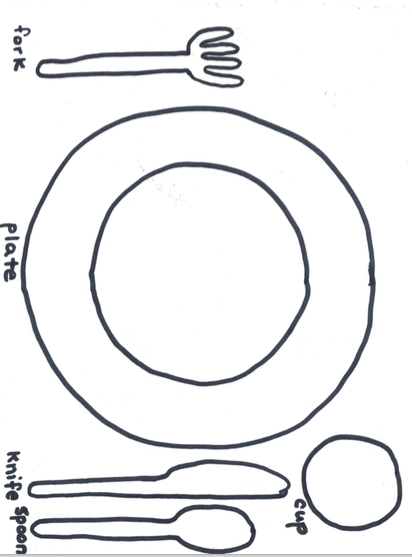
  • Placemat pattern

Vocabulary

  • Creative (to think of something and then make it)

Before Reading the Story;

Hold up the cover of the book and read the title. Ask the children if they can guess what the story might be about. Ask them to name the shape. Can they tell if the shape has been cut by scissors or ripped? How can you tell? (The edges are not straight).

Mathematics/Geometry & Spatial Sense; begins to recognize, describe, compare, and name common shapes, their parts and attributes.

Reading the Story

Bring a cut red circle to the story and follow the author as she makes an apple with a bite. Point out all the shapes and ideas as the story progresses. When the book asks “What would you do with a piece of red paper”, let the children share their ideas.

Mathematics/Geometry & Spatial Sense; begins to recognize, describe, compare, and name common shapes, their parts and attributes.  AND Creative Arts/Art; begins to understand and share opinions about artistic products and experiences.

After Reading the Story

Play Jumping Bean! Cut a manila file into 1 inch strips. At the bottom of each strip draw a shape. On some of the strips draw a little lima bean shaped man. (for 20 children I would make 15 shape strips and 5 jumping bean strips). Put all the strips into a cleaned out can. The children take turns picking a strip. If they get a shape they must name it. If they get a bean man they shout “Jumping Beans!” and everyone jumps up and down. Continue until everyone gets a turn or two.

Mathematics/Geometry & Spatial Sense; begins to recognize, describe, compare, and name common shapes, their parts and attributes.  AND Social & Emotional Development/Cooperation; develops increasing abilities to give and take in interactions; to take turns in games or using materials; and to interact without being overly submissive or directive.

Discovery;

Go on a shape walk and look for shapes in the world. What shape do you see on the chain link fence? What shape do you see in the sidewalk, on the car, or near the door?

Mathematics/Geometry & Spatial Sense; progresses in ability to put together and take shapes apart.

Music and Movement

Play Musical Chairs. Make two sets of shapes in a variety of colors. (2 red circles, 2 blue circles, 2 red triangles, etc). Bring enough chairs to the area, as there are children who are playing the game. Tape one color shape set to the back of the chairs, one per chair. Give the children the matching color shapes, one per child. Turn on the music and the children walk around the chairs. When the music stops, everyone must find the chair that has the correct shape and color on it and sit down. Have the children name the colors and shapes as you go around collecting them. Mix them up and play again. Do not take any chairs or children away. The concept is to find the shape and color that match the one you are holding.

Mathematics/Geometry & Spatial Sense; begins to be able to determine whether or not two shapes are the same size and shape.  

Blocks

Encourage the children to make shapes with the blocks.  How many blocks will it take to make a square?  Can you find blocks to make a triangle?  Can you find blocks to make a letter in your name?

Mathematics/Geometry & Spatial Sense; progresses in ability to put together and take shapes apart.

Art

Give the children lots of paper to cut and rip into a variety of shapes.  Challenge them to collage them together to make an art picture.

Mathematics/Geometry & Spatial Sense; progresses in ability to put together and take shapes apart.  AND Physical Health & Development/Fine Motor Skills; grows in hand-eye coordination in building with blocks, putting together puzzles, reproducing shapes and patterns, stringing beads, and using scissors.

Library and Writing

Put out pieces of colored paper with the color written across it. (green paper with the word green written across it). Encourage the children to find the same color marker and practice writing the color name on their own piece of white paper.

Literacy/Early Writing; progresses from using scribbles, shapes, or pictures to represent ideas, to using letter-like symbols, to copying or writing familiar words such as their own name.

Sand and Water

Put small magnet shapes in the sand, if you do not have small shapes, cut them out of cardboard.  Add sand to cover the shapes and give the children tongs, pinchers, tweezers to pick up the shapes and drop into a basket as they name.

Physical Health & Development/Fine Motor Skills; grows in hand-eye coordination in building with blocks, putting together puzzles, reproducing shapes and patterns, stringing beads, and using scissors.

Dramatic Play

Encourage the children to set the table putting the knives, spoons, and forks, in their proper places. Make placemats that the children can follow.

Social & Emotional Development/Control; develops growing capacity for independence in a range of activities , routines, and tasks.

Math and Manipulatives

Make weaving looms from paper for the children to use. Cut out strips of 1 inch wide paper in a variety of colors. Show the children how to take the strips and go under over, then over under.

Approaches to Learning/Engagement & Persistence; grows in abilities to persist in and complete a variety of tasks and activities.  AND Mathematics/Geometry & Spatial Sense; builds an increasing understanding of directionality, order, and positions of objects, and words such as up, down, over, under, top, bottom, inside, outside, in front, and behind.

Outdoor Play

Encourage the children to use sticks to draw shapes in the dirt or dampened sand.

Mathematics/Geometry & Spatial Sense; progresses in ability to put together and take shapes apart.  AND Literacy/Early Writing; experiments with a growing variety of writing tools and materials, such as pencils, crayons, and computers.

Transitions

Hold up a piece of paper and ask the children to name the color name and if they can think of an object that is the color.

Approaches to Learning/Reasoning & Problem Solving; develops increasing ability to find more than one solution to a question, task, or problem.

Dear Parent- today we talked about shapes.  Cut out a circle, a square, or a triangle from a  piece of paper.  Hand it to your child and encourage them to look about your home to find 3-5 items that have that shape as part of their structure.  Try playing this shape game using several shapes.

Resources

Screen Shot 2018-09-09 at 12.04.30 PM

Arthur’s Eyes, by Marc Brown

Arthur was having some problems seeing until his parents took him to the optometrist. After that, Arthur was having a problem with his friends teasing him about his new glasses. How does Arthur solve his problem about having to wear glasses? If you have a child, or children in your classroom that must wear glasses, this book may help them feel better about themselves.

Materials

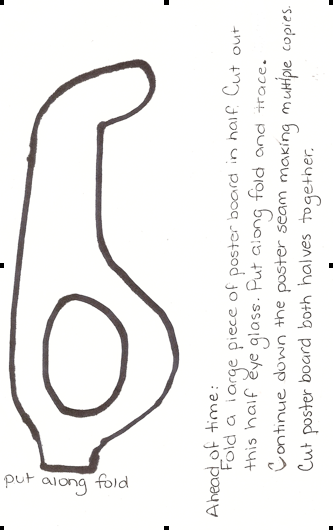
  • Eyeglass shape to use for making glasses

Vocabulary

  • Blind (to not be able to see with your eyes)
  • Optometrist (a doctor who takes care of your eyes)
  • Concentrate (to think about something really hard)

Before Reading the Story

Play a 5 senses game with the children. I’m thinking of something I use to smell the good foods we will eat at lunch. I’m thinking of something I use to hear my favorite song on the radio. I’m thinking of something I use to see who is coming in the door. When you do the riddle about eyes, stop and tell the children that sometimes people’s eyes do not see at all. This is called being blind. Ask the children to cover their eyes with their hands. How many fingers am I holding up? You can’t tell because you cannot see my fingers, this is like being blind. Sometimes people’s eyes are just not strong enough and so they cannot see very well. When this happens they wear glasses. Does anyone know anyone who wears glasses? Tell the children that today’s story is about an aardvark that had to get glasses to help him see better.

Social and Emotional Development/Knowledge of Families & Communities; progresses in understanding similarities and respecting differences among people such as genders, race, special needs, culture, language, and family structures.  AND Language Development/Listening & Understanding; demonstrates increasing ability to attend to and understand conversations, stories, songs, and poems.

Reading the Story

Stop on the page where Arthur is at the optometrists’ office. Spend a moment talking about what an eye examine is like (the optometrist might shine a light in your eyes, or a puff of air). Stop again on the page where Arthur and his friends are waiting for the school bus. How do you think Arthur feels when his friends make fun of his new glasses? What would you do if your friend had to wear new glasses?

Social & Emotional Development/Social Relationships; progresses in responding sympathetically to peers who are in need, upset, hurt, or angry; and in expressing empathy or caring for others.

After Reading the Story

Lead any discussion the children might have about glasses. Then tell the children that sometimes people wear glasses for other reasons also (sunglasses, eye protection/mowing lawn, working with tools, goggles are like glasses to see underwater)

Language Development/Listening & Understanding; understands an increasingly complex and varied vocabulary.  AND Approaches to Learning/Initiative & Curiosity; grows in eagerness to learn about and discuss a growing range of topics, ideas, and tasks.

Discovery

Put out magnifying glasses and interesting objects. Explain that some glasses make things look bigger so they are easier to see. You can also put out color paddles.

Science/ Scientific Skills & Methods; begins to use senses and a variety of tools and simple measuring devices to gather information, investigate materials, and observe processes and relationships.

Music and Movement

Chant, My Eyes Are Little Windows

 My eyes are little windows and through them I can see.
The birds and trees and flowers that are beautiful to me.

(The children can help name things that they feel are beautiful that you can then sing about. Make sure to write their ideas on a piece of paper and hang it up on the wall).

Literacy/Print Awareness & Concepts; develops growing understanding of the different functions of forms of print such as signs, letters, newspapers, lists, messages, and menus.

Blocks

Practice making letters with the blocks E,A,H,L,M,T etc.

Literacy/Early Writing; experiments with a growing variety of writing tools and materials, such as pencils, crayons, and computers.

Art

Put out a vase of flowers or a bowl of fruit. Give the children drawing materials and ask them to see if they can draw what they see.

Creative Arts/ Art; progresses in abilities to create drawings, paintings. models, and other art creations that are more detailed, creative, or realistic.  AND Science/Scientific Skills & Methods; develops growing abilities to collect, describe, and record information through a variety of means, including discussion, drawings, maps, and charts.

Decorate a pair of eyeglasses with stickers and markers.

Sand and Water

Hide alphabet magnet letters in the sand. As the children find them they can match them to a letter chart.

Literacy/Alphabet Knowledge; shows progress in associating the names of letters with their shapes and sounds.

Library and Writing

Have the children make their own eye charts. Start by making an E, and then turn it to face different directions. After they have finished their eye charts they can practice pointing the direction of the E with their fingers while they cover one eye.

Social & Emotional Development/Knowledge of Families & Communities; develops growing awareness of jobs and what is required to perform them.

Dramatic Play

Make an optometrists office. Bring in some old eyeglass or sunglass frames, make an eye chart, and add a small pen flashlight.

Social & Emotional Development/Knowledge of Families & Communities; develops growing awareness of jobs and what is required to perform them. 

Math and Manipulatives

Make a graph of several different colored glasses. Ask the children to decide what color they would want and to mark the graph. Count which color is the most popular, which color has the fewest votes, which has the most girls, boys, etc.

Mathematics/Patterns & Measurement; begins to make comparisons between several objects based on a single attribute.  AND Mathematics/Number & Operations; begins to use language to compare numbers of objects with terms such as more, less, greater than, fewer, equal to.

Outdoor Play

Teach the children to play Four Square. Mark out a large box shape with chalk on the sidewalk, the bigger the better but at least 10×10. Divide this box into quarters. Each person stands in his or her own space/quarter of box. Take a ball and bounce it to a child. It must bounce in their space. The child tries to catch the ball and then bounce it into another’s space. This is a game of bounce and catch. You can also divide your large square in half if there is not a space big enough for four players.

Physical Health & Development/Large Motor Skills; demonstrates increasing abilities to coordinate movements in throwing, catching, kicking, bouncing balls, and using the slide and swing.

Transition

I spy with my little eye, something in the room that is shaped like a circle, square, is the color blue, begins with the letter sound R, etc.  Language Development/Listening & Understanding; demonstrates increasing ability to attend to and understand conversations, stories, songs, and poems.

Dear Parent,

            Today we read a story about an aardvark that needed to get glasses in order to see properly. Play a seeing game with your child. Say, “I spy with my eyes something that is. …(Describe something within your vision and see if your child can guess what it is you’re describing). I spy with my eyes something that is tall and has four legs. We have a cushion on it to sit on. It is made of wood and is beside the table. Can you guess?

Resources

Screen Shot 2018-09-09 at 2.45.38 PM