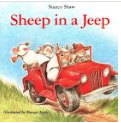
Five sheep go out in a jeep for an adventure but things do not go as planned. The illustrations and rhyming words make this the kind of book that young children seem to enjoy over and over.
Materials
- Pictures of rhyming words
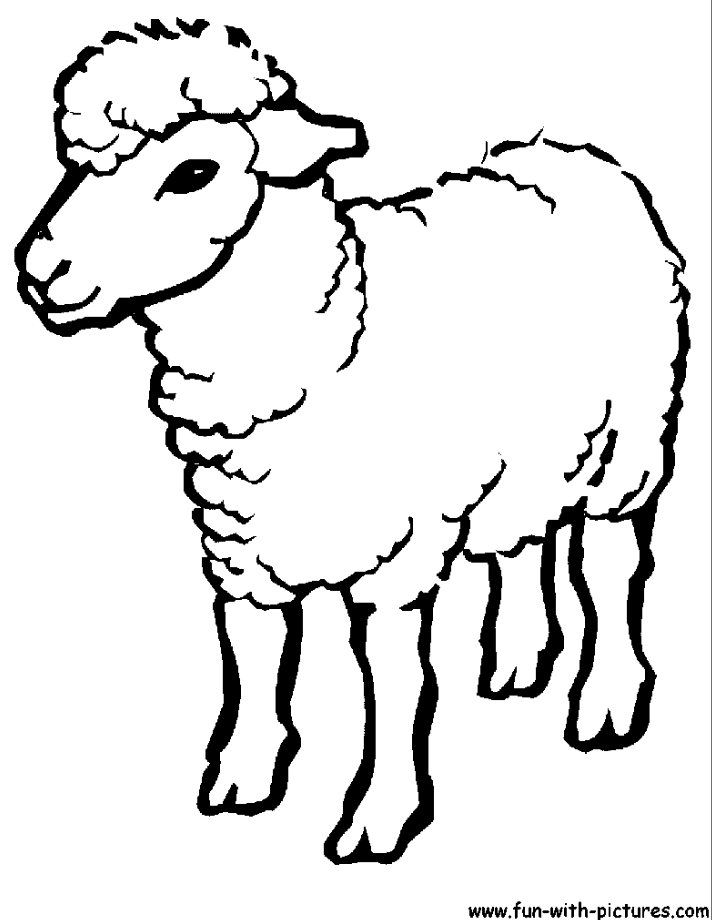
- Sheep outline
- Cotton balls
- Pincher clothes pins
- 5-10 objects with texture (bumpy corduroy piece, rough sandpaper, soft cotton ball, smooth plastic, squishy stress ball, etc).
- Bucket of dirt
Vocabulary
- Steep (that goes down very quickly and sharply) use arm to show
- Leap (to jump)
- Yelp (to shout)
- Weep (to cry)
Before Reading the Story
Look at the cover of the book with the children. Ask them if they know what kind of animal is in the jeep? Tell the children that the sheep are going on an adventure; I wonder where they could be going? Allow the children to make guesses about where the sheep might be going. Introduce the book and read.
Approaches to Learning/Reasoning & Problem Solving; develops an increasing ability to find more than one solution to a question, task, or problem.
Reading the Story
When you get to page that says, “sheep don’t think to look up front”. Ask the children what they think might be about to happen? If necessary, remind the children that the sheep are on a steep hill (use arm to show). On page where, “sheep shrug”, ask the children now what could the sheep do? On the page where the sheep shout, have the children notice the sheep’s faces. How do you think they are feeling? Why? When you get to the page that says, “the driver sheep forgets to steer”, ask the children again what they think might happen?
Literacy/Book Knowledge & Appreciation; demonstrates progress in abilities to retell and dictate stories from books and experiences; to act out stories in dramatic play; and ability to predict what will happen next in a story. AND Language Development/Speaking & Communicating; develops increasing abilities to understand and use language to communicate information, experiences, ideas, feelings, opinions, needs, questions,; and for other varied purposes.
After Reading the Story
Now go back and reread the story without stopping and asking comprehension questions. Read it with a good rhythm so that it flows and the children can really hear the rhyming that occurs throughout the story. When you are finished reading play a game with rhyming words. Say AT and have the children try to make words that rhyme with it (cat, bat, fat, hat, etc.). Try other sounds such as IT, OG, and EEP.
Literacy/Phonological Awareness; progresses in recognizing matching sounds and rhymes in familiar words, games, songs, stories, and poems.
Discovery
Put out a variety of textured objects for the children to feel and talk about. Can they name the various textures or relate them to something else? (this tree bark is rough and bumpy like this sandpaper). Ask the children if they can guess which texture object is most like a real sheep? (soft like a cotton ball).
Science/Scientific Skills & Methods; begins to use senses and a variety of tools and simple measuring devices to gather information, investigate materials, and observe processes and relationships.
Music and Movement
Sing Rhyming Words Sound the Same sung to tune of Loopty Loo.
Rhyming words sound the same (clap, clap)
Rhyming words sound the same. (clap, clap)
Rhyming words sound the same (clap, clap)
Rhyming words sound the same.
As you are singing this put out three pictures, two of rhyming words and one that does not rhyme. Have a child tell you which does not belong and then begin again.
Literacy/Phonological Awareness; progresses in recognizing matching sounds and rhymes in familiar words, games, songs, stories, and poems.
1 little 2 little 3 little sheep
4 little 5 little 6 little sheep
7 little 8 little 9 little sheep
10 little sheep say “Baaaa”.
Hold up fingers as you sing or recite.
Mathematics/Number & Operations; develops increasing ability to count in sequence to 10 and beyond.
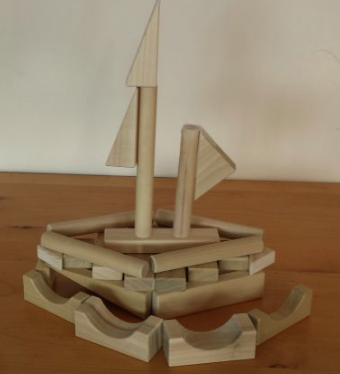
Blocks
Add small cars and long pieces of sturdy cardboard to make ramps. Show the children how when they make a bigger angle, the car will go down the ramp quicker. Add a ruler so they can measure the length from the bottom of the ramp to where the car stops rolling.
Science/Scientific Skills & Methods; begins to use senses and a variety of tools and simple measuring devices to gather information, investigate materials, and observe processes and relationships. AND Mathematics/Number & Operations; begins to associate number concepts, vocabulary, quantities, and written numerals in meaningful ways.
Art
Sheep cotton balls For more artistic sheep, use puff balls
Creative Arts/Art; develops growing abilities to plan, work independently, and demonstrate care and persistence in a variety of art projects.
Sand and Water
Make mud. Empty the dirt into the table and then have the children add water one measuring cup full at a time. What will happen when you mix the dirt and water? How many cups did it take to make mud? How have the children figured out how to mix the dirt and water?
Science/Scientific Skills & Methods; begins to participate in simple investigations to test observations, discuss and draw conclusions, and form generalizations.
Library and Writing
Remind the children that the book today was called Sheep in a Jeep. Ask the children if sheep could really drive a jeep? What else could you pretend the sheep are in? Encourage the children to use their imagination and then draw an illustration of Sheep in a __________. After they have finished, you can write their response on the bottom of their paper or on another piece of paper and attach it. (Sheep in a car, truck, washing machine, swimming pool, grocery store).
Literacy/Early Writing; begins to represent stories and experiences through pictures, dictation, and in play.
Dramatic Play
Bring in several chairs today and something to be a steering wheel. The children can pretend that they are sheep in a jeep. (I have used a Styrofoam plate or the cardboard under a pizza for a steering wheel).
Literacy/Early Writing; begins to represent stories and experiences through pictures, dictation, and in play. AND Creative Arts/Dramatic Play; shows growing creativity and imagination in using materials and in assuming different roles in dramatic play situations.
Math and Manipulatives
Give each child a bowl or cup and a pincher type clothespin. Spread two handfuls of cotton balls out on the table or floor. The children take turns rolling a dice and picking up that many cotton balls using the clothespin and dropping them into their bowl. When all the cotton balls are picked up, have the children count how many they have. Who has the most? The least?
Mathematics/Number & Operations; begins to use one-to-one correspondence in counting objects and matching groups of objects. AND Mathematics/Number & Operations; begins to use language to compare numbers of objects with terms such as more, less, greater than, fewer, equal to.
Outdoor Play
If you have a hill in your play yard, roll balls or hula-hoops down. If using balls, roll the ball down the hill and see if the children can kick it back up the hill.
Physical Health & Development/Gross Motor Skills; demonstrates increasing abilities to coordinate movements in throwing, catching, kicking, bouncing balls, and using the slide and swing.
Remind the children that in the story the sheep tried to tug their jeep from the mud. Use a jump rope to make a tug of war game. Have two children on each team. The children pull and tug trying to get the other team to move forward. Let different groups of children try being tugging teams.
Physical Health & Development/Health Status & Practices; participates actively in games, outdoor play, and other forms of exercise that enhance physical fitness.
Transitions
Play I’m Thinking of a child that rhymes with __________. That child may then move on to the next activity. (I’m thinking of a child that rhymes with berry. I’m thinking of a child that rhymes with favid).
Literacy/Phonological Awareness; progresses in recognizing matching sounds and rhymes in familiar words, games, songs, stories, and poems.
Resources














 Book Play Everyday
You must be logged in to post a comment.