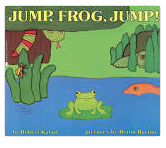
Jump, Frog, Jump! by Robert Kalan

            This is a build upon story.  Older children will be able to follow along with the verse.  In this story the frog is pursued by many predators who would like to eat him for lunch.  How will he ever stay safe?

Materials

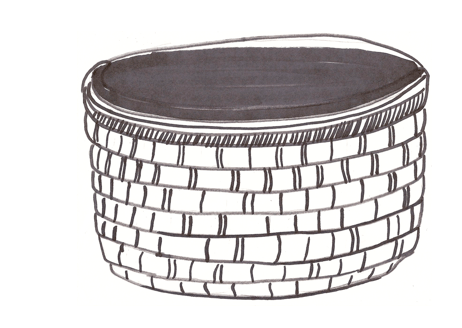
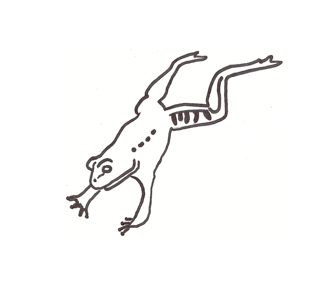
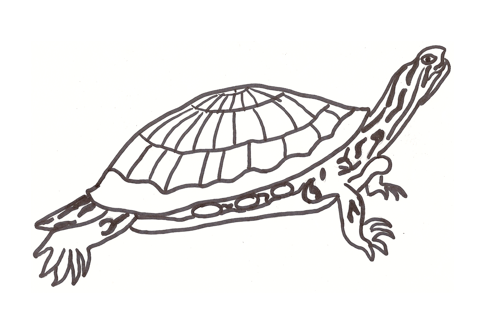
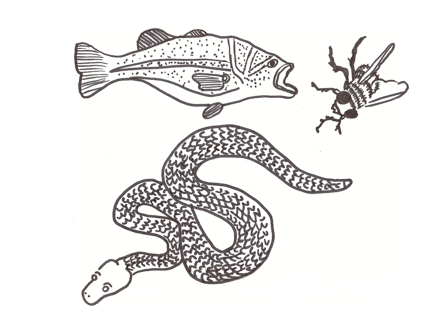
  • Flannel pieces/fly, fish, jumping frog, snake, turtle, basket, boy
  • Frogs numbered 1-10
  • Jump frog jump path/maze page
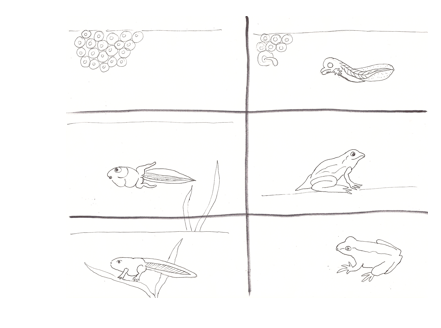
  • Frog cycle cards
  • Cornstarch packing noodles (ask your director to save all packing noodles that come with children’s materials and check to see if they are cornstarch based.
  • Small aquarium net or other small net like tool.
  • Tiddlywinks or poker chips

Vocabulary

  • Carnivore (one who eats meat or animals)

Before Reading the Story

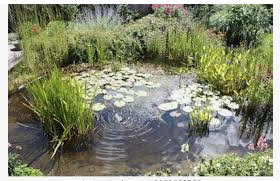
Hold up a picture of a pond and ask the children if anyone knows what this is? Ask the children if any of them have ever been to visit a pond? Allow the children to share their pond experiences. What did you see at the pond? Did you hear any animal sounds? Tell them that your story today takes place at a pond. Introduce the story.

Science/Scientific Knowledge; expands knowledge of and abilities to observe, describe, and discuss the natural world, materials, living things, and natural processes.

Reading the Story

            As you read, put up the flannel board pieces so the children can recall the chorus lines of this story.

Literacy/Early Writing; develops understanding that writing is a way of communicating for a variety of purposes. AND Language Development/Listening & Understanding; demonstrates increasing ability to attend to and understand conversations, stories, songs, and poems.

After Reading the Story

            Talk about the sequence of events.  Why were the fish, the snake, and turtle chasing the frog? (They wanted to eat him).  Tell the children that the fish, the snake, and the turtle were all carnivores because carnivores eat meat or animals.  Ask them who else in the story was a carnivore? (the frog, he wanted to eat the fly.  And the boys are carnivores too although I doubt they wanted to eat the frog).

Science/Scientific Knowledge; expands knowledge of and abilities to observe, describe, and discuss the natural world, materials, living things, and natural processes.

Discovery

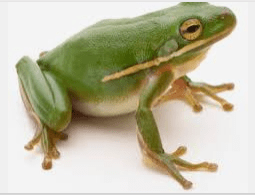
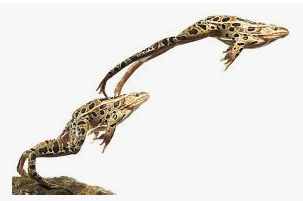
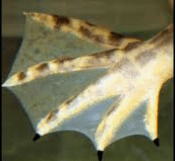
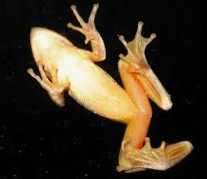
            Bring in pictures of real frogs.  Talk about the frog’s appearance. ( frogs have smooth skin, frogs have strong back legs so they can jump, A frog has big eyes that sit on top of his head, frogs have webbed feet to help them be better swimmers, frogs must live near water, a frog has a long sticky tongue to catch insects for lunch).

Science/Scientific Knowledge; expands knowledge of and abilities to observe, describe, and discuss the natural world, materials, living things, and natural processes.

            Make the frog cycle cards and encourage the children to put them into proper order.

Science/Scientific Skills & Methods; develops growing abilities to collect, describe, and record information through a variety of means, including discussion, drawings, maps, and charts.

Music and Movement

            Sing Mmm-ahh Went the Little Green Frog https://www.youtube.com/watch?v=NwU3beZ9kcw

Mmm-ahhh went the little green frog one day

Mmm-ahh went the little green frog.

Mmm-ahh went the little green frog  one day

And they all went went Mmm-ahh.

Language development/Speaking & Understanding; progresses in clarity of pronunciation and towards speaking in sentences of increasing length and grammatical complexity.

            Make about 10 of the large frogs.  Number them 1-10 and tape them to the floor touching front to back.  Make a lily pad by cutting out a circle and tape it to the floor in front of the number one frog.  Show the children how to do a standing long jump.  Let them see how far they can jump on the frog measuring tape.  Record their scores.

Mathematics/Patterns & measurement; shows progress in using standard and non-standard measures for length and area of objects.

Blocks

Ask the children to make a simple pond using the blocks. Then show them how to play tiddlywinks and flip the tiddlywink/chip into the pond. This takes practice to get the correct amount of pressure to fli[ the tiddlywink. (Put one tiddlywink/poker chip flat on the ground. Use the other to put pressure on the edge of the flattened one and pull back gently causing the flattened tiddlywink/poker chip to flip, hopefully into the pond.

Physical Health & Development/Fine Motor Skills; develops growing strength, dexterity, and control needed to use tools such as scissors, paper punch, stapler, and hammer. AND Approaches to Learning/Engagement & Persistence; grows in abilities to persist in and complete a variety of tasks, activities, projects, and experiences.

Art

            Show the children the cover of the book and how the turtle is hiding within the pond grass.  Bring in cornstarch based packing noodles for the children to make 3 dimensional pond grass.  Put out a bowl with a little water in it.  Show the children how to dip the end of the noodle into the water (because it is a cornstarch base it will dissolve and the noodles will stick together).  Show the children how to dip and stick their noodles together to make a 3 dimensional shape.  When they are finished, let them dribble green paint over and it can be pond grass.

Creative Arts/Art; gains ability using different art media and materials in a variety if ways for creative expression and representation.

            Give the children long thin pieces of paper that are cut out to resemble snakes.  Let them use markers to decorate the snake.  Encourage them to add a pattern like the snake in the book. (I have used unifix cubes to make patterns for the children to follow).

Mathematics/Patterns & Measurement; enhances abilities to recognize, duplicate, and extend patterns using a variety of materials.

Library and Writing

            Make a copy of the Jump Frog Jump page.  Cover it with contact paper and let the children use a washable marker to follow the frog’s path.  When they are done they can wipe it off with a damp cloth for another child to use.

Literacy/Early Writing; experiments with a growing variety of writing tools and ,materials, such as pencils, crayons, and computer.

Sand and Water

            Add any small pond animals that you might have to the water table.  Put out Tupperware lids that the children can pretend are lily pads.  Let them use a small aquarium net to try to catch the animals/fish. How many fish did you catch? How many frogs fit on the lilly pad?

Mathematics/Number & Operations; begins to make use of one-to-one correspondence in counting objects and matching groups of objects.

Dramatic Play

Math and Manipulatives

Mark a frog pond onto the floor or use a hoolahoop. Mark a line about 5 feet from the pond. Give a child 5 beanbags to try to throw into the pond. (Tell the children that the beanbag is a pretend frog that must try to jump into the pond). How many ‘frogs’ made it into the pond? How many did not? For older children you can give them a piece of paper that they can graph their results (2 in and 3 out of the pond). Have the children take turns throwing the bean bags into the pond.

Mathematics/Number & Operations; begins to use language to compare numbers of objects with terms such as more, less, greater than, fewer, equal to. AND Science/Scientific Skills & Methods; develops growing abilities to collect, describe, and record information through a variety of means, including discussion, drawings, maps, and charts.

Outdoor Play

            Play leap frog with the children.

Physical Health & Development/Gross Motor Skills; shows increasing levels of proficiency , control, and balance in walking, climbing, running, jumping, hopping, skipping, marching, and galloping.

Transitions

            As children go to the next activity sing or say;   Tell the children to crouch down on their haunches and listen for when their name is called.

Jeepers creepers look at all those leapers.

Jeepers creepers look at ____jump.

(The child named jumps off  and begin again with a different child)

Language Development/Listening & Understanding; shows progress in understanding simple and multiple-step directions.

Resources
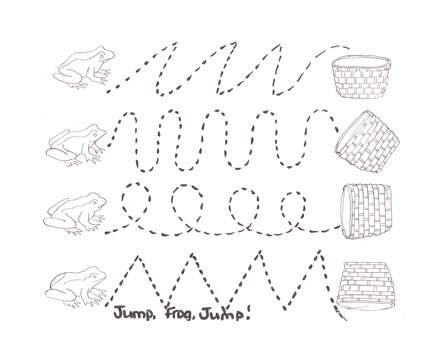
for writing center
frog life cycle


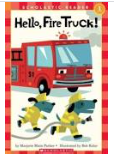
Hello, Fire Truck! by Marjorie Blain Parker

            Very simple book about firemen.  This is a beginner reader so perhaps older children can learn to sound out a read.

Materials

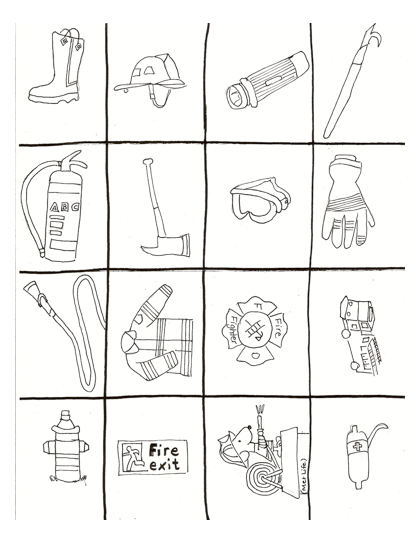
  • Pictures of fireman’s gear
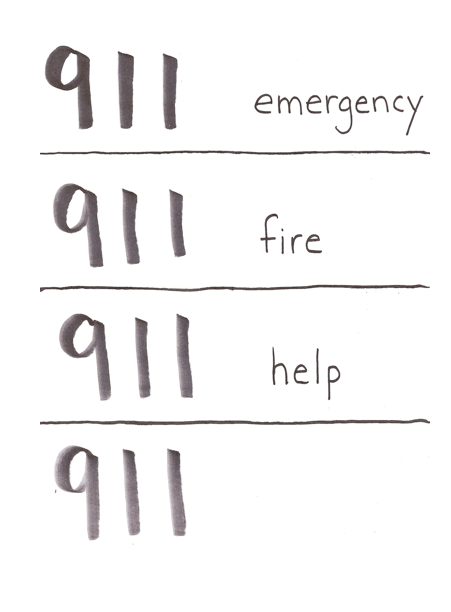
  • Page with words to copy 911
  • Smoke detector
  • Spray bottle with water

Vocabulary

  • Gear (all the equipment firemen need to put out a fire)

Before Reading the Story

            Color and contact the fireman’s gear pictures.  Bring to the rug and tape them to a flannel board.  Ask the children if they can tell who the story is going to be about by looking at the special equipment that is needed.  State it is about firemen.  Ask the children to help you name all the gear/equipment.  Turn the board around and remove one item, let the children guess what piece of gear is missing.  Play until each item has been removed at least once.

Social & Emotional Development/Knowledge of Families & Communities; develops growing awareness of jobs and what is required to perform them.

Reading the Story

            This book is very simple and full of rhymes on every other page.  Read the first page and then when you get to its rhyming word segment it out.  For example; “Look-smoke and flames.  Kitty is in trouble.  Call 911! Quick-on the d/ou/ble”. Do this slowly to see if any children can hear and discriminate the final word.

Literacy/Phonological Awareness; shows growing ability to hear and discriminate separate syllables in words.

After Reading the Story

            Bring in a smoke detector for the children to see up close and experience the sound of the alarm.  Talk about what you should do in case the smoke detector goes off at school. Do a mock drill if allowed.

Physical Health & Development/Health Status & Practices; builds awareness and ability to follow basic health and safety rules such as fire safety and pedestrian safety, and responding appropriately to potentially harmful objects, substances,and activities.

Discovery

            Put play phones into the center and help the children practice dialing 911, stating their name and what the emergency is.

Mathematics/Number & Operations; begins to associate number concepts, vocabulary, quantities, and written numbers in meaningful ways. AND Language Development/Speaking & Communicating; progresses in clarity of pronunciation and towards speaking in sentences of increasing length and grammatical complexity.

Music and Movement

            Teach the children The Fireman poem.

I am the fireman.

Please check your smoke detector

Because they are your home protector

I am the fireman.

Language Development/Listening & Understanding; understands an increasingly complex and varied vocabulary.

            Use masking tape to make a ladder design on the floor.  Put on music and encourage the children to jump between the rungs, walk heel to toe up the side, walk with one foot on each side bar. 

Creative Arts/Music; participates with increasing interest and enjoyment in a variety of music activities, including listening, singing, finger plays, games, and performances. AND Physical Health & development/Gross Motor Skills; shows increasing levels of proficiency, control, and balance in walking, climbing, running, jumping, hopping, skipping, and galloping.

Blocks

            Add fire trucks and encourage the children to build houses with blocks.

Creative Arts/Dramatic Play; participates in a variety of dramatic play activities that become more extended and complex.

Art

            Have the children draw a picture of a house using water soluble magic markers.  Find a place where you can hang the house pictures up and give each child a spray bottle of water.  They then spray the house pretending to put out the fire.  The markers will run down the page and make a design.

Creative Arts/Art; develops growing abilities to plan, work independently, and demonstrate care and persistence in a variety of art projects.

Library and Writing

            Put out cards that have the numbers 911 written on it.  Encourage the children to copy the numbers. 

Literacy/Early Writing; experiments with a growing variety of writing tools and materials, such as pencils, crayons, and computers. AND Mathematics/Number & Operations; begins to associate number concepts, vocabulary, quantities, and written numerals in meaningful ways.

Sand and Water

Have the children bring their picture from the art center and spray it in the water table today.

Physical Health & Development/Fine Motor Skills; develops growing strength, dexterity, and control needed to use tools such as scissors, paper punch, stapler, and hammer.

Dramatic Play

            Bring in fireman props you may have (3 foot piece of hose, boots, jackets, and plastic helmets. Talk about how the firefighter must put on all the gear before he/she heads out to a fire.

Social & Emotional Development/Knowledge of Families & Communities; develops growing awareness of jobs and what is required to perform them.

Math and Manipulatives

Make two sets of the firefighter gear pages and cut out the pictures to make a memory game to play with the children.

Approaches to Learning/Engagement & Persistence; grows in abilities to persist and complete a variety of tasks, activities, projects, and experiences.

Outdoor Play

            Use bicycles or wagons and pretend that they are fire engines racing to the fire.  Make sure the children are making loud siren noises so that everyone else will move out of the way!

Creative Arts/Drama; shows growing creativity and imagination in using materials and in assuming different roles in dramatic play activities. AND Physical Health & Development/Health Status & Practices; participates actively in games, outdoor play, and other forms of exercise that enhance physical fitness.

Transitions

            Give each child a turn to practice dialing 911 and stating who they are and that there is a fire.  Send a note home today that encourages parents to practice their address and phone number with the children so that they can call for help in an emergency.

Physical Health & Development/Health Status & Practices; builds awareness and ability to follow basic health and safety rules such as fire safety and pedestrian safety, and responding appropriately to potentially harmful objects, substances,and activities.

Resources

Firefighters, by Norma Simon

            This book is a good introduction to the many responsibilities of being a firefighter.

Materials

  • Any firefighter dramatic play materials you may have
  • Books or pictures of real fire persons in their fire fighting clothes, uniforms.
  • 2-3 turkey basters
  • Old hose cut into 3 foot sections

Vocabulary

  • Siren (the loud sounds that a fire truck or police car makes)
  • Masks (object that covers the firefighter’s face that allows them to breathe smoky air)
  • Teamwork (working together, i.e. to put out a fire)

Before Reading the Story

            With the children make a knowledge chart about what they know about firefighters and fire safety.   Do they know what a fireman wears to fight a fire, and why?  Do they know what the fireman connects his hose to for water supply?  

Language Development/Speaking & Communicating; develops increasing abilities to understand and use language to communicate information, experiences, ideas, feelings, opinions, needs, questions; and for other varied purposes. AND Social & Emotional Development/Knowledge of Families & Communities; develops growing awareness of jobs and what is required to perform them.

Reading the Story

            Take your time going through the pages and let the children discuss and ask questions as you read. 

Language Development/Speaking & Communicating; uses an increasingly complex and varied spoken vocabulary. AND Language Development/Speaking & Communicating; develops increasing abilities to understand and use language to communicate information, experiences, ideas, feelings, opinions, needs, questions; and for other varied purposes.

After Reading the Story

            Notice the page where the doctors/paramedics are helping make sure everyone is safe.  Tell the children that firefighters and doctors/paramedics are community helpers. Ask the children if they can think of any other community helpers.

Social & Emotional Development/Knowledge of Families & Communities; develops growing awareness of jobs and what is required to perform them.

Talk to the children about what you school’s procedures are if the fire alarm was to go off.  If appropriate, do a practice fire drill walking and talking through all the steps. 

Physical Health & Development/Health Status & Practices; builds awareness and ability to follow basic health and safety rules such as fire safety, traffic and pedestrian safety, and responding appropriately to potentially harmful objects, substances and activities.

Discovery

            Put  out pictures and books of real fire persons in their fire fighting outfits.  Try to especially find a picture of a fireman in his mask, as these are often frightening to the children.  Take time to look through the materials with the children and answer any questions they may have.  Ask them open-ended questions about the pictures and see if they can answer with logic and insight. 

Literacy/’Book Knowledge & Appreciation; shows growing interest and involvement in listening to and discussing a variety of fiction, non-fiction, and poetry. AND Language Development/Speaking & Communicating; develops increasing abilities to understand and use language to communicate information, experiences, ideas, feelings, opinions, needs, questions; and for other varied purposes.

Music and Movement

Do the fingerplay 10 Brave Firefighters

Ten brave firefighters sleeping in a row.

(hands by head sleeping)

Ding, dong, goes the bell

(pull the bell cord)

and down the pole they go.

(with hands together slide down the pole)

Off on the engine, oh, oh, oh!

(steer the fire engine)

Using the big hose, so, so, so.

(make a nozzle with hands to spray thehose)

When all the fire’s out, home so slow.

(walk very slow)

Back to bed, all in a row.

(hands by head sleeping)

Let’s count the ten brave firemen.1,2,3,4,5,6,7,8,9,10!

Creative Arts/Music; participates with increasing interest and enjoyment in a variety of music activities including listening, singing, finger plays, games, and performances. AND Mathematics/Numbers & operation; develops increasing ability to count to ten and beyond.

Blocks

            Bring out any fire trucks that you have and encourage the children to build a firehouse. 

Physical Health & Development/Fine Motor Skills; grows in hand-eye coordination in building with blocks, putting together puzzles, reproducing shapes and patterns, stringing beads and using scissors.

Art

            Finger-paint with red and yellow finger-paint.  Teach the children to make zigzag lines that look like fire.  Encourage them to draw a house and then make fire all around.  Talk about the kinds of lines that they make (zigzag, curved, looped, straight, wiggly, etc.).  

Creative Arts/Art; progresses in abilities to create drawings, paintings, models, and other art creations that are more detailed, creative, or realistic. AND Language Development/Speaking & Communicating; uses an increasingly complex and varied spoken language.

Library and Writing

            Give each child a copy of the fire hat picture.  Encourage them to write their name on their hat.  Let the children cut them out and staple onto a sentence strip to wear. 

Literacy/Early Writing; progresses from using scribbles and shapes, or pictures to represent ideas, ato using letter-like symbols, to copying or writing familiar words such as their own name. AND Physical Health & Development/Fine Motor Skills; develop[s growing strength, dexterity, and control needed to use tools such as scissors, paper punch, stapler, and hammer.

Sand and Water

            Add water to the table.  Put out turkey basters and show the children how to suck up the water and then spray it out.  Give the children either a small box to spray or a bowl to fill.  The object is to suck up the water and then spray it out.

Physical Health & Development/Fine Motor Skills; develop[s growing strength, dexterity, and control needed to use tools such as scissors, paper punch, stapler, and hammer.

Dramatic Play

            Add a fireman prop box.  This can include simple paper shaped fire hats or store bought fire suits.  Include several pieces of old hose that has been cut into three foot lengths.  Add gloves and boots if you have them.

Creative Arts/ Dramatic Play; participates in a variety of dramatic play activities that become more extended and complex.

Math and Manipulatives

            Play fireman memory.  Cut out 2 sets and contact the fire fighter cards. Flip them upside down and take turns flipping them over to make matches. 

Social & Emotional Development/Cooperation; develops increasing abilities to give and take in interactions; to take turns in games or using materials; and to interact without being overly submissive or directive.

Outdoor Play

            Let the children carry buckets of water.  You can either let them fill buckets and pour them into the sand or dirt for digging or you can have a bucket brigade relay game. 

Physical Health & Development/Gross Motor Skills; shows increasing levels of proficiency, control, nad balance in walking, climbing, running, jumping, hopping, skipping, marching, and galloping.

Transitions

            The book talks about how the fire fighters must look around and ask questions about how the fire might have started.  As the children prepare to go to the next activity, ask questions about personal safety, especially fire safety.  (If you heard the fire alarm, what would you do?  If you smelled smoke what would you do?  Do we run or walk during a fire drill? ) 

Physical Health & Development/Health Status & Practices; builds awareness and ability to follow basic health and safety rules such as fire safety, traffic and pedestrian safety, and responding appropriately to potentially harmful objects, substances and activities.

Resources

Dear Parent-

            Today we talked about fire safety.  It is important that your child understand that they should not hide in a closet or under a bed in the event of a fire.  Talk to your child about this scary yet important topic so that they know what and where to go if ever a fire were to occur ij your home.   Have a plan and include your child.