Old MacDonald’s Things That Go, by Jane Clarke

Old MacDonald has a farm, and a whole collection of transportations that go!

Materials

  • 1 paper plate per child in the classroom and tape to tape to floor.
  • Roll of aluminum foil
  • 3 large circles cut from construction paper. One red, one yellow, one green
  • Transportation counters or cards, enough copies to make patterns with

Vocabulary

  • Transportation (ways to get from here to there)
  • Transporters (vehicles used in transportation like a car, a boat, an airplane to go from here to there)
  • Combine harvester (a transporter that helps farmers to cut and move his crop)
  • Wheels (rollers for vehicles in the shape of a circle)
  • Buoyant (able to float)

 Introducing the Story

Sing Old McDonald with the children. After singing, tell the children that your story today is about a different Old MacDonald who really likes transportation vehicles, things that go. Ask the children if they know what transportation means. Reiterate that it means getting from one place to another. Get out a piece of paper and ask the children to name different transporters. Write their answers on the paper. After the children have listed transporters that they can think of, introduce the book by saying, “let’s find out what kinds of transporters, things that go, Old MacDonald loved”.

Language Development/Speaking & Communicating; uses an increasingly complex and varied spoken vocabulary.

Reading the Story

This book can easily be sung to the tune of Old McDonald. Practice it once before singing with the children so that you comfortable with the rhythm of the text. As you turn each page and sing “and on this farm he had a ______”, pause and let the children name the vehicle is they can. As you sing each page, encourage the children to join along making the various vehicle sounds.

Creative Arts/Music; participates with increasing interest and enjoyment in a variety of music activities, including listening, singing, finger-plays, games, and performances.

After Reading the Story

Have the children recall all the modes of transportation in the story-song. Look at the list the children made before reading the story, is it on the list? If not, add it to the list. When your list is complete, ask the children to help you check all the transporters that have wheels. Put your finger next to each mode of transportation and name it, ask the children if they think it has wheels. Put a mark next to all the ones that do have wheels. Then ask the children if they can remember which transporter Old MacDonald had that did not have wheels (boat).

Literacy/Book Knowledge & Appreciation; shows growing interest and involvement in listening to and discussing a variety of fiction and non-fiction books, and poetry.

Music and Movement

Sing The Wheels on the Bus but turn to various pages in the book and sing about different transporters. The wheels on the _____go round and round,

Round and round. Round and round.
The wheels on the _____go round and round
All through the town.

Science/Scientific Skills & Methods; develops increased ability to observe and discuss common properties, differences, and comparisons among objects and materials.  AND Approaches to Learning/Reasoning & Problem-Solving; develops increasing ability to find more than one solution to a question, task, or problem.

Give each child a paper plate and ask them to stand somewhere in the room where they cannot touch another child or a piece of furniture. Make a loop of tape for each and have the children tape their paper plate to the floor. Tell them that you are going to play a balance game on their circle. Ask them to stand up straight on their circle with their hands at their side. Can they stand on one foot? On their knee and one foot on their circle? Can they squat down low on their circle? Can they stand with one foot on their circle and on leg behind them? In front of them? Can they kneel on their circle with one leg up? Take any children’s suggestions and play until they are tired. Make sure you are modeling all the movements with the children.

Physical Health & Development/Gross Motor Skills; shows increasing levels of proficiency, control, and balance in walking, climbing, running, jumping, hopping, skipping, marching, and galloping.

Discovery

Tell the children that today you are going to build buoyant boats. Show the children two aluminum shapes that you have made, one a ball, and one a simple boat type shape. Have the children guess what will happen when you put your shapes into the water. Explain to the children that the boat shape floats because it is buoyant. Give each child a square of aluminum foil about 10 to 12 inches.   Encourage them to make a boat shape and then test in in a tub of water. Is it buoyant? Encourage the children to say, “I built a buoyant boat” as their boat floats in the water.

Science/Scientific Knowledge; shows increased awareness and beginning understanding of changes in materials and cause-effect relationships.

Blocks

Put out a variety of cars today and show the children show to build a ramp using the long blocks. If you do not have long blocks, you can make a ramp from a long piece of cardboard. Let the children experiment rolling their cars down the ramp as they raise/lower the ramp angle.

Science/Scientific Knowledge; shows increased awareness and beginning understanding of changes in materials and cause-effect relationships. Social & Emotional Development/Cooperation shows increasing abilities to use compromise and discussion in working, playing, and resolving conflict with peers.

Art

Bring over several small toy cars. Put out large sheets of paper, and paper plates of tempera paint. Have the children dip the cars into the paint and roll it back and forth on their paper. As they work, encourage them to sing, The Wheels On The Car Go Round and Round.

Creative Arts/Art; gains ability in using different art media and materials in a variety if ways for creative expression and representation.

Sand and Water

Put water in the table today and let the children use it to see if their home-made aluminum foil boats float.

Approaches to Learning/Reasoning & Problem-Solving; grows in recognizing and solving problems through active exploration, including trial and error, and interactions and discussions with peers and adults.

Library and Writing

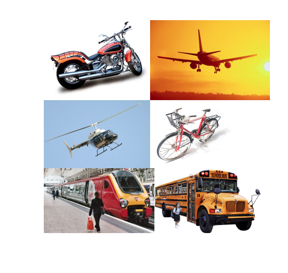
Get many books about transportation and add them to your center. Encourage the children to talk about and name the different kinds of transporters in the picture. As they look at the books, ask the child if this is something that goes on the land, on the water, or in the sky.

Literacy/Book Knowledge & Appreciation; progresses in learning to handle and care for books; knowing to view one page at a time in sequences from front to back; and understanding that a book has a title, author, and illustrator. AND Mathematics/Patterns & Measurements; shows growth in matching, sorting, putting in a series, and regrouping objects according to one or two attributes such as color, shape, or size.

Dramatic Play

Use one or two of your paper plates and draw a simple steering wheel upon it (a circle to be the horn). Encourage the children to pretend that they are going on a trip. What kind of transportation will you use? Invite them to bring chairs, boxes, or large blocks into the center to use to make their transporter.

Creative Arts/Drama; shows growing creativity and imagination in using materials and assuming different roles in dramatic play situations.

Math and Manipulaties

If you have transportation counters or cards, use them to make patterns for the children to copy. (train, train, helicopter). Have two children play together. One makes a pattern using 4-5 counters/cards, and the other child has to copy it.

Mathematics/Patterns & Measurement; enhances abilities to recognize, duplicate, and extend simple patterns using a variety of materials.

 Outdoor Play

Play Red Light, Green Light with the children. Make two goals on opposite sides of your playground (the fence and the tree). Have the children stand at one goal and you at the other. Explain that when you hold up the green circle, the children must (walk, jump, gallop, crawl) towards you. When you hold up the yellow and shout warning!, the children will know that it is almost time to freeze. When you hold up the red and yell Stop! The children must freeze in their place until you hold up the green and shout Go! again. Play until the children have all reached you. After several rounds, a child might be able to be the caller alongside you.

Social & Emotional Development/Self-Control; demonstrates increasing capacity to follow rules and routines and use materials purposefully, safely, and respectfully.  AND  Physical Health & Development/Gross Motor Skills; shows increasing levels of proficiency, control, and balance in walking, climbing, running, jumping, hopping, skipping, and marching

Transitions

Use the Old MacDonald book and say, I am a thinking of a kind of transporter that Old MacDonald loved. Sound it out slowly and phonetically and have the children see if they can guess the word before you finish. It begins with /b/b/b/u/s/.

Literacy/Phonological Awareness; shows increasing ability to discriminate and identify sounds in the spoken language.

Dear Parents, today we read Old MacDonald’s Things That Go. In it was many forms of transportation. As we read about transportation, it might be a good time to talk to your child about safety rules both in the car and around cars. If you use public transportation, share safety reminders about these also.

Resources
Screen Shot 2018-07-15 at 11.44.02 AM

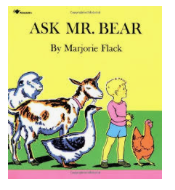
Ask Mr. Bear by Marjorie Flack

Farm animals try to help a little boy find the perfect gift for his Mother’s birthday. Find out what the perfect gift is while reading this simple book with your children.

Materials

  • Picture of cow and bear with word printed underneath.
  • Feely box (shoe box with a hole cut out of each end so child can put their hands inside) A pillowcase will work also.
  • Bear Face
  • 1 brown lunch bag per child
  • Many foil squares and wrapping bows
  • Roll of crepe paper
  • Homemade or store bought “birthday” hats and any other birthday supply

Vocabulary

  • Fine (something that is made very well)
  • Wool (a kind of fur)

 Introducing the Story

Turn to the first page and ask the children how they think the little boy is feeling. Why do you think he is feeling this way? Explain to the children that Danny is sad because he does not know what to get his Mother for her birthday. Ask the children what they would do if it were them?  Tell them the story is called Ask Mr. Bear, why do you think it is named that?

Social & Emotional Development/Social relationships; progresses in responding sympathetically to peers who are in need, upset, hurt, or angry; and in expressing empathy or caring for others.

 Reading the Story

As you read the story give the children the opportunity to name the animal and make the animal sound in the appropriate places  When you get to the page where Danny’s Mother is guessing what Danny has gotten her for her birthday, stop and ask the children if they can guess too.

Approaches to Learning/Initiative & Curiosity; chooses to participate in an increasing variety of tasks and activities. AND Approaches to Learning/Reasoning & Problem Solving; develops increasing ability to find o more than one solution to a question, task, or problem.

 After reading the Story

Show the children the front cover of the book. Ask the children to remember what animals were in the story that are not on the cover (bear and cow).

Literacy/Book Knowledge & Appreciation; demonstrates progress in abilities to retell or dictate stories from books and experiences; to act out stories in dramatic play; and to predict what will happen next in as story.

Cover the cow and bear picture with a piece of paper. Slowly slide the paper off the picture and stretch the word so the children can hear the individual sounds.

Literacy/Phonological Awareness; shows growing awareness f beginning and ending sounds in words.

 Discovery

Introduce the feely box. Put a familiar object inside the box/ pillowcase and show the children how to put their hands in the holes to feel it. Use familiar items from your classroom. Can they guess what you have put in the box? Teach them to play this game with their friends.

Science/Scientific Knowledge & Skills; begins to participate in simple investigations to test observations, discuss and draw conclusions, and form generalizations.

 Music and Movement

With the book in hand, ask the children to show you what walking looks like, skipping looks like, hopping, galloping, trotting, and running

Language Development/Listening & Understanding; understands an increasingly complex and varied vocabulary. AND Physical Health & Development/Gross Motor Skills; shows increasing levels of proficiency , control, and balance in walking, climbing, running, hopping, jumping, hopping, skipping, marching, and galloping.

 Blocks

Put out the many foil squares and encourage the children to wrap blocks like birthday gifts. Let them attach wrapping bows for decoration.

Physical Health & Development/Fine Motors; develops growing strength, dexterity, and control needed to use tools such as scissors, paper punch, stapler, and hammer.

 Art

Have the children cut a bear head out and glue it to a brown paper lunch sack to make puppets Let the children water color their puppet.

Physical Health & Development/Fine Motors; develops growing strength, dexterity, and control needed to use tools such as scissors, paper punch, stapler, and hammer. AND   Creative Arts/Art; develops growing ability to plan, work independently, and demonstrate care and persistence in a variety of art projects.

 Sand and Water

Fill the bottom of the sand table with an inch or two of dirt. Take the children outside to help gather sticks, small branches, and rocks. Put these into the table along with several plastic animals or people. Encourage the children to make a forest scene.

Science/Scientific Knowledge; expands knowledge of and abilities to observe, describe, and discuss the natural world, materials, living things, and natural processes.

Library and Writing

Put out the cow and bear pictures, encourage the children to practice writing the words and then drawing their own animals.

Literacy/Early Writing; experiments with a growing variety of writing tools and materials, such as pencils, crayons, and computers.

 Dramatic Play

Set up a birthday theme by adding hats, crepe paper, and small boxes that the children can put objects in. Add self sticking wrapping bows.

Creative Arts/Dramatic Play; shows growing creativity and imagination in using materials and in assuming different roles in dramatic play situations.

 Math and Manipulatives

Use counting bears to make simple patterns. Ask the children to make one just like yours. Ask the child to show you how many bears old they are, how many people are in their family

Mathematics/Patterns & Measurement; enhances ability to recognize, duplicate, and extend patterns using a variety of materials. AND Mathematics/Number & Operations; begins to use one-to-one correspondence in counting objects and matching groups of objects.

 Outdoor Play

Encourage the children to act out the story with you. Depending on how many children are interested you will have to include other animals and movements. Example; Then Kerry asked Kangaroo, do you have a gift I can give my mother? But Kangaroo said no and so they all jumped along and jumped along until they met Snake.

Literacy/Book Knowledge & Appreciation; demonstrates progress in abilities to retell or dictate stories from books and experiences; to act out stories in dramatic play; and to predict what will happen next in as story.

Transitions

           As children are laying down for nap or getting ready to leave, give each a hug and say; Here’s a big bear hug just from me.

Dear Parent- Today we read the book Ask Mr. Bear in which a child tries to find the perfect gift for his Mother’s birthday. Talk to your child about when his/her birthday is. Give the child the date and then state something that will happen close to the date so the child can begin to become aware of things that happen near their birthday. (Kerry your birthday is in the spring when it starts to get warmer outside. Roger, your birthday is just after your father’s birthday).

Resources

Screen Shot 2018-08-19 at 3.59.08 PM
Screen Shot 2018-08-19 at 3.59.24 PM

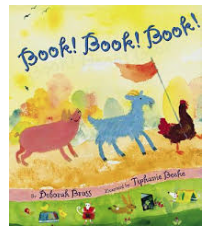
Book! Book! Book!, by Deborah Bruss

 Everybody is happy on the farm until the children go back to school.  Now the animals are bored and are looking for something to do.  Follow their adventure as they try to check a book out of the library.

Materials

Vocabulary

  •                   Bored (tired and annoyed because something is not                                    interesting)
  •                   Librarian (the person who works at the library to take care                      of all the books.)

Before Reading the Story

                  Talk to the children about things they like to do.    Ask them to think of a place where they cannot do things they like to do (at the doctor’s office, at my grandma’s).  How did this make you feel?  (sad, mad, bored).  Explain that today’s story is about some animals that got bored on the farm.  Let’s find out what they do to have fun.

Language Development/Speaking & Communicating; develops increasing abilities to understand  and use language to communicate information, experiences, ideas, feelings, opinions, needs, questions; and for varied other purposes.

Reading the Story

                  When you get to the part where the animal speaks to the librarian, wait a second and give the children the opportunity to make the animal sounds first.

Literacy/Book Appreciation & Knowledge; shows interest and involvement in listening to and discussing  a variety of fiction and non-fictions books and poetry.

After Reading the Story

                  Ask the children to help recall all the animals that were in the story.  There were two animals in the story that did not talk to the librarian, can you think who they were?

Literacy/Book Appreciation & Knowledge; shows interest and involvement in listening to and discussing  a variety of fiction and non-fictions books and poetry.

Discovery

                  Bring in a variety of paper types for the children to explore.  Bring in some rough homemade type paper,tissue paper, tracing paper, graph paper, cardboard, lined, etc.  Let the children use colored pencils and feel the differences and variations of the paper types as they practice writing their names.

Literacy/Early Writing; progresses from using scribbles, shapes, or pictures to represent ideas, to using letter-like symbols, to copying or writing familiar words such as their own name.  AND Physical Health & Development/Fine Motor Skills; progresses in a bilities to use writing , drawing, and art tools, including pencils, markers, chalk, paint brushes, and various types of technology.

Music and Movement

                  Practice doing different kinds of walking with the children.  What does it look like to clip clop in, to plod in, to amble, to flap on in.

Approaches to Learning/Reasoning & Problem Solving; develops increasing ability to find more than one solution to a question, problem, or task.

                  Sing Read Me A Story, to the tune of Found a Peanut. https://www.youtube.com/watch?v=RmxzJVUXR7E

Read me a story, read me a story
Read me a story please oh please.
I’d love to hear one, I’d love to hear one
Read me a story, please oh please.

Creative Arts/Music; participates with increasing interest and enjoyment in a variety of music activities, including listening, singing, finger plays, games, and performances.

Blocks

                  Put out any farm animals you might have today.  Encourage the children to sort them by like kinds and then build a fence around each kind.  Which animal has the most inside the fence?  If you do not have enough farm animals, include any animals that you might have and then have the children sort them by those that would live ona farm and those that would not.

Mathematics/Number & Operations; Geometry  Spatial Sense; shows growth in matching, sorting, putting in a series, and regrouping objects according to one or two attributes such as color, shape, or size.  AND Mathematics/Number  Operations; begins to use language to compare numbers of objects with terms such as more, less, greater than, fewer, equal to.

Art

                  Give the children sheets of paper that are 2-inches by 5-inches.  Let them decorate these and call them book markers.

Creative Arts/Art; develops growing abilities to plan, work independently, and demonstrate care and persistence in a variety of art projects.

Library and Writing

                  Talk to the children about some of the books you have read recently to the class.  Ask the children to draw a picture about one of their favorite books.  When they are finished, write the title of the book underneath.

Literacy/Early Writing; begins to represent stories and experiences through pictures, dictation, and in play.

Sand and Water

                  Add bubbles and soap bars to the water. Explain to the children that we must always have clean hands when we look at books.  Watch them as they show you their hand washing technique.

Physical Health & Development/Health Status & Practices; shows growing independence in hygiene, nutrition, and personal care when eating, dressing, washing hands, brushing teeth, and toileting.

Dramatic Play

                  Ask the children how many of them have ever been to the library.  If there is a library locally, plan a field trip to take your children there.  Tell the children that you are going to let them each borrow a school library book overnight.  Let them pick a book and sign their name to paper with the title of the book they are borrowing.

Literacy/Early Writing; develops understanding that writing is a way of communicating for a variety of purposes.  AND Literacy/Book Knowledge & Appreciation; shows growing interest in reading-related activities, such as asking to have a favorite book read; choosing to look at books; drawing pictures based on stories; asking to take books home; going to the library; and engaging in pretend reading with other children.

Math and Manipulatives

                  Ask the children to help you clean your library center today.  Have them take the books of the shelf and dust.  When they begin to put the books back on the shelf, show them how to put the title facing outwards and so the pages are not bent or stuffed into another book.  Have them go through the books and look for any that might need repair.  For older children, you can have them sort the books by like kind.

Social & Emotional Development/Cooperation; shows increasing abilities to use compromise and discussion in working, playing, and resolving conflicts with peers.  AND Literacy/Book Knowledge & Appreciation; progresses in learning how to handle and care for books; knowing to view one page at a time in sequence from front to back; and understanding that a book has a title, author, and illustrator.  AND Mathematics/ Pattern & Measurement; shows increasing abilities to match, sort, put in a series, and regroup objects according to one or two attributes such as shape or size.

Outdoor Play

                  Bring a basket of books outside and a sheet to sit on.  Spread out and enjoy reading.

Literacy/Book Knowledge & Appreciation; progresses in learning how to handle and care for books; knowing to view one page at a time in sequence from front to back; and understanding that a book has a title, author, and illustrator. 

Transitions

                  Encourage the children to walk in a nice straight line like the animals in the story.

Language Development/Listening  Understanding; shows progress in understanding and following simple and multiple-step directions.