Pete’s a Pizza, by William Steig

Pete’s in a bad mood!  What can Dad do that will cheer him up?

Materials

  • 10 small paper plates
  • Ingredients to make playdough (Non-cook playdough ingredients; 2 cups self rising flour, 2 Tablespoons alum, 2 Tablespoons salt, 2 Tablespoons cooking oil, 1 cup plus 2 Tablespoons boiling water).
  • Playdough or pastry rollers/cutters

Vocabulary

  • Miserable (unhappy, sad)

Before Reading the Story

Tell the children that your story today is about pizza.  Ask the children to raise their hands if they like pizza.  Let them talk about their favorite pizza ingredients, places they eat pizza, or any pizza experience that they might have had.  Introduce the story.

Language Development/Speaking & Communicating; develops increasing abilities to use and understand language to communicate information, experiences, ideas, feelings, opinions, needs, questions; and for other varied purposes.

Reading the Story

This story has a funny plot. As you read, make sure the children can see the pictures so that they can better understand the humor.

Literacy/Book Knowledge & Appreciation; shows growing interest and involvement in listening to and discussing a variety of fiction, non-fiction, and poetry.

After Reading the Story

Ask the children if they remember what kind of a mood was Pete in at the beginning of the story (miserable, sad, mad, lonely). Now ask the children when a friend is feeling miserable or sad, what can they do to make them feel better? (I could give them a hug, I could play with them, I want to be a pizza!).

Social & Emotional Development/Social Relationships; progresses in responding sympathetically to peers in need, upset, hurt, or angry; and in expressing empathy or caring for others.

Discovery

Make play dough!  Let the children help knead the dough until soft and pliable. Use the non-cooking ingredients above and mix and knead them together or use your favorite playdough recipe and let the children do the kneading of the dough.

Science/Scientific Methods & Skills; begins to use senses and a variety of tools and simple measuring devices to gather information, investigate materials, and to observe processes and relationships.

Music and Movement

Sing The Pizza Song to Do You Know the Muffin Man?sung to Do You Know the Muffin Man?

Do you like a cheese pizza?

A cheese pizza, a cheese pizza?

Do you like a cheese pizza?  

Eat it if you do!

Sing several times changing the toppings. The children can pretend to eat the pizza if they like the toppings you are singing about.

Creative Arts/Music; participates with increasing and enjoyment in a variety of music activities, including listening, singing, finger plays, games, and performances.

Sing, If You’re Happy and You Know It.  

If You’re Happy and you know it clap your hands.

If you’re happy and you know it clap your hands.

If you’re happy and you know it, then you really ought to show it,

If you’re happy and you know it clap your hands.

Sing about angry, miserable, tired, etc.

Creative Arts/Music; participates with increasing and enjoyment in a variety of music activities, including listening, singing, finger plays, games, and performances.

Blocks

Encourage the children to act out the story.  First they will need to make the table out of blocks.  Give them some colored paper to represent the cheese and pepperoni.  They can tear it and then take turns turning each other into pizzas.

Literacy/Book Knowledge & Appreciation; demonstrates abilities to retell and dictate stories from books and experiences: to act out stories in dramatic play; and to predict what will happen next in a story.

Art

Do you have playdough wheels in your play dough supply?  Or do you have a pastry wheel at home?  Use these to dip into paint and allow the children to roll back and forth across a piece of circle shaped paper.

Creative Arts/Art; gains ability in using different art media and materials in a variety of ways for creative expressions and representation.

Sand and Water

Put flour into the table today with a couple of sifters and plates.  This will be messy but the flour has a wonderful silky feel. Make sure the children do not add any water or you will have an even bigger mess.

Social & Emotional Development/Self-Control; demonstrates increasing capacity to follow rules and routines and use materials purposefully, safetly, and respectfully. AND Approaches to Learning/Initiative & Curiosity; chooses to participate in an increasing variety of tasks and activities.

Library and Writing

Have the children trace around a small paper plate to make a circle.  Let the children use markers to color a pizza.  Encourage them to cut their pizza in half. Ask them how many halves make a whole pizza?  Older children can be challenged to cut their pizza into quarters.  How many quarters make a whole pizza?

Mathematics/Number & Operations; develops increased abilities to combine, separate, and name “how many” concrete objects. AND Mathematics/Number & Operations; begins to associate number concepts, vocabulary, quantities, and written numerals in meaningful ways.

Dramatic Play

Let the children pretend to cook today.  You could set up a pizza parlour for the children to play in, there are lots of ideas on the internet on how to do this. You could even close the center for play today and use it as a real pizza making station. Make English Muffin pizzas with the children. Give each child a half of an english muffin. Let them spoon some pizza sauce or spaghetti sauce onto their muffin. Then let them load it with ingredients that they like. Place in the oven on 350 until the cheese melts.

Science/Scientific Methods & Skills; begins to use senses and a variety of tools and simple measuring devices to gather information, investigate materials, and to observe processes and relationships.

Math and Manipulatives

Write a number 1-10 on 10 paper plates.  For younger children you might add corresponding dots also.  Give the children checkers, poker chips, or plastic dots.  Ask them to put the correct number of dots onto each plate. They can pretend to be making pepperoni pizza.

Mathematics/Numbers & Operations; begins to make use of one-to-one correspondences in counting objects and matching groups of objects.

Outdoor Play

Pete wanted to go outside and play ball with his friends.  Take the balls outside today to practice, bouncing, kicking, and catching.

Physical Health & Development/Gross Motor Skills; demonstrates increasing abilities to coordinate movements in throwing, catching, kicking, bouncing balls, and using the slide and swing.

Transitions

Remind the children that in the story, Pete was feeling miserable but then his Dad made him feel better by playing the pizza game with him. Ask the children to tell you something that they can do when they see someone who is feeling miserable. (I tickle my baby when she cries, I could hug you, My Mommy gives me candy, I tell Jamie “I will play with you”).

Social & Emotional Development/Social Relationships; progresses in responding sympathetically to peers who are in need, upset, hurt, or angry; and in expressing empathy or caring for others.
Water is Water, by M. Paul

This is a book about the water cycle and the many forms that water can take.  With simple words and clear pictures, children will get a good first understanding of the many forms of water and the importance they are to life on earth.

Materials

  • A dozen pinecones, as close to fresh as possible
  • Several trays of ice that has had food coloring added to it.
  • Beach props; towels, sunglasses, bathing suits (big enough to put over clothes), swim cap, empty sunscreen bottle, etc.
  • Metal tray or cookie sheet

Vocabulary

  • Steam (the water vapor that comes off hot liquids)
  • Fog (It’s a cloud that is on the ground.  It has a blurry look)
  • Galoshes (Another name for boots)
  • Swig (suck up the water)
  • Conserve (to protect)
  • Moist (a little bit wet)
  • Dehydrated (super thirsty)

Before Reading the Story

Ask the children to name ways that they use water in their homes. (My dog, he drinks lots of water.  I don’t like water I like juice.   I take a bath at night.  My Mommy and me we washed the car at that place where the water squirts).  Write their responses onto a piece of paper that you can hang on the wall. Explain that today you are going to read a story about all the forms that water comes to earth in.   Ask the children if anyone knows one way that water comes to earth?  Let them respond and then introduce the story.

Science/Scientific Knowledge; expands knowledge of and abilities to observe, describe, and discuss the natural world, materials, living things, and natural processes.

Reading the Story

As you read the story, stop on each page and talk about what you see on the page.  What are the children doing?  What season of the year is it?  Have you seen these water kinds in your area?

Science/Scientific Knowledge; expands knowledge of and abilities to observe, describe, and discuss the natural world, materials, living things, and natural processes.

After Reading the Story

Can the children remember some of the forms that water comes to earth?  Explain to the children that water is very important.  All living things need water to drink.  Tell them that dogs need to drink water, trees need to drink water, and people need to drink water.  Water lubes our bodies up and keeps us moist inside so we do not become dehydrated and sick.  Teach the children the following poem;

You can sip it through a straw,

You can slurp it through a cup.

Water’s so important

So drink it all up!

Repeat the poem often throughout the day when you see someone drinking water or it is time for someone to take a water break.

Literacy/Book Knowledge & Appreciation; demonstrates progress in abilities to retell and dictate stories from books and experiences; to act out stories in dramatic play; and to predict what will happen next in a story. AND Science/Scientific Knowledge; expands knowledge of and respect for their bodies and the environment.

Discovery

Look at a world map or globe with the children.  Show them where the water is and the land.  Show them where you live.  Is it near water?  Is your water saltwater or freshwater? 

Social & Emotional Development/Knowledge of Families & Communities; begins to express and understand concepts and language of geography in the contexts of the classroom, home, and community.

Bring in several pinecones that are dry.  Explain to the children that pinecones can tell when it is going to rain.  When they feel the rain coming, they close up.  Spray one with water to observe.  Put one into a shallow bowl of water to simulate a puddle and observe.  Put several pine cones outside where you can watch them to see if they begin to close up or not. 

Science/Scientific Methods; develops increased ability to observe and discuss common properties, differences, and comparisons among objects and materials.

Music and Movement

Make a Rain Storm

Drip, drop, drip, drop                                   Tap fingers gently on knees

Rain, rain, rain                                               Make rain with fingers

Drizzle, drizzle, drizzle ,drizzle                     Tap fingers quickly on hard surface

Rain, rain, rain                                               Make rain with fingers

Pitter patter, pitter patter                            Tap knees with hands

Rain, rain, rain                                               Make rain with fingers

Pouring, pouring, pouring, pouring          Pound knees quickly with hands

Rain, rain, rain                                               Make rain with fingers

Cloud burst, cloud burst                              Clap and wiggle hands in air

Rain, rain, rain                                               Make rain with fingers

Pouring, pouring, pouring, pouring          Pound knees quickly with hands

Rain. Rain, rain                                              Make rain with fingers

Pitter patter-Drizzle-Drip drop                   Continue backwards till drip drop

Rain, rain, rain                                               Make rain with fingers

Creative Arts/Music; participates with increasing interest and enjoyment in a variety of music activities, including listening, singing, finger plays, games, and performances.

Sing or chant, If All The Raindrops Were lemon Drops and Gum Drops

If all the raindrops were lemon drops and gum drops,

Oh what a rain it would be.

I’d stand outside with my mouth opened wide

Ah, ah, ah, ah, ah, ah, ah, ah, ah, ah

If all the raindrops were lemon drops and gum drops,

Oh what a rain it would be!

(Now let the children help decide what the raindrops will be and sing again).

Approaches to Learning/Reasoning & problem Solving; develops increasing ability to find more than one solution to a question, task, or problem.

Tell the children that you are going to pretend to go ice-skating today.  Give each child two wooden rectangle blocks.  Show them how to stand on them and slide one foot forward and then the next.  Put on music and skate around the room.  Can you skate quickly?  Can you turn in a circle without falling off your skates?  Can you skate backwards?

Physical Health & Development/Gross Motor Skills; shows increasing levels of proficiency, control, and balance in walking, climbing, running, jumping, hopping, skipping, marching, and galloping.

Blocks

Challenge the children to continue skating today but to build a skating rink first.  Or challenge them to build a swimming pool.  Are they able to work together?  Have they built it big enough for more than one child to be able to use?  Is there a pattern to the types of blocks that they used to build the enclosure?

Social & Emotional Development/Cooperation; increases abilities to sustain interactions with peers by helping, sharing, and discussing.

Art

Give the children watercolor paints to use today. Challenge them to make letters and shapes with the paint.

Literacy/Early Writing; progresses from using scribbles, shapes, or pictures to represent ideas, to using letter-like symbols, to copying and writing familiar words such as their own name.

Messy but fun, paint with mud at the easel today.  Bring in some dirt or dirt-sand mix and add water to make a thickish consistency.  Give the children brushes and let them experiment with using the mud as paint.

Creative Arts/Art; gains ability in using different art media and materials in a variety of ways for creative expression and representation.

Sand and Water

Choose two complimentary colors of food coloring and make a frozen ice tray of each.  Add the ice cubes to the water table today with several inches of water.  As the ice melts, the colors begin to come out into the water.  Ask the children what is happening?  What do they think will happen next?  What color do they think the water will become? Record their observations and answers on paper and hang on the wall.

Science/Scientific Methods & Skills; develops growing abilities to collect, describe, and record information through a variety of mean, including discussion, drawings, maps, and charts.

Library and Writing

Put the book into the library center today and as the children look through it, encourage them to talk about the pictures and then their own experiences. 

Literacy/Book knowledge & Appreciation; progresses in learning how to handle and care for books; knowing to view one page at a time in sequence from front to back; and understanding that a book has a title, author, and illustrator. AND Science/Scientific Methods & Skills; develops growing abilities to collect, describe, and record information through a variety of mean, including discussion, drawings, maps, and charts.

Can they illustrate one part of the water cycle?  Write their dictation down that talks about their experience with the water cycle.  (This is a picture of me and my sister when it was froggy and we couldn’t see outside the window good.  My Daddy is gonna teach me how to ice skate when I am six).

Literacy/Early Writing; begins to represent stories and experiences through pictures, dictation, and in play.

Dramatic Play

Add beach props to the center.

Creative Arts/Dramatic Play; shows growing creativity and imagination in using materials and in assuming different roles in dramatic play situations.

Math and Manipulatives

Play Kerplunk. You will need 1-5 hard manipulatives (counting bears, 1-inch cubes) and the metal tray.  Have a child sit on a chair and put the tray behind them so they cannot see.  Then tell them that you are going to drop counting bears onto the tray and they must count how many.  Drop 1-5 onto the tray.  The child counts with the dropping or after all have dropped depending on their mathematical development.

Mathematics/Number & Operations; begins to make use of one-to-one correspondence in counting objects and matching groups of objects.

Outdoor Play

Take a blanket and a basket of books outside today.  If there are clouds in the sky, layback and watch them float by.  Can the children find any shapes in the clouds?

Approaches to Learning/Engagement & Persistence; shows growing capacity to maintain concentration over time on a task, question, set of directions or interactions, despite distractions and interruptions.

Bring out the parachute and play Running Through The Clouds.   Have the children hold the edges of the parachute as evenly spaced as possible.  Get the parachute going up and down, up and down.  Call out a child’s name, “Andres, Andres, run through the cloud”!  Andres then runs under the parachute and out he other side.  He comes back to his place and holds on.  Call another child’s name and an action.

(Jump through the cloud, hop, skip, twirl, gallop).

Language Development/Listening & Understanding; shows progress in understanding and following simple and multiple-step directions.

Transitions

Ask the children to go to the next activity by pretending to jump through puddles, swim in the lake, ice skate on the frozen water, float like a cloud, walk very low like fog.

Creative Arts/Dramatic Play; shows growing creativity and imagination in using materials and in assuming different roles in dramatic play situations.

Peter’s Chair, by Ezra Jack Keats

This simply told story clearly lets the reader know how Peter feels about having a new sister in the house.

Materials

  • Laundry basket or box big enough for child to sit in.
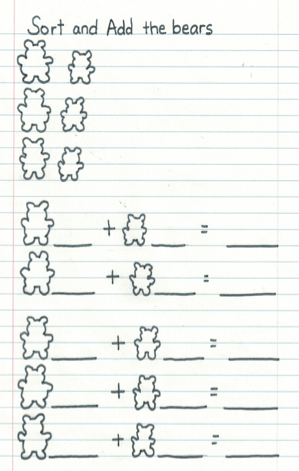
  • Bear Counter Card

Vocabulary

  • Fussing (trying to make it perfect and pretty)
  • Cradle (A small bed for a baby)
  • Rascal (trickster)
  • Jealous (envious, feeling like things are not fair)

Before Reading the Story

Have all the children stand on one side of your carpet area. Ask them, “Who has a baby sister at home?” Have those children move to the other side of the carpet. Count them and write on a piece of paper ‘Baby Sister’ and the amount. Have the children move back to the original side of the carpet and do the same thing asking about a baby brother, a big sister, and then a big brother. Talk about which count had the most and the least.

Mathematics/Number & Operations; begins to associate number concepts, vocabulary, quantities, and written numerals in meaningful ways.

Reading the Story

In the story Peter is jealous and angry, use your voice to make this emotion heard. When you get to the part where it says, “But he couldn’t fit in the chair”. Stop and ask the children why they think he cannot fit (He was too big). When you read the last line of the story, ask the children how they think Peter was feeling throughout the story. (He was mad. He didn’t like his sister. He was sad). Then ask them how they think Peter felt at the end of the story. (He was gonna help his Daddy. He felt better cause he shared).

Approaches to Learning/Reasoning & Problem Solving; develops increasing abilities to classify, compare, and contrast objects, events, and experiences.  

After Reading the Story

Ask the children who have younger siblings if they ever felt jealous? Give the children a chance to share about their own families and how the members interact with each other. (My brother always takes things away from me. My baby bit me on the arm and I cried! My little brother he wakes up at night and cries so my Mommy comes and gets him).

Social & Emotional Development/Knowledge of Families & Communities; develops ability to identify personal characteristics, including gender and family composition. AND Language Development/Speaking & Communicating; develops increasing abilities to understand and use language to communicate information, experiences, ideas, feelings, opinions, needs, questions, and for other varied purposes.

Discovery

Explain to the children that red and white paint mixed together makes pink paint. Let them combine the two colors together in a paint cup until they have made a shade of pink that they like. Now put at the easel a small amount of blue and yellow paint that they can experiment mixing with their pink paint on the easel paper. The blue and yellow will change the color to more shades of peach and magenta.

Science/Scientific Skills & Methods; begins to participate in simple investigations to test observations, discuss and draw conclusions and comparisons among objects and materials.

Music & Movement

Sing or say the poem, When I Was One Years Old.

When I was one years old, I was very, very small.                           Crouch down small

But now I’m _______ years old, and I’ve grown up big and tall!    Begin to stand with hands raised

Social & Emotional Development/Self-Concept; begins to develop and express awareness of self in terms of specific abilities, characteristics, and preferences.

Say the following poem, Up and Down, slowly as the children bend over lower and lower each time.

Up and down, up and down,

We’re bending over, up, and down.

Up and down, a little bit more,

See if you can touch the floor!

As the children get the hang of bending up and down with the poem, change the rhythm to a quicker and slower pace.

Creative Arts/ Movement; shows growth in moving in time to different patterns of beat and rhythm in music.

Growing Up

When I was just a baby, I didn’t know how to walk.  

I could only crawl like this.                                                         Children crawl around.

When I was just a baby, I didn’t know how to sit.

I could only sit like this.                                                               Child holds knees and rolls to side.

Now I’m big like this                                                                     Child holds hands over head.

And I can walk, and sit, and play.  I can do so many things at school each day!

Social & Emotional Development/Self-Concept; begins to develop and express awareness of self in terms of specific abilities, characteristics, and preferences.

Blocks

Put out any dollhouse supplies that you have, or let the children try to build furniture out of small blocks. Encourage them to build a little chair for the child and a bigger chair for the adult figures.

Mathematics/Geometry & Spatial Sense; begins to determine whether or not two shapes are the same size and shape.

Art

Put out play dough or clay today. Encourage the child to make a ball. Now ask them to make a bigger ball, a smaller ball. Ask them to roll out a snake shape. Can they roll out a longer snake, a shorter snake? Ask them to pound the play dough into a flat pancake, can they make a bigger pancake, a smaller pancake? If you have people cookie cutters let them make people, or encourage them to construct their own people. Can they make taller and shorter people?

Mathematics/Patterns & Measurement; begins to make comparisons between several objects based on a single attribute.

Sand and Water

Put dry sand into the sensory table today along with capital and small letters. Explain to the children that the capital letters are the adults and the small letters are the children. Ask them to see if they can find the pairs that go together. For children who are not experienced with letter knowledge, trace around the letters onto a piece of poster board so as the children find the letters, they can put them onto the poster board. Trace Aa with a space between Bb, etc through to Zz.

Literacy/Alphabet Knowledge; knows that letters of the alphabet are a special category of visual graphics that can be individually named.

Library and Writing

Put out markers today and have the children draw pictures of their families. After they have finished their drawing, help them to label all their family members. Ask them to talk about who is older and younger than them. (This is my sister, she is big. My family gots lots of people, I’m the big brother).

Creative Arts/Art; progresses in abilities to create drawings, paintings, models, and other art creations that are more detailed, creative, and realistic. AND Social & Emotional Development/Knowledge of Families & Communities; develops ability to identify personal characteristics, including gender and family composition.

Dramatic Play

Put a laundry basket or box into the center and let the children take turns being the baby. Ask the other children what they need to do to take care of the baby?

Creative Arts/Dramatic PLay; shows growing creativity and imagination in using materials and in assuming different roles in dramatic play situations. AND Social & Emotional Development/Cooperation; develops increasing abilities to give and take in interactions; to take turns in games and using materials; and to interact without being overly submissive or directive.

Math and Manipulatives

If you have family puzzles, put them out today.

Physical Health & Development/Fine Motor Skills; grows in hand-eye coordination in building with blocks, putting together puzzles, reproducing shapes and patterns, stringing beads, and using scissors.

Put out your Bear Counters and counter card. If you do not have Bear Counters, put out any type of counters that you have which comes in a large and small size.

Mathematics/Number & Operations; develops increased abilities to combine , separate, and name”how many” concrete objects.

Outdoor Play

If it is a sunny day, play with the children’s shadows. Can the find their shadow? Can they make it longer and shorter?

Science/Scientific Skills & Methods; begins to participate in simple investigations to test observations, discuss and draw conclusions, and form generalizations.

Transitions

Ask the children to name something they can do today that they could not do when they were little. Write their responses onto a piece of paper to hang on the wall. (Alison can ride her bike, Ryan used to use a bottle but now he can use a water jug, Lee can eat candy cause he has teeth).

Social & Emotional Development/Self-Concept; begins to develop and express awareness of self in terms of specific abilities, characteristics, and preferences

Dear Parent- Today we read a story about a child who was jealous of his baby brother. If your family has a baby in the house, your preschooler may experience jealousy. Jealousy is normal and you can help alleviate some by taking time to talk and be with your preschool child, let him know how special he is and how you appreciate when he helps take care of the baby. Make sure to spend some alone time with your preschool child, reading books is a wonderful one-on-one.

Resources