I Stink! By Kate and Jim McMullan

This story is told by the garbage truck as he rolls through his day/night.   Find out what a garbage truck does, and how much he likes this stinky job.

 Materials

  • Garbage and Recycle cards
  • Several shoe boxes

Vocabulary

  • Doubles-two of everything
  • Hopper-where you throw the garbage into the truck
  • Compacted-squished till really small

Before Reading the Story

Play I’m thinking of a community helper.  Think of several community helpers and make statements about their work.  Have the children guess who you are thinking of.  Do the Garbage collector last and then introduce the story.  (I’m thinking of a community helper who wears a uniform with a star on it.  This person helps keep us safe.  This person is someone we can call upon when we are scared or in danger.  Police.  I’m thinking of a community helper who works in a building full of books.  This person sometimes has storytimes for children.  This person lets you check out books if you have a special card with your name on it.  Librarian.  I’m thinking of a  community helper who helps keep our streets and neighborhoods clean.  This person drives a big truck that picks up our garbage and takes it to the dump.  This person has a very stinky job.  Garbage collector). 

Social & Emotional Development/Knowledge of Families & Communities; develops a growing awareness of jobs and what is required to perform them.

Reading the Story

 On the page where the truck asks, “Did I wake you?” Use your hands to show the squeezing, crushing, mashing, smashing motions. When doing the alphabet soup pages, point to the letter and say A is for _____ and let the children help name the items. As you do the alphabet pages make a face like it stinks, hold your nose, say eww, have fun with it. On the last page; Ask the children what they think would happen if no one ever picked up the garbage? Ask them where they think the barge/boat will take all the garbage?

Literacy/Alphabet Knowledge; shows progress is associating the names of letters with their shape and sound.

After Reading the Story

 Does your school recycle? If so, talk about how important it is as it helps keep the garbage dump from getting too filled. If you do not, talk with the children about doing some classroom recycling. Can they save drawing paper by using both sides? And if they use paper for cutting, save the scraps for collaging. Can you save plastic cups and use them as paint cups later?

Approaches to Learning/Reasoning & Problem Solving; develops increasing ability to find more than one solution to a question, task, or problem.

Discovery

 Put some of your breakfast leftovers into a zip lock bag and hang it in the classroom. Later in the day, open up the bag and let the children smell it. Reseal the bag and leave it over night. Ask the children to guess/hypothesis what they think is going to happen to it? Check it out the next morning and how ever many you choose to after that. Warning-some stink bombs are quite noxious so open with caution.

Science/Scientific Skills; begins to describe and discuss predictions, explanations, and generalizations based on past experiences.

Do you know the day the garbage man comes to your school? Take the children out to watch as the garbage man collects your schools trash.

Social & Emotional Development/Knowledge of Families & Communities; develops a growing awareness of jobs and what is required to perform them.

Share this video about recycling. https://www.youtube.com/watch?v=6jQ7y_qQYUA

Music and Movement

 Sing, I Like To Eat https://www.youtube.com/watch?v=lNNMknj0PyE

I like to eat, I like to eat, apples and bananas

I like to eat, I like to eat, apples and bananas.
Now as you sing, change all the vowel sounds to /A/ sounds
A lAte taA A te, A lAte tA Ate, Apples and bAnAnAs

Now to short /a/ sound, then /E/, /e/,/I/,/i/,etc.

Or Sing it learning the sign language that goes along with. https://www.youtube.com/watch?v=4R7kkTNQdYw

 Literacy/Phonological Awareness; progress in recognizing matching sounds and rhymes in familiar words, games, songs, stories, and poems.

Blocks

Add shoe boxes to the center. Tell the children to pretend that it is the garbage truck. How many bags/blocks of garbage can they fit in their truck?

Mathematics/Numbers & Operations; demonstrates increasing interest and awareness if numbers and counting as a means for solving problems and determining quantity.

Art

Use old scraps of paper, scissors, and glue today to collage.

Creative Arts/Art; gains ability in using different art media and materials in a variety of ways for creative expression and representation.

Add a scent to playdough, preferably one that smells good.

Sand and Water

Add alphabet letters to the sand (the magnetic refrigerator kind work well) and a small box or container. Let the children pretend the container is the garbage truck and they can look for letter in the sand to fill it. As they fill their truck with letters, ask them if they can name the letters that they have found.

Literacy/Alphabet Knowledge; identifies at least 10 letters of the alphabet, especially those in their name.

If you have a small magnetic board that you can write on; use a permanent marker to trace around each magnetic letter. As the children find a letter they must put it onto the correct letter shape drawn on the magnet board.

Library and Writing

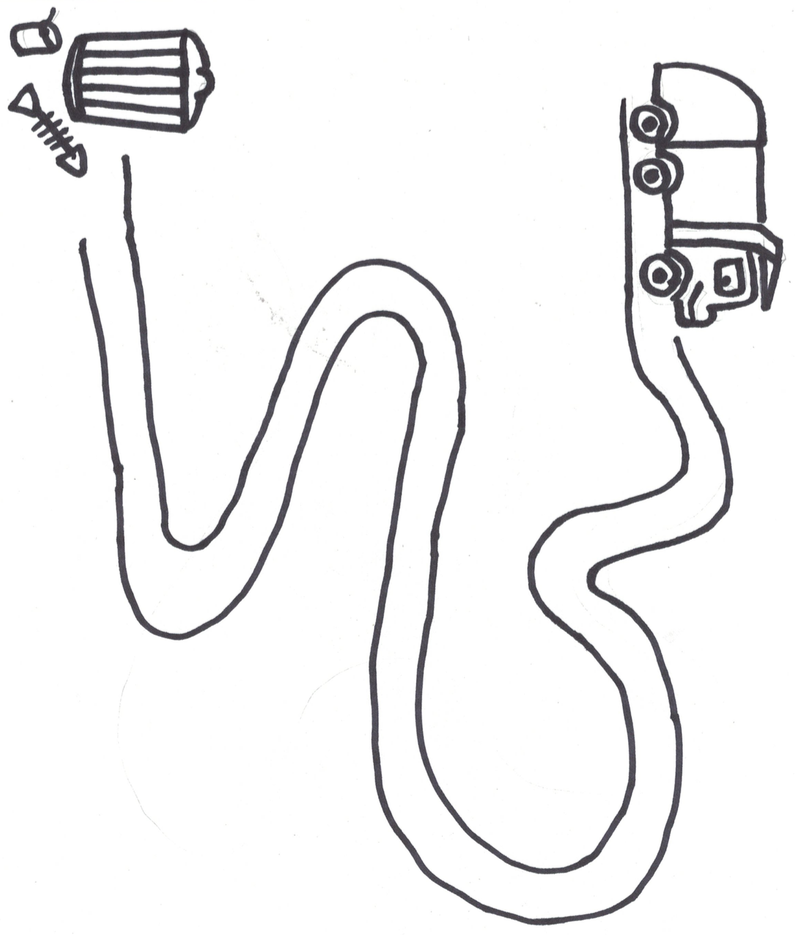
Give each child a copy of the garbage truck maze and encourage them to follow the path from beginning to end. Can they stay within the lines of the path? Did they follow the path from beginning to end? Have each child write their name upon their page.

Physical Health & Development/Fine Motor Skills; progresses in abilities to use writing, drawing, and art tools, including pencils, markers, chalk, paint brushes, and various types of technology.  AND Literacy/Early Writing; experiments with a growing variety of writing tools and materials, such as pencils, crayons, and computers. 

Dramatic Play

Tell the children that today is cleaning day in the dramatic center. Give the children damp paper towels and have them empty the shelves and wipe them. Add a garbage container and ask the children to help you throw away anything that is broken or chewed upon. I do b not have them throw things directly into the garbage when we do this because some children just like to throw things away. Use a basket or cubby that you can go through later to make sure that the garbage is truly garbage.

Social & Emotional Development/Knowledge of Families & Communities; develops a growing awareness of jobs and what is required to perform them.

Math and Manipulatives

Garbage verses Recycle cards. Put the cards on the table and challenge the children to sort them by things that can be recycled and things that are thrown away.

Mathematics/Patterns & Measurement; shows increasing abilities to match, sort, put in a series, and regroup objects according to one or two attributes such as color, shape, or size.

Outdoor Play

Tell the children that you going to roll like wheels of the garbage truck. Let the children experiment with different types of rolling. Can the make their body long and straight and roll? Can they curl up and roll into a somersault? Can they roll a hula-hoop on its edge? Can they roll a ball? Can you roll a ball to them and they kick it? What other things can they children find to roll?

Physical Health & Development/Health Status & Practices; participates actively in games, outdoor play, and other forms of exercise that enhance physical fitness.  AND Approaches to Learning/Initiative & Curiosity; chooses to participate in an increasing variety of tasks and activities.

Transitions

 Ask each child to name something they think is stinky as they go off to the next activity. Be prepared for some silly answers and lots of giggles. (I once had a child who said another child’s fart. I told the child everyone farts and sometimes I bet yours are stinky too. Just be prepared for this kind of answer to deflect it off the child mentioned and back on the child who said it).

Approaches to Learning/Reasoning & Problem Solving; develops increasing ability to find more than one solution to a question, task, or problem.  

Dear Parent, Today we read a story about the garbage truck and how he comes to collect our garbage each week. If you have garbage service, encourage your child to help take the garbage out to the can. If you do not, you can still have your child help by emptying your trash bins in the house. And don’t forget to recycle!

Resources
Screen Shot 2018-08-31 at 12.24.18 PM

Raindrops Roll, by April Pulley Sayre

This non-fiction book looks at rain and its effect on the environment. Beautiful pictures and poetic text make it a nice book to use in any weather or water unit.

Materials

  • Several clean spray bottles
  • Colored chalk
  • A penny, a nickel, a dime, and a quarter
  • Eyedroppers
  • Piece of cardboard with a 2-inch hole cut out of it in the center
  • Many larger pictures cut from magazines or calendars.
  • A piece of yarn/string long enough to reach across dramatic center
  • 10-12 spring loaded clothespins

Vocabulary

Before Reading the Story

Bring your piece of cardboard and many pictures to the rug. Without the children seeing the picture, place one behind the cardboard. Move the picture around and ask the children if they can tell what it is. Doing this allows them to only see one part of the picture at a time.

Science/Scientific Skills; begins to describe and discuss predictions, explanations, and generalizations based on past experiences.

Reading the Story

This is a very simple story with beautiful pictures. Take your time reading and talk about the pictures as you read. Can they name the insects? Note the shape of the raindrops; are they really tear shaped like people think?

Science/Scientific Knowledge; expands knowledge of and abilities to observe, describe, and discuss the natural world, materials, living things,and natural processes.

After Reading the Story

Spend a few minutes talking to the children about storm safety. When you hear thunder you should go inside because lightning is near. Rushing water during a storm could knock you over (2 feet can sweep away an SUV and pickup truck!). Stay away from trees and water, even puddles, when there is a thunderstorm.

Physical Health & Development/Health Status & Practices; builds awareness and ability to follow basic health and safety rules such as fire safety, traffic and pedestrian safety, and responding appropriately to potentially harmful objects, substances, and activities.

Discovery

Put out magnifying glasses today with interesting nature objects. Let the children use a spray bottle of water to see how water droplets cling to the objects.

Science/Scientific Skills & Methods; begins to use senses and a variety of tools and simple measuring devices to gather information, investigate materials, and observe processes and relationships.

Music and Movement

Make a rainstorm. Begin by tapping one finger on your knees and saying, “drop, plop, drop, plop, rain”. Next take your fingers and tap them on your knee and say, “pitter-patter, pitter-patter, rain”. Take your hands and pat your knees and say, “downpour, downpour, rain”. Clap your hands and say “thunder, thunder, rain”. Now reverse the order; downpour, pitter-patter, drip drop, rain.

Creative Arts/Music; participates with increasing interest and enjoyment in a variety of music activities, including listening, singing, finger plays,  games, and performances.

Sing If All The Raindrops Were Lemon Drops and Gum Drops https://www.youtube.com/watch?v=cNvL_5COPtM

If all the raindrops were lemon drops and gumdrops,
Oh what a rain it would be!
I’d stand outside with my mouth open wide,
Ah,ah,ah,ah,ah,ah,ah,ah,ah,ah
If all the raindrops were lemon drops and gumdrops,
Oh what a rain it would be.

Ask the children to name other edibles and switch out lemon drops and gumdrops.

Language Development/Listening & Understanding; demonstrates increasing ability to attend to and understand conversations, stories, songs, and poems.  AND Approaches to Learning/Reasoning Problem Solving; develops increasing ability to find more than one solution to a questions, task, or problem.

Blocks

Encourage the children to use the blocks to make houses to get out of the rain. If you have large cardboard blocks they can make a house for themselves. If you have small wooden blocks, add small people.

Approaches to Learning/Reasoning Problem Solving; develops increasing ability to find more than one solution to a questions, task, or problem.  AND Physical Health & Development/Fine Motor Skills; grows in eye-hand coordination in building with blocks, putting together puzzles, reproducing shapes and patterns, stringing beads, and using scissors.

Art

Give the children colored chalk to draw with. After the children have drawn their chalk picture, show them how to spray water on it with the spray bottle. Talk about what happens to the chalk.  Or…Use a permanent marker to draw a simple umbrella shape onto a piece of paper. Give the children colored chalk and ask them to make raindrops. After they have finished making raindrops, show them how to spray their paper with the spray bottle of water.

Creative Arts/Art; begins to understand and share opinions about artistic products and experiences. AND Science/Scientific Skills & Methods; begins to participate in simple investigations, discuss and draw conclusions, and form generalizations.

Encourage the children to make a rain picture. At the easel put out several colors. Show the children how to fill their paintbrush with paint and then press it against the top of their paper so that the colors roll run down the paper.

Creative Arts/Art; gains ability in using different art media and materials in a variety of ways for creative expression and representation.  AND Language Development/Listening & Understanding; shows progress in understanding and following simple and multi-step directions.

Sand and Water

Put out a variety of things that the children can move water from one container to another (turkey baster, squeeze bottle, funnel, pitcher, sponge).

Science/Scientific Skills & Methods; begins to use senses and a variety of tools and simple measuring devices to gather information, investigate materials, and observe processes and relationships.

Library and Writing

Put the book into the center for the children to be able to spend time looking at the beautiful pictures.

Literacy/Book Knowledge & Appreciation; shows growing interest in reading related activities, such as asking to have a favorite book read; choosing to look at books; drawing pictures based on stories; asking to take  books home; going to the library; and engaging in pretend reading with others.

Dramatic Play

Hang a piece of string or laundry line across the center. Give the children clothespins and explain that on sunny days people hang their clothes out to dry. Encourage the children to hang doll clothes on the line. When they are all hung go back to the center and tell the children it looks like rain, time to take the clothes off the line!

Physical Health & Development/Fine Motor Skills; develops growing strength, dexterity, and control needed to use tools such as scissors, paper punch, stapler, and hammer.

Math and Manipulatives

Put a piece of newspaper on the table to catch any water drops. Put a coin onto the newspaper and show the children how to use the eyedropper to suck up water and then slowly drip one drop at a time onto the coin. Before they begin, ask them how many water drops they think the coin will hold. Let the child begin to drip the drops and count. Were they able to guess how many water drops the coin could hold? Which coin held the most, the least? What happens when you squeeze all the water from the eyedropper at one time?

Mathematics/Number & Operations; begins to use one-to-one correspondence in counting objects and matching groups of objects.  AND Mathematics/Number & Operations; begins to use language to compare numbers of objects in terms such as more, less, greater than, fewer, equal to.

Outdoor Play

Rain makes mud. Let the children dig on the playground with shovels and add water. Make mud! Let the children experiment with the mud, can they build with it? What happens if you only add a little water? A lot of water?

Science/Scientific Skills & Methods; begins to participate in simple investigations to test observations, discuss and draw conclusions, and form generalizations.

Transitions

Pull out your cardboard and variety of pictures that you used before reading the story. Let the children take turns guessing what the picture is. (Note it is hard for children to wait turns to answer so note those who can and those who shout out).

Science/Scientific Knowledge; expands knowledge of and abilities to observe, describe, and discuss the natural world, materials, living things,and natural processes.  AND Physical Health & Development/Cooperation; develops increasing abilities to give and take in interaction, to take turns in games or using materials; and to interact without being overly submissive or directive.

A Piece of Red ›Paper, by Sara Stein

What if you found a sheet of paper and turned it into wonderful food and a whole table full of good things? This book will inspire children to get creative.

Materials

  • Lots of paper in plenty of colors and textures.
  • Placemat pattern

Vocabulary

  • Creative (to think of something and then make it)

Before Reading the Story;

Hold up the cover of the book and read the title. Ask the children if they can guess what the story might be about. Ask them to name the shape. Can they tell if the shape has been cut by scissors or ripped? How can you tell? (The edges are not straight).

Mathematics/Geometry & Spatial Sense; begins to recognize, describe, compare, and name common shapes, their parts and attributes.

Reading the Story

Bring a cut red circle to the story and follow the author as she makes an apple with a bite. Point out all the shapes and ideas as the story progresses. When the book asks “What would you do with a piece of red paper”, let the children share their ideas.

Mathematics/Geometry & Spatial Sense; begins to recognize, describe, compare, and name common shapes, their parts and attributes.  AND Creative Arts/Art; begins to understand and share opinions about artistic products and experiences.

After Reading the Story

Play Jumping Bean! Cut a manila file into 1 inch strips. At the bottom of each strip draw a shape. On some of the strips draw a little lima bean shaped man. (for 20 children I would make 15 shape strips and 5 jumping bean strips). Put all the strips into a cleaned out can. The children take turns picking a strip. If they get a shape they must name it. If they get a bean man they shout “Jumping Beans!” and everyone jumps up and down. Continue until everyone gets a turn or two.

Mathematics/Geometry & Spatial Sense; begins to recognize, describe, compare, and name common shapes, their parts and attributes.  AND Social & Emotional Development/Cooperation; develops increasing abilities to give and take in interactions; to take turns in games or using materials; and to interact without being overly submissive or directive.

Discovery;

Go on a shape walk and look for shapes in the world. What shape do you see on the chain link fence? What shape do you see in the sidewalk, on the car, or near the door?

Mathematics/Geometry & Spatial Sense; progresses in ability to put together and take shapes apart.

Music and Movement

Play Musical Chairs. Make two sets of shapes in a variety of colors. (2 red circles, 2 blue circles, 2 red triangles, etc). Bring enough chairs to the area, as there are children who are playing the game. Tape one color shape set to the back of the chairs, one per chair. Give the children the matching color shapes, one per child. Turn on the music and the children walk around the chairs. When the music stops, everyone must find the chair that has the correct shape and color on it and sit down. Have the children name the colors and shapes as you go around collecting them. Mix them up and play again. Do not take any chairs or children away. The concept is to find the shape and color that match the one you are holding.

Mathematics/Geometry & Spatial Sense; begins to be able to determine whether or not two shapes are the same size and shape.  

Blocks

Encourage the children to make shapes with the blocks.  How many blocks will it take to make a square?  Can you find blocks to make a triangle?  Can you find blocks to make a letter in your name?

Mathematics/Geometry & Spatial Sense; progresses in ability to put together and take shapes apart.

Art

Give the children lots of paper to cut and rip into a variety of shapes.  Challenge them to collage them together to make an art picture.

Mathematics/Geometry & Spatial Sense; progresses in ability to put together and take shapes apart.  AND Physical Health & Development/Fine Motor Skills; grows in hand-eye coordination in building with blocks, putting together puzzles, reproducing shapes and patterns, stringing beads, and using scissors.

Library and Writing

Put out pieces of colored paper with the color written across it. (green paper with the word green written across it). Encourage the children to find the same color marker and practice writing the color name on their own piece of white paper.

Literacy/Early Writing; progresses from using scribbles, shapes, or pictures to represent ideas, to using letter-like symbols, to copying or writing familiar words such as their own name.

Sand and Water

Put small magnet shapes in the sand, if you do not have small shapes, cut them out of cardboard.  Add sand to cover the shapes and give the children tongs, pinchers, tweezers to pick up the shapes and drop into a basket as they name.

Physical Health & Development/Fine Motor Skills; grows in hand-eye coordination in building with blocks, putting together puzzles, reproducing shapes and patterns, stringing beads, and using scissors.

Dramatic Play

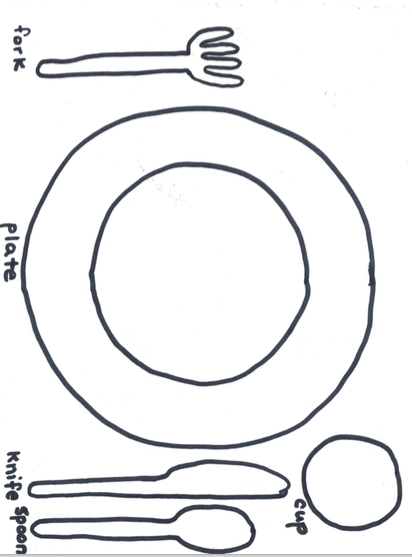
Encourage the children to set the table putting the knives, spoons, and forks, in their proper places. Make placemats that the children can follow.

Social & Emotional Development/Control; develops growing capacity for independence in a range of activities , routines, and tasks.

Math and Manipulatives

Make weaving looms from paper for the children to use. Cut out strips of 1 inch wide paper in a variety of colors. Show the children how to take the strips and go under over, then over under.

Approaches to Learning/Engagement & Persistence; grows in abilities to persist in and complete a variety of tasks and activities.  AND Mathematics/Geometry & Spatial Sense; builds an increasing understanding of directionality, order, and positions of objects, and words such as up, down, over, under, top, bottom, inside, outside, in front, and behind.

Outdoor Play

Encourage the children to use sticks to draw shapes in the dirt or dampened sand.

Mathematics/Geometry & Spatial Sense; progresses in ability to put together and take shapes apart.  AND Literacy/Early Writing; experiments with a growing variety of writing tools and materials, such as pencils, crayons, and computers.

Transitions

Hold up a piece of paper and ask the children to name the color name and if they can think of an object that is the color.

Approaches to Learning/Reasoning & Problem Solving; develops increasing ability to find more than one solution to a question, task, or problem.

Dear Parent- today we talked about shapes.  Cut out a circle, a square, or a triangle from a  piece of paper.  Hand it to your child and encourage them to look about your home to find 3-5 items that have that shape as part of their structure.  Try playing this shape game using several shapes.

Resources

Screen Shot 2018-09-09 at 12.04.30 PM