Old MacDonald’s Things That Go, by Jane Clarke

Old MacDonald has a farm, and a whole collection of transportations that go!

Materials

  • 1 paper plate per child in the classroom and tape to tape to floor.
  • Roll of aluminum foil
  • 3 large circles cut from construction paper. One red, one yellow, one green
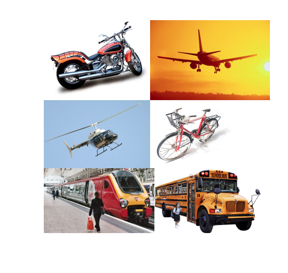
  • Transportation counters or cards, enough copies to make patterns with

Vocabulary

  • Transportation (ways to get from here to there)
  • Transporters (vehicles used in transportation like a car, a boat, an airplane to go from here to there)
  • Combine harvester (a transporter that helps farmers to cut and move his crop)
  • Wheels (rollers for vehicles in the shape of a circle)
  • Buoyant (able to float)

 Introducing the Story

Sing Old McDonald with the children. After singing, tell the children that your story today is about a different Old MacDonald who really likes transportation vehicles, things that go. Ask the children if they know what transportation means. Reiterate that it means getting from one place to another. Get out a piece of paper and ask the children to name different transporters. Write their answers on the paper. After the children have listed transporters that they can think of, introduce the book by saying, “let’s find out what kinds of transporters, things that go, Old MacDonald loved”.

Language Development/Speaking & Communicating; uses an increasingly complex and varied spoken vocabulary.

Reading the Story

This book can easily be sung to the tune of Old McDonald. Practice it once before singing with the children so that you comfortable with the rhythm of the text. As you turn each page and sing “and on this farm he had a ______”, pause and let the children name the vehicle is they can. As you sing each page, encourage the children to join along making the various vehicle sounds.

Creative Arts/Music; participates with increasing interest and enjoyment in a variety of music activities, including listening, singing, finger-plays, games, and performances.

After Reading the Story

Have the children recall all the modes of transportation in the story-song. Look at the list the children made before reading the story, is it on the list? If not, add it to the list. When your list is complete, ask the children to help you check all the transporters that have wheels. Put your finger next to each mode of transportation and name it, ask the children if they think it has wheels. Put a mark next to all the ones that do have wheels. Then ask the children if they can remember which transporter Old MacDonald had that did not have wheels (boat).

Literacy/Book Knowledge & Appreciation; shows growing interest and involvement in listening to and discussing a variety of fiction and non-fiction books, and poetry.

Music and Movement

Sing The Wheels on the Bus but turn to various pages in the book and sing about different transporters. The wheels on the _____go round and round,

Round and round. Round and round.
The wheels on the _____go round and round
All through the town.

Science/Scientific Skills & Methods; develops increased ability to observe and discuss common properties, differences, and comparisons among objects and materials.  AND Approaches to Learning/Reasoning & Problem-Solving; develops increasing ability to find more than one solution to a question, task, or problem.

Give each child a paper plate and ask them to stand somewhere in the room where they cannot touch another child or a piece of furniture. Make a loop of tape for each and have the children tape their paper plate to the floor. Tell them that you are going to play a balance game on their circle. Ask them to stand up straight on their circle with their hands at their side. Can they stand on one foot? On their knee and one foot on their circle? Can they squat down low on their circle? Can they stand with one foot on their circle and on leg behind them? In front of them? Can they kneel on their circle with one leg up? Take any children’s suggestions and play until they are tired. Make sure you are modeling all the movements with the children.

Physical Health & Development/Gross Motor Skills; shows increasing levels of proficiency, control, and balance in walking, climbing, running, jumping, hopping, skipping, marching, and galloping.

Discovery

Tell the children that today you are going to build buoyant boats. Show the children two aluminum shapes that you have made, one a ball, and one a simple boat type shape. Have the children guess what will happen when you put your shapes into the water. Explain to the children that the boat shape floats because it is buoyant. Give each child a square of aluminum foil about 10 to 12 inches.   Encourage them to make a boat shape and then test in in a tub of water. Is it buoyant? Encourage the children to say, “I built a buoyant boat” as their boat floats in the water.

Science/Scientific Knowledge; shows increased awareness and beginning understanding of changes in materials and cause-effect relationships.

Blocks

Put out a variety of cars today and show the children show to build a ramp using the long blocks. If you do not have long blocks, you can make a ramp from a long piece of cardboard. Let the children experiment rolling their cars down the ramp as they raise/lower the ramp angle.

Science/Scientific Knowledge; shows increased awareness and beginning understanding of changes in materials and cause-effect relationships. Social & Emotional Development/Cooperation shows increasing abilities to use compromise and discussion in working, playing, and resolving conflict with peers.

Art

Bring over several small toy cars. Put out large sheets of paper, and paper plates of tempera paint. Have the children dip the cars into the paint and roll it back and forth on their paper. As they work, encourage them to sing, The Wheels On The Car Go Round and Round.

Creative Arts/Art; gains ability in using different art media and materials in a variety if ways for creative expression and representation.

Sand and Water

Put water in the table today and let the children use it to see if their home-made aluminum foil boats float.

Approaches to Learning/Reasoning & Problem-Solving; grows in recognizing and solving problems through active exploration, including trial and error, and interactions and discussions with peers and adults.

Library and Writing

Get many books about transportation and add them to your center. Encourage the children to talk about and name the different kinds of transporters in the picture. As they look at the books, ask the child if this is something that goes on the land, on the water, or in the sky.

Literacy/Book Knowledge & Appreciation; progresses in learning to handle and care for books; knowing to view one page at a time in sequences from front to back; and understanding that a book has a title, author, and illustrator. AND Mathematics/Patterns & Measurements; shows growth in matching, sorting, putting in a series, and regrouping objects according to one or two attributes such as color, shape, or size.

Dramatic Play

Use one or two of your paper plates and draw a simple steering wheel upon it (a circle to be the horn). Encourage the children to pretend that they are going on a trip. What kind of transportation will you use? Invite them to bring chairs, boxes, or large blocks into the center to use to make their transporter.

Creative Arts/Drama; shows growing creativity and imagination in using materials and assuming different roles in dramatic play situations.

Math and Manipulaties

If you have transportation counters or cards, use them to make patterns for the children to copy. (train, train, helicopter). Have two children play together. One makes a pattern using 4-5 counters/cards, and the other child has to copy it.

Mathematics/Patterns & Measurement; enhances abilities to recognize, duplicate, and extend simple patterns using a variety of materials.

 Outdoor Play

Play Red Light, Green Light with the children. Make two goals on opposite sides of your playground (the fence and the tree). Have the children stand at one goal and you at the other. Explain that when you hold up the green circle, the children must (walk, jump, gallop, crawl) towards you. When you hold up the yellow and shout warning!, the children will know that it is almost time to freeze. When you hold up the red and yell Stop! The children must freeze in their place until you hold up the green and shout Go! again. Play until the children have all reached you. After several rounds, a child might be able to be the caller alongside you.

Social & Emotional Development/Self-Control; demonstrates increasing capacity to follow rules and routines and use materials purposefully, safely, and respectfully.  AND  Physical Health & Development/Gross Motor Skills; shows increasing levels of proficiency, control, and balance in walking, climbing, running, jumping, hopping, skipping, and marching

Transitions

Use the Old MacDonald book and say, I am a thinking of a kind of transporter that Old MacDonald loved. Sound it out slowly and phonetically and have the children see if they can guess the word before you finish. It begins with /b/b/b/u/s/.

Literacy/Phonological Awareness; shows increasing ability to discriminate and identify sounds in the spoken language.

Dear Parents, today we read Old MacDonald’s Things That Go. In it was many forms of transportation. As we read about transportation, it might be a good time to talk to your child about safety rules both in the car and around cars. If you use public transportation, share safety reminders about these also.

Resources
Screen Shot 2018-07-15 at 11.44.02 AM

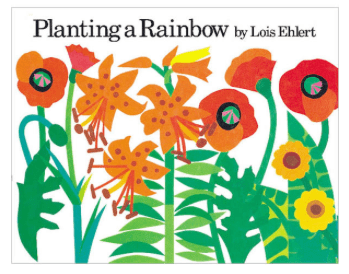
Planting a Rainbow, by Lois Ehlert

This book has bright lively pictures and a simple planting information to help children understand the world of gardening.

Materials

  • Seed catalogs of any kind
  • Silk flowers. If you do not have stems, attach pipe cleaners
  • Small paper plates, one per child
  • Many triangles cut in rainbow colors. They will be the pedals of the flowers
  • Long strips of construction paper about ½ inch wide
  • Large sheet of paper where you have drawn a simple rainbow: using the colors in your color strips.
  • On a large piece of paper draw a red circle, an orange, yellow, green, blue, and purple circle.

Vocabulary

  • Catalog-a directory magazine
  • Soil-dirt
  • Seedlings-baby plants
  • Sow-to plant
  • Petals-a part of the flower on a plant.

Introducing the Story

Show the children the front and back covers of the book.   Tell the children that the title is called, Planting a Rainbow by Lois Ehlert. Ask the children what they think the author meant by planting a rainbow? Ask the children if they have ever helped to plant flowers before? What do they think flowers need to grow? (Dirt, water, and sunshine).

Science/Scientific Knowledge;Expands knowledge of and abilities to observe, describe, and discuss the natural world, materials, living things, and natural processes.

Reading the Story

As you read, stop occasionally on pages and ask the children to name some of the colors that they see. On others, point to a color and name and ask the children if they are wearing that color.

Literacy/Book Knowledge & Appreciation; shows growing interest and involvement in listening to and discussing a variety of fiction, non-fiction, and poetry.

After Reading the Story

Put the sheet of paper on the wall with the colored circles. Ask the children which color flower they would be if they were a flower. Write their name inside the circle. Count how many of each color flower you would have in your garden. Act out the poem, Dig a Little Hole.

Literacy/Print Awareness & Concepts; develops  growing understanding of the different functions of forms of print such as signs, letters, newsletters, lists, messages, and menus.  AND Mathematics/Number & Operations; demonstrates increasing interest and awareness if numbers and counting as a means for solving problems and determining quantity.

Music and Movement

Dig a Little Hole

Dig a little hole and put the seed in.                      Act out digging a hole with your hands.
Cover it with dirt and let the sun shine in.          Pretend to cover the hole and lift arms                                                                                                                         over head.
Add a little water and keep it fed                          Wiggle fingers like rain
Pretty soon a little plant will show it’s head.      Use one arm to grow up towards sky.

 Science/Scientific Knowledge; expands knowledge of and abilities to observe, describe, and discuss the natural world, materials, living things, and natural processes.  AND Creative Arts/Music; participates with increasing interest and enjoyment in a variety of music activities including listening, singing, finger plays, games, and performances.

Discovery

At the easel put out red, yellow, and blue paint and encourage the children to mix the colors as they paint. What colors did you make?

Science/Scientific Skills & Methods; begins to use senses and a variety of tools and simple measuring devices to gather information, investigate materials, and observe processes and relationships.

If you have extra monies to spend, there is a fun science experience using a bag of M&M’s, a plate, and water. Have the children line the edges of the plate with M&M’s. Carefully pour a little water onto the plate so that all the M&M bottoms are standing in it. Then wait. As the color starts to dissolve and run towards the center of the plate, a rainbow will appear.

Science/Scientific Skills & Methods; begins to use senses and a variety of tools and simple measuring devices to gather information, investigate materials, and observe processes and relationships.

Blocks

Let the children use colored blocks today and challenge them to make a flower. How many shapes did they use? What shapes did you use? Show me the stem, the leaves, or the petals.

Mathematics/Geometry & Spatial Sense; progresses in ability to put together and take shapes apart.

Art

Give each child a paper plate and show them how to glue the triangle pedals onto it. When they have dried you can cut out stems and leaves or let the children cut out stems and leaves. These make a cute wall display. As the children are gluing the triangles on, ask them about the colors that they are using. If by chance you have foam squares, the colors are much more vibrant.

Creative Arts/Art; develops growing abilities to plan, work independently, and demonstrates  care and persistence in a variety  of art projects.  AND Approaches to Learning/Engagement & Persistence; grows in abilities to persist in and complete a variety of tasks, activities, experiences, and projects.

Sand and Water

Add dampened sand or dirt to the table and the silk flowers. The children can pretend to plant a garden. Give them spoons or small shovels and watering cans. Do not let them add any more real water or you will have a mess.

Creative Arts/Dramatic Play; shows growing creativity and imagination using materials and in assuming different roles in dramatic play situations.

Library and Writing

Put out colored markers or crayons and encourage the children to draw flowers, around shapes cut from cardboard, or to practice writing their names.

Literacy/Early Writing;experiments with a growing variety of writing tools and materials, such as pencils, crayons, and computers.

Dramatic Play

Take some of the silk/plastic flowers that you have and put them into dramatic play along with a plastic vase (a mayonnaise jar works well). Remind the children that in the story they picked the flowers and took them home. Encourage the children to make a bouquet for the vase. This can then be left on the table for future arranging.

Dramatic Play; shows growing creativity and imagination using materials and in assuming different roles in dramatic play situations.

Math and Manipulatives

Give the children the long strips of construction paper and the large rainbow design. Let the children snip the paper into little squares and glue to the coordinating rainbow arch.

Physical Health & Development/Fine Motor Skills; develops growing strength, dexterity, and control needed to use tools such as scissors, paper punch, stapler, and hammer.

Outdoor Play

If you are working on a school garden, let the children help by watering and /or planting seeds. Remind the children that in the story, the narrator and mother dug holes to plant the bulbs. Give the children shovels or spoons and let them dig holes in the sand or dirt. How big a hole can you dig? Encourage the children to work together to dig a really big hole

Social & Emotional Development/Cooperation;  develops increasing abilities to give and take in interactions; to take turns in games or using materials; and to interact without being overly submissive or directive.

Transitions

Dismiss the children to the next activity by naming colors. Put one of each color strip that you made for manipulatives, or puffballs, under a blanket or into a sack that the children cannot see through. Have a child pick out a strip and name the color.

Social & Emotional Development/Cooperation;  develops increasing abilities to give and take in interactions; to take turns in games or using materials; and to interact without being overly submissive or directive.

Or have the child find something in the room that is that color.

Mathematics/Geometry & Spatial Sense; shows growth in matching, sorting, putting in a series, and regrouping objects according to one or two attributes such as color, shape, or size.

Ella Sarah Gets Dressed, by Margaret Chodos-Irvine

Ella Sarah needs to get dressed but no one in her family agrees upon what she wants to wear.

Materials

  • 15 index cards cut in half the long way. On 20 of the halves, make a small circle of color using a crayon or marker. On the remainder 10, make a bean shape with arms and legs (jumping beans)
  • Paint swatches from local paint store. You will need two to three of each color swatch you choose.
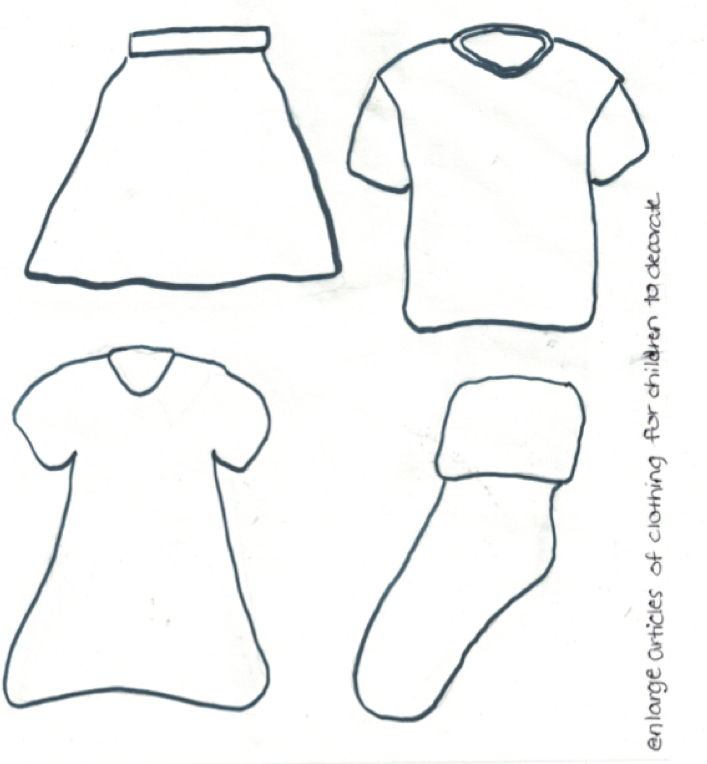
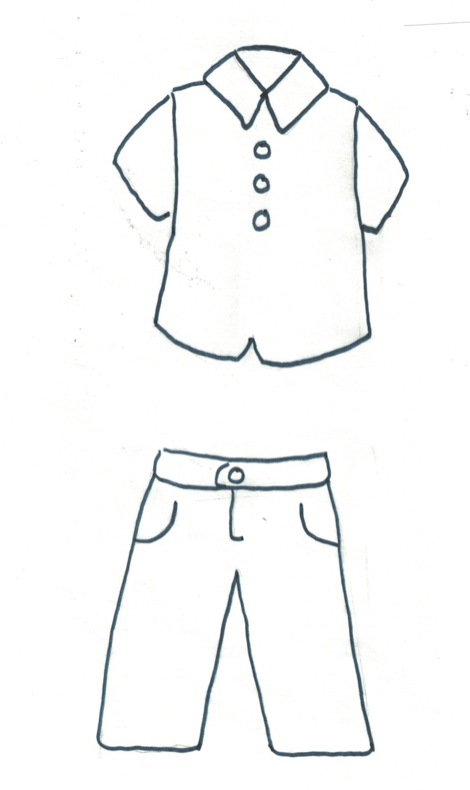
  • Clothing pattern, enlarge for children to color individual items.
  • An assortment of larger buttons, about 20-25 in all.
  • A parachute or large flat sheet. Colored scarves.

Vocabulary

  • Naming articles of clothing (short sleeves, t-shirt, blouse, long sleeves, sandals, sneakers, slippers, etc.)

Introducing the Story

Wear something that is one or more of your favorite articles of clothing to school today. Introduce the story by saying’ “I wore my favorite (socks) to school today because (they have cats all over them and cats are my favorite animal). If you know of a child who has a favorite article of clothing, mention it (I see Roger is wearing his baseball shirt, he told me once that he loves baseball. Roger is it one of your favorite shirts?). Let the children share their favorites if they choose to.

Language Development/Listening & Understanding; demonstrates increasing ability to attend to and understand conversations, stories, songs, and poems.

Reading the Story

As you read the story, use your voice to show Ella Sarah’s displeasure at being told not to wear her favorite outfit. Note to the children after these pages that you think Ella Sarah really wants to wear her pink polka-dot pants, her dress with orange and green flowers, her purple and blue striped socks, her yellow shoes, and her red hat! On the page where Ella Sarah looks in the mirror and feels her outfit is just right, ask the children to look at her face and tell you what they think she might be feeling.

Literacy/Book Knowledge & Appreciation; shows growing interest and involvement in listening to and discussing a variety of fiction and non-fiction books, and poetry.   AND Social & Emotional Development/Self-Concept; begins to develop and express awareness of self in terms of specific abilities, characteristics, and preferences.

After Reading the Story

Tell the children that Ella Sarah really had on a variety of colors. Ask them if they can remember some of the colors that she was wearing.   Then say, “Let’s play a color game”. Get out your jumping bean cards directions on how to make is under materials.   Hold the cards face down so the children cannot see the marks/colors on the opposite side. Let the children take turns picking a card and naming the color. If they get a jumping bean card they shout ‘Jumping Bean!” and everyone jumps up and down. Continue playing until all the children have had a turn or they lose interest.

Social & Emotional Development/Cooperation; develops increasing abilities to give and take interactions; to take turns in games or using materials; and to interact without being overly submissive or directive.

Music and Movement

Sing What Are You Wearing Today?   https://www.youtube.com/watch?v=-vmhPxdR_do

Creative Arts/Music; participates with increasing interest and enjoyment in a variety of music activities, including listening, singing, finger plays, games, and performances.

Discovery

Put out the paint color swatches on the table and encourage the children to find the matching cards. For older children you can get several hues in the same color family. For younger children, use swatches that are more defined. When they have matched the color swatches, ask the child if he/she can name the colors.

Mathematics/Patterns & Measurement; shows growth in matching, sorting, putting in a series, and regrouping objects according to one or two attributes such as color, shape, or size.

Blocks

Put out colored blocks today. Encourage them to sort the blocks by colors or to match the blocks to colors that they are wearing. As they build ask them to name some of the colors they are using or if they have a favorite color.

Mathematics/Patterns & Measurement; shows growth in matching, sorting, putting in a series, and regrouping objects according to one or two attributes such as color, shape, or size.

Art

Ask each child if they have a favorite article of clothing at home. Challenge them to draw their favorite outfit or give the child a clothing pattern to match their choice and markers or crayons to color them. As they work encourage them to talk about the article with detail., just like Ella Sarah and her family did in the story today.

Creative Arts/Art; progresses in abilities to create drawings, paintings, models, and other art creations that are more detailed, creative, or realistic.

Sand and Water

Bring the baby doll clothes over to the center today and fill the water table with soapy water. Let the children wash the clothes. As they wash, talk about the articles of clothing. Can they name them? Do they wear these at home? When do you wear the article of clothing? (I have pajamas at my house for nighttime. I have a fancy dress to wear when I go to parties. My baby has one of these.)

Language Development/Speaking & Communicating; develops increasing abilities to understand and use language to communicate information, experiences, ideas, feelings, opinions, needs, questions; and for other purposes.

Library and Writing

Put the book in the center today. With one or two children at a time take a picture walk through the book.   As you go through the pages ask the children what happened first, next, and last. Can they remember what Ella Sarah’s favorite outfit was?

Literacy/Book Knowledge & Appreciation; demonstrates progress in abilities to retell and dictate stories from books and experiences; to act out stories in dramatic play and to predict what will happen next in a story.

Dramatic Play

Get out all the dress up clothes today. Add jewelry and scarves if you have them. Suggest to the children to dress for a party. Comment on how lovely they look (Alison I love your blue striped skirt and green lace blouse, you look marvelous for the party!).

Creative Arts/Dramatic Play; participates in a variety of dramatic play activities that become more extended and complex. Physical Health & Development/Fine Motor Skills

Math and Manipulaties

Call several children over to the table to play a counting game with you. Give each child a copy of the large shirt pattern and put a bowl of buttons in the middle. The children take turns rolling a dice and adding that many buttons to their shirt pattern. After their turn they put the buttons back into the bowl for the next player’s turn. Continue rolling the dice and counting out buttons until each child has had several turns or loses interest.

Mathematics/Number & Operations; begins to make use of one-to-one correspondence in counting objects and matching groups of objects.

Outdoor Play

Bring your parachute and colored scarves out onto the playground. Spread the parachute out flat and have the children stand all around the edges. Give each child a colored scarf. Have them name the color/s of their scarf and toss it onto the parachute. Once all the scarves are on the parachute, the children pick up the chute by the edges or handles and make the scarves dance by shaking their arms up and down. Repeat giving each child a different color scarf.

Physical Health & Development/Gross Motor Skills; demonstrates increasing abilities to coordinate movements in throwing, catching, kicking, bouncing balls, and using the slide and the swing.

Transitions

Call the children to the next activity or to line up by what they are wearing. (If you are wearing a shirt with buttons, shoes with laces, pants with a zipper, etc.)

Language Development/Listening & Understanding; understands an increasingly complex and varied vocabulary.

Dear Parents, Today we read a story about a little girl who wanted to choose what she was going to wear, even if it did not match well. Encourage your child to help pick out their clothes for school. As they do, mention the colors or the patterns on the clothing. Give your child a few extra minutes to practice dressing themselves in the morning. This is good not only for their self-esteem but is a wonderful way for your child to develop large and small muscles.

Resources

Screen Shot 2018-08-10 at 3.01.31 PM
Screen Shot 2018-08-10 at 3.01.52 PM
Screen Shot 2018-08-10 at 3.02.54 PM