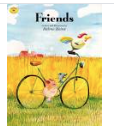
Friends, by Helme Heine

            Three good friends share their adventures and their philosophy on what it means to be a friend.

Materials

  • Picture of each child in the class, full body
  • Pictures of children at play
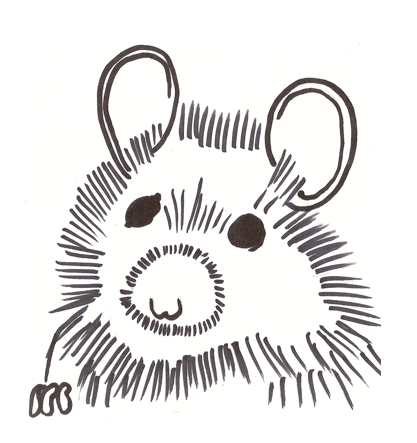
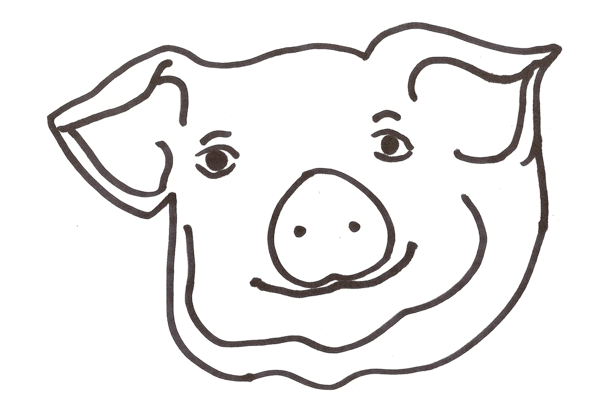
  • Pig, rooster, mouse mask
  • Hi-ho cherry-o game boards

Vocabulary

  •  Conquered (to take control of something)
  •  Fair (always thinking about another person and to share equally)

Before Reading the Story

            Explain to the children that you are going to play a game called thumbs up.  You are going to say a short story and if it sounds like the good way to treat a friend, give a thumb up sign.  If not, give a thumb down sign.  Make your scenario/stories ones that you have seen happen within your classroom (one day Kerry and Roger were playing in the blocks and Kerry kicked Roger’s tower by accident.  Kerry said she was sorry and Roger said it was ok..  One day Kerry and Roger were playing in the blocks and Kerry wanted the block Roger had but Roger said “no” so  Kerry knocked down his block tower because she was mad).  Give examples using puppets and let the children decide if it was a thumb up or a thumb down.   Do friend and not friend actions, how does it make you feel? What could you have done instead?

Social & Emotional Development/Self-Control; develops an understanding of how their actions affect others adm begins to accept the consequences of their actions. AND Social & Emotional Development/Social Relationships; progresses in responding sympathetically to peers who are in need, upset, hurt, or angry; and in expressing empathy and caring for others.

Reading the Story

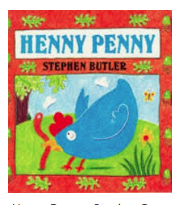
Looking at the cover, can the children predict what it might be about? Introduce the story.

Literacy/Book Knowledge & Appreciation; shows growing interest and involvement in listening to and discussing a variety of fiction, non-fiction, and poetry.

After Reading the Story

            Talk about what the three friends liked to do together, recall the order of events.  What things did they share along the way?  Ask the children what kinds of things they like to do with their friends.

Literacy/Book Knowledge & Appreciation; demonstrates growing abilities to retell and dictate stories from books and experiences; to act out stories in dramatic play; and to predict what will happen next in a story. AND Social & Emotional Development/Social Relationships; shows progress in developing friendships with peers.
Discovery

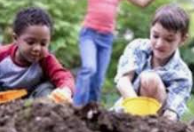
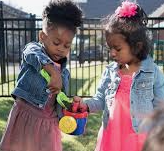
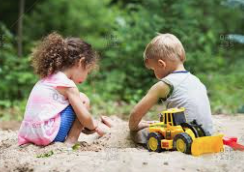
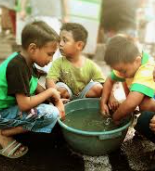
            Bring in pictures of children interacting together. Ask the children to describe what they see happening.  Do you think these children are friends, why?  Do they look like they are having fun, being safe, etc?  Talk about the actions in the pictures.  Have the children use their observation skills to notice faces and body language.

Social & Emotional Development/Self-Control; develops an understanding of how their actions affect others adm begins to accept the consequences of their actions.

Music and Movement

            Have the children lay on their backs and put their feet up in the air.  Pretend to pedal a bicycle.  Can you peddle fast, slow, around a sharp corner? 

Physical Health & Development/Health Status & Practices; participates actively in games, outdoor play, and other forms of exercise that enhance physical fitness.

            Sing Row, Row, Row the Boat with the children.  The children can partner up with another and try to row together, side-side, holding hands back and forth, back to back, etc.

Social & Emotional Development/Cooperation; develops increasing ability to give and take in interactions; to take turns in games and using materials; and to interact without being overly directive or submissive.

Blocks

            Contact pictures of the children in the class to the small rectangle blocks.  The children can then build a structure for their friends and act out play scenarios.

Approaches to Learning/Initiative & Curiosity; approaches tasks and activities with increasing flexibility, imagination, and inventiveness.

Art

            Print out large letters of the alphabet from the computer.  Give the children a variety of art materials to decorate the letters (collage, paint, drawing supplies).  When the letters are dry you can cut them out and mount them onto your wall.  As the children decorate the letters, ask if they know the letter name, the letter sound, and words that might begin with that letter.

Literacy/Alphabet Knowledge;Identifies at least 10 letters of the alphabet, especially those in their name.

Sand and Water

            Put boats into the water table and small animals.  If you have no boats, plastic containers and lids will work.  Can you put three friends in and float?  How many friends can you get into your boat? 

Mathematics/Number & Operations; demonstrates increasing interest and awareness of numbers and counting as a means to solving problems and determining quantity. AND Science/Scientific Skills & Methods; begins to participate in simple investigations to test observations, discuss and draw conclusions, and form generalizations.

Library and Writing

            Take a big piece of paper and write F is for Friends across the top.  Have the children think of words that begin with F.  Write these words on the paper down the left side.  After the children have thought of F words, they can all practice making their own F’s on the paper, or they may like to illustrate some of the F words. (Foot, flower, funny, freckle, finger, fingernail, flap, four, fish)

Literacy/Phonological Awareness; shows growing progress of beginning and ending sounds in words.

Dramatic play

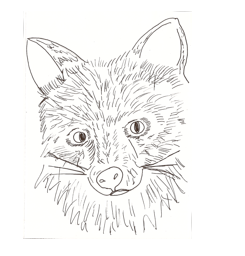
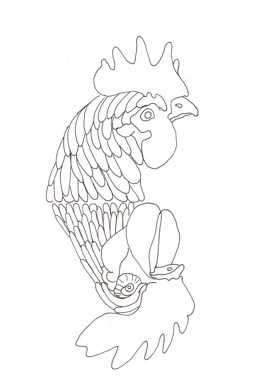
            Use the animal heads to make masks.  Color and decorate.  Staple to a sentence strip and adjust to the child’s head size.  They can become the characters while they share and play in dramatics.

Creative Arts/ Dramatic Play; shows growing creativity and imagination in using materials and in assuming different roles in dramatic play situations.

Math and Manipulatives

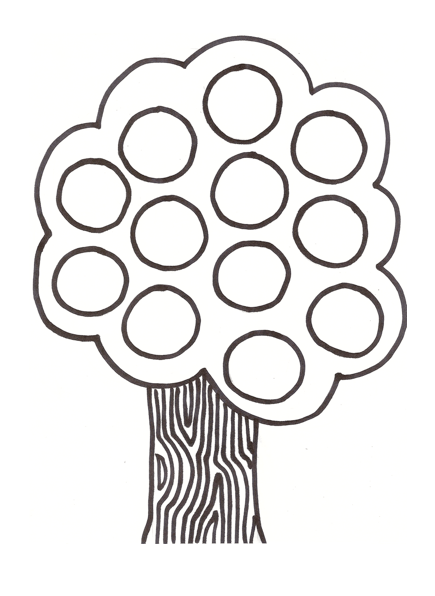
            Home made Hi-ho Cherri-o game.  Make several copies of the cherry tree and cut out many small red circles.  Put the circles onto the trees.  The children use a dice to roll.  The number they roll is the number of cherries they can remove from their tree.  The object is to remove all the cherries from the tree.  Play until everyone’s tree is empty.

Mathematics/Number & Operations; begins to use one-to-one correspondence in counting objects and matching groups of objects.

Outdoor play

            Give each other rides on the back of the tricycles. 

Physical Health & Development/Health Status & Practices; progresses in physical growth, strength, stamina, and flexibility.

Put a sheet on the ground and pretend that it is a boat.  Gather as many children as want to play and go for a sail.  Pretend to catch fish and swim from the side of the boat.

Creative Arts/ Dramatic Play; shows growing creativity and imagination in using materials and in assuming different roles in dramatic play situations. AND Social & Emotional Development/Cooperation; develops increasing ability to give and take in interactions; to take turns in games and using materials; and to interact without being overly directive or submissive.

Transitions

            Ask the children to describe one thing they like to do with a friend. Write their responses on a piece of paper and hang on the wall.

Social & Emotional Development/Social Relationships; shows progress in developing friendships with peers.


Henny Penny, by Stephen Butler

            Henny Penny thinks the sky is falling and runs off in a panic.  On the way she meets some of her friends and gets them all afraid too.  What will happen when they meet the fox who pretends to be the king?  Is the sky really capable of falling? 

Materials

  •   Numbers 1-5 and lots of acorns
  •  Bird masks
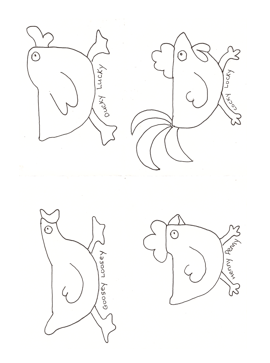
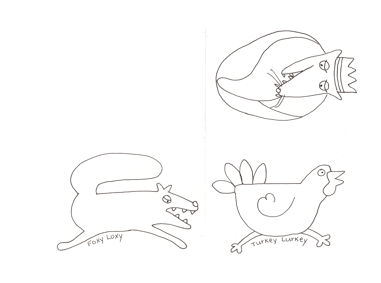
  •  Puppets; acorn, henny penny, cocky locky, ducky lucky, goosey loosey, turkey lurkey, foxy loxy

Vocabulary

  • Acorn (the seed from an oak tree)
  • Disguise (To dress up to look like someone else)
  • Cave (a hole in the rocks or the ground)
  • Emergency (something bad happens and it has to be taken care of immediately)

Before Reading the Story

            Tell the children that today you are going to put on a puppet show with them.  Ahead of time, cut out the puppet figures and attach to a popsicle stick.  Ask the children if they know what it means when you say characters of the story (the people/animals in the story).  Tell the children that you would like to introduce the characters of the puppet show.  This is Henny Penny, can you tell shat kind of an animal she is?  Continue to introduce all the characters.  When you have finished, tell the children that one of the characters is very different from the others, can you tell me who?  (The fox is the only animal, the rest are birds).

Mathematics/Patterns & Measurement; begins to make comparisons between several objects based on a single attribute.

Reading the Story

            Make puppets and either hold them up yourself or ask several children help you as you read the story.  As you read, encourage the children to repeat, “The sky is falling!  The sky is falling!”

Literacy/Book Knowledge & Appreciation; shows growing interest and involvement in listening and discussing a variety of fiction, non-fiction, and poetry.

After Reading the Story

Tell the children that in the story, Henny Penny thought it was an emergency.  Explain that sometimes at school we practice for an emergency by having a fire drill.  If it was a real fire emergency, do the children know what they should do?  Go over your fire drill plan, your tornado plan and any other emergency plans that the children would partake in at school.

Physical Health & Development/Health Status & practices; builds awareness and ability to follow basic health and safety rules such as fire safety, traffic and pedestrian safety, and responding appropriately to potentially harmful objects, substances, and activities.

Ask the children if they think Henny Penny handled herself in a safe way? Why or why not?

Language Development/Speaking & Communicating; develops increasing abilities to understand and use language to communicate information, experiences, ideas, feelings, opinions, needs, questions; and for other varied purposes.

Ask the children if they have ever had a scary dream.  Let them talk about their dreams.  Are scary dreams for real?  What can you do if you have a scary dream? 

Language Development/Speaking & Communicating; develops increasing abilities to understand and use language to communicate information, experiences, ideas, feelings, opinions, needs, questions; and for other varied purposes.

Discovery

            Ask the children to think about all of Henny Penny’s friends.  They were birds.  Ask the children to draw birds.  How many feet do birds have?  What do they have instead of a mouth, instead of arms?  We have skin all over our bodies, what are chickens covered with?

Science/Scientific Knowledge; expands knowledge of and abilities to observe, describe, and discuss the natural world, materials, living things, and natural processes.

Music and Movement

            Sing Rhyming Words Sound the Same, to the Mexican Hat Dance.

Rhyming words sound the same, (clap, clap)

Rhyming words sound the same. (clap, clap)

Rhyming words sound the same. (clap, clap)

Rhyming words sound the same.

(ask a child to make a rhyming word that goes along with their name, it does not have to be a real word)

Literacy/Phonological Awareness; progresses in recognizing matching sounds and in rhymes familiar words, games, songs, stories, and poems.

Blocks

            The fox tricked Henny Penny and her friends into a cave.  Ask the children to see if they can make a cave where they can put something inside.  Also encourage them to make a castle for the king.

Approaches to Learning/Engagement & Persistence; demonstrates increasing ability to set goals and develop and follow through on plans.

Art

            Cut out simple Kings Crowns and let the children decorate them. (I have made stencils of shapes for the children to cut and glue onto their crown and a co-worker got out the glitter and sequences for very fancy crowns).

Creative Arts/Art; begins to share opinions about artistic products and experiences.

Library and Writing

            Ask the children to help you write a new ending to the story where Henny Penny looks up at the tree when the acorn falls.  How would this story go?  They can illustrate their ending?

Literacy/Early Writing; begins to represent stories and experiences through pictures, dictation, and in play.

Sand and Water

            If you live in an area where there might be acorns, put some into the water table.  If not, look for other kinds of tree seeds that you can use. Let the children scoop and pour the acorns into a variety of vessels. Do they make different sounds in plastic versus wood or metal?

Science/Scientific Skills & Methods; begins to participate in simple investigations to test observations, discuss and draw conclusions, and form generalizations.

Dramatic Play

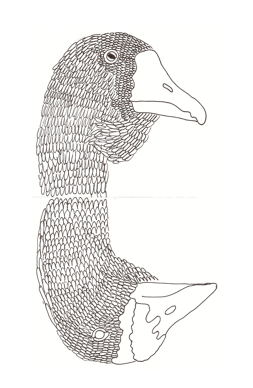
            Cut and color the masks and attach to sentence strips so the children can act out the story.  For the king, a child can wear a crown that was made in art.

Literacy/Book Knowledge & Appreciation; demonstrates progress in abilities to retell and dictate stories from books and experiences; to act out stories in dramatic play; and to predict what will happen next in a story.

Math and Manipulatives

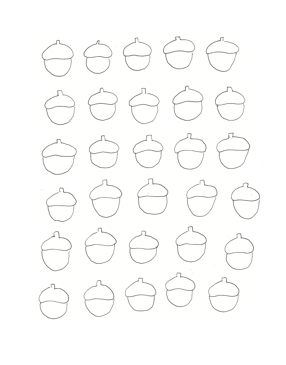
            Put out 1-5 or 1-10 pieces of paper with the number written upon it. Cut out the acorns on the acorn page and let the children make piles on the corresponding numbers.

Mathematics/Number & Operations; begins to make use of one-to-one correspondence in counting objects and matching groups of objects.

Outdoor Play

            Play follow the leader.

Physical Health Development/Health Status & practices; participates actively in games, outdoor play, and other forms of exercise that enhance physical fitness.

Transitions

            As the children leave to go to the next activity, simply ask them where they are going.  Find a word real or silly that rhymes with their name.  (Kerry Berry, where are you going?  Roger Dodger, where are you going?)

Approaches to Learning/Initiative & Curiosity; develops increased ability to make independent choices.

Puppets for story, glue to popsicle stick

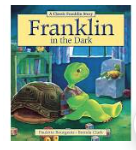
Franklin in the Dark, by Paulette Bourgeois

            Franklin turtle is afraid of being in small dark places.  How will he ever get into his shell to sleep?  In this story Franklin finds out that lots of other animals have fears also and learns how to be brave.

Materials

  • A shoe box with a 2 inch hole cut out of one end
  • Flashlight
  • Paper plate per child.
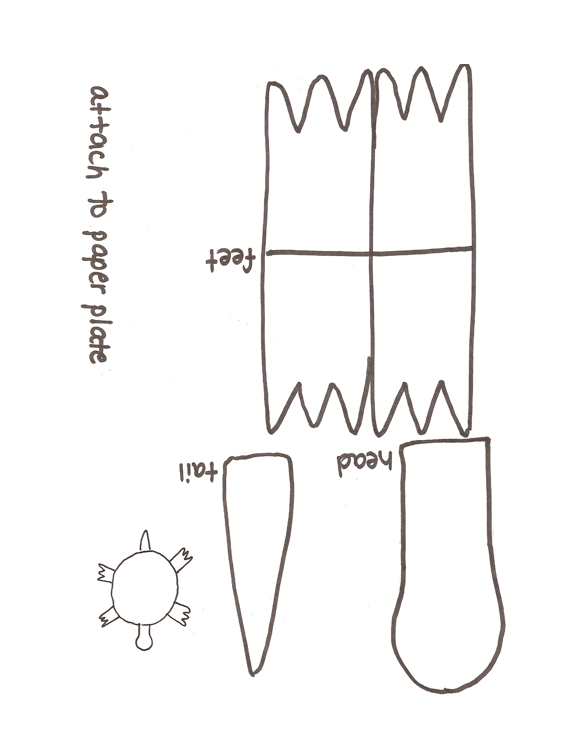
  • Head, feet, tail pattern
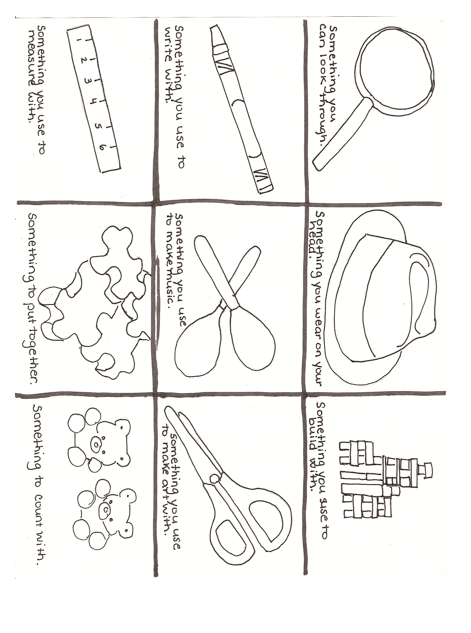
  • Scavenger Hunt cards
  • Scarf or cloth napkin per child
  • Yarn cut into 12 inch pieces, 4 per child.

Vocabulary

  • Brave (to show courage when you have to do something really scary or hard)
  • Afraid (to be frightened or scared of something)

Before Reading the Story

            Look at the front cover with the children; ask the children how they think Franklin is feeling, why?  Say, “I always thought turtles were supposed to be in their shell, I wonder why Franklin is not?”  Let the children respond.

Language Development/Listening & Understanding; demonstrates increasing ability to attend to and understand conversations, stories, songs, and poems.

While Reading the Story

            As you turn the pages that show the duck, the lion, the bird, and the bear, stop and ask the children, “why do you think the duck is wearing water wings?  The lion is wearing earmuffs, the bird is wearing a parachute, and the bear is wearing a snowsuit?”

Language Development/Speaking & Communicating; develops increasing abilities to understand and use language to communicate information, experiences, ideas, feelings, opinions, needs, questions; and for other varied purposes.

When you get to the page where Franklin goes to bed and says Goodnight, ask the children how do you think Franklin solved his fear of small dark places? 

Approaches to Learning/Reasoning & Problem Solving; develops increasing ability to find more than one solution to a question, task, or problem. AND Literacy/Book Knowledge & Appreciation; demonstrates progress in abilities to retell and dictate stories from books and experiences; to act out stories in dramatic play; and to predict what will happen next in a story.

After Reading the Story

            Tell the children about one time that you were scared and what you did to help you be brave.  Allow the children to share ways that they have been brave.

Language Development/Speaking & Communicating; develops increasing abilities to understand and use language to communicate information, experiences, ideas, feelings, opinions, needs, questions; and for other varied purposes. AND Social & Emotional Development/Self-Concept; demonstrates growing confidence in a range of abilities and expresses pride in accomplishments.

Discovery

            Have the children take turns putting classroom objects in the shoe box with a hole at one end.  Another child can then take a flashlight and look in the hole and name the object.  Can you see what is in there?  Can you name the color that you see?  How many legs do you see on the animal?  What kind of person-helper do you see in the box?

Science/Scientific Skills & Methods; begins to use senses and a variety of tools and simple measuring devices to gather information, investigate materials, and observe processes and relationships.

Music and Movement

            Explain to the children that you are going to try to act out different feelings while moving.  Ask the children if they can move like they are afraid.  Ask them to try to move like they are angry, sad, excited, tired, surprised.  There is no right way to do this; it is all about experimenting with movement and feelings.  If you like, give each child a scarf to help them act out with.

Creative Arts/Movement; expresses through movement and dancing what is felt and heard in various musical tempos and styles. AND Approaches to Learning/Reasoning & Problem Solving; develops increasing ability to find more than one solution to a question, task, or problem.

            Sing If You’re Happy and You Know It.  Try different verses using a variety of emotions; scared, angry, brave.

Approaches to Learning/Reasoning & problem Solving; develops increasing abilities to classify, compare, and contrast objects, events, and experiences.

Blocks;

            Challenge the children to make a ‘dark space’. Congratulate them on any structure they make that has an enclosed space that could be dark.

Approaches to Learning/Reasoning & Problem Solving; develops increasing ability to find more than one solution to a question, task, or problem.

Art;

            Make turtles out of paper plates.  Show the children how to draw lines that divide the plate into quarters or eighths.  Encourage them to color each section a different color or to make a pattern.  Give each child a page with the head, feet, and tail.  Older children can cut these out themselves.  Glue these onto the bottom of the decorated paper plate. 

Physical Health & Development/Fine Motor Skills; grows in hand-eye coordination in building with blocks, putting together puzzles, reproducing shapes and patterns, stringing beads, and using scissors.

Sand and Water

            Do a float and sink activity.

Science/Scientific Skills & Methods; begins to participate in simple investigations to test observations, discuss and draw conclusions, and form generalizations.

Library and Writing

            Make a scavenger game to play with your children.  Use the cards provided and have the children find objects that fit into each category. 

Approaches to Learning/Engagement & Persistence; shows growing capacity to maintain concentration over time on a a task, question, set of directions or interactions, despite distractions and interruptions. AND Approaches to Learning/Reasoning & Problem Solving; develops increasing ability to find more than one solution to a question, task, or problem.

Dramatic Play

            Encourage the children to put on the dress ups like the bear in the story, practice buttoning, zipping, and Velcro. 

Physical Health & Development/;Fine Motor Skills; develops growing strength, dexterity, and control needed to use tools such as scissors, paper punch, stapler, and hammer. AND Social & Emotional Development/Self-Concept; develops growing capacity for independence in a range of activities, routines, and tasks.

Math and Manipulatives

            Tell the children that they can make parachutes like the bird wore in the story.  Give each child a scarf or cloth napkin and show them how to tie a knot with the yarn to each corner.  How many corners are there?  How many pieces of yarn will you need?  After they tie the corners, they can take the four loose ends and tie them around a rubber animal or person.  Take them outside and see if they work.

Mathematics/Number & Operations; begins to use one-to-one correspondence in counting objects and matching groups of objects. AND Physical Health & Development/;Fine Motor Skills; develops growing strength, dexterity, and control needed to use tools such as scissors, paper punch, stapler, and hammer.

Outdoors Play

            Let the children use wagons that they can push, and pull (like Franklin pulled his shell)

Physical Health & Development/Health Status & practices; progresses in physical growth, strength, stamina, and flexibility.

Transitions

Ask the children if they can remember what Franklin was afraid of? What were the other animals afraid of? What can you do if you are afraid?

Literacy/Book Knowledge & Appreciation; demonstrates progress in abilities to retell and dictate stories from book s and experiences; to act out stories in dramatic play; and to predict what will happen next in a story.

Resources