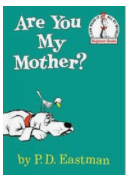
Are You My Mother? by PD Eastman

One day a baby bird hatches from his egg and his mother is not there! Follow little birds’ trail as he looks for his mother.

Materials

  • Pictures of things that are alive/not alive from story and magazines
  • Several scarves or bandanas
  • Colored feathers or pieces of paper strips to represent feathers

Vocabulary

  • Alive (something that eats/drinks, grows, depends upon their environment where they live, and breaths.)

Before Reading the Story

Ask the children if they know what it means to be alive. Define for them that being alive means things that eat/drink, grow, depend upon their environment where they live, and breathe. Ask the children if a fish is alive, a bear, their Mom, a rock, a tree? Make a list of alive-not alive with the children. Ask the children about a variety of objects and list them on a sheet of paper as ‘alive’-‘not alive’. Add any items to the list that they might share.

Science/Scientific Knowledge; Expands knowledge of and abilities to observe, describe, and discuss the natural world, materials, living things and natural processes.

Reading the Story

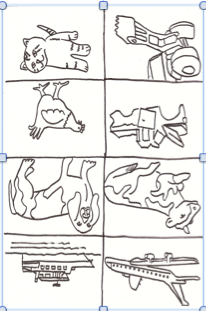
As you read the story, ask the children about each thing that the baby bird thinks is its Mother. What is it? Is it alive, or not alive?  Why or why not? (a car does not breathe and does not grow).

Language Development/Speaking and Communicating; develops increasing abilities to understand and use language to communicate information, experiences, ideas, feelings, opinions, needs, questions; and for other varied purposes.

After Reading the Story

Ask the children if they remember why the mother bird left the nest. Talk to the children about what they would do if they woke up and could not find their mother? Would you be scared? Ask if anyone has ever gotten lost in a store or a park. How did it feel? If the children have not had this experience, share one of yours with them.   What should you do if you are lost or you cannot find your parent?

Physical Health & Development/Health Status & Practices; Builds awareness and ability to follow basic health and safety rules such as fire safety, traffic, and pedestrian safety, and in responding appropriately to potentially harmful objects, substances, and activities.

Discovery

Tell the children that the baby bird thought all kinds of things were his mother.   Some were alive and some were not, cut and sort magazine pictures by things that are alive and things that are not alive.

Mathematical/Geometry & Spatial Sense; shows growth in matching, sorting, putting in a series, and regroup objects according to one or two attributes such as color, shape, or size. AND Physical Health & Development/Fine Motor Skills; develops strength, dexterity, and control needed to use tools such as scissors, paper punch, stapler, and a hammer.

Music and Movement

Act out being birds. Sit on your eggs and get comfortable. (Children can squat down and pretend to rustle their wings by flapping their arms). Fly down from your nest and look for food. (Children can stand up and pretend to fly around the room). What do you eat? Look for worms and bugs. (Show the children how to pinch their thumb and fingers to make a pretend beak). Use your beak to pick the worm out of the ground. Hold the worm in your beak and fly back to nest and feed your babies. (Open and shut your beak and pretend to feed baby birds in the nest). Now be the baby birds and pop out of the egg. Stretch your wings and peep for food because you are hungry from all that pecking. Practice flapping your wings and then try to fly, slowly at first and then faster.

Creative Arts/Dramatic Play; shows growing creativity and imagination in using materials and in assuming different roles in dramatic play situations.

 Blocks

Add animals, preferably adults and their babies or large and small similar animals for the children to sort as they play.

Mathematics/Patterns & Measurement; shows increasing abilities to match, sort, put in a series, and regroup objects according to one or two attributes such as shape or size.

 Art

Bring out the play dough. Ask the children if they can make a ball, an egg, a long snake, and a mother bird.

Creative Arts/ Art; gains ability in using different art media and materials in a variety of ways for creative expression and representation.

Library and Writing

Ask the children to draw a picture of their Mom, or other caretaker, doing something special with them. Write what the children dictate about their Mom, or other caretaker. (My Mom gives me ice cream, My Grandma took me to the park and we saw a squirrel that runned up the tree).

Literacy/Early Writing; begins to represent stories and experiences through pictures, dictation, and in play.

Sand and Water

Add grass and mud to the table. Challenge the children to make a nest for baby bird. Add small rocks to be eggs.

Approaches to Learning/Initiative & Curiosity; approaches tasks and activities with increased flexibility, imagination, and inventiveness.

Dramatic Play

Put out scarves or bandanas like Mother Bird is wearing. Encourage the children to cook nutritious meals for their babies. (Do you have a fruit for your baby? What vegetable will you cook? What is your baby drinking?)

Physical Health & Development/Health Status & Practices; builds awareness to follow basic health and safety rules.

Math and Manipulatives

Add a variety of colored feathers and a piece of dark paper. Show the children how they can use the feathers to make designs and patterns on the paper.

Mathematics/Patterns & Measurements; enhances abilities to recognize, duplicate, and extend simple patterns using a variety of materials.

Outdoor Play

Teach the children how to not get kidnapped. Tell the children that you are going to pretend to be a stranger and try to take them into your car. Explain to the children that you are going to grab them by the arm and pretend to try to get them in your (pretend) car. Explain to the children that if this were to happen they should throw themselves on the ground and shout loudly, “You are not my mother!” Practice giving each child a turn. Encourage them to shout loud!

Physical Health & Development/ Health Status & Practices; Physical Health & Development/Health Status & Practices; Builds awareness and ability to follow basic health and safety rules such as fire safety, traffic, and pedestrian safety, and in responding appropriately to potentially harmful objects, substances, and activities.

Transitions

As the children go off to the next area, tell them that they are to think of an animal that starts with a letter sound. Use the child’s first letter or one that is simple to think of an animal. Call each child and give them the letter sound i.e.; Kerry-cat, Roger-rhinoceros. Then ask them, “are you my mother?” Help the children respond using a full sentence; “No I am not your mother, I am a cat, meow” “No I am not your mother, I am a rhinoceros, hunn.”

Literacy/Phonological Awareness; shows growing awareness of beginning and ending sounds of words.

Dear Parents, Today we read the book, Are You My Mother? By PD Eastman. In the book the baby bird does not know what his Mother looks like and goes to find her. It might be fun to take a few minutes and look through old pictures that you might have of family members and talk about each one. (This is a picture of me when I was your age and that is Grandpa holding me in his lap.

Resources
Screen Shot 2018-08-08 at 3.29.50 PM

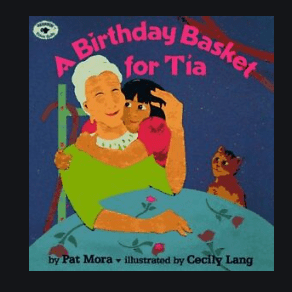
A Birthday Basket for Tia, by Pat Mora

It’s Tia’s birthday, what special gifts will she find in the basket?

Materials

  • Large basket to hold a book, a teacup, a mixing bowl, a (red) ball, a flowerpot, and some silk flowers.
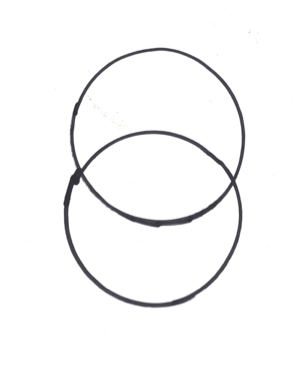
  • A circle graph
  • A sheet, or towel, large enough to cover the items in the basket.
  • Pillowcase
  • 10 flannel candles, color these yellow and blue
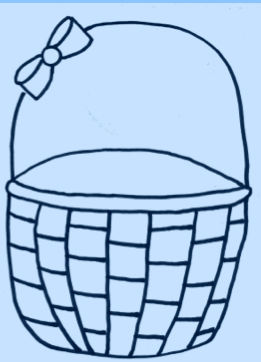
  • Copy of basket, one per child
  • old wrapping paper or aluminum foil
  • 4-5 pipe cleaners cut into thirds

Vocabulary

  • Tia (means Aunt in Spanish)
  • Tea Cup (a special cup to drink tea in)
  • Surprise (to give somebody something unexpectedly)

Introducing the story

Bring the large basket filled with the items listed. Tell the children that you have a surprise for my Tia/aunt whom I love very much. Ask them if they can guess why you are giving them to your Tia. “Yes! It’s her birthday!” If nobody suggests birthday, tell the children because it is her birthday. Pick up each item and have the children name. Ask the children how they celebrate birthdays. Write their responses on a large sheet of paper.

Language Development/Speaking & Communicating; develops increasing abilities to understand and use language to communicate information, experiences, ideas, feelings, opinions, needs, questions; and for other varied purposes.

Reading the Story

Read the story quietly, secretly as though you do not want Tia to hear. As you read, hold up each item in the basket when presented in the story and put down in front of you in a haphazard order.

Language Development/Listening & Understanding; demonstrates increasing ability to attend to and understand conversations, stories, songs, and poems.

After Reading the Story

Ask the children to recall what item was put in the basket first, second, third, last. Put the items back in the basket in the proper order with the help of the children.

Literacy/Book Knowledge & Appreciation; demonstrates progress in abilities to retell and dictate stories from books and experiences; to act out stories in dramatic play; and to predict what will happen next in a story.

Use the circle graph and take the list of the children responses of how they celebrate birthdays and mark those that are like the story and those that are different.

Mathematics/Patterns & Measurement; begins to make comparisons between several objects based on a single attribute. 

 Music and Movement

Sing Happy Birthday with your children. Or, try

Happy Birdle Daydle toodle yooudle.
Happy Birdle Daydle toodle youdle
Happy Birdle Daydle deardle youdle
Happy Birdle Daydle toodle youdle.

Literacy/Phonological Awareness; shows growing awareness of beginning and ending sounds in words.

Or teach them to sing it in Spanish

Feliz cumpleaños a ti
feliz cumpleaños a ti
feliz cumpleaños querido/a (name)
feliz cumpleaños a ti.

Language Development/Speaking & Communicating; uses an increasingly complex and varied spoken vocabulary.

Discovery

Without the children being able to see, put an object into the pillowcase. It should be something from the classroom that the children are familiar with. Let the children take turns feeling the item through the pillow case. Can they guess what it is without looking? After each child, change the object. Try putting in the objects from the story also. Encourage the children to take turns finding a classroom object and putting it into the pillowcase for a friend to guess.

Approaches to Learning/Initiative & Curiosity; approaches tasks and activities with increased flexibility, imagination, and inventiveness. Chooses to participate in increasing variety of tasks and activities.

Blocks

Give the children scraps of wrapping paper and tape, or pieces of aluminum foil, and show them how to wrap the blocks up like gifts.

Physical Health & Development/Fine Motor Skills; develops growing strength, dexterity, and control needed to use tools such as scissors, paper punch, stapler, and hammer.

Art

Use the teacup and a variety of cups to print circle shapes on paper. Talk about small, medium, and large circles as they print.

Mathematics/Geometry & Spatial Sense; begins to be able to determine whether or not two shapes are the same size and shape.

Sand and Water

Use dampened sand today to make cakes. Add pieces of pipe cleaners to represent candles. Encourage the children to add 3 candles, 5 candles, etc.

Mathematics/Number & Operations; develops increased abilities to combine, separate, and name “how many” concrete objects.

Library and Writing

Give children a copy of the basket and ask them to draw a picture of a gift that they would give to Tia.

Literacy/Book Knowledge & Appreciation; shows growing interest in reading related activities, such as asking to have a book read; choosing to look at books; drawing pictures based on stories, asking to take books home…

Dramatic Play

Put the basket with the items from the story (minus the tea cup-replace with a plastic one) and encourage the children to play birthday party. You could also add some crepe paper and tape, some boxes to put items in, and birthday hats.

Social & Emotional Development/Cooperation; develops increasing abilities to give and take in interactions; to take turns in games or using materials; and to interact without being overly submissive or directive.

Math and Manipulatives

Teach the children the poem, Ten Little Candles and let them subtract the candles as you recite.

10 Little Candles standing on a cake (Put the 10 candles on the flannel board)
Whhh, Whhh, now there are 8 (Take 2 candles away)
8 little candles in candlesticks
Whhh, Whhh, now there are 6 (Take 2 candles away)
6 little candles and not one more
Whhh, Whhh, now there are 4 (Take away 2 candles)
4 little candles, yellow and blue
Whhh, Whhh, now there are 2 (Take away 2 candles)
2 little candles, 1 plus 1
Whhh, Whhh, now there are none. (Take away 2 candles)

Mathematics/Number & Operations; demonstrates increasing interest and awareness of numbers and counting as a means for solving problems and determining quantity.

For younger children you might try Five Little Candles

5 little candles standing tall
Burning brightly, count them all
Puff, I blow with all my might
And out goes one little candle light.
Then so on for 4, 3, etc.

Mathematics/Number & Operations; demonstrates increasing interest and awareness of numbers and counting as a means for solving problems and determining quantity.

Outdoor Play

Hang a piñata from a tree and practice hitting it with a plastic baseball bat. If you do not have a piñata you can use a pillowcase stuffed with newspaper, sack, anything that the children can practice hitting at. You do not need to fill it with goodies, you can pretend.

Physical Health & Development/Gross Motor Skills; demonstrates increasing abilities to coordinate movements in throwing, catching, kicking, bouncing balls, and using slide and swing.

Transitions

Have each child pretend to blow out the birthday candles. Remove 1-10 and the child must tell you how many remain before they go to the next activity.

Mathematics/Number & Operations; develops increasing ability to count in sequence to 10 and beyond.

Dear Parents, Today we read a story about a birthday celebration. Talk with your child about when their birthday is. Tell them the date and what happens just before. Example; Kerry your birthday is March 11, when it is your birthday it will begin to get warmer because soon it will be spring. Roger your birthday is December 23, when it is almost Christmas it will be your birthday.

Resources

Screen Shot 2018-08-05 at 11.59.18 AM
candles
Screen Shot 2018-08-05 at 12.12.23 PM

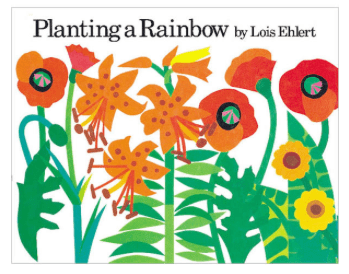
Planting a Rainbow, by Lois Ehlert

This book has bright lively pictures and a simple planting information to help children understand the world of gardening.

Materials

  • Seed catalogs of any kind
  • Silk flowers. If you do not have stems, attach pipe cleaners
  • Small paper plates, one per child
  • Many triangles cut in rainbow colors. They will be the pedals of the flowers
  • Long strips of construction paper about ½ inch wide
  • Large sheet of paper where you have drawn a simple rainbow: using the colors in your color strips.
  • On a large piece of paper draw a red circle, an orange, yellow, green, blue, and purple circle.

Vocabulary

  • Catalog-a directory magazine
  • Soil-dirt
  • Seedlings-baby plants
  • Sow-to plant
  • Petals-a part of the flower on a plant.

Introducing the Story

Show the children the front and back covers of the book.   Tell the children that the title is called, Planting a Rainbow by Lois Ehlert. Ask the children what they think the author meant by planting a rainbow? Ask the children if they have ever helped to plant flowers before? What do they think flowers need to grow? (Dirt, water, and sunshine).

Science/Scientific Knowledge;Expands knowledge of and abilities to observe, describe, and discuss the natural world, materials, living things, and natural processes.

Reading the Story

As you read, stop occasionally on pages and ask the children to name some of the colors that they see. On others, point to a color and name and ask the children if they are wearing that color.

Literacy/Book Knowledge & Appreciation; shows growing interest and involvement in listening to and discussing a variety of fiction, non-fiction, and poetry.

After Reading the Story

Put the sheet of paper on the wall with the colored circles. Ask the children which color flower they would be if they were a flower. Write their name inside the circle. Count how many of each color flower you would have in your garden. Act out the poem, Dig a Little Hole.

Literacy/Print Awareness & Concepts; develops  growing understanding of the different functions of forms of print such as signs, letters, newsletters, lists, messages, and menus.  AND Mathematics/Number & Operations; demonstrates increasing interest and awareness if numbers and counting as a means for solving problems and determining quantity.

Music and Movement

Dig a Little Hole

Dig a little hole and put the seed in.                      Act out digging a hole with your hands.
Cover it with dirt and let the sun shine in.          Pretend to cover the hole and lift arms                                                                                                                         over head.
Add a little water and keep it fed                          Wiggle fingers like rain
Pretty soon a little plant will show it’s head.      Use one arm to grow up towards sky.

 Science/Scientific Knowledge; expands knowledge of and abilities to observe, describe, and discuss the natural world, materials, living things, and natural processes.  AND Creative Arts/Music; participates with increasing interest and enjoyment in a variety of music activities including listening, singing, finger plays, games, and performances.

Discovery

At the easel put out red, yellow, and blue paint and encourage the children to mix the colors as they paint. What colors did you make?

Science/Scientific Skills & Methods; begins to use senses and a variety of tools and simple measuring devices to gather information, investigate materials, and observe processes and relationships.

If you have extra monies to spend, there is a fun science experience using a bag of M&M’s, a plate, and water. Have the children line the edges of the plate with M&M’s. Carefully pour a little water onto the plate so that all the M&M bottoms are standing in it. Then wait. As the color starts to dissolve and run towards the center of the plate, a rainbow will appear.

Science/Scientific Skills & Methods; begins to use senses and a variety of tools and simple measuring devices to gather information, investigate materials, and observe processes and relationships.

Blocks

Let the children use colored blocks today and challenge them to make a flower. How many shapes did they use? What shapes did you use? Show me the stem, the leaves, or the petals.

Mathematics/Geometry & Spatial Sense; progresses in ability to put together and take shapes apart.

Art

Give each child a paper plate and show them how to glue the triangle pedals onto it. When they have dried you can cut out stems and leaves or let the children cut out stems and leaves. These make a cute wall display. As the children are gluing the triangles on, ask them about the colors that they are using. If by chance you have foam squares, the colors are much more vibrant.

Creative Arts/Art; develops growing abilities to plan, work independently, and demonstrates  care and persistence in a variety  of art projects.  AND Approaches to Learning/Engagement & Persistence; grows in abilities to persist in and complete a variety of tasks, activities, experiences, and projects.

Sand and Water

Add dampened sand or dirt to the table and the silk flowers. The children can pretend to plant a garden. Give them spoons or small shovels and watering cans. Do not let them add any more real water or you will have a mess.

Creative Arts/Dramatic Play; shows growing creativity and imagination using materials and in assuming different roles in dramatic play situations.

Library and Writing

Put out colored markers or crayons and encourage the children to draw flowers, around shapes cut from cardboard, or to practice writing their names.

Literacy/Early Writing;experiments with a growing variety of writing tools and materials, such as pencils, crayons, and computers.

Dramatic Play

Take some of the silk/plastic flowers that you have and put them into dramatic play along with a plastic vase (a mayonnaise jar works well). Remind the children that in the story they picked the flowers and took them home. Encourage the children to make a bouquet for the vase. This can then be left on the table for future arranging.

Dramatic Play; shows growing creativity and imagination using materials and in assuming different roles in dramatic play situations.

Math and Manipulatives

Give the children the long strips of construction paper and the large rainbow design. Let the children snip the paper into little squares and glue to the coordinating rainbow arch.

Physical Health & Development/Fine Motor Skills; develops growing strength, dexterity, and control needed to use tools such as scissors, paper punch, stapler, and hammer.

Outdoor Play

If you are working on a school garden, let the children help by watering and /or planting seeds. Remind the children that in the story, the narrator and mother dug holes to plant the bulbs. Give the children shovels or spoons and let them dig holes in the sand or dirt. How big a hole can you dig? Encourage the children to work together to dig a really big hole

Social & Emotional Development/Cooperation;  develops increasing abilities to give and take in interactions; to take turns in games or using materials; and to interact without being overly submissive or directive.

Transitions

Dismiss the children to the next activity by naming colors. Put one of each color strip that you made for manipulatives, or puffballs, under a blanket or into a sack that the children cannot see through. Have a child pick out a strip and name the color.

Social & Emotional Development/Cooperation;  develops increasing abilities to give and take in interactions; to take turns in games or using materials; and to interact without being overly submissive or directive.

Or have the child find something in the room that is that color.

Mathematics/Geometry & Spatial Sense; shows growth in matching, sorting, putting in a series, and regrouping objects according to one or two attributes such as color, shape, or size.