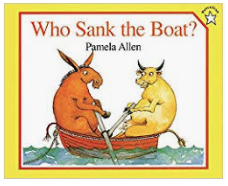
Who Sank the Boat? By, Pamela Allen

Five friends decide to go for a boat ride… This book is a who done it for preschoolers.  Will they be able to figure out who sank the boat? 

Materials

  • Plastic lids of various sizes.
  • A dishwashing tub
  • Naptime mat or blanket
  • Boat picture for writing center
  • Boat picture to cut around for art

Vocabulary

  • Bay (harbor or cove)
  • Tilted (to make the boat angle crookedly)
  • Din (lots of loud noise)
  • Bow (the front of the boat)
  • Flutter (to make the boat go up and down)

Before reading the Story

Show the children the front of the book.  Ask if any have ever been in a boat?  What are these animals not doing for safety?  (Wearing a life preserver).  Talk about what a life preserver does.  Do you ever wear one when you are swimming?  Always wear a life preserver in a boat, it’s the law.

Physical Health & Development/Health Status & Practices; builds awareness and ability to follow basic health and safety rules such as fire safety, traffic and pedestrian safety, and responding appropriately to potentially harmful objects, substances, and activities.

Reading the Story

On the page where the reader is first asked, “Do you know who sank the boat”?  Stop and let the children make a prediction about who they think will sink the boat and why.  Each time the author asks, “Do you know who sank the boat”? stop and let the children change their prediction if they like.

Approaches to Learning/Reasoning & problem Solving; develops increasing abilities to classify, compare, and contrast objects, events, and experiences.

As the different animals are getting into the boat, can the children name the expressions? (fear, nervousness, relief). Can they tell you about a time that they felt these emotions?

Language Development/Speaking & Communicating; develops increasing abilities to understand and use language to communicate information, experiences, ideas, feelings, opinions, needs, questions,; and for other varied purposes.

After Reading the Story

Ask the children to name the 5 animals that were in the boat.  Ask the children if they think just one animal sank the boat, why?  Now ask the children if they noticed what was happening to the boat each time an animal friend got in.  Go back through the pages and show them how the boat is getting lower and lower in the water.  Ask them if they know what is causing the boat to sink?

Science/Scientific Knowledge; shows increased awareness and beginning understanding of changes in materials and cause-effect relationships.

Discovery

Do a float and sink experiment.  Bring a variety of objects from the classroom over to a large tub of water.  Ask the children to predict if it will float or sink.  Can they explain why they think so?

Science/Scientific Skills; begins to participate in simple investigations to test observations, discuss and draw conclusions, and form generalizations.

Music and Movement

Sing Row Row Row Your Boat https://www.youtube.com/watch?v=7otAJa3jui8  After singing it through once or twice, ask the children to get a partner and sit facing each other holding hands. Now sing a verse and have the children rock back and forth. Have the children sit back to back and row the boat. Sit side by side. What other ways can the children think to row the boat with their partner?

Creative Arts/Movement; shows growth in moving to different patterns of beat and rhythm in music.

In the story there were lots of rhymes today.  Who remembers what rhyming words are?  Sing Rhyming Words Sound the Same 

Rhyming words sound the same (clap, clap)

Rhyming words sound the same. (clap, clap)

Rhyming words sound the same (clap, clap)

Rhyming words sound the same. (clap, clap)

Say a word and see if the children can name a rhyming word. Bring in pictures of rhyming words. Put half the rhymes up on a board where everyone can see them and then each time you sing, hold up a picture from the other half of the rhyming words. Can the children see and name the rhyming words?

Literacy/Phonological Awareness; progresses in recognizing matching sounds and rhymes in familiar words, games, songs, stories, and poems.

Blocks

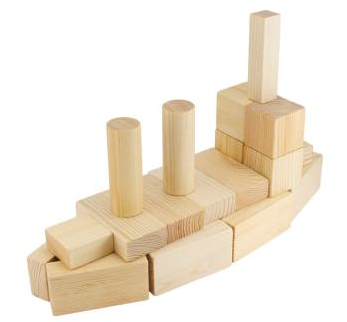
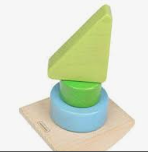
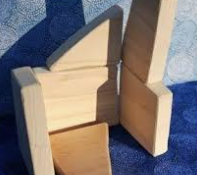
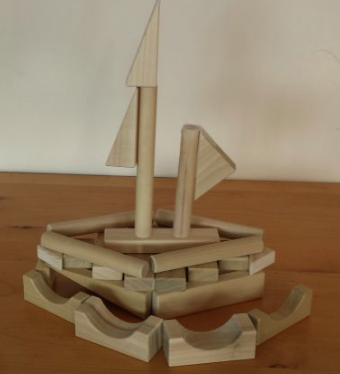
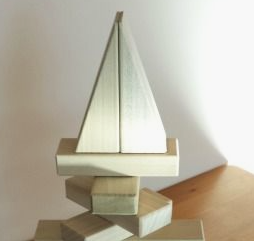
Challenge the children to make boats out of blocks. Print and hang pictures of block boats.  Challenge your children to read the model and make their own boats from blocks.

Approaches to Learning/Engagement & Persistence; grows in ability to persist and complete a variety of tasks, activities, projects, and experiences.

Art

Watercolor paints.  Can you paint a lake?  Give each child a simple boat shape to cut out and glue onto their lake picture when it is dry.

Creative Arts/Art; gains ability in using different art media and materials in a variety of ways for creative expression and representation. AND Physical Health & Development/Fine Motor Skills; develops growing strength, dexterity, and control needed to use tools such as scissors, paper punch, stapler, and hammer.

Cut out various sized squares, rectangles, and triangles from assorted papers.  Encourage the children to put them together to make boats.  Glue to paper.

Approaches to Learning/Engagement & Persistence; demonstrates increasing ability to set goals and develop and follow through on plans. AND Mathematics/Geometry & Spatial Sense; progresses in ability to put together and take apart shapes.

Sand and Water

Add water to the table today along with the counting bears and plastic lids.  Show the children how to float the lid like a boat.  How many counting bears can they get on the boat before it tilts and sinks?

Mathematics/Number & Operations; demonstrates increasing interest and awareness of numbers and counting as a means for solving problems and determining quantity.

Library and Writing

Give the children a copy of the boat picture.  Encourage them to draw friends, either real or imaginary in the boat. Ask them to tell you about their boat and write their words underneath.

Literacy/Early Writing; begins to represent stories and experiences through pictures, dictation, and play.

Dramatic Play

Use a mat or blanket to pretend it is a boat.  Remind the children about water safety, wear a life preserver.  Talk to the children about boat safety.  What were the animals NOT wearing that they should have been?  Life preservers.  Use scarves to be pretend life preservers.  The children can drape them over their shoulders and pretend to be out in a boat. Add fishing poles and a picnic lunch.

Creative Arts/ Dramatic Play; participates in a variety of dramatic play activities that become more extended and complex.

Math and Manipulatives

Today would be a good day to reintroduce your children to the balance scale. Put out a bowl of one inch cubes and a variety of small objects to weigh. How many cubes does a plastic banana weigh? How many cubes does a rock weigh? Can you find something that weighs less than a one inch cube?

Mathematics/Number & Operations; begins to make use of one-to-one correspondence in counting objects and matching groups of objects.

Outdoor Play

If you are doing this unit in the summer, have a water day on the playground!  Set up sprinklers for the children to run through.

Bring your paint outside today.  Hang a large piece of bulletin board paper on the fence today.  Bring out paper plates.  Pour paint onto the plate and use sponge rollers to make a body of water.  When it dries you can use it for the background of the children’s boats made in art.

Creative Arts/Art; gains ability in using different art media and materials in a variety of ways for creative expression and representation.

Transitions

As the children prepare to go to the next activity ask each one to name an object that is heavier than a _____. Also try lighter than a _______, bigger than a ______, smaller, Longer/shorter.

Mathematics/Patterns & Measurement; begins to make comparisons between several objects based on a single attribute.

Resources
Ella Sarah Gets Dressed, by Margaret Chodos-Irvine

                  Ella Sarah knows exactly what she wants to wear and will not be swayed.  This story is a fun addition to a clothing theme as well as shows a little girl who is determined and thus dresses herself.

Materials

  • Sock pattern
  • Sheet
  • Patterned papers (newspaper, wrapping paper, wallpaper samples)

Vocabulary

  • Pattern (something that repeats itself over and over)
  • Polka dots (many small circle shapes on clothing)
  • Striped (many line shapes on clothing)

Before Reading the Story

                  Talk to the children about the clothing that they are wearing.  Make mention of patterns that they may have on (I notice that Kerry has stripes on her shirt).  Explain that the story today is about a little girl who had a favorite outfit that she wanted to wear.  Ask the children if they have a favorite outfit or color that they like to wear. 

Mathematics/Patterns & Measurement; enhances abilities to recognize, duplicate, and extend simple patterns using a variety of materials. AND Social & Emotional Development/Self-Concept; begins to develop and express awareness of self in terms of specific abilities, characteristics, and preferences.

Reading the Story

                  Have children repeat with Ella Sarah,  “I want to wear my pink-polka-dot pants, my dress with orange and green flowers, my purple and blue striped socks, my yellow shoes, and my red hat!”

Literacy/Book Knowledge & Appreciation; shows growing interest and involvement in listening to and discussing a variety of fiction, non-fiction, and poetry.

After Reading the Story

                  Close the book and ask the children to recall what color pants Ella Sarah wanted to wear.  What color was her dress?  What shape was on her dress?  What color were her socks, shoes and hat?  Bring in a sheet and have the children take turns hiding underneath it.  When the child is under the sheet ask the class to remember what color an article of clothing was that that child is wearing.

Literacy/Book Knowledge & Appreciation; demonstrates progress in abilities to retell and dictate stories from books and experiences; to act out stories in dramatic play; and to predict what will happen next in a story. AND Approaches to Learning/Engagement & Persistence; shows growing capacity to maintain concentration over a task, question, set of directions or interactions, despite distractions and interruptions.

Discovery

                  Bring in a book of peoples from around the world.  Look at the pictures with the children and discuss how others dress similar and different from us in the United States.  As you look at the pictures, ask why they think different peoples wear different kinds of clothing.  (Why do you think that man has one those great big boots, look at her hat-what might that tell you about the weather where she lives?)

Science/Scientific Knowledge; develops growing awareness of ideas and language related to attributes of time and temperature.

Music and Movement

                  Sing What Are You Wearing?  This is a Hap Palmer CD and can be seen on YouTube.

Creative Arts/Music; participates with increasing interest and enjoyment in a variety of music activities, including listening, singing, finger plays, games, and performances.

                  Sing Jenny Jenkins.

Will you wear red, my dear my dear?

Will you wear red Jenny Jenkins?

No I won’t wear red, it’s the color of my bed

Roll, Jenny Jenkins, roll!

Will you wear blue…color of my shoe

Will you wear green…it makes me feel mean

Continue naming colors and verse that rhyme.

Literacy/Phonological Awareness;progresses in recognizing matching sounds and rhymes in familiar words, games, songs, stories, and poems.

Blocks

                  Ask the children to see if they can make a pattern using the blocks.

Mathematics/Patterns & Measurement; enhances abilities to recognize, duplicate, and extend simple patterns using a variety of materials.

Art

                  Bring in many patterned pieces of paper cut into shapes.  The children can collage these.

Creative Arts/Art; gains ability in using different art media and materials in a variety of ways for creative expression and representation. AND Mathematics/Patterns & Measurement; enhances abilities to recognize, duplicate, and extend simple patterns using a variety of materials.

Library and Writing

                  Give each child a T-shirt shape and encourage them to make a pattern on it.

Mathematics/Patterns & Measurement; enhances abilities to recognize, duplicate, and extend simple patterns using a variety of materials. AND Approaches to Learning/Engagement & Persistence; grows in abilities to persist in and complete a variety of tasks and activities.

Sand and Water

Child choice today.

Math and Manipulatives

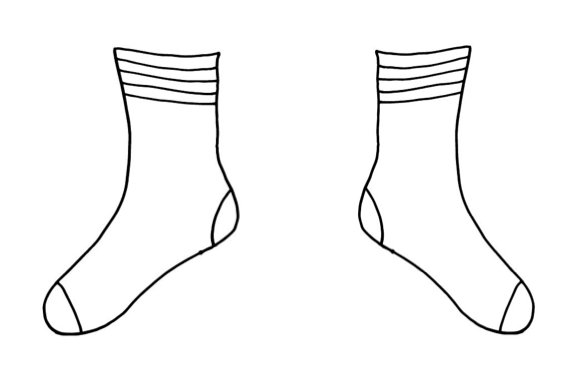
                  Make two sets of the sock patterns and color them the same to make matching sets.  Cut them out and cover with contact paper.  Put the socks into a bowl and mix them up.  The children can then sort and match the socks.

Mathematics/Patterns & Measurement; enhances abilities to recognize, duplicate, and extend simple patterns using a variety of materials.

Dramatic Play

                  Make sure you have lots of fun and colorful dress-ups for the children to use.  This would be a good day to bring in some new stuff to really catch their interest.

Physical Health & Development/Fine Motor Skills; develops growing strength, dexterity, and control needed to use tools such as scissors, paper punch, stapler, hammer.

Outdoor Play

                  In the story, Ella Sarah and her friends had a tea party.  Encourage the children to make sand or dirt cakes so they too may have a tea party.

Creative Arts/Dramatic Play; shows growing creativity and imagination in using materials and in assuming different roles in dramatic play situations. AND Social & Emotional Development/Cooperation; develops increasing abilities to give and take in interactions, to take turns in games and in using materials; and to interact without being overly submissive or directive.

Transitions

                  Excuse the children to the next activity by articles of clothing that they are wearing. (If you are wearing stripes, if you are wearing short sleeves, if you have a snap on your clothing).

Language Development/Listening & Understanding; shows progress in understanding and following simple and multi-step directions.

Resources

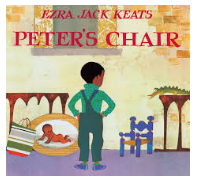
Peter’s Chair, by Ezra Jack Keats

This simply told story clearly lets the reader know how Peter feels about having a new sister in the house.

Materials

  • Laundry basket or box big enough for child to sit in.
  • Bear Counter Card

Vocabulary

  • Fussing (trying to make it perfect and pretty)
  • Cradle (A small bed for a baby)
  • Rascal (trickster)
  • Jealous (envious, feeling like things are not fair)

Before Reading the Story

Have all the children stand on one side of your carpet area. Ask them, “Who has a baby sister at home?” Have those children move to the other side of the carpet. Count them and write on a piece of paper ‘Baby Sister’ and the amount. Have the children move back to the original side of the carpet and do the same thing asking about a baby brother, a big sister, and then a big brother. Talk about which count had the most and the least.

Mathematics/Number & Operations; begins to associate number concepts, vocabulary, quantities, and written numerals in meaningful ways.

Reading the Story

In the story Peter is jealous and angry, use your voice to make this emotion heard. When you get to the part where it says, “But he couldn’t fit in the chair”. Stop and ask the children why they think he cannot fit (He was too big). When you read the last line of the story, ask the children how they think Peter was feeling throughout the story. (He was mad. He didn’t like his sister. He was sad). Then ask them how they think Peter felt at the end of the story. (He was gonna help his Daddy. He felt better cause he shared).

Approaches to Learning/Reasoning & Problem Solving; develops increasing abilities to classify, compare, and contrast objects, events, and experiences.  

After Reading the Story

Ask the children who have younger siblings if they ever felt jealous? Give the children a chance to share about their own families and how the members interact with each other. (My brother always takes things away from me. My baby bit me on the arm and I cried! My little brother he wakes up at night and cries so my Mommy comes and gets him).

Social & Emotional Development/Knowledge of Families & Communities; develops ability to identify personal characteristics, including gender and family composition. AND Language Development/Speaking & Communicating; develops increasing abilities to understand and use language to communicate information, experiences, ideas, feelings, opinions, needs, questions, and for other varied purposes.

Discovery

Explain to the children that red and white paint mixed together makes pink paint. Let them combine the two colors together in a paint cup until they have made a shade of pink that they like. Now put at the easel a small amount of blue and yellow paint that they can experiment mixing with their pink paint on the easel paper. The blue and yellow will change the color to more shades of peach and magenta.

Science/Scientific Skills & Methods; begins to participate in simple investigations to test observations, discuss and draw conclusions and comparisons among objects and materials.

Music & Movement

Sing or say the poem, When I Was One Years Old.

When I was one years old, I was very, very small.                           Crouch down small

But now I’m _______ years old, and I’ve grown up big and tall!    Begin to stand with hands raised

Social & Emotional Development/Self-Concept; begins to develop and express awareness of self in terms of specific abilities, characteristics, and preferences.

Say the following poem, Up and Down, slowly as the children bend over lower and lower each time.

Up and down, up and down,

We’re bending over, up, and down.

Up and down, a little bit more,

See if you can touch the floor!

As the children get the hang of bending up and down with the poem, change the rhythm to a quicker and slower pace.

Creative Arts/ Movement; shows growth in moving in time to different patterns of beat and rhythm in music.

Growing Up

When I was just a baby, I didn’t know how to walk.  

I could only crawl like this.                                                         Children crawl around.

When I was just a baby, I didn’t know how to sit.

I could only sit like this.                                                               Child holds knees and rolls to side.

Now I’m big like this                                                                     Child holds hands over head.

And I can walk, and sit, and play.  I can do so many things at school each day!

Social & Emotional Development/Self-Concept; begins to develop and express awareness of self in terms of specific abilities, characteristics, and preferences.

Blocks

Put out any dollhouse supplies that you have, or let the children try to build furniture out of small blocks. Encourage them to build a little chair for the child and a bigger chair for the adult figures.

Mathematics/Geometry & Spatial Sense; begins to determine whether or not two shapes are the same size and shape.

Art

Put out play dough or clay today. Encourage the child to make a ball. Now ask them to make a bigger ball, a smaller ball. Ask them to roll out a snake shape. Can they roll out a longer snake, a shorter snake? Ask them to pound the play dough into a flat pancake, can they make a bigger pancake, a smaller pancake? If you have people cookie cutters let them make people, or encourage them to construct their own people. Can they make taller and shorter people?

Mathematics/Patterns & Measurement; begins to make comparisons between several objects based on a single attribute.

Sand and Water

Put dry sand into the sensory table today along with capital and small letters. Explain to the children that the capital letters are the adults and the small letters are the children. Ask them to see if they can find the pairs that go together. For children who are not experienced with letter knowledge, trace around the letters onto a piece of poster board so as the children find the letters, they can put them onto the poster board. Trace Aa with a space between Bb, etc through to Zz.

Literacy/Alphabet Knowledge; knows that letters of the alphabet are a special category of visual graphics that can be individually named.

Library and Writing

Put out markers today and have the children draw pictures of their families. After they have finished their drawing, help them to label all their family members. Ask them to talk about who is older and younger than them. (This is my sister, she is big. My family gots lots of people, I’m the big brother).

Creative Arts/Art; progresses in abilities to create drawings, paintings, models, and other art creations that are more detailed, creative, and realistic. AND Social & Emotional Development/Knowledge of Families & Communities; develops ability to identify personal characteristics, including gender and family composition.

Dramatic Play

Put a laundry basket or box into the center and let the children take turns being the baby. Ask the other children what they need to do to take care of the baby?

Creative Arts/Dramatic PLay; shows growing creativity and imagination in using materials and in assuming different roles in dramatic play situations. AND Social & Emotional Development/Cooperation; develops increasing abilities to give and take in interactions; to take turns in games and using materials; and to interact without being overly submissive or directive.

Math and Manipulatives

If you have family puzzles, put them out today.

Physical Health & Development/Fine Motor Skills; grows in hand-eye coordination in building with blocks, putting together puzzles, reproducing shapes and patterns, stringing beads, and using scissors.

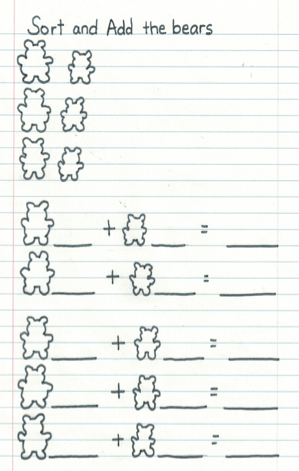
Put out your Bear Counters and counter card. If you do not have Bear Counters, put out any type of counters that you have which comes in a large and small size.

Mathematics/Number & Operations; develops increased abilities to combine , separate, and name”how many” concrete objects.

Outdoor Play

If it is a sunny day, play with the children’s shadows. Can the find their shadow? Can they make it longer and shorter?

Science/Scientific Skills & Methods; begins to participate in simple investigations to test observations, discuss and draw conclusions, and form generalizations.

Transitions

Ask the children to name something they can do today that they could not do when they were little. Write their responses onto a piece of paper to hang on the wall. (Alison can ride her bike, Ryan used to use a bottle but now he can use a water jug, Lee can eat candy cause he has teeth).

Social & Emotional Development/Self-Concept; begins to develop and express awareness of self in terms of specific abilities, characteristics, and preferences

Dear Parent- Today we read a story about a child who was jealous of his baby brother. If your family has a baby in the house, your preschooler may experience jealousy. Jealousy is normal and you can help alleviate some by taking time to talk and be with your preschool child, let him know how special he is and how you appreciate when he helps take care of the baby. Make sure to spend some alone time with your preschool child, reading books is a wonderful one-on-one.

Resources