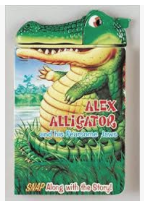
Alex Alligator and his Fearsome Jaws, by Paul Flemming

Alex alligator does not understand why no one wants to be his friend. This book is a good book to talk about bullying behaviors and also teeth! Children like this story because the alligator snaps.

Materials

Alligator mouth for game

Example of A for alligator drawing, B for butterfly, A for ice cream cone****

Several toothbrushes for painting.

Vocabulary

Fearsome (terrifying or frightening)

Handsome (good looking)

Before Reading the Story

Tell the children that each of us is very special and each has a feature/something special they should be proud of themselves for/about. Give the children an example about yourself ( I like that my legs are strong so I am a good runner, I like that my hair is long so it moves in the wind, I like that my eyes are green like my cats). Let the children name some things that they like about themselves. Introduce the story by showing the children the cover. Tell them that this is Alex Alligator and he is proud about something too. Can anybody guess? He is proud of his fearsome jaw and many teeth. Ask, What do you think will happen if he shows all those teeth to the other animals?

Social & Emotional Development/Self-Concept;begins to develop and express awareness of self in terms of specific abilities, characteristics, and preferences.  AND Literacy/Book Knowledge & Appreciation; demonstrates progress in abilities to retell nad dictate stories from books and experiences; to act out stories in dramatic play; amd to predict what will happen next in a story.

Reading the Story

Use the snapper that the story provides and show the children how to make an alligator using their hand in an open/closed fashion. Have them snap along with the story.

Language Development/Listening & Understanding; demonstrates increasing ability to attend to and understand conversations, stories, songs, and poems.

After Reading the Story

Ask, why were all the animals afraid of Alex alligator? (He had mean teeth, they thought he was gonna eat them, he’s an alligator). Explain to the children that sometimes people do not know that they are doing things that make other people afraid of them or not want to play with them. Give some examples, minus names, of things that you have seen in your classroom. (Yesterday I saw one of my friends go into the block center and another child snapped at him, You can’t play here! This morning I saw one of my friends ask if she could have the glue and another child just pretended that she was not even there). How does it make you feel when people treat you badly or snap at you (sad, scared, mad). Let’s practice some better ways to talk to people. Tell the children that you are going to play a friend game. Go around the circle and ask the children questions about being friends. (Kerry what would you do if I asked you for the scissors but you were still using them? What could you say if a friend was watching you build with legos? What should you say if a friend pushes you when we are lining up to go outside?). Think of times in your own room where you see situations arise. If necessary help the children by talking through appropriate responses.

Social & Emotional Development/Social relationships; progresses in responding sympathetically to peers who are in need, upset, hurt, or angry; and in expressing empathy or caring for others.

Discovery

Bring in any real teeth that you might have for the children to look at with a magnifying glass. If you have no real teeth, bring in a book of animals that shows their teeth. (Ask your Dentist for any of your old x-rays)

Science/Scientific Skills & Methods; begins to use senses and a variety of tools and simple measuring devices to gather information, investigate materials, and observe processes and relationships.

Music and Movement

Do the movement rhyme, Here Comes Hungry Alligator by Lori Van Winden

Here comes hungry alligator       

(Put one hand on top of the other and sway back & forth )

He goes chomp, chomp, chomp    

(Open and close hands)

In the swamp, swamp, swamp.

So swim fast little fish                     

(Use one hand to make a fish swimming)

Birds, fly away!                                 

(Raise arms and flap)

Move along turtles and crabs        

(wiggle fingers)

Hurry out of the way!

Because here comes the hungry  Alligator   

(Put one hand on top of the other and sway back & forth.)

Going chomp, chomp, chomp       

(Open and close hands)

In the swamp, swamp, swamp.

Creative Arts/Music; participates with increasing interest and enjoyment in a variety of music activities, including listening, singing, finger plays, games, and performances.

Blocks

Challenge the children to make a path using blocks from one side of the center to the other.  Can they walk across without falling off?  Can they walk it backwards?  When finished the path may look thin like a balance beam or wider like a sidewalk.

Mathematics/Patterns & Measurement; shows progress in using standard and non-standard measures for length and area of objects.  AND Physical Health & Development/Gross Motor Skills; shows increasing levels of proficiency, control, and balance in walking, climbing, running, jumping, hopping, skipping, marching, and galloping.

Art

Give the children pieces of yellow paper that has been cut into a large tooth shape. Put out bowls of white paint and toothbrushes. The children can brush the teeth to a pearly white.  While they work, talk to them about dental hygiene and allow them to share their toothbrushing experiences.

Creative Arts/Art; begins to understand and share opinions about artistic products and experiences.

Library and Writing

Show the children how to make a capital A on a piece of paper. Now turn it on its side and draw an alligator head! The children can add teeth and an eye. Try doing lots of different letters, what shapes can they make?

Literacy/Alphabet Knowledge; shows progress in associating the names of letters with their shapes and sounds.

Sand and Water

Water play. Add long rectangle blocks to pretend to be alligators.

Creative Arts/Dramatic Play; shows growing creativity and imagination in using materials and in assuming different roles in dramatic play situations.

Dramatic Play

While brushing your teeth today, pretend that you are alligators. Brush all your handsome teeth and when you are through, smile a toothy grin and then chomp, chomp, chomp just for fun.

Physical Health & Development/Health Status & Practices; shows growing independence in hygiene nutrition, and personal care when eating , dressing, washing hands, brushing teeth, and toileting.

Math and Manipulatives

Play, The Alligator’s Fearsome Teeth. Make 4 copies of the alligator mouth. Cover them with contact paper. Show the children how to roll tiny balls of play dough to represent the teeth. Now you are ready to begin the game. The children take turns rolling the dice. They may then add that many teeth to their alligator. The winner is the first to fill the alligator’s mouth with fearsome teeth.

Mathematics/Numbers & operations; begins to associate number concepts, vocabulary, quantities, and written numerals in meaningful ways.

Outdoor Play

Use a balance beam and practice walking the plank.  My class liked to use the edge of the sandbox as the balance beam.  They often played that if they fell off into the sandbox that there was an alligator or shark ready to eat them.  Encourage them to try walking forward, backward, and sliding along the beam.

Physical Health & Development/Gross Motor Skills; shows increasing levels of proficiency, control, and balance in walking, climbing, running, jumping, hopping, skipping, marching, and galloping.

Transitions

As the children go to the next activity ask them to answer a question about teeth and dental care. (What kind of doctor takes care of your teeth? When should you brush your teeth? What will happen if you do not brush your teeth? Is drinking soda pop healthy for your teeth? Is it ok to try to open things with your teeth? Why not?).

Physical Health & Development/Health Status & Practices; builds awareness and ability to follow basic health and safety rules such as  fire safety, traffic and pedestrian safety , and responding appropriately to potentially harmful objects, substances, and activities.

Dear Parent- today we talked about the importance of brushing our teeth.  Children should brush their teeth every day.  Watch your child to make sure that he/she is brushing up and down as well as back and forth.

Resources

Screen Shot 2018-09-15 at 7.00.35 PM
Screen Shot 2018-09-15 at 7.03.09 PM

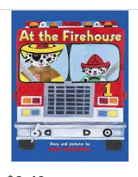
At the Firehouse, Anne Rockwell

This book introduces the children to what happens at a firehouse. It would be a good book to read before taking a field trip to the firehouse.

Materials

  •   Small syringes or spray bottles

Vocabulary

  •  Shiny (all bright and polished clean)
  • Glow in the dark
  • Extension ladder (something that gets longer and longer)
  • Exit (this way out/in case of a fire)

Before Reading the Story

Bring in a smoke detector and talk to the children about what it is and how it keeps us safe. Turn it on so they can hear the loud piercing sound. Talk about what they should do if they ever hear this sound at school or in their home.

Physical Health & Development/Health Status & Practices; builds awareness and ability to follow basic health and safety rules such as fire safety, traffic and pedestrian safety, and responding appropriately to potentially harmful objects, substances, and activities.

Reading the Story

Stop on the page that shows all the parts of a fire truck for a few moments and talk with the children about what the part is called and how it might be used.

Social & Emotional Development/Knowledge of Families & Communities; develops growing awareness of jobs and what is required to perform them.  AND Language Development/Speaking & Communicating; uses an increasingly complex and varied spoken vocabulary.

After Reading the Story

Have a pretend fire drill with your class. Do the children know where to go, what to do or not do when they hear the alarm? Do they know to walk versus run to the exit?

Physical Health & Development/Health Status & Practices; builds awareness and ability to follow basic health and safety rules such as fire safety, traffic and pedestrian safety, and responding appropriately to potentially harmful objects, substances, and activities.

Discovery

Bring in a smoke detector and show it to the children. Have the children cover their ears and then turn it on so they can hear the shrill sound. Talk about the sound that the smoke detector makes. Do you think you could hear it if you were sleeping? Talk about the fire alarm at your school. What do you do in case the alarm goes off at school? Practice having a fire evacuation with the children making sure to tell them what is going to happen before it happens so that they are prepared and will not become frightened.

Physical Health & Development/Health Status & Practices; builds awareness and ability to follow basic health and safety rules such as fire safety, traffic and pedestrian safety, and responding appropriately to potentially harmful objects, substances, and activities.

Music and Movement

Use masking tape to put a ladder design down on the floor. The children can use this for jumping or walking the lines.

Physical Health & Development/Gross Motor Skills; shows increasing levels of proficiency, control, and balance walking, climbing, running, jumping, hopping, skipping, marching, and galloping.

Sing Stop, Drop, and Roll to The Farmer in the Dell https://www.youtube.com/watch?v=1c0srtQUZtE

Stop, drop, and roll
If my clothes are on fire
I stop, drop, and roll.

Creative Arts/Music; participates with increasing interest and enjoyment in a variety of music activities, including listening, singing, finger plays, games, and performances.

Blocks

Add any fire trucks that you may have to the center. If you have none, draw a simple fire truck like that in the story and tape it to the side of the blocks. Encourage the children to be firemen and save the burning building.

Creative Arts/Dramatic Play; shows growing creativity and imagination in using materials and in assuming different roles in dramatic play situations.  AND Social & Emotional Development/Cooperation; increases abilities to sustain interactions with peers by helping, sharing, and discussion.

Art

Put out red, orange and yellow finger paint. Show the children how to make zig zags like fire flames. Also practice making circles and wavy lines.

Creative Arts/Art; progresses in abilities to create drawings, paintings, models, and other art creations that are more detailed, realistic, and creative.

Sand and Water

Fire persons use lots of water. Put out water today with small syringes and/or spray bottles. The children can practice putting out fires. Give them bowls to aim their spray at, or make bulls eyes using cardboard and markers so that when they hit the mark, the color bleeds.

Physical Health & Development/Fine Motor Skills; develops growing strength, dexterity, and control needed to use tools such as scissors, paper punch, stapler, and hammer.

Library and Writing

Put the book on the writing table and the children can try to draw their own fire trucks using the design on the balloons in the story. Take a moment and discuss and name all the parts of the fire truck.

Literacy/Early Writing; begins to represent stories and experiences through pictures, dictation, and in play.

Make EXIT signs that resemble those in your classroom. Ask the children to show you where the signs are, in the room and then practice writing the letters on a piece of paper.

Literacy/Early Writing; progresses from using scribbles, shapes, or pictures to represent ideas, to using letter-like symbols, to copying or writing familiar words such as their own name.

Dramatic play

Add some fire hats, jackets, and boxes to the center so the children can drive their own fire truck. If this is an extended unit they can take the box outside and paint it red.

Approaches to Learning/Initiative & Curiosity; approaches tasks and activities with increased flexibility, imagination, and inventiveness.

Math and Manipulatives

Bring in a play phone and have the children take turns practicing dialing 911.

Mathematics/Number & Operation; begins to associate number concepts, vocabulary, quantities, and writen numerals in meaningful ways.

Outdoor Play

Have a tricycle wash today or a chair wash to make them nice and shiny.

Social & Emotional Development/Cooperation; increases abilities to sustain interactions with peers by helping, sharing, and discussion.

Transitions

As the children prepare to go to the next center say, “My Firefighter Friend hold up a card with a child’s name written on it may go and fight a fire. Continue until all the children’s names have been held up.

Literacy/Alphabet Knowledge; identifies at least 10 letters of the alphabet, especially those in their own name.

Dear Parent-

            Today we talked about fire safety. Have you made an evacuation plan for your family in case of a fire or emergency? Find a spot away from the house to meet and practice getting there safely with your child.

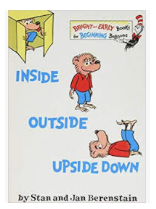
The Berenstain Bears Inside, Outside, Upside Down by Stan & Jan Berenstain

This silly book has few words but wonderful descriptions of inside and outside, as well as upside down.

Materials

  • Boxes big enough for the children to climb inside of.  (Ask your cook to save boxes that the schools food is delivered in).
  • A tumble mat or large pillow
  • Roll of masking tape
  • Hoola Hoop
  • 3-5 bean bags
  • One smaller box with a school object inside
  • A tray of ice cubes and a glass

Vocabulary

Before Reading the Story

Before the children arrive, put one favorite school toy in a box  and seal it shut.  Bring it to the group area and tell the children that you have put something inside the box.  Let the children take turns asking a question and then guessing what it might be.  If your children are unable to ask questions, give them clues.  Pass the box around and let the children shake it.  Tell them that it might be something that they would see in a particular center.  Tell them what color it is or what material it is made out of.  The idea is for the children to be able to guess from clues that you have given or questions that they have asked.

Approaches to Learning/Reasoning & Problem Solving; develops increasing abilities to classify, compare, and contrast objects, events, and experiences.  AND Language Development/Speaking & Communicating; develops increasing abilities to understand and use language to communicate information, experiences, ideas, feelings, opinions, needs, questions, and for other varied purposes.

Reading the Story

This is a super short story.  Read it to the children and then go back and help the children read it to you.

Literacy/Book Knowledge & Appreciation; demonstrates progress in abilities to retell and dictate stories from books and experiences: to act out stories in dramatic play; and to predict what will happen next in a story.

 After Reading the Story

Bring a doll or stuffed animal to the group area.  Using the box from Before Reading the Story, have the first child put the doll inside the box.  Have the next child put the doll outside the box.  The next child puts the doll upside down.  Continue like this until everyone has had a turn.

Language Development/Listening & Understanding; shows progress in understanding and following simple and multiple-step directions.

 Discovery

Tell the children that you are going to try a watching experiment.  Fill the glass with the ice cubes and then add water to the top.  Put the glass out where it is visible to the children.  Every few minutes, go and examine the glass, do you see any changes?  (The glass should begin to sweat and the water drip out as the ice cubes begin to melt).   Encourage the children to tell you what they see happening.

Science/Scientific Skills & Methods; begins to use senses and a variety of tools and simple measuring devices to gather information, investigate materials, and observe processes and relationships.

Music and Movement

Encourage the children to take turns practicing somersaults.  Help them by telling them to put their hands next to their feet and to tuck in their chin.  Some children may need a gentle push from an adult to help them get over.

Physical Health & Development/Health Status & Practices; progresses in physical growth, strength, stamina, and flexibility.

Play In The Pond.  Mark a large area on the floor to be the pond (or use your group rug as the pond if there is room to stand beside it.  Tell the children that when you say “In the pond”, everyone is to jump into the large marked off area.  When you say,”Out of the pond”, everyone is to jump out of the marked area.  Start by slowly saying in the pond, out of the pond.  Try calling faster or saying in the pond two and three times in a row before saying out of the pond.

Language Development/Listening & Understanding; shows progress in understanding and following simple and multiple-step directions.

Do The Hokey Pokey with the children.  https://www.youtube.com/watch?v=g11SI1nUcf8

You put your foot in, you put your foot out                                                                You put your foot in and you shake it all about.                                                        You do the hokey pokey and you turn yourself around                                            That’s what it’s all about!                                                                                                    Move up your body doing knees, hips, etc.  Do your whole body last.

Language Development/Listening & Understanding; understands an increasingly complex and varied vocabulary.  

Blocks

Ask the children to build structures and then put manipulatives inside and outside their structure.  Manipulatives may include people, animals, or small cars.

Language Development/Listening & Understanding; understands an increasingly complex and varied vocabulary.  

 Art

Give each child a piece of white construction paper.  Help them take strips of masking tape and tape from one side of the paper to the other.  Give each child 3-6 strips of masking tape.  Put out small containers of colored paint.  Encourage the children to paint inside each shape made by the masking tape a different color.  When the paint has dried, carefully pull the masking tape of f the paper.  The result will be a stain glass type look with white between each color.

Language Development/Listening & Understanding; shows progress in understanding and following simple and multiple-step directions.  AND Creative Arts/Art; develops growing abilities to plan, work independently, and demonstrate persistence in a variety of art projects.

Sand and Water

Fill the table up with water today and add a variety of containers.  Challenge the children to see which container holds the most water.  Show the children how to scoop with a measuring cup and count how many scoops it takes to fill a container.  Can they guess which will hold the most water?

Mathematics/Number & Operations; develops increasing ability to count in sequence to 10 and beyond AND Mathematics/Number & Operations; begins to use language to compare numbers of objects with terms such as more, less, greater than, fewer, equal to.  AND Science/Scientific Skills & Knowledge; begins to describe and discuss predictions, explanations, and generalizations based on past experiences.

 Library and Writing

Give each child a piece of drawing paper that has a line drawn down the middle.  Challenge the children to draw a picture of something that they like to do inside on one half and outside on the other.  Write a their responses on the bottom of each half.

Literacy/Early Writing; begins to represent stories and experiences through pictures, dictation, and in play.

Dramatic Play

Suggest to the children that they play that they are going to town.  What do they need to take with them? (purse, money, dressing up, food basket, car keys).  Let them bring chairs into the center to make a car or truck to drive to town.

Literacy/Book Knowledge & Appreciation; demonstrates progress in abilities to retell and dictate stories from books and experiences: to act out stories in dramatic play; and to predict what will happen next in a story.

 Math and Manipulatives

Place a hoola hoop on the floor (or make a masking tape square).  Put a line back about 6 feet from the hoola hoop/square.  Give a child 3-5 bean bags and ask them to see if they can throw them into the hoola hoop/square.  After they have thrown their bean bags, have the child count how many are in the hoola hoop/ square and how many are outside.  Have them hand the bean bags off to the next child.  Older children can be encouraged to try to draw their results on a piece of paper.

Mathematics/Number & Operations; begins to make use of one-to-one correspondence in counting objects and matching groups of objects.

 Outdoor Play

Bring out any boxes that you have been able to collect and allow the children to play inside and outside of them.  Can they turn themselves upside down?

Social & Emotional Development/Cooperation; shows increasing abilities to use compromise and discussion in working, playing, and resolving conflicts with peers.

 Transitions

Use one of your boxes and ask each child to find something of a particular color to put inside the box.  (Aubrey can you find something red to put into the box, Alison can you find something green).  For children who are just learning their colors you can give them a small piece of colored paper or a crayon in the color that you would like them to find.

Language Development/Listening & Understanding; shows progress in understanding and following simple and multiple-step directions.   AND Mathematics/Geometry & Spatial Sense; shows growth in matching, sorting, putting in a series, and regrouping objects according to one or two attributes such as color, shape, or size.

Dear Parent- today we read a book about inside, outside, and upside down.  Ask your child to show you what inside looks like using a closet or bedroom.  (Can you put yourself inside the closet?)   Ask your child to show you what outside and upside down look like also.