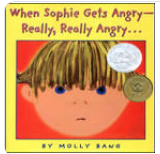
When Sophie Gets Angry- Really, Really Angry, Molly Bang

Sometimes we all get really, really angry. This book shows how one person defuses with all those angry feelings in a positive way.

Materials

  • Blank head with ‘I get angry when ____’
  • Vinegar
  • Baking soda

Vocabulary

  • Smithereens (lots of little pieces)
  • Angry (when you feel really mad inside)
  • Explode (to get really, really angry)
  • Volcano (a mountain that spits out the earth’s innards)

Introducing the Story

Ask the children how you can tell if someone is angry? Ask them to show you what angry looks like. Help the children to notice anger does not only show in the face but the whole body. Tell them that you are going to act out some emotions and see if the children can guess from your body language and facial expression. Let the children try mimicking you.

Social & Emotional Development/Social Relationships; progresses in responding sympathetically to peers who are in need, upset, hurt, or angry; and in expressing empathy or caring to others.  

Reading the Story

Tell the children that the story today is about a girl named Sophie. Hold up the cover of the book. How do you think Sophie is feeling? What are some things that make you feel this way? Introduce the book. 

Social & Emotional Development/Self-Concept; begins to develop and express awareness of self in terms of specific abilities, characteristics, and preferences.  AND Language Development/Speaking & Communicating; develops increasing abilities to understand and use language to communicate information, experiences, ideas, feelings, opinions, needs, questions; and for varies other purposes.

After Reading the Story

Talk with the children about what to do when they become angry with a friend at school? (We count to 3. Say give it back, we can tell the teacher, I say you are not my friend anymore). It’s ok to feel angry but it’s not ok to hurt people. What is your classroom protocol? (i.e.; Stop, count to 10. Say what is wrong. Tell what you want).   Talk with the children about how you would like to see them handle problems. Have the children help act out how your classroom would ideally handle problems.

Social & Emotional Development/Self-Control; shows progress in expressing feelings, needs, and opinions in difficult situations and conflicts without harming themselves, others, or property.

Music and Movement

Sing; If You Are Happy and You Know It. https://www.youtube.com/watch?v=13wd8KvOt58 Make up verses that sing about different emotions. Encourage the children to make the facial expressions accordingly. (If you’re angry and you know it stomp your fist, If you’re sad and you know it wipe your tears).

Language Development/Speaking & Communicating; develops increasing abilities to understand and use language to communicate information, experiences, ideas, feelings, opinions, needs, questions; and for varies other purposes.

Play Bruno Mars Happy https://www.youtube.com/watch?v=MOWDb2TBYDg song and dance!

Creative Arts/Movement; expresses through movement and dancing what is felt and heard in various musical tempos and styles.

Give the children cues on how to move. If they can think of no movements, demonstrate for them to follow. Suggest that they move like; they are really, really angry, move like you are scared of something, move like you are so excited because you just got a present you always wanted, move like you are sleepy and can hardly stay awake.

Language Development/Listening & Understanding; shows progress in understanding and following simple and multiple-step directions.

Discovery

Make a volcano. As you are making your volcano, ask the children if they can remember what happened to Sophie when she exploded.  Ask them if they can guess, hypothesis, what will happen when you mix the volcano ingredients in the soda bottle.  Take the children out on the playground and have them help you big a giant sand mountain. Put a soda bottle into the center of the volcano with the top exposed. Fill the soda bottle up ¾ with warm water. Add 2 tablespoons of baking soda. Fill the rest of the bottle with vinegar. Step back and count down for the eruption!

Science/Scientific Knowledge; shows increased awareness and beginning understanding of changes in materials and cause-effect relationships.

Blocks

Today would be a good day to allow the children to build with blocks and then knock them down.  If you have foam or cardboard blocks, encourage the children to build as tall as they like and then knock down only their structure.  If you have only wooden blocks, you will need to set up very specific ground rules such as you can build no higher than your waist and must take turns knocking the structure down when your friends are cleared from being hit by falling blocks.

Social & Emotional Development/Self-Control; demonstrates increasing capacity to follow rules and routines and use materials purposefully, safely, and respectfully.  AND Health & Physical Development/Fine Motor Skills; grows in eye-hand coordination in building with blocks, putting together puzzles, reproducing patterns and shapes, stringing beads, and using scissors.

Art

Make trees. Cut out tree trunks and let the children glue them to a sheet of paper. Put out strips of colored paper ½ inch wide by the length of the construction paper. The children can take scissors and snip the strips and then glue the snips to the tree for leaves.

Health & Physical Development/Fine Motor Skills; grows in eye-hand coordination in building with blocks, putting together puzzles, reproducing patterns and shapes, stringing beads, and using scissors.

Sand and Water

Water play can be very soothing for children. Put out water today and let the children scoop and pour.

Social & Emotional Development/Cooperation; increases abilities to sustain interactions with peers by helping, sharing, and discussion.

Library and Writing

Give each child a paper with a blank head on it. Ask the child to draw what angry looks like. Let the child share ideas of what makes him/her angry and write it underneath their angry face.

Literacy/Early Writing; begins to represent stories and experiences through pictures, dictations, and in play.

Dramatic Play

Encourage the children to play house and work together so no one gets their feelings hurt and everyone feels welcomed.

Social & Emotional Development/Social Relationships; Shows progress in developing friendships with peers.  

Math and Manipulaties

Any puzzles that you have that show emotion. As the children put the puzzles together talk about the people’s expressions. Can you tell how they feel? What makes you feel that way? If you do not have puzzles, you can still let the children do puzzles today and you observe their body language as they put the puzzles together. Comment on their emotions. (Ryan, you look frustrated, would you like some help? Alison, you finished that puzzle all by yourself, you must feel proud. Roger, you have done that puzzle three times now, you must be feeling confident).

Approaches to Learning/Engagement & Persistence; grows in abilities to persist in and complete a variety of task, activities, projects, and experiences.

Outdoor Play

Run, run, run, run, and run. Then sit down and relax and enjoy the nature your playground provides.  While they are sitting and cooling down, make an awareness of how their breathing and heartbeat have changed.  Remind them that it is important to work their heart muscle everyday.

Physical Health & Development/Gross Motor Skills; shows increasing levels of proficiency, control, and balance in walking, climbing, running, jumping, hopping, skipping, marching, and galloping.  AND Science/Scientific Knowledge; expands knowledge of and respect for their bodies and the environment.

Transitions

In the story, Sophie lets out a “red, red, roar!”. Let each child let out a red, red roar as they go to the next activity.

Language Development/Listening & Understanding; understands an increasingly complex and varied vocabulary.

Dear Parents, today we read a story about a little girl who gets very angry. We then talked about ways to defuse anger. Ask your child if they can think of ways that they can defuse anger at home. Encourage them to think of multiple solutions. Then ask them which one they would like to try next time they get really, really angry.

Resources

Green Eggs and Ham, by Dr. Seuss

            When Sam-I-Am tries to get the old grouchy dog (?) to try his green eggs and ham, the grouch says absolutely not.  Sam-I-Am tries to get the grouch to try them in a variety of settings.  Will the grouch finally try green eggs and ham?  Will the grouch ever like green eggs and ham?

Materials

  •   Ingredients for an egg dish
  •  Rhyming word cards from story
  •  Food pictures or magazines with pictures of food
  • Green food coloring

Vocabulary

  • Grouchy (someone in a bad mood)

Before Reading Story

            Show the children the front of the book.  Ask them if they can tell what is on the plate?  Ask them if the dog looks like he likes what’s on the plate? Ask the children if there are any foods that they do not like? Now ask them if there are any foods that they like very much? Give the children a minute to talk about likes and dislikes and then remind them that sometimes you have to try something new before you decide you do not like it. And sometimes you might think you do not like a food but then you try just a tiny bit and realize that you really do like it!

Language Development/Speaking & Communicating; develops increasing abilities to understand and use language to communicate information, experiences, ideas, feelings, opinions, needs, questions,; and for other varied purposes. 

Reading the Story

            Practice ahead of time so that you can read all the rhymes smoothly.

Literacy/Phonological Awareness; progresses in recognizing matching sounds and rhymes in familiar words, games, songs, stories, and poems.

After Reading the Story

            Ask the children why the dog was so grouchy?  (Sam-I-Am kept making him try the eggs).  Ask the children why Sam-I-Am kept bothering the dog? (he wanted him to try the food).   What happened when the dog finally tried the new food? (He liked it).  Ask the children if they ever had an experience like this where they finally tried something and found out it was good. 

Literacy/Book Knowledge & Appreciation; demonstrates progress in ability to retell and dictate stories from books and experiences; to act out stories in dramatic play; and to predict what will happen next in a story.

Discovery

            Make an egg dish with the children.  You can use an electric wok or fry pan to make scrambled eggs.  If you do not have access to heat, you can make egg salad by bringing in already cooked eggs for them to peel and mix.  Add a drop of green to any of the egg recipes.

Science/Scientific Skills & Methods; begins to use senses and a variety of tools and simple measuring devices to gather information, investigate materials, and observe processes and relationships.

Music and Movement

            Teach your children the song Rhyming Words. (Tune of The Mexican Hat dance). Cut out the rhyming word picture cards.  Put one rhyming word from each pair on a flannel board where the children can see it.  Hold up a picture card from the pile and sing.

Rhyming words sound the same,     (clap Clap)

Rhyming words sound the same.    

Rhyming words sound the same,     (clap, clap)

Rhyming words sound the same.

(Ask the children if they can name the picture that rhymes with the picture in your hand)

Literacy/Phonological Awareness; progresses in recognizing matching sounds and rhymes in familiar words, games, songs, stories, and poems.

Blocks

            Make a track (train or car) out of blocks.  Challenge the children to build a bridge or a tunnel.

Approaches to Learning/Engagement & Persistence; shows growing capacity to maintain concentration over time on a task, question, set of directions or interactions, despite distractions or interruptions.

Art

            Green finger paint today.  As the children paint, encourage them to make circle, ovals and other shapes.

Mathematics/Geometry & Spatial Sense; begins to recognize, describe, compare, and name common shapes, their parts and attributes. AND Social & Emotional Development/Self-Concept; demonstrates growing confidence in a range of abilities and expresses pride in accomplishments. AND Physical Health & Development/Fine Motor Skills; grows in hand-eye coordination in building with blocks, putting together puzzles, reproducing shapes and patterns, stringing beads, and using scissors.

Library and Writing

            Ask the children to go through the food cards or magazines and cut out pictures to make a menu they would like to eat.  Remind them to include a fruit and a vegetable!

Social & Emotional Development/Self-Concept; begins to develop an awareness of self in terms of specific abilities, characteristics, and preferences. AND Physical Health & Development/Fine Motor Skills; grows in hand-eye coordination in building with blocks, putting together puzzles, reproducing shapes and patterns, stringing beads, and using scissors.

Sand and Water

            Add green food coloring to the water today.

Dramatic Play

            Let the children pretend to cook green eggs and ham.  If you have any plastic Easter eggs these could be added to the center today.  Add old recipe cards or books.

Creative Arts/Dramatic Play; participates in a variety of dramatic play activities that become more extended and complex.

Math and Manipulatives

            Have each child cut out a green oval shape and write their name on it.  After trying your egg recipe, ask the children to take their paper egg and place it on a graph marker; yes I like Green Eggs/ No I do not like Green Eggs.

Social & Emotional Development/Self-Concept; begins to develop an awareness of self in terms of specific abilities, characteristics, and preferences. AND Physical Health & Development/Fine Motor Skills; grows in hand-eye coordination in building with blocks, putting together puzzles, reproducing shapes and patterns, stringing beads, and using scissors.

Outdoor play

            Use a ball or a bean bag to play catch.  Before you toss the ball/bag to a child, say a word.  The child must try to make a rhyme for the word.  If a child is having a lot of trouble with rhyming words, have the child say a word and you make a rhyme for him.

Literacy/Phonological Awareness; progresses in recognizing matching sounds and rhymes in familiar words, games, songs, stories, and poems.

Transitions

            As the children go to their next activity ask them to name a food that is green.  When they have exhausted green foods, pick another color.

Mathematics/Geometry & Spatial Sense; shows growth in matching, sorting, putting in a series, and regrouping objects according to one or two attributes such as color, shape, or size.

Resources

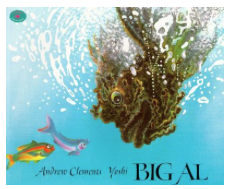
Big Al, by Yoshi

Big Al is a fish that is very big and scary looking.  All the other fish stay away never realizing that he is kind and brave until one day…Big Al saves the day.

Materials

  • Camouflage pictures
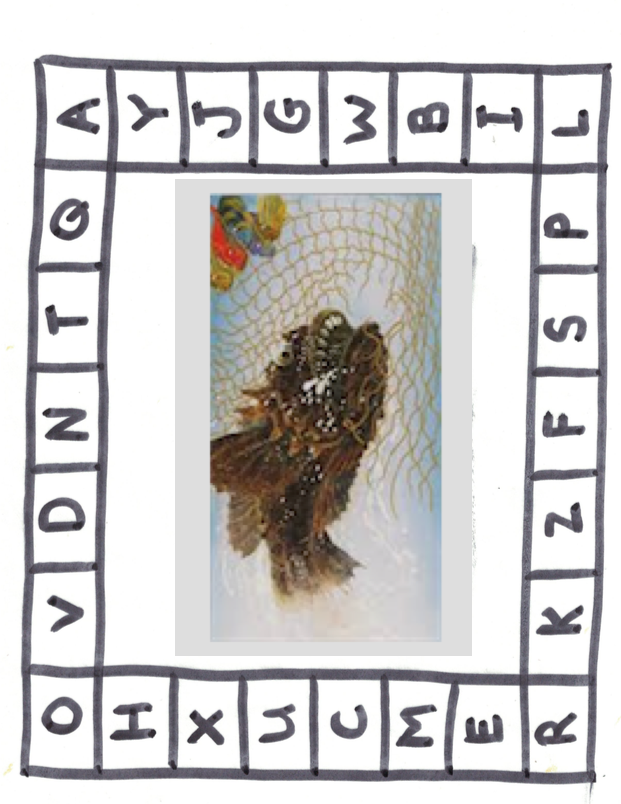
  • Alphabet Fish page
  • Five little fish
  • 20 more big ugly fish
  • Individual picture of each child in your classroom
  • One index card per child

Vocabulary

  • Plowed (run right into someone or something)
  • Tremendous (great big)
  • Camouflage (to disguise or hide)

Before Reading the Story

Reading the Story

On the page when Big Al thought that he would never have a friend and something happened, stop and ask the children if they can guess what they think Big Al is going to do?  When you finish the story, ask the children if Big Al was a good friend, why? 

Language Development/Speaking Understanding; develops increasing abilities to understand and use language to communicate information, experiences, ideas, feelings, opinions, needs, questions; and for other varied purposes.

After Reading the Story

Talk with the children about how friends can help each other.  Mention any incidents that you have recently seen of one classmate helping another (At breakfast I saw Ryan help Michael to cut his waffle, Alison helped Ann to zipper her party dress in the dramatic corner).  Ask the children if they can think of a time when a friend helped them.  Ask the children what they should say to another person who helps them (thank you). 

Social & Emotional Development/Social Relationships; shows progress in developing friendships with peers.

Discovery

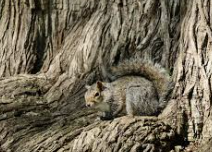
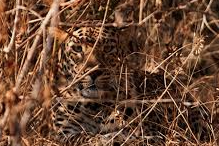
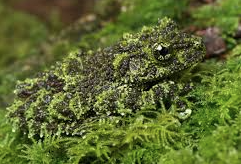
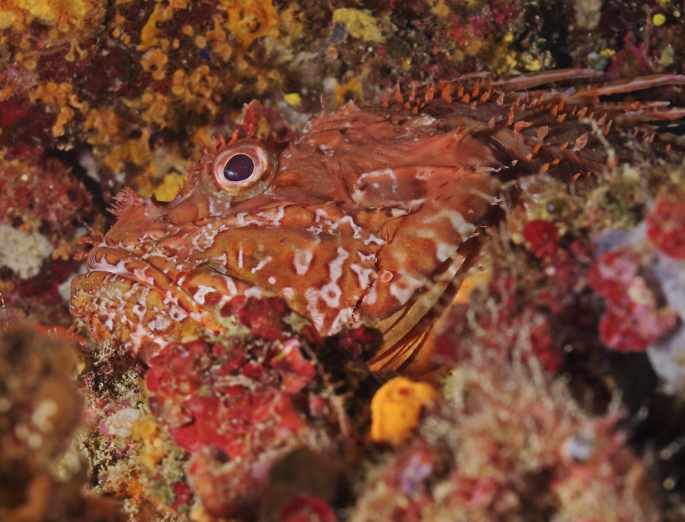
In the story, Big Al tried to camouflage himself.  Put out pictures of animals that are camouflaged for the children to look at. 

Science/Scientific Knowledge; expands knowledge of and abilities to observe, describe, and discuss the natural world, materials, living things, and natural processes.

Music and Movement

Sing The More We Get Together  https://www.youtube.com/watch?v=lldmkrJXQ-E

Creative Arts/Music; participates with increasing interest and enjoyment in a variety of music activities, including listening, singing, finger plays, games, and performances.

Do the chant, 2,4,6,8, Who Do We Appreciate?  Then add a child’s name and clap out the syllables.  2,4,6,8, who do we appreciate?  Ro-ger, Ro-ger, Ro-ger.  2,4,6,8, who do we appreciate?  Pri-scil-la, Pri-scil-la, Pri-scil-la.  Go around the circle and do everyone’s name.

Literacy/Phonological Awareness; shows growing ability to hear and discriminate separate syllables in words.

Finger play, Five Little Fish

One little fish alone and new

Soon she finds a friend and now there are two.

Two little fish swimming in the sea

They meet another friend and now there are three.

Three little fish swim along the shore

Soon they see a friend and now there are four.

Four little fish go for a dive

There they find another friend and now there are five.

1,2,3,4,5.

Mathematics/Number & Operations; begins to associate number concepts, vocabulary, quantities, and written numerals in meaningful ways.

Blocks

Cut around pictures of the children and tape or contact paper each one to a small unit block.  As the children play in the block center they can use their friend pictures as part of their play.

Approaches to Learning/Initiative & Curiosity; approaches tasks and activities with increased flexibility, imagination, and inventiveness.

Art

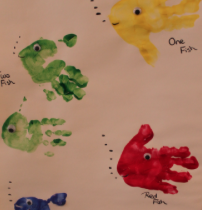
Finger-paint today.  As the children finger paint, have them make a handprint on a separate piece of paper.  When this dries, embellish.  Cut around and glue them all onto a large piece of blue paper.  Make a bulletin board, A School of Friends.

Creative Arts/Art; gains ability in using different art media and materials in a variety of ways for creative expression and representation.

Sand and Water

Put sand into the table today and then pour water on top. Add any plastic sea creatures/fish that you have.  The children can bury the creatures in the sand to hide and camouflage or pretend to swim them in the water. 

Creative Arts/ Dramatic PLay; shows growing creativity and imagination in using materials and in assuming different roles in dramatic play situations.

Library and Writing

Give each child a copy of the Alphabet Fish Page and several crayons or markers.  Put a basket of magnet letters in the middle of the table.  Let the children take turns picking a magnet letter out of the bowl.  The children then look for that letter on their alphabet page and color it in.  Play until all 26 letters have been found.

Literacy/Alphabet Knowledge; shows progress in associating the names of letters with their shapes and sounds.

Dramatic Play

Encourage the children ask a friend to help with the zippers, buckles, and buttons on your dress-up clothing.

Social & Emotional Development/Cooperation; increases abilities to sustain interactions with pers by helping, sharing, and discussion.

Math and Manipulatives

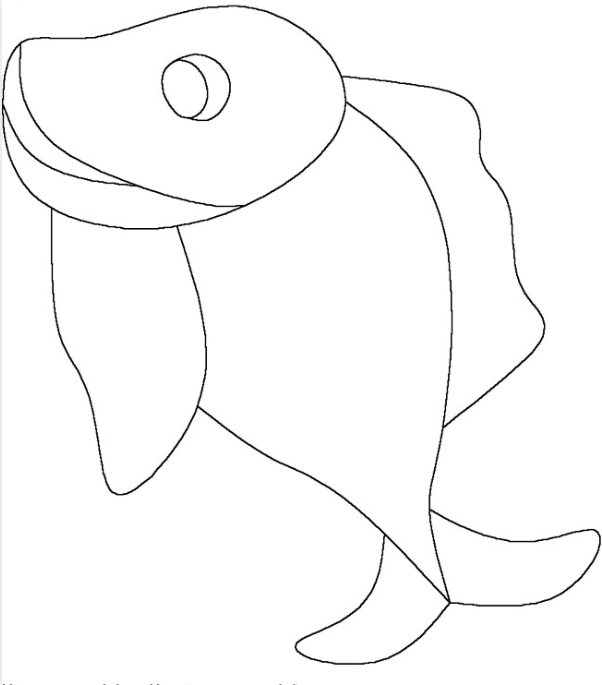
Cut out 20 fish shapes.  Make two sets of fish labeled 1-10.  Challenge the children to line the fish up starting with number one and going to number ten.  Are they able to identify the numbers?  For younger children use 1-5 and add dots that they can count.

Mathematics/Number & Operations; begins to associate number concepts, vocabulary, quantities, and written numerals in meaningful ways.

Outdoor Play

Play Swimming in a School.  The teacher is the leader and the children follow as in Follow the Leader.  Swim around the tree, under the climber, on top of the bench, etc.

Physical Health & Development/Health Status & Practices; participates actively in games, outdoor play, and other forms of exercise that enhance physical fitness.

Transitions

Write each child’s name on an index card.  Hold up the card and ask whose name is this?  That child can then help name the letters before going off to the next activity.

Literacy/Alphabet Awareness; identifies at least 10 letters of the alphabet, especially those in their own name.

Resources