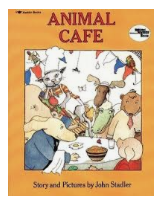
Animal Cafe,by John Stradler

This story is about an all night cafe for the animals of the neighborhood. Children will delight in learning all that goes into what makes this restaurant run.

Materials

  • Ingredients used for a cooking project or to make your favorite play dough.
  • Several restaurant bags or boxes that would be familiar to the children.
  • Magazines
  • Poster Board
  • Cookbooks with illustrations
  • Pictures of foods on index cards
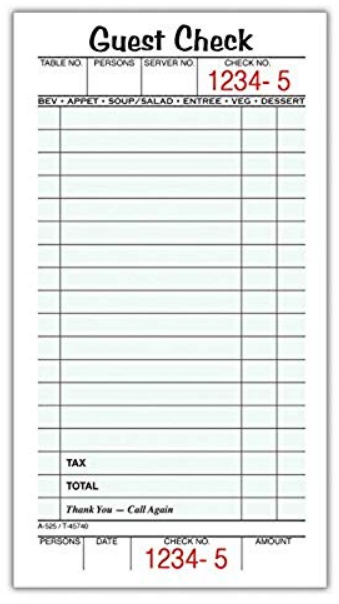
  • Guest Checks
  • Placemats

Vocabulary

  • Magic (it means something happens which you can not explain, a mystery)
  • Spicing (To add flavor to food to make it taste better)
  • Café (a place where food and drinks are sold, like a restaurant)

Before Reading the Story

Bring several food bags (McDonald’s, Chick-Fil-A, Bojangles) and a pizza box. Ask the children if they know where these come from.

Literacy/Print Awareness & Concepts; recognize a word as a unit of print, or awareness that letters are grouped to form words, and that words are separated by spaces.  

Hold up one of the bags and ask the children to clap their hands if they have eaten there. Hold up the next bag and ask them to put their hands on their head.

Language Development/Listening & Understanding; shows progress in understanding and following simple and multi-step directions.

Count with the children each time to see how many children have visited each restraint.

Mathematics/Numbers & Operations; demonstrates increasing interest and awareness of numbers and counting as a means for solving problems and determining quantity.

After a short discussion on where the children have eaten and like to eat, hold up the book cover and tell them that the story today is called Animal Café.

Reading the Story

Ask questions along the way. What do you think the magic is? Why do you think Casey the cat is in the kitchen, slicing, dicing, and spicing? When the guests start arriving say to the children, “Oh, Casey and Sedgewick are opening up a restaurant or café!”

Literacy/Book KNowledge & Appreciation; shows growing interest and involvement in listening to and discussing a variety of fiction and non-fiction books and poetry.

After Reading the Story

With the children list all the things that Casey and Sedgewick had to do to prepare the café for the animals (slicing,dicing,and spicing, decorating, setting the tables, writing the menu, greeting, serving, taking the money and cleaning up).

Social & Emotional Development/Knowledge of Families & Communities; develops growing awareness of jobs and what is required to perform them.

Music and Movement

Turn this into a song by making up verses to the tune of Fere Jaqua. https://www.youtube.com/watch?v=QI0abuwq31g

At the café, at the café,                               At the café, at the café,
There’s a chef, there’s a chef                   There’s a menu, there’s a menu
He chops and he dices,                             It tells us all the good foods
He cooks and he spices                            We can order
At the café, at the café.                               At the café, at the café.
Waitress takes our order                          The cleaner scrubs the café
Brings the yummy food                            Keeps it safe and clean

Social & Emotional Development/Knowledge of Families & Communities; develops growing awareness of jobs and what is required to perform them.

Discovery

This would be a great day to do a cooking project with your children in small group. Dice cheese, slice apples, and spice the apples with cinnamon for an easy snack. Or make a batch of play dough with the children and talk about what happens when you mix the ingredients.

Science/Scientific Skills & Methods; begins to use senses and a variety of tools and simple measuring devices to gather information, investigate materials, and observe other processes and relationships.  AND Language Development/Listening & Understanding; shows progress in understanding and following simple and multiple-step directions.

Art

Give the children magazines to cut out food pictures and glue them to a piece of poster board.  This can later be hung in the dramatic center as a wall menu for restaurant play.

Physical Health & Development/Fine Motor Skills; develops growing strength, dexterity, and control needed to use tools such as scissors, paper punch, stapler, and hammer . 

Sand and Water

Put out dampened sand and several dishes. Let the children pretend to make sand food.

Approaches to Learning/Initiative & Curiosity; approaches tasks and activities with increased flexibility, imagination, and inventiveness.

Library and Writing

Add several cookbooks that have illustrations.

Literacy/Print Awareness & Concepts; develops growing understanding of the different functions of forms of print such as signs, letters, newspapers, lists, messages, and menus.

Cut out pictures of food ahead of time and glue them to index cards. Label the foods. Ask the children if they can help put them onto your word wall.

Literacy/Alphabet Knowledge; increases in ability to notice the beginning letters of familiar words. 

Dramatic Play

Turn your dramatic play area into a restaurant for an extended period of time. Have the children help organize the dishes by putting all the like kinds together

Mathematics/Geometry & Spatial Sense; begins to be able to determine if two shapes are the same size and shape.

 Make copies of the placemat and cover them with contact paper. Show the children how to set the table/s by placing the like dishes over the placemat cutouts. As they are setting the table/s talk to them about how the fork goes on the left and the cup goes above the plate.

Mathematics/Patterns & Measurement; enhances abilities to recognize , duplicate, and extend simple patterns using a variety of materials.

Add any menus and food containers that you have collected to the center.  Encourage the children to participate in a variety of roles related to the kitchen and as a guest.  Show the children how to use the guest check to pretend to write down their order.  Observe the children as they play, are they able to  switch and share roles?  Are they able to use restaurant related words (menu, waitress, cook, chef, order)?

Social & Emotional Development/Cooperation; develops increasing abilities to give and take in interactions; to take turns in games and in using materials; and to interact without being overly submissive or directive.

Math and Manipulatives

Put out all your food related puzzles

Physical Health & Development/Fine Motor Skills; grows in hand-eye coordination in building with blocks, putting together puzzles, reproducing shapes, stringing beads, and using scissors.

 Outdoor Play

Play a bounce and catch game.  Have several children stand in a circle.  Bounce the ball to a child and name a food.  The child must catch the bounced ball, name a food and bounce the ball to another.  Continue naming foods.  For older children, make food categories.  Bounce and name food s that you keep in the refrigerator, foods that you might eat for breakfast, favorite foods, etc.

Physical Health & Development/Gross Motor Skills; demonstrates increasing abilities to coordinate movements in throwing, catching, kicking, bouncing balls, and using the swing and slide.  AND Mathematics/Patterns & Measurement; begins to make comparisons between several objects based on a single attribute.

 Transitions

Put any play foods that you might have into a pillow case or bag that the children can not see through.  Let them take turns pulling out a food item and then naming it.

Social & Emotional Development/Cooperation; develops increasing abilities to give and take in interactions; to take turns in games and in using materials; and to interact without being overly submissive or directive.

Resources
Screen Shot 2018-10-30 at 4.34.48 PM
Screen Shot 2018-10-30 at 4.52.56 PM
Screen Shot 2018-10-30 at 4.53.12 PM
Screen Shot 2018-10-30 at 4.53.23 PM
Screen Shot 2018-10-30 at 4.51.00 PM
Screen Shot 2018-10-30 at 4.44.06 PM
Screen Shot 2018-10-30 at 4.42.44 PM
Screen Shot 2018-10-30 at 4.43.33 PM
Screen Shot 2018-10-30 at 4.47.02 PM
Screen Shot 2018-10-30 at 4.51.14 PM
Screen Shot 2018-10-30 at 4.53.38 PM
Screen Shot 2018-10-30 at 4.53.49 PM
Screen Shot 2018-10-30 at 4.51.32 PM
Screen Shot 2018-10-30 at 4.42.53 PM
Screen Shot 2018-10-30 at 4.54.12 PM
Screen Shot 2018-10-30 at 4.51.41 PM
Screen Shot 2018-10-30 at 4.43.05 PM
Screen Shot 2018-10-30 at 4.49.08 PM
Screen Shot 2018-10-30 at 4.50.34 PM
Screen Shot 2018-10-30 at 4.52.06 PM
Screen Shot 2018-10-30 at 4.39.58 PM

Yoko, by Rosemary Wells

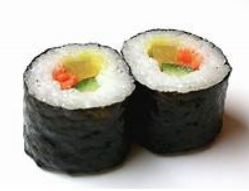
Yoko is taking her favorite lunch to school today, homemade sushi. But at lunch the children make fun of her unusual meal. Find out how her teacher helps her to feel better about eating differently than the other children. This is a good book to talk about acceptance and the hurtfulness of teasing.

 Materials

  • Several sets of chopsticks (you can use unsharpened pencils also). Put a small rubber band around them so the children can more easily open and close the sticks.
  •  2 small bowls and a handful of puffballs
  • Pictures of foods

 Vocabulary

  • sushi-a food from Japan that is made with rice, fish, and vegetables that look like balls or rolls.

 Before Reading the Story

Start a conversation about favorite lunch time foods.  If you have a cook at your school  write a thank you not that tells some of the children’s favorite foods.  Remind the children that sometimes the lunch has a new item on the menu and that you encourage everyone to try a “no thank you helping at the least”.

Literacy/Early Writing; develops understanding that writing is a way of communicating for a variety of purposes.

Reading the Story

When you get to the page where Valerie blew the whistle and says, “Everybody out!” Ask the children why they think that Valerie did this (the children were teasing her, they were not being nice to the cat, they made fun of her).

Literacy/Book Knowledge & Appreciation; shows growing interest and involvement in listening to and discussing a variety of fiction, non-fiction and poetry.

 After Reading the Story

After you have read the story, ask again what happened at lunch that made Yoko so upset? Lead this into a discussion about kindness and not teasing others. Explain that teasing makes people feel sad and mad. Let the children know of any acts of kindness that you have seen in the last two days (Ann showed Michael how to open the paint jar so he could get more paint. Ryan told Paula he would give her a ride on the back of his tricycle when there were no more left. Alison told Sean “I like your new shoes”). Remind the children that if someone is teasing you, you can stand up for yourself and say, ”I don’t like it when you______”.

Social & Emotional Development/Self Control; develops growing understanding of how their actions affect others and begins to accept the consequences of their action. AND Social & Emotional Development/Social Relationships; progresses in responding sympathetically to peers who are in need, upset, hurt, angry; and in expressing empathy or caring to others.

Discovery

At lunch today, encourage all the children to try at least one bite of a new food. If you have a picky eater, ask someone who likes the food already to try to explain the taste before the picky eater tries his/her bite. Remind them that in the story the children decided that they would try everything!  Encourage all the children to try a No thank you helping of all foods served at lunch.

Social & Emotional Development/Cooperation; increases abilities to sustain interactions with peers b helping, sharing, and discussion.

Music and Movement

If you use any of the song titles from the story with your classroom, sing it with the children at your music time today. (The Good Morning Song, The Snack Time Song, The Friendly Song, The Clean Hands Song, and The School Bus Song).

Language Development/Listening & Understanding; demonstrates increasing ability to attend to and understand conversations, stories, songs, and poems.

Sing You Have To Eat Good Food to The Hokey Pokey https://www.youtube.com/watch?v=QfPg_GzC-HA

You have to eat good food to grow, grow, grow
You have to exercise to grow, grow, grow
You have to sleep at night to grow, grow, grow
Take good care of yourself.

Physical Health & development/Health Status & Practices; builds awareness and ability to follow basic health and safety rules such as fire safety, traffic and pedestrian safety, and responding appropriately  to potentially harmful objects, substances, and activities.

 Blocks

Challenge the children to make a table big enough for them to eat at. How many blocks did it take? What else did they use besides blocks?

Approaches to learning/Reasoning & Problem Solving; develops increasing ability to find more than one solution to a question, task, or problem.

 Art

Pretend to make sushi and practice rolling play dough. Give each child a lump of play dough and a roller. If you do not have rollers, cylinder blocks work well. Let the children practice rolling the dough out thin. After they have rolled it out, show them how to roll the dough into a long cylinder like shape. Let them use plastic knives to cut it into small sushi like pieces.

Physical Health & Development/Fine Motor Skills; develops growing strength, dexterity, and control needed to use tools such as scissors, paper punch, stapler, and hammer.

Sand and Water

Use dampened sand in the table today. Add some plates, pots and pans, and cooking utensils. The children can pretend to be making food.

Creative Arts/Dramatic Play; shows growing creativity and imagination in using materials and in assuming different roles in dramatic play situations.

 Library and Writing

Ask the children to draw a picture of their favorite lunch and then the teacher can write what they say it is underneath. Hang these on the wall, as ‘These are a few of our favorite meals’.

Literacy/Early Writing; begins to represent stories and experiences through pictures, dictation, and in play.  AND Literacy/Early Writing; develops understanding that writing is a way of communicating for a variety of purposes.

 Dramatic Play

Remind the children that in the story Yoko and Timothy pushed their desks together to play restaurant. Put out a takeout menu or restaurant props for the children today

Creative Arts/Dramatic Play; shows growing creativity and imagination in using materials and in assuming different roles in dramatic play situations.

Math and Manipulatives

Bring in several pairs of chopstick or make them using unsharpened pencils. Put out a bowl of puffballs and challenge the children to pick up the puffballs one at a time and drop them into another bowl.

Physical Health & Development/Fine Motor Skills; develops growing strength, dexterity, and control needed to use tools such as scissors, paper punch, stapler, and hammer.

Outdoor Play

Let the children make Garden Soup today.  Put out buckets, water, and scissors.  Show the children how to cut grass with the scissors to add to the soup as well as pine needles, rocks, bark, etc..

Creative Arts/Dramatic Play; shows growing creativity and imagination in using materials and in assuming different roles in dramatic play situations.  AND Approaches to learning/Initiative & Curiosity; approaches tasks and activities  with increased flexibility, imagination, and inventiveness.

 Transitions

Hold up a picture of a food and ask a child to name it. The child can then move on to the next activity.

Resources
Screen Shot 2018-11-04 at 2.14.06 PM
Screen Shot 2018-11-04 at 2.12.30 PM
Screen Shot 2018-11-04 at 2.10.02 PM
Screen Shot 2018-11-04 at 2.11.45 PM
Screen Shot 2018-11-04 at 1.58.01 PM
Screen Shot 2018-11-04 at 2.13.28 PM
Screen Shot 2018-11-04 at 1.53.02 PM
Screen Shot 2018-11-04 at 2.03.47 PM
Screen Shot 2018-11-04 at 1.58.45 PM
Screen Shot 2018-11-04 at 1.55.18 PM
Screen Shot 2018-11-04 at 1.53.43 PM
Screen Shot 2018-11-04 at 2.04.27 PM
Screen Shot 2018-11-04 at 1.56.57 PM
Screen Shot 2018-11-04 at 2.04.45 PM
Screen Shot 2018-11-04 at 2.00.15 PM
Screen Shot 2018-11-04 at 2.00.51 PM
Screen Shot 2018-11-04 at 2.01.30 PM
Screen Shot 2018-11-04 at 2.05.56 PM
Screen Shot 2018-11-04 at 2.06.48 PM
Screen Shot 2018-11-04 at 2.03.08 PM

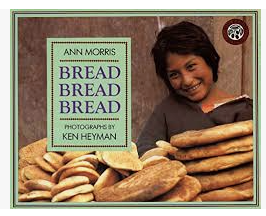
Bread, Bread, Bread by Ann Morris

 Ann Morris shares bread with us from around the world. This book celebrates our love of bread in all its various forms.

Materials

  • Ingredients for uncooked playdough
  • 2 cups plain flour (all purpose)
  • 2 tablespoons vegetable oil  (baby oil and coconut oil work too)
  • 1/2 cup salt
  • 2 tablespoons cream of tartar
  • 1 to 1.5 cups boiling water (adding in increments until it feels just right)
  • few drops glycerine 
  • A piece of bread and a plastic knife per child. 
  • A spread to go onto the bread.

Vocabulary

  • Knead (to roll and smush and pound the dough until it is smooth)
  •  Loaf (a pans worth of bread, usually cut up into pieces)

Before Reading the Story

            Look at the cover of the book and ask the children if they can guess what the story is about.  Ask if any of them like to eat bread, do they eat it plain or do they put something on their bread?  Read the title and tell the children that people everywhere eat bread.  Begin the book.

Literacy/Book Knowledge & Appreciation; shows growing interest and involvement in listening to and discussing a variety of fiction and non-fiction books and poetry.  AND Language Development/Speaking & Communicating; progresses in abilities to initiate and respond appropriately in conversations and discussions with peers and adults.

Reading the Story

            As you read, ask the children if they have tried the various kinds of breads shown in the pictures.  Do they know the name of the different breads?

Language Development/Speaking & Communicating; uses an increasingly complex and varied spoken vocabulary.

After Reading the Story

            Show the children a globe or map of the world and point to some of the places where the pictures were taken.
Social & Emotional Development/Knowledge of Families & Communities; begins to express and understand concepts and language of geography in the contexts of the classroom, home, and community.
Discovery

            Let the children make non-cooked playdough and pretend that they are kneading the dough for bread. 

2 cups plain flour (all purpose)

2 tablespoons vegetable oil  (baby oil and coconut oil work too)

1/2 cup salt

2 tablespoons cream of tartar

1 to 1.5 cups boiling water (adding in increments until it feels just right)

food colouring (optional)

few drops glycerine 

  • Mix the flour, salt, cream of tartar and oil in a large mixing bowl
  • Add food colouring TO the boiling water then into the dry ingredients
  • Stir continuously until it becomes a sticky, combined dough
  • Add the glycerine (optional)
  • Allow it to cool down then take it out of the bowl and knead it vigorously for a couple of minutes until all of the stickiness has gone. * This is the most important part of the process, so keep at it until it’s the perfect consistency!*
  • If it remains a little sticky then add a touch more flour until just right

Creative Arts/ Dramatic Play; shows growing creativity and imagination in using materials and in assuming different roles  in dramatic play situations.  AND Science/Scientific Methods & Skills; begins to participate in simple investigations to test observations, discuss & draw conclusions, and form generalizations.

Music and Movement

Mr Mike has a You Tube called Peanut Butter and Jelly. https://www.youtube.com/watch?v=67A3XmpVAGI

Creative Arts/Music; participates with increasing interest and enjoyment in a variety of music activities, including listening to music, singing, finger plays, games, and performances.

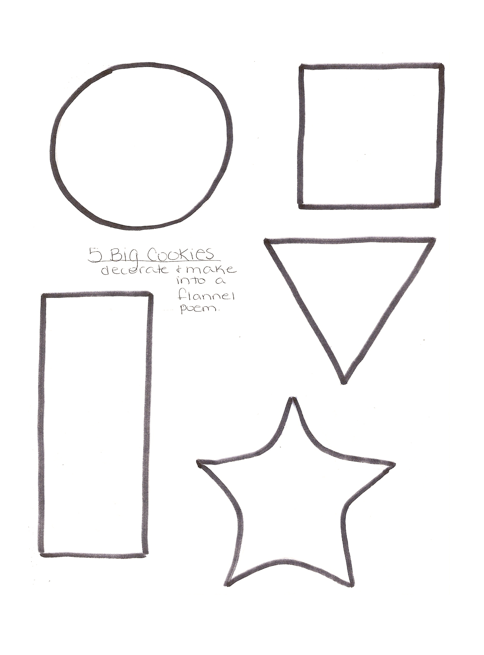
Cut out and color the shape cookies and Teach the children the finger play, Five Little Cookies

Five little cookies in the bakery shop

Shining bright with sugar on top.

Along comes (name a child) with a nickel to pay,

He/she buys a cookie and takes it away.

What shape cookie did (child) buy?  How many cookies are left?

Continue with 4, 3, 2, 1.

Mathematics/ Number & operations; begins to associate number concepts, vocabulary, quantities, and written numerals  in meaningful ways.

Blocks

            Encourage the children to use the small rectangle wooden blocks as loaves of bread.  Can they build an oven where the bread can fit inside?  For younger children, let them use a shoe box or cubby on its side to represent an oven.  How many loaves can they fit in the oven at one time?  Ask them to load the oven and then count all the loaves of bread.

Creative Arts/ Dramatic Play; shows growing creativity and imagination in using materials and in assuming different roles  in dramatic play situations.   AND Mathematics/Number & Operations; demonstrates increasing interest and awareness of numbers and counting as a means for solving problems and determining quantity.

Art

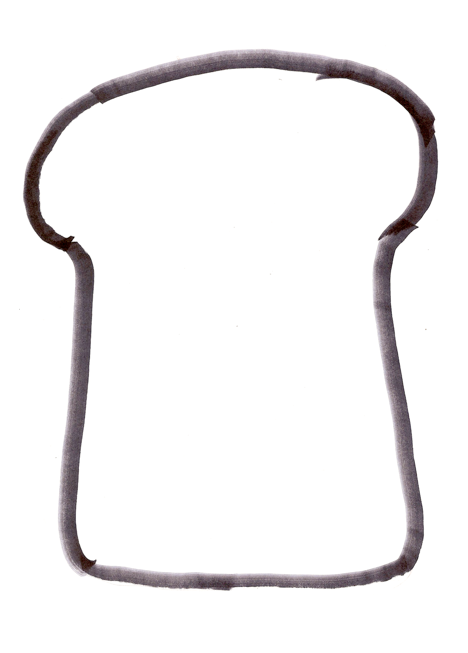
            Cut out bread shapes from white construction paper. The children can paint it shades of brown to make wheat bread or rye breads.  Put the paints out in an old muffin tin.  Use brown, white, and black paints today.

Physical Health & Development/Fine Motor Skills; progresses in abilities to use writing, drawing, and art tools, including pencils, markers, chalk, paint brushes, and various types of technology.

Library and writing

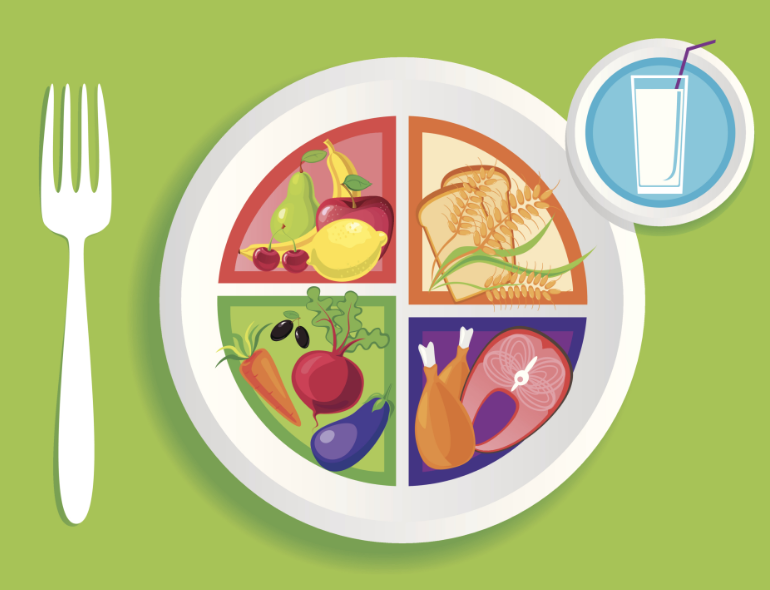
            If you have a flannel board and flannels of foods, put this into the center today.  Challenge the children to find all the bread/grain products and put them on the flannel board.  If you have done some nutrition teaching with the children, ask them to divide the foods up by food groups (fruits, vegetables, proteins, grains, and dairy)

Mathematics/Patterns  & Measurement; shows increasing abilities to match, sort, put in a series, and regroup objects according to one or two attributes such as shape or size.

Sand and water

            Bring in some bread pans and muffin pans for the children to use with dampened sand as they pretend to bake bread.  Include measuring cups, bowls, and measuring spoons, and a small roller.  Ask the children to count how many cups of flour/sand it takes to fill the bread pan, etc..

Creative Arts/ Dramatic Play; shows growing creativity and imagination in using materials and in assuming different roles  in dramatic play situations. 

Dramatic Play

             Bring out any restaurant props that you might have and encourage the children to act out the different roles (waitress, chef, customer). 

Creative Arts/ Dramatic Play; shows growing creativity and imagination in using materials and in assuming different roles  in dramatic play situations.  AND Social & Emotional Development/Cooperation; develops increasing abilities to give and take in interactions; to take turns with in games and using materials; and to interact without being overly submissive or directive.

Math and Manipulatives

            Bring in a kind of bread and a spread that goes with it. Have the children spread onto their bread using a plastic knife. (Bagel and soft crème cheese, bread and butter, bread and jelly)

Physical Health & Development/Fine Motor Skills; develops growing strength, dexterity, and control needed to use tools such as scissors, paper punch, stapler, and hammer.

            Make 2 copies of the bread pictures on paper that the children cannot see through.  Use these to play Memory by turning all the pictures upside down on the table.  A child picks two cards.  If they match he keeps them, if they do not match he turns them back upside down on the table.  The next child goes.  Continue till all the pairs are collected and have the children count how many cards they have.

Mathematics/Patterns  & Measurement; shows increasing abilities to match, sort, put in a series, and regroup objects according to one or two attributes such as shape or size.

Outdoor Play

            Tell the children that crackers are a kind of bread or grain.  Today you are going to pretend that you are crackers, animal crackers!  Call out animals and the children act them out both in their actions and their voices.  Encourage them to run and roar as different animals.  Give them a moment to act out each animal and then shout “Animal crackers freeze!”.  This cues the children to stop and listen for the next animal.

Language Development/Listening & Understanding; shows progress in understanding and following simple and multi-step directions.  AND Physical Health & Development/Health Status and Practices; participates actively in games, outdoor play, and other forms of exercise that  enhance physical fitness.

Transitions

            Ask children if they can think of words that rhyme with bread (spread, head, red,said, bed).  Continue to dismiss by playing with rhyming words.

Literacy/Phonological Awareness; progresses in recognizing matching sounds and rhymes in familiar words, games, songs, stories, and poems.

Resources