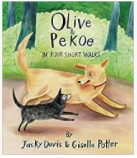
Olive & Pekoe in Four Short Walks, by J. Davis & G. Potter

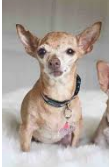
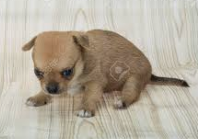
Pekoe and Olive are friends even though they are very different. Olive is old and Pekoe is young. They find they have many opposites but they can still be friends and enjoy spending time together.

Materials

  • Young and old animal match pictures
  • Package of dot or star stickers
  • Sheets of sandpaper
  • Foil
  • Several shoebox sized boxes and stuffed animals of pets

Vocabulary

  • Appreciates (to understand and welcome the gesture)
  • Regrets (wishes had not done something)
  • Impressed (Interested or excited about something)
  • Chipmunk (a little animal kind of like a squirrel)

Before Reading the Story

Start a discussion about how no two people are just alike.  Pick two children in your classroom and have them stand up.  Explain that both the children might be the same sex and the same age but that does not mean that they are alike.  Ask the two children several questions about themselves that you know will make for different responses.  (Jamal says he likes broccoli but Andrew does not, Susan says she has two brothers but Lisa has only one sister).   Explain to the class that these two can and are friends even though they are different.  Ask the children if this is ok?  Of course it is!  Everybody is different and likes different things, that’s what makes having friends so much fun.  Sometimes we like the same things and sometimes we do not.  Introduce the story by saying that today’s story is about two friends who are different in many ways but are still good friends.

Social & Emotional Development/Knowledge of Families & Communities; progresses in understanding similarities and respecting differences among people such as genders, race, special needs, culture, language, and family structure.

Reading the Story

On page 6 when Pekoe brings the stick to Olive, explain that Olive appreciates the gesture because she understands that Pekoe is just being a good friend even if she does not really like playing with sticks.  On page 9, ask the children what they think the dogs will eat for snack?  Then ask several children what they like to eat for snack, note that not everyone likes the same things but they can still be friends.  On page 16, note the dogs faces, ask the children how do you think they are feeling?  Introduce the word disappointed.  Ask the children why they think Pekoe and Olive are disappointed.  (They cannot play outside, They have to go home, They wanted to play together).  On page 20 ask the children if they can see where the chipmunk went?  Do the same on page 22 and 25.  On page 28 ask the children to look at the dogs faces.  Why do you think they look so angry?  How does it make you feel when other children fight with you?  On page 31 comment on how Olive is being a good friend to Pekoe by standing up to the bully dog with him.

Language Development/Speaking & Communicating; develops increasing abilities to understand and use language to communicate information, experiences, ideas, feelings, opinions, needs, questions,; and for other varied purposes.

After Reading the Story

Explain again to the children that no two people, or dogs, are alike.  Note that in the story Pekoe and Olive are opposite in several ways.  Ask the children if they can recall any ways that the two dogs are different.  (Pekoe is fast and Olive is slow, Pekoe likes sticks and Olive does not really like them, Pekoe is afraid of the thunderstorm and Olive just does like to get wet, Pekoe wants to chase chipmunks, Olive just wants to watch, Pekoe wants to play with the other dogs, Olive just wants to watch, Pekoe is a puppy and Olive is an old dog). 

Literacy/Book Knowledge & Appreciation; demonstrates progress in ability to retell and dictate stories from books and experiences; to act out stories in dramatic play; and to predict what will happen next in a story.

Make a graph that includes all the pets that the children in your classroom have.  Then ask the children if their pet is a puppy or an old dog, a kitten or an old cat, etc.?   Mark each animal with a Y for young and an O for old.  Count how many of each pet there is and then count how many are young versus old. 

Mathematics/Number & Operations; demonstrates increasing interest and awareness of numbers and counting as a means for solving problems and determining quantities. AND Approaches to Learning/Reasoning & Problem Solving; develops increasing abilities to classify, compare, and contrast objects, events, and experiences.

Give the children a few moments to talk about any pet that they might have.  What does your pet like to do with you?

Approaches to Learning/Initiative & Curiosity; grows in eagerness to learn about and discuss a growing range of topics, ideas, and tasks. AND Language Development/Speaking & Communicating; develops increasing abilities to understand and use language to communicate information, experiences, ideas, feelings, opinions, needs, questions,; and for other varied purposes.

Discovery

Make a match game using pictures of young and old like animals.

Approaches to Learning/Reasoning & Problem Solving; develops increasing abilities to classify, compare, and contrast objects, events, and experiences.

Music and Movement

Remind the children that in the story, Pekoe and Olive were opposite in many ways.  Sing the Opposites Songhttps://www.youtube.com/watch?v=TW4OQxUVjiE

Language Development/Listening & Understanding; demonstrates increasing ability to attend to and understand conversations, stories, songs, and poems.

Sing I have a Dog his Name is Ragshttps://www.youtube.com/watch?v=pjiH_pj1_Lw

Creative Arts/Movement; expresses through movement and dancing what is felt and heard in various musical tempos and styles.

Tell the children that they are going to go on a listening walk.  Give a direction and see if the children can follow it.  Walk in front of the window, walk past the door, walk along the wall, walk around the table, walk to a corner of the room, walk beside a friend.

Mathematics/Geometry & Spatial Sense; builds an increasing understanding of directionality, order, and positions of objects, and words such as up, down, over, under, top, bottom, inside, outside, in front, behind.

Blocks

Encourage the children to work cooperatively in their structures today.  Remind them that nobody is the boss but that each child involved gets to help make decisions on how the structure will be built.  As the children are building, ask them to point out the part of the structure that they helped design.  Compliment the children on working together even though they all had different ideas and opinions.

Social & Emotional Development/Cooperation; develops increasing abilities to give and take in interactions; to take turns in games or using materials; and to interact without being overly submissive or directive.

Art

Attach sheets of sandpaper and sheets of foil to the easel.  Allow the children to experiment painting on the two surfaces; Rough and Smooth, opposites.

Creative Arts/Art; begins to understand and share opinions about artistic products and experiences.

Sand and Water

Tell the children that float and sink are opposites.  Put water in your table today along with a variety of objects that float or sink.  Put out two containers, one to hold the objects that float and one to hold the objects that sink.  Challenge the children to gather objects from around the room and hypothesis whether it will float or sink.

Science/Scientific Skills & Methods; begins to participate in simple investigations to test observations, discuss and draw conclusions, and form generalizations.

Library and Writing

Remind the children that today’s story was called Olive and Pekoe in Four Short Walks.  Suggest to the children that they are going to take a pretend walk and to imagine where they might be going (to the park, the zoo, the beach, the grocery store).  Give each child five to ten dots or star stickers.  Have them stick them anywhere on their piece of paper.  Now have them draw a line using a marker from dot to dot/star to star.  As they connect the dots/stars, ask them to tell you what they might see on their walk.  Write their responses on the bottom of the page or beside each dot/star.

Literacy/Early Writing; begins to represent stories and experiences through pictures, dictation, and in play.

Dramatic Play

Set up a pet store or veterinary clinic today using boxes and stuffed animals.  Add a cash register for pet store or your doctor kit for veterinary play.

Creative Arts/Dramatic Play; participates in a variety of dramatic play activities that become more extended or complex.

Math and Manipulatives

Explain to the child that more and less are opposites.  Put out two sets of like objects and ask the child which has more?  Which has less?  Start with sets that are easy to see the differences (3 cubes and 7 cubes).  Continue playing this way until the child seems comfortable being able to recognize which set has more and which set has less.  Then put out one set of objects and ask the child to make a set with more and a set with less.  With older children they can make sets for each other.  Encourage the children to count the number of objects in each set.

Mathematics/Number & Operations; begins to use language to compare numbers of objects with terms such as more, less, fewer, greater than, equal to.

Outdoor Play

If possible, take your children on a walk around the neighborhood or school.  Talk about the many things that you see along the way.

Approaches to Learning/Initiative & Curiosity; grows in eagerness to learn about and discuss a growing range of topics, ideas, and tasks.

Transitions

Ask a child to name their favorite food.  Now ask the rest of the children to raise their hand if they like that food too.  Ask a child to name their favorite color, now ask the class to raise their hand if that is their favorite color also.  Continue asking the children to name a favorite something (animal, snack, TV show, song, center, etc.).  After each, remind the children that for some it might be their favorite but for others it is not and yet, we can still all be friends.

Social & Emotional Development/Self-Concept; begins to develop and express awareness of self in terms of specific abilities, characteristics, or preferences.

Resources


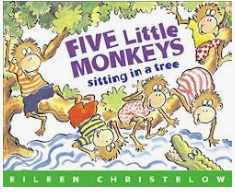
Five Little Monkeys Sitting in a Tree, by Eileen Christelow

            Teasing is not nice as these five monkeys learn. This is a fun counting/subtraction book based on a popular finger play.

Materials

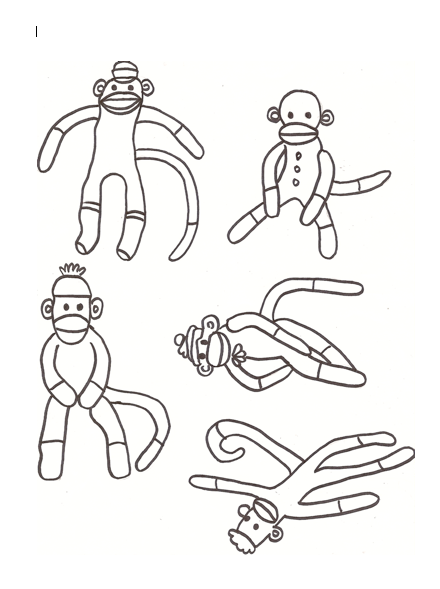
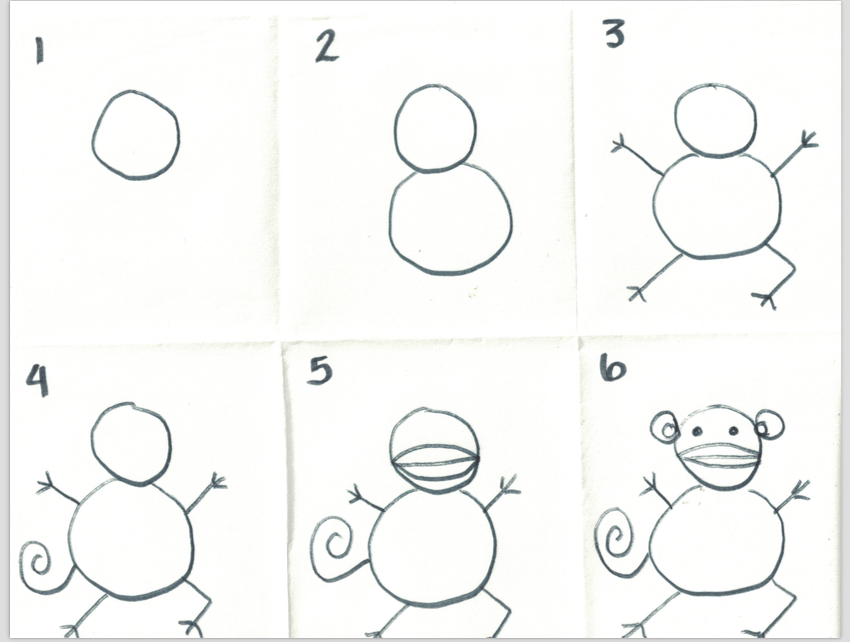
  • Drawing monkey directions
  • Number line 1-5
  • A basket the children can use for picnic play
  • A deck of cards.
  • Bits of tree parts (bark, leaf, stickbud, seed)

Vocabulary

  • Snooze (a nap)
  • Scolds (to tell somebody off, to speak angrily to another)
  • Tease (to make somebody mad on purpose or to be purposely hurtful)

Before Reading the Story

            Tell the children that you want to talk to them about teasing.  Ask them if they know what it means to tease somebody?  Ask them how they feel when somebody teases them?  After the children have shared their experiences about teasing, tell them that you are going to play a game.  Have them make a thumbs up sign and tell them that when they hear a kind/friendly idea make a thumbs up.  When they hear a thoughtless or mean idea make a thumbs down.  Make up scenarios or use ones you have seen in your classroom and ask the children if it is a thumbs up or thumbs down?  After you have run several scenarios pass the children, older children might like to try making one up.  (You are playing in the blocks and another child comes in and goes right up to your building and knocks it down and laughs, is this a thumbs up, or thumbs down?  You are getting some water to put into the water table and you spill some on the floor by accident.  Another child comes over with a paper towel and helps you wipe it up, is this a thumbs up/down?  You fell down while running on the playground and someone laughs at you, thumbs up/down?)

Social & Emotional Development/Self-Control; develops growing understanding of how their actions affect others and begins to accept the consequences for their actions.

Reading the Story

            Tell the children that your story today is about 5 little monkeys who tease.  Hold up the cover and read the title.  Ask the children if anyone can guess who the monkeys might be teasing?

Literacy/Book Knowledge & Appreciation; shows growing interest and involvement in listening to and discussing a variety of fiction and non-fiction books and poetry.

After Reading the Story

            Ask the children why the mother monkey was scolding her children?  Do you think teasing is nice?  Why should we not tease (it hurts peoples feelings, it could make somebody mad, sad, cry).  What should you do if somebody is teasing you?  Have the children practice saying “Stop It, I don’t like that!”  Have them practice saying it loud.  Tell them if you as the teacher hear a child say this (Stop it I don’t like that) that you will come over to where they are and help them.  Have everyone practice saying it again.  Say it again loudly.

Social & Emotional Development/Self-Control; shows progress in expressing feelings, needs, and opinions in difficult situations and conflicts without harming themselves, others, or property.

Discovery

            Bring in parts of trees and magnifying glasses.  Help the children to name the bark, branch, bough, leaf, bud, and seed of the trees.

Science/Scientific Skills & Methods; begins to use senses and a variety of tools and simple measuring devices to gather information, investigate materials, and observe processes and relationships.

Music and Movement;

            Count 1-5 and back again. Hold up your fingers as you count. Count 1-5 in Spanish (uno, dos, tres, quatro, cinco, quatro, tres, dos, uno) or another language that you would like the children to be exposed to.

Mathematics/Number & Operations; develops increasing ability to count in sequence to 10 and beyond.

            Do the Crocodile, Crocodile chant.

Crocodile, crocodile long and green

Crocodile, crocodile with teeth so mean

He snapped at a fish

He snapped at a bee

He snapped at a frog

And he snapped at me.

He caught that fish

He caught that bee

He caught that frog

But he did not catch me!

Whew

Creative Arts/Music; participates with interest and enjoyment in a variety of music activities, including listening, singing, finger plays, games, and performances.

            Gather all the children into a circle and play Monkey See, Monkey Do.  One person starts off as the leader and everyone mimics their movements.  Take turns being the leader. https://www.youtube.com/watch?v=lJ4a7007dV4

When (name) claps, claps, claps her hands

The monkeys clap, clap, clap their hands

Monkey see, Monkey do

Monkey do the same as you (point to the next leader.)

Begin again saying the person’s name and letting them choose the next action

Language Development/Listening & Understanding; shows progress in understanding and following simple and multiple-step directions.

Blocks

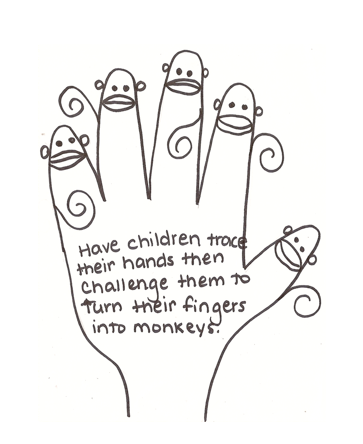
            Draw 5 monkeys, or let the children draw their own.  Cut around the monkey shapes and put a piece of tape onto the back.  The children can build with blocks and then add the 5 monkeys to swing from their structures.

Physical Health & Development/Fine Motor Skills; grows in hand-eye coordination in building with blocks, putting together puzzles, reproducing shapes and patterns, stringing beads, and using scissors.

Art

            Put sand into the paint at the easel today.  When it dries the surface will be a rough texture like a crocodiles back.  Put out green, brown, and white paint to simulate a crocodiles coloring.

Creative Arts/Art; begins to understand and share opinions about artistic products and experiences.

Library and Writing

            Show the children the How to Draw a Monkey page.  Encourage them to try to follow the steps and make five monkeys. 

Mathematics/Geometry & Spatial Sense; progresses in ability to put together and take apart shapes. AND Creative Art/Art; progresses in abilities to create drawings, paintings, models, and other art creations that are more detailed, creative, or realistic.

Sand and Water

            Put water into the table today.   Add several long blocks that the children can pretend are crocodiles.  They can bob these up and down or pour water over them. Add counting bears or similar manipulative, how many bears can the children float on the block/crocodiles back?

Mathematics/Number & Operations; begins to make use of one-to-one correspondence in counting objects and matching groups of objects.

Dramatic Play

            Bring in a basket and a towel or blanket.  The children can pretend to go on a picnic.

Creative Arts/ Dramatic Play; shows growing creativity and imagination in using materials and in assuming different roles in dramatic play situations. AND Literacy?book Knowledge & Appreciation; demonstrates progress in abilities to retell and dictate stories from books and experiences,; to act out stories in dramatic play; and to predict what will happen next in a story.

Math and Manipulatives

            Bring in a deck of cards.  Take out all the face cards.  Shuffle the cards and pass them out evenly between 2-4 players.  Have the children put their pile of cards face down in front of them.  On the count of three, everyone turns over their top card.  The person with the highest number gets to take all the cards and put them in a second pile beside them.  If two or more players turn over the same number, they must slap their card and say SNAP!  The one who says snap first gets to take all the cards and put them beside them.  Play until one person has all the cards or the children loose interest.

Mathematics/Number & Operations;begins to associate number concepts, vocabulary, quantities, and writen numerals in meaningful ways. AND Social & Emotional Development/Cooperation;develops increasing abilities to give and take in interactions,; to take turns in games and using materials; and to interact without being overly submissive or directive.

Outdoor Play 

            If you have a tree or structure to climb, let the children pretend to be the monkeys and the teacher can go about snapping like a crocodile at them.

Literacy?book Knowledge & Appreciation; demonstrates progress in abilities to retell and dictate stories from books and experiences,; to act out stories in dramatic play; and to predict what will happen next in a story.

Transitions

            As children move on to the next activity, hold up 1-5 fingers and say 4-1=? (Four take away one equals how many?)  Do different combinations and have the children figure out the math equation.  Make sure to use only 1-5 unless your children are older then try 1-10.  Use your fingers as a visual cue to help the children.

Mathematics/Number & Operations; develops increasing abilities to combine, separate and name “how many” concrete objects.

Resources
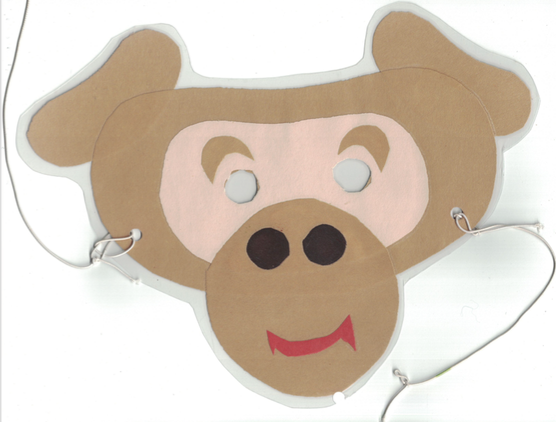
Monkey mask for dramatics

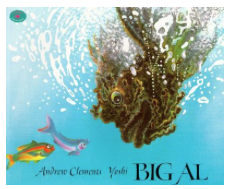
Big Al, by Yoshi

Big Al is a fish that is very big and scary looking.  All the other fish stay away never realizing that he is kind and brave until one day…Big Al saves the day.

Materials

  • Camouflage pictures
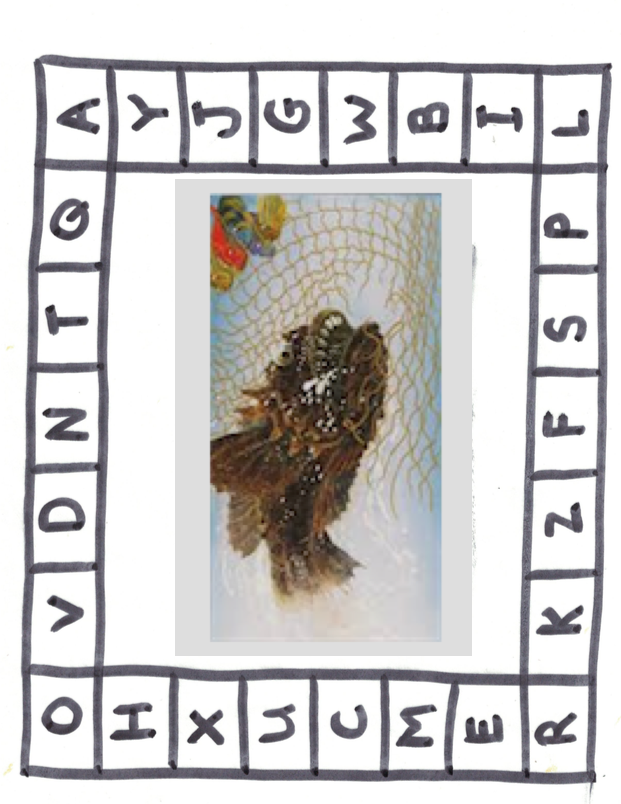
  • Alphabet Fish page
  • Five little fish
  • 20 more big ugly fish
  • Individual picture of each child in your classroom
  • One index card per child

Vocabulary

  • Plowed (run right into someone or something)
  • Tremendous (great big)
  • Camouflage (to disguise or hide)

Before Reading the Story

Reading the Story

On the page when Big Al thought that he would never have a friend and something happened, stop and ask the children if they can guess what they think Big Al is going to do?  When you finish the story, ask the children if Big Al was a good friend, why? 

Language Development/Speaking Understanding; develops increasing abilities to understand and use language to communicate information, experiences, ideas, feelings, opinions, needs, questions; and for other varied purposes.

After Reading the Story

Talk with the children about how friends can help each other.  Mention any incidents that you have recently seen of one classmate helping another (At breakfast I saw Ryan help Michael to cut his waffle, Alison helped Ann to zipper her party dress in the dramatic corner).  Ask the children if they can think of a time when a friend helped them.  Ask the children what they should say to another person who helps them (thank you). 

Social & Emotional Development/Social Relationships; shows progress in developing friendships with peers.

Discovery

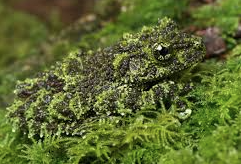
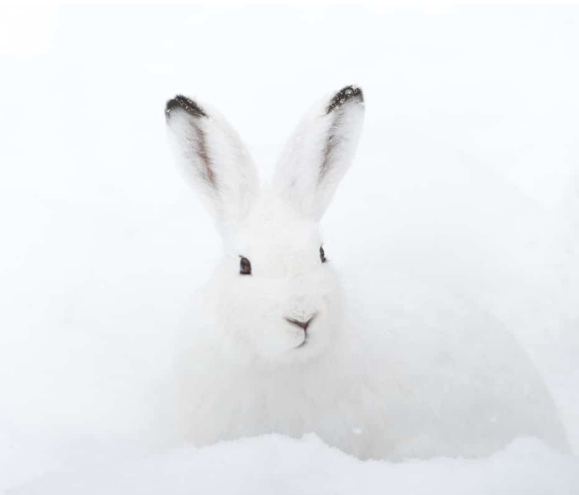
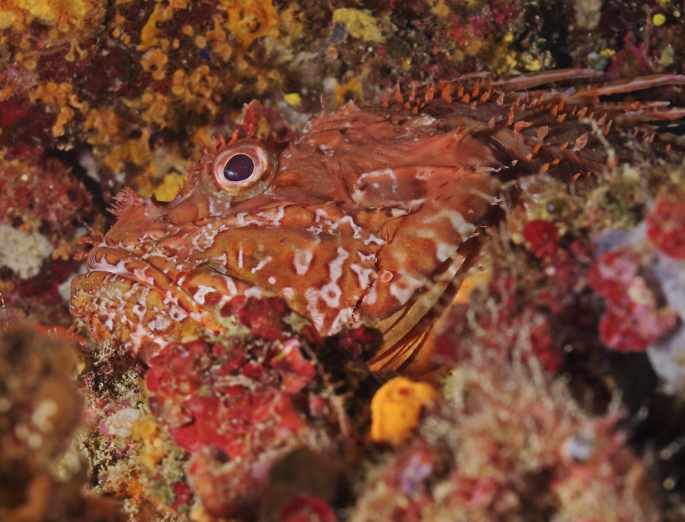
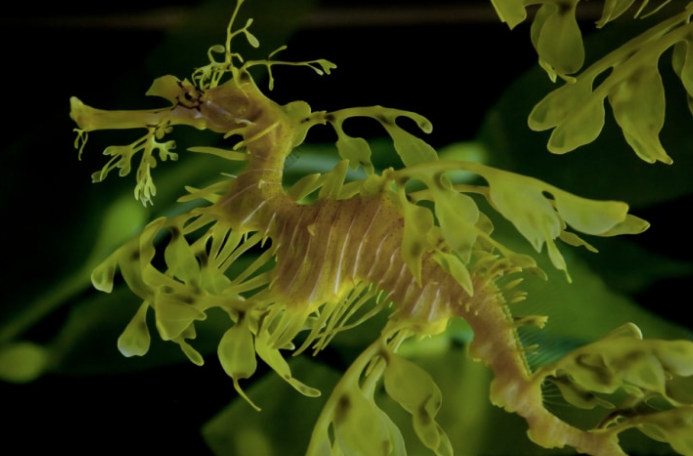
In the story, Big Al tried to camouflage himself.  Put out pictures of animals that are camouflaged for the children to look at. 

Science/Scientific Knowledge; expands knowledge of and abilities to observe, describe, and discuss the natural world, materials, living things, and natural processes.

Music and Movement

Sing The More We Get Together  https://www.youtube.com/watch?v=lldmkrJXQ-E

Creative Arts/Music; participates with increasing interest and enjoyment in a variety of music activities, including listening, singing, finger plays, games, and performances.

Do the chant, 2,4,6,8, Who Do We Appreciate?  Then add a child’s name and clap out the syllables.  2,4,6,8, who do we appreciate?  Ro-ger, Ro-ger, Ro-ger.  2,4,6,8, who do we appreciate?  Pri-scil-la, Pri-scil-la, Pri-scil-la.  Go around the circle and do everyone’s name.

Literacy/Phonological Awareness; shows growing ability to hear and discriminate separate syllables in words.

Finger play, Five Little Fish

One little fish alone and new

Soon she finds a friend and now there are two.

Two little fish swimming in the sea

They meet another friend and now there are three.

Three little fish swim along the shore

Soon they see a friend and now there are four.

Four little fish go for a dive

There they find another friend and now there are five.

1,2,3,4,5.

Mathematics/Number & Operations; begins to associate number concepts, vocabulary, quantities, and written numerals in meaningful ways.

Blocks

Cut around pictures of the children and tape or contact paper each one to a small unit block.  As the children play in the block center they can use their friend pictures as part of their play.

Approaches to Learning/Initiative & Curiosity; approaches tasks and activities with increased flexibility, imagination, and inventiveness.

Art

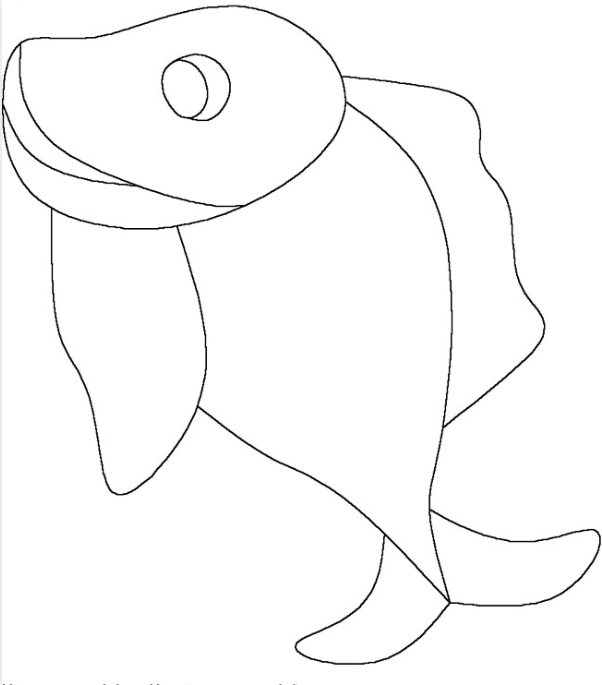
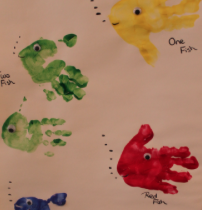
Finger-paint today.  As the children finger paint, have them make a handprint on a separate piece of paper.  When this dries, embellish.  Cut around and glue them all onto a large piece of blue paper.  Make a bulletin board, A School of Friends.

Creative Arts/Art; gains ability in using different art media and materials in a variety of ways for creative expression and representation.

Sand and Water

Put sand into the table today and then pour water on top. Add any plastic sea creatures/fish that you have.  The children can bury the creatures in the sand to hide and camouflage or pretend to swim them in the water. 

Creative Arts/ Dramatic PLay; shows growing creativity and imagination in using materials and in assuming different roles in dramatic play situations.

Library and Writing

Give each child a copy of the Alphabet Fish Page and several crayons or markers.  Put a basket of magnet letters in the middle of the table.  Let the children take turns picking a magnet letter out of the bowl.  The children then look for that letter on their alphabet page and color it in.  Play until all 26 letters have been found.

Literacy/Alphabet Knowledge; shows progress in associating the names of letters with their shapes and sounds.

Dramatic Play

Encourage the children ask a friend to help with the zippers, buckles, and buttons on your dress-up clothing.

Social & Emotional Development/Cooperation; increases abilities to sustain interactions with pers by helping, sharing, and discussion.

Math and Manipulatives

Cut out 20 fish shapes.  Make two sets of fish labeled 1-10.  Challenge the children to line the fish up starting with number one and going to number ten.  Are they able to identify the numbers?  For younger children use 1-5 and add dots that they can count.

Mathematics/Number & Operations; begins to associate number concepts, vocabulary, quantities, and written numerals in meaningful ways.

Outdoor Play

Play Swimming in a School.  The teacher is the leader and the children follow as in Follow the Leader.  Swim around the tree, under the climber, on top of the bench, etc.

Physical Health & Development/Health Status & Practices; participates actively in games, outdoor play, and other forms of exercise that enhance physical fitness.

Transitions

Write each child’s name on an index card.  Hold up the card and ask whose name is this?  That child can then help name the letters before going off to the next activity.

Literacy/Alphabet Awareness; identifies at least 10 letters of the alphabet, especially those in their own name.

Resources