Every Buddy Counts, by Stuart J. Murphy

            What do you do when you wake up feeling lonely, crummy, yucky, and sad?  Count your friends and you will feel better!  This is a nice counting book to share with your children.

Materials

  • Rebus Gorp recipe cards
  • Gorp ingredients for the class
  • Dice

Vocabulary

  • More and less

Before Reading the Story

           Do several fingerplays or songs that require some counting (5 Little Ducks, 1,2,3,4,5 I Caught a Fish Alive).

Mathematics/Number & Operations; develops increasing ability to count in sequence to 10 and beyond.

Reading the Story

            As you read the book, stop and have the children help count (Example; On the page for 7, count the aunts and uncles and the cars.  Are there more people or more cars?  On the eight page after counting the playmates, ask what the girl is holding in her hand, What is it used for?)

Literacy/Book Knowledge & Appreciation; shows growing interest and involvement in listening to and discussing a variety of fiction and non-fiction and poetry. AND Mathematics/Number & Operations; begins to make use of one-to-one correspondence in counting objects and matching groups of objects.

After Reading the Story

            Bring in a dice.  Take turns rolling the dice and having the children count how many dots.  Then let the child choose a movement for everyone to do that many times. (Kerry you rolled 3.  Kerry wants to do 3 kicks, everybody kick and count 1,2,3.)

Mathematics/Number & Operations; begins to make use of one-to-one correspondence in counting objects and matching groups of objects. AND Physical Health & Development/Health Status & Practices; participates actively in games, outdoor play, and other forms of exercise that enhance physical fitness.

Discovery

            Make gorp using the rebus cards to count out ingredients.

Literacy/Print Awareness & Concepts; develops growing understanding of different functions of forms of print such as signs, letters, newspapers, lists, messages, and menus. AND Mathematics/Number & Operations; begins to make use of one-to-one correspondence in counting objects and matching groups of objects.

Music and Movement

            Have the children start in a squatting position and begin to count 1-10.  As they count, they begin to stand up slowly until they get to 10 and are on tip toe with hands in the air.  Now start a 10 and work down to 1 getting smaller and smaller as they count.

Mathematics/Number & Operations; develops increasing ability to count in sequence to 10 and beyond.

            Teach the children the finger play 1,2,3,4,5 I Caught a Fish Alive.

           1,2,3,4,5                                    Hold up fingers as you count

           I caught a fish alive                      Point towards yourself

           6, 7, 8,9,10                                Hold up fingers as you count

           Then I threw him back again!    Pretend to throw fish

           What made you let him go?         Shrug shoulders up

           Because he bit my finger so!        Hands on hips with mad face

           Which finger did he bite?             Look of  surprise

           The little pinkie on the right        Hold up little pinkie and look sad

Language Development/Listening & Understanding; demonstrates increasing ability to attend to and understand conversations, stories, songs, and poems.

Blocks

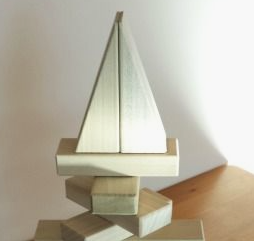
          Challenge the children to make a set of stairs using 10 blocks.  What else can you make using only 10 blocks?

Approaches to Learning/Reasoning & Problem Solving; develops increasing ability to find more than one solution to a question, task, or problem.

Art

            Have the children trace around their hands, or they can trace around their friends hands.  Encourage them to embellish their hands with fingernails, rings, and bracelets or watches at the wrist.  When they are finished decorating their hands, show them how to write the numbers 1-10 and put a number above each finger.

Literacy/Early Writing; experiments with a growing variety of writing tools and materials, such as pencils, crayons, and computers. AND Mathematics/Number & Operations; begins to associate number concepts, vocabulary, quantities, and written numerals in meaningful ways.

Library and Writing

            Put out a variety of flannel board shapes and let the children make patterns or count.

Mathematics/Patterns & Measurements; enhances abilities to recognize, duplicate, and extend simple patterns using a variety of materials.

Sand and Water

            Put sand or water in the table.  Ask the children to use a measuring cup and count how many scoops it takes to fill a bowl.  Use several size measuring cups and a variety of containers to fill.  Which containers hold the most?  Which container holds the least?

Mathematics/Number & Operations; begins to use language to compare numbers of objects with terms such as more, less, greater than, fewer, equal to.

Math and Manipulatives

            Make a counting book with the children.  Give each child a paper with a number on it.  The children can draw or cut out pictures of objects to represent their number.  Do numbers 1-10.

Mathematics/Number & Operations; begins to make use of one-to-one correspondence in counting objects and matching groups of objects.

Dramatic Play

            Have the children set the table for two, three, and four.  They will have to count to make sure they have enough dishes and silverware.

Mathematics/Number & Operations; begins to make use of one-to-one correspondence in counting objects and matching groups of objects.

Outdoor Play

           Play Mother-May-I?  All the children stand at one side of the area.  The children take turns asking “Mother may I take (3) (jumps)?  Mother then says yes, or no you may only take (2) jumps.  The children work their way across to the other side of the play yard counting different movements. (Slides, tippy toe walks, giant steps, skips, jumps, twirls).

Mathematics/Number & Operations; begins to make use of one-to-one correspondence in counting objects and matching groups of objects. AND Physical Health & Development/Gross Motor Skills; shows increasing levels of proficiency, control, and balance in walking, climbing, running, jumping, hopping, skipping, marching, and galloping.

Transitions

            Have the children count how many steps it takes to get from point A to point B.

Mathematics/Number & Operations; demonstrates increasing interest and awareness of numbers and counting as a means for solving problems and determining quantity.
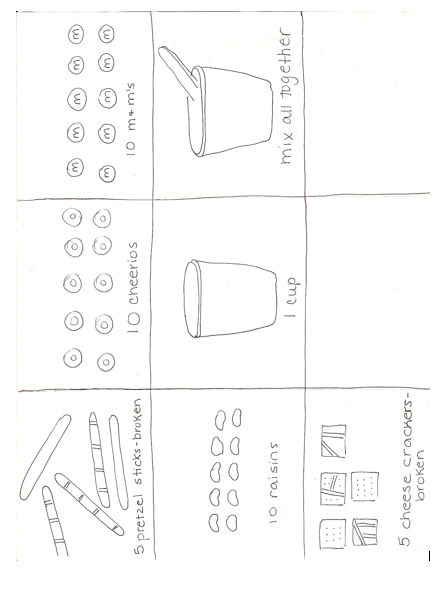
Cut out and put into order for children to follow recipe for Gorp

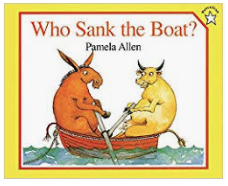
Who Sank the Boat? By, Pamela Allen

Five friends decide to go for a boat ride… This book is a who done it for preschoolers.  Will they be able to figure out who sank the boat? 

Materials

  • Plastic lids of various sizes.
  • A dishwashing tub
  • Naptime mat or blanket
  • Boat picture for writing center
  • Boat picture to cut around for art

Vocabulary

  • Bay (harbor or cove)
  • Tilted (to make the boat angle crookedly)
  • Din (lots of loud noise)
  • Bow (the front of the boat)
  • Flutter (to make the boat go up and down)

Before reading the Story

Show the children the front of the book.  Ask if any have ever been in a boat?  What are these animals not doing for safety?  (Wearing a life preserver).  Talk about what a life preserver does.  Do you ever wear one when you are swimming?  Always wear a life preserver in a boat, it’s the law.

Physical Health & Development/Health Status & Practices; builds awareness and ability to follow basic health and safety rules such as fire safety, traffic and pedestrian safety, and responding appropriately to potentially harmful objects, substances, and activities.

Reading the Story

On the page where the reader is first asked, “Do you know who sank the boat”?  Stop and let the children make a prediction about who they think will sink the boat and why.  Each time the author asks, “Do you know who sank the boat”? stop and let the children change their prediction if they like.

Approaches to Learning/Reasoning & problem Solving; develops increasing abilities to classify, compare, and contrast objects, events, and experiences.

As the different animals are getting into the boat, can the children name the expressions? (fear, nervousness, relief). Can they tell you about a time that they felt these emotions?

Language Development/Speaking & Communicating; develops increasing abilities to understand and use language to communicate information, experiences, ideas, feelings, opinions, needs, questions,; and for other varied purposes.

After Reading the Story

Ask the children to name the 5 animals that were in the boat.  Ask the children if they think just one animal sank the boat, why?  Now ask the children if they noticed what was happening to the boat each time an animal friend got in.  Go back through the pages and show them how the boat is getting lower and lower in the water.  Ask them if they know what is causing the boat to sink?

Science/Scientific Knowledge; shows increased awareness and beginning understanding of changes in materials and cause-effect relationships.

Discovery

Do a float and sink experiment.  Bring a variety of objects from the classroom over to a large tub of water.  Ask the children to predict if it will float or sink.  Can they explain why they think so?

Science/Scientific Skills; begins to participate in simple investigations to test observations, discuss and draw conclusions, and form generalizations.

Music and Movement

Sing Row Row Row Your Boat https://www.youtube.com/watch?v=7otAJa3jui8  After singing it through once or twice, ask the children to get a partner and sit facing each other holding hands. Now sing a verse and have the children rock back and forth. Have the children sit back to back and row the boat. Sit side by side. What other ways can the children think to row the boat with their partner?

Creative Arts/Movement; shows growth in moving to different patterns of beat and rhythm in music.

In the story there were lots of rhymes today.  Who remembers what rhyming words are?  Sing Rhyming Words Sound the Same 

Rhyming words sound the same (clap, clap)

Rhyming words sound the same. (clap, clap)

Rhyming words sound the same (clap, clap)

Rhyming words sound the same. (clap, clap)

Say a word and see if the children can name a rhyming word. Bring in pictures of rhyming words. Put half the rhymes up on a board where everyone can see them and then each time you sing, hold up a picture from the other half of the rhyming words. Can the children see and name the rhyming words?

Literacy/Phonological Awareness; progresses in recognizing matching sounds and rhymes in familiar words, games, songs, stories, and poems.

Blocks

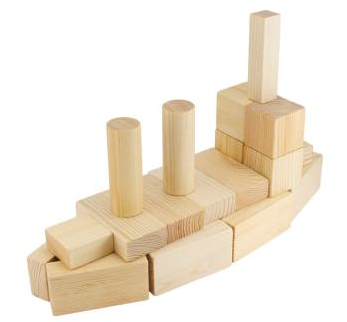
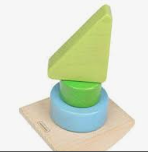
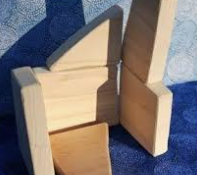
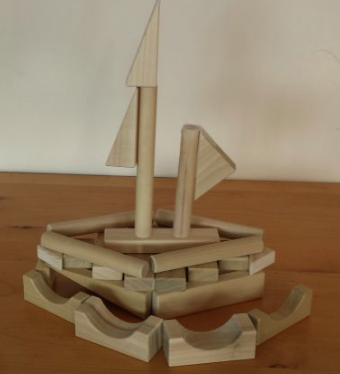
Challenge the children to make boats out of blocks. Print and hang pictures of block boats.  Challenge your children to read the model and make their own boats from blocks.

Approaches to Learning/Engagement & Persistence; grows in ability to persist and complete a variety of tasks, activities, projects, and experiences.

Art

Watercolor paints.  Can you paint a lake?  Give each child a simple boat shape to cut out and glue onto their lake picture when it is dry.

Creative Arts/Art; gains ability in using different art media and materials in a variety of ways for creative expression and representation. AND Physical Health & Development/Fine Motor Skills; develops growing strength, dexterity, and control needed to use tools such as scissors, paper punch, stapler, and hammer.

Cut out various sized squares, rectangles, and triangles from assorted papers.  Encourage the children to put them together to make boats.  Glue to paper.

Approaches to Learning/Engagement & Persistence; demonstrates increasing ability to set goals and develop and follow through on plans. AND Mathematics/Geometry & Spatial Sense; progresses in ability to put together and take apart shapes.

Sand and Water

Add water to the table today along with the counting bears and plastic lids.  Show the children how to float the lid like a boat.  How many counting bears can they get on the boat before it tilts and sinks?

Mathematics/Number & Operations; demonstrates increasing interest and awareness of numbers and counting as a means for solving problems and determining quantity.
Library and Writing

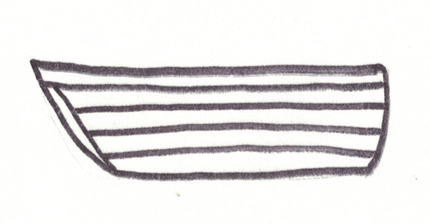
Give the children a copy of the boat picture.  Encourage them to draw friends, either real or imaginary in the boat. Ask them to tell you about their boat and write their words underneath.

Literacy/Early Writing; begins to represent stories and experiences through pictures, dictation, and play.

Dramatic Play

Use a mat or blanket to pretend it is a boat.  Remind the children about water safety, wear a life preserver.  Talk to the children about boat safety.  What were the animals NOT wearing that they should have been?  Life preservers.  Use scarves to be pretend life preservers.  The children can drape them over their shoulders and pretend to be out in a boat. Add fishing poles and a picnic lunch.

Creative Arts/ Dramatic Play; participates in a variety of dramatic play activities that become more extended and complex.

Math and Manipulatives

Today would be a good day to reintroduce your children to the balance scale. Put out a bowl of one inch cubes and a variety of small objects to weigh. How many cubes does a plastic banana weigh? How many cubes does a rock weigh? Can you find something that weighs less than a one inch cube?

Mathematics/Number & Operations; begins to make use of one-to-one correspondence in counting objects and matching groups of objects.

Outdoor Play

If you are doing this unit in the summer, have a water day on the playground!  Set up sprinklers for the children to run through.

Bring your paint outside today.  Hang a large piece of bulletin board paper on the fence today.  Bring out paper plates.  Pour paint onto the plate and use sponge rollers to make a body of water.  When it dries you can use it for the background of the children’s boats made in art.

Creative Arts/Art; gains ability in using different art media and materials in a variety of ways for creative expression and representation.

Transitions

As the children prepare to go to the next activity ask each one to name an object that is heavier than a _____. Also try lighter than a _______, bigger than a ______, smaller, Longer/shorter.

Mathematics/Patterns & Measurement; begins to make comparisons between several objects based on a single attribute.

Resources

Matthew and Tilly, by Rebecca C. Jones

Matthew and Tilly are best friends, they do everything together.  But sometimes even best friends fight.  Find out how Matthew and Tilly get their friendship back on track.

Materials

  •   Unsweetened lemonade mix, sugar, pitcher
  •   Grocery or gift bags
  •   Old receipts
  •  Several boxes (liquor store sized)

Vocabulary

  • Sick of each other (to grow tired of being with someone all the time)

Before Reading the Story

 Introduce the book by saying that the story today is about two friends.  Attach a piece of paper to the wall and write, ‘Things I do with my friends/Things I do alone’.  Talk to the children about how there are many things that we can do and like to do with our friends.  Write their responses on the paper.  Then ask them about  things that they can do alone and write these on the other side.

Social & Emotional Development/Self-Concept; begins to develop and express awareness of self in terms of specific abilities, characteristics, and preferences.

Reading the Story

When you get to the page where the crayon gets broken point out the body and facial expressions, ask the children how they would feel if someone called them stinky and stupid (mad, sad, hurt).  Do you think they can still be friends?  Then continue reading.

Language Development/Speaking & Communicating; develops increasing abilities to understand and use language to communicate information, experiences, ideas, feelings, opinions, needs, questions; and for varied other purposes.

After Reading the Story

Begin a discussion about friends.  If someone is your friend, do you have to play with them all the time? Can you have more then one friend?  If you and a friend fight, what can you do?  If you want to play with someone, what can you do?  This discussion works well with puppets.  As you discuss the questions and the problem solving, you can use the puppets to act it out.

Social & Emotional Development/Self-Control; develops growing understanding of how their actions affect others and begins to accept the consequence of their actions.  AND Approaches to Learning/Reasoning & Problem Solving; grows in recognizing and solving problems through active exploration, including trial and error, and interactions and discussions with peers and adults.

Discovery

 Matthew and Tilly made lemonade in the story.  Make lemonade with the children.  Before adding all the sugar, let the children taste the lemonade.  What does sugar do to food?

Science/Scientific Skills & Methods; begins to participate in simple investigations to test observations, discuss and draw conclusions, and form generalizations.

Music and Movement 

  Ahead of time, write each child’s name on a piece of paper.  Teach the children the song, There is a Friend at My School (sung to BINGO). Hold up a name, point out the letters as you sing, and let the children call the name out at the end of the verse

There is a friend in my class,

Can you guess his/her name-o?

K-e-r-r-y, K-e-r-r-y, K-e-r-r-y

And Kerry is her name-o.

Literacy/Alphabet Knowledge; knows that letters of the alphabet are a special category of visual graphics that can be individually named.  AND Literacy/Alphabet Knowledge; shows progress in associating the names of the letters with their shapes and sounds.

Art

 Tell the children that you need their help.  You have some boxes that you want to use to hold books, store materials in the closet, etc..  You need the children to work with a friend or friends to paint them for you. Put out the boxes, paint, brushes and/or rollers.  When they are finished make sure to thank them for helping you. 

Approaches to Learning/Engagement & Persistence; grows in abilities to persist in a nd complete a variety of tasks, activites, projects, and experiences.  AND Social & Emotional Development/Cooperation; shows increasing abilities to use compromise and discussion in working, playing, and resolving conflict with peers.

Sand and Water

 Add funnels, tubing, and tall bottles to the water today.  The idea is to use water and equipment that will require an extra hand from a friend to hold or stabilize.  

Social & Emotional Development/Cooperation; increases abilities to sustain interactions with peers by helping, sharing, and discussion.

Library and Writing

 Talk to the children about something they like to do with a friend.  Encourage them to draw a picture of themselves and a friend/s doing it. Write their dictation underneath.

Literacy/Early Writing; begins to represent stories and experiences through pictures, dictation, and play.

Math and Manipulatives

Make a graph of the children’s favorite ice cream flavor.  On a piece of paper write chocolate, vanilla, and strawberry across the bottom.  Let the children mark their favorite flavor. Which flavor had the most votes? Count how many the strawberry vote had.  Write the numbers on the columns so the children can see the results of the ice cream survey. 

Mathematics/Number & Operations; begins to associate number concepts, vocabulary, quantities, and written numerals in meaningful ways.

Dramatic Play

 Bring out the cash register and help the children set up a simple store.  You can use tape to put prices on your food and dress up clothes.  Bring in some bags so the cashier can put the stuff in for the customers.  Bring in old receipts.

Social & Emotional Development/Knowledge of Families & Communities; develops a growing awareness of jobs and what is required to perform them.  AND Creative Arts/Dramatic Play; participates in a variety of dramatic play activities that become more extended or complex.

Outdoor play

Bring chalk outside and make a hopscotch board to play on. Make sure to allow the children to use the chalk to make their own sidewalk games also.

Social & Emotional Development/Cooperation; develops increasing abilities to give and take in interactions; to take turns in games and using materials; and to interact without being overly submissive or directive.  AND Mathematics/Number & Operations; begins to associate number concepts, vocabulary, quantities, and written numerals in meaningful ways.

Transitions

 Have each child show you a facial expression  as you call out the emotion they are to express.  Tell a child to make a face that shows you they are _______.  Use a variety of emotions.  Some emotions  may include; happy, angry, excited, surprised, mad, confused, sleepy, annoyed, nervous, scared, tired, sad, bored, disappointed.     If the child say they do not know what it looks like, give them an example of what may cause that emotion.   (Disappointed is like when you thought we were having spaghetti for lunch but instead we have something you don’t really like).  Have the children watch each others faces so that they can see what the emotion looks like on another person.

Social & Emotional Development/Social Relationships; progresses in responding sympathetically to peers who are in need, upset, hurt, angry; and in expressing empathy or caring for other.