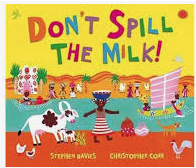
Don’t Spill The Milk! By Stephen Davies

Materials

  • Paper plates , one for each child and 10 extra for transitions

Vocabulary

  • Grasslands (Park lands with tall grass)
  • Dunes (giant hills made of sand)
  • Desert jinn’s (genies)
  • Looming (approaching)
  • Absorb (to soak into something)
  • Chore (to do a task or job for someone)

Introducing the Book

Ask the children if they ever help their parent/s at home. What kinds of things do you do to help? (I helped my Daddy wash his car, I make my bed, I play with my baby when Grandma is cooking supper) Hold up the cover of the book and tell the children that this is the story about a little girl who helps her Mother. Explain that in the bowl is milk that she is to carry to her Father. Ask the children if they have ever carried anything on their heads. Tell them in parts of the world people carry things on their heads and they get SO good at it that they do not even have to hold onto the item/bowl. Introduce the story.

Social & Emotional Development/Knowledge of Families & Communities; develops growing awareness of jobs and what is required to perform them.

Reading the Book

On the pages where Penda is talking to herself, read a little slower so the children can feel her determination to get the milk on top of her head to her father without spilling a drop.

Language Development/Listening & Understanding; understands an increasingly complex and varied vocabulary.  

When you get to the page where the milk spills and Penda says, “It’s all gone!” ask the children what they think will happen next. 

Approaches to Learning/Reasoning & Problem Solving; develops increasing ability to find more than one solution to a question, task, or problem AND LIteracy/Book Knowledge & Appreciation; demonstrates abilities to retell and dictate stories from book sna experiences; to act out stories in dramatic play; and to predict what will happen next in a story.

After Reading the Book

When you get to the page that says, “Tell her it comes with all my love”, see if the children can look at the picture and recall some of the places that Penda carried the milk.

Literacy/Book Knowledge & Appreciation; demonstrates progress in abilities to retell and dictate stories from books and experiences; to act out stories in dramatic play; and to predict what will happen next in a story.

Music and Movement

Get out the beanbags and tell the children to put a beanbag on top of their head. Can they walk forward without the beanbag falling? Backwards? Can they bend down slowly and touch the ground? What other ways can they think of to carry the beanbag (on their foot, on their bent over back, on their shoulder). Let them practice doing different walks and movements without dropping the beanbag.

Physical Health & Development/Gross Motor Skills; shows increasing levels of proficiency, control, and balance in walking, climbing, running, jumping, hopping, skipping, marching, and galloping.

Discovery

Put a tray or cookie sheet onto the science center table. On the tray put a variety of objects that will absorb water and some that will not. (Cotton ball, paper towel, part of a clean-unused diaper, a scarf, and a piece of construction paper. Also include items such as a crayon, a Lego, and a plastic animal). Give the children a small cup of water and an eyedropper. Let them experiment filling the dropper with water and squirting it onto the object. What happens to the water? Talk with them as they experiment asking, “Do you think that paper towel will absorb the water”? Have them sort the items by those that absorb water and those that do not.

Science/Scientific Skills & Methods; begins to use senses and a variety of tools and simple measuring devices to gather information, investigate materials, and observe processes and relationships.

Art

Open the book to the mask dance page and tell the children that they are going to make their own masks. Put out markers and collage materials. When the children have completed their masks they can be attached to a sentence strip to be worn, or to a popsicle stick to be held in front of their face.

Creative Arts/Art; develops growing abilities to plan, work independently, and demonstrates care and persistence in a variety of art project.

Sand and Water

Put water in the table today and add plastic lids of various sizes and small manipulatives such a counting bears. Challenge the children to put different amounts of bears onto the plastic lid that is floating in the water. Do certain lids hold more bears? Does the shape of the lid matter? Let the children explore floating and buoyancy (the ability to stay afloat).

Science/Scientific Knowledge; begins to describe and discuss predictions, explanations, and generalizations based on past experiences. AND       Mathematics/Number & Operation; begins to use language to compare numbers of objects with terms such as more, less, greater than, fewer, and equal to.

Library and Writing

Put the book into the center along with any other multicultural books you may have and a globe/world map. As the children pick up a book, show them on the globe/map, where the story takes place. Always show them where your school is located also.

Social & Emotional Development/Knowledge of Families & Communities; begins to express and understand concepts and language of geography in the contexts of the classroom, home, and community.

Dramatic Play

Encourage the children to work together and clean the center. Give them damp paper towels to wipe the shelves. Tell them thank you for your good cooperation.

Social & Emotional Development/Cooperation; increases abilities to sustain interactions with peers by helping, sharing, and discussing.

Math and Manipulatives

Give children a small manipulative such as a counting bear and have them follow your verbal directions. Ask them to make their manipulative climb up their body and then back down to their knee. Have the manipulative go around their knee and hide behind. Have their manipulative now come around to the front of their body and now go beside. Ask the children if they can make their manipulative go under a body part and then over another body part. Have them put the manipulative beside them and clap their hands as they did a good listening job.

Mathematics/Geometry & Spatial Sense; builds an increasing understanding of directionality, order, and positions of objects, and words such as up, down, over, under, top, bottom, inside, outside, in front, behind.

Outdoor play

Challenge the children to work together today using shovels to dig a long river in your sandbox. Can they add some dunes to the side of the river? If the weather is not too cold, let the children help fill the river up with water. What happens to the water? Remind those who were in the science center today that this is another form of absorption!

Science/Scientific Knowledge; shows increased awareness and beginning understanding of changes in materials and cause-effect relationships.  AND    Social & Emotional Development/Cooperation; develops increasing abilities to give and take in interactions; to take turns in games or using materials; and to interact without being overly submissive or directive.

Transitions

On 1-10 paper plates, write a letter on each. These should be letters that begin with the children’s names or letters that you have been working on with the children. Scatter the letters about on the floor about a step away from each other. Tell the children that they will have to walk the path to get to the next activity. Have one child at a time stand up beside the letters. Ask them if they can name the letter as they step onto the paper plate. Or you can name the letters and then they step onto the plate. Have them walk on 3-5 letters and then send them off to the next activity.

Literacy/Alphabet Knowledge; Knows that the letters of the alphabet are a special category of visual graphics that can be individually named.

Resources

Dear Parents-Today we read a book about a little girl who helps her Mother by carrying milk to her Father who is up in the grasslands shepherding sheep. See if you can find a way that your child can be a helper to you doing something for someone else or around the house. Make sure to thank them after they have completed the chore and to tell them how much you appreciate them being a helper to you.

The Napping House, by Audrey Wood

            Naps are very important to help us grow.  This fun story is about a house that is napping, until a wakeful flea arrives, then everything goes crazy.

Materials

  • Copy of characters. Make into flannel pieces by covering with contact paper and taping to the board. Pictures come from; Projecto A casa sonolenta em LIBRAS

Vocabulary

  • Colored construction paper cut into one-inch lengths.
  • Construction paper that has been made into a weaving frame (see resources).

Before reading the story

            Hold up the cover of the book and say the title.  Ask the children why they think naps are important (we grow while we sleep, when we are tired we do not think as well, naps help us from getting crabby).  Talk about how the children sleep (Kerry always falls asleep first, Roger likes to read a book before he takes a nap, and Ryan you are usually the last to fall asleep).  Turn off the light if you have window light to darken the room slightly.

Social & Emotional Development/Self-Concept; begins to develop and express awareness of self in terms of specific abilities, characteristics, and preferences.

Reading the Story

            As you read the pages where everyone is sleeping, use a soothing voice and yawn as you turn the pages.  Point to each critter as they climb onto the bed.  When you get to the page where the flea bites the mouse, change your voice to one of surprise and a quicker pace.

After reading the story

            Ask the children if they noticed the flea in the first half of the story.  Go back through the pages and look for the flea.  Use the copy of the characters to put onto the bed in the correct order (Who was the first one on the bed?  Who was second, third, fourth, etc).

Literacy/Book Knowledge & Appreciation; demonstrates progress and abilities to retell and dictate stories from books and experiences; to act out stories in dramatic play; and to predict what will happen next in a story.

Discovery

            If you have nesting toys these would be good to put into the center.  I use the Russian nesting dolls and talk about smallest, bigger, bigger, and largest.

Mathematics/Patterns & Measurement; shows increasing abilities to match, sort, put in a series, and regroup objects according to one or two attributes such as color, shape, or size.

Music and Movement

            Put lullabies on during the day as background music.

Blocks

            Encourage the children to make a bed and load it up with animals.  How many animals can you get on the bed?  Can you put the cow on top of the tiger?

Mathematics/Number & Operations; demonstrates increasing interest and awareness of numbers and counting as a means for solving problems and determining quantity.

Art

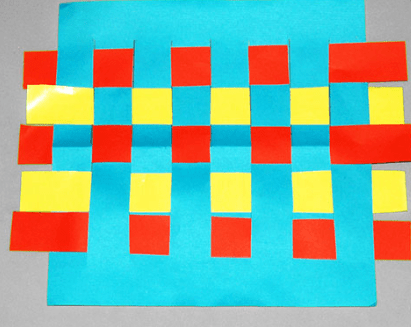
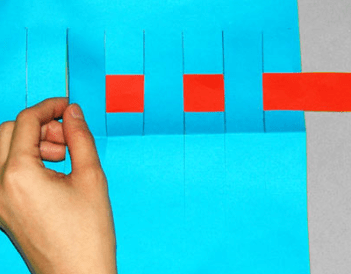
Make woven blankets. Fold a piece of construction paper in half the long length, one per child. Cut from the fold to approximately one inch from the outside edge. Open up, this is your weaving frame. Cut many one inch lengths of colored construction paper. Show the children how to take a length of colored paper and go under, over, under, over the weaving frame stripes. Take the next piece of colored paper and go over, under, over, under. Continue filling in the weaving frame.

Mathematics/Pattern & Measurement; enhances abilities to recognize, duplicate, and extend simple patterns using a variety of materials. AND Physical Health & Development/Fine Motor Skills; grows in hand-eye coordination in building with blocks, putting together puzzles, reproducing shapes and patterns, stringing beads, and using scissors.

Sand and Water

            Put out water and colanders or plastic containers with holes punched into the bottom to simulate rain.  Note that in the story it was raining outside the window. As they play, talk to them about rain. Talk about how it is important to be safe and come out of the rain if you hear thunder or see lightning.

Physical Health & Development/Health Status & Practices; builds awareness and ability to follow basic health and safety rules such as fire safety, traffic and pedestrian safety, and responding appropriately to potentially harmful objects, substances, and activities.

Library and Writing

            Give the children a piece of white paper and, tell them that you are going to tell them how to make a Mexican blanket.  Have them turn the paper the tall way (vertically).  On the top of the paper use a pencil and make an L on the left and an R on the right.  Model with your own piece of paper.  Tell, and show, the children to draw a blue dotted line from the left side to the right.  Next, tell and show them to draw a curly yellow line from the left side to the right.  Continue this using a variety of colors and different kinds of lines until they have filled their paper.  Use words that describe lines as you model ( dotted line, curly line, zig-zag line, straight line, thick line, wavy line). 

Language Development/Speaking & Communicating; uses an increasingly complex and varied vocabulary. AND Language Development/Listening & Understanding; show progress in understanding and following simple and multiple-step directions, AND Literacy/Early Writing; experiments with a growing variety of writing tools and materials, such as pencils, crayons, and computers.

Dramatic Play

            Use boxes and blankets to make beds.  Add stuffed animals. Encourage the children to act out the story.

Literacy/Book Knowledge & Appreciation; demonstrates progress and abilities to retell and dictate stories from books and experiences; to act out stories in dramatic play; and to predict what will happen next in a story.

Outdoor Play

            Tell the children that you are going to play a game of night and day.  Have the children sit in a circle.  Stand in the middle of the circle, holding your arms out and your hands up with your fingers spread.  Tell the children that your hands are the sun and when the sun is shining on them they are awake.  If your hands are not shining on them they are to pretend that they are asleep.  Slowly start turning in the circle and help them get the rhythm of the game.  As they are able to wake and sleep while you turn, speed up and slow down and see if they can keep up with your rhythm.

Approaches to Learning/Initiative & Curiosity; chooses to participate in an increasing variety of tasks and activities.

Transitions

Put a piece of tape on the backs of each of the napping house figures. Ask a child to put the dog over the cat or the grandmother under the mouse. Each child can have a turn moving pieces as they go to the next activity.

Mathematics/Geometry & Spatial Sense; builds an increasing understanding of directionality, order, and positions of objects, and words such as up, down, over, under, top, bottom, inside, outside, in front, behind.

Resources

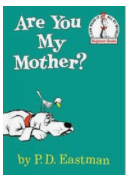
Are You My Mother? by PD Eastman

One day a baby bird hatches from his egg and his mother is not there! Follow little birds’ trail as he looks for his mother.

Materials

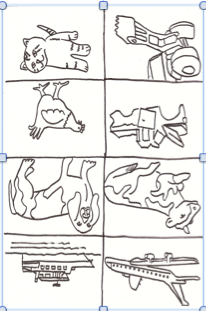
  • Pictures of things that are alive/not alive from story and magazines
  • Several scarves or bandanas
  • Colored feathers or pieces of paper strips to represent feathers

Vocabulary

  • Alive (something that eats/drinks, grows, depends upon their environment where they live, and breaths.)

Before Reading the Story

Ask the children if they know what it means to be alive. Define for them that being alive means things that eat/drink, grow, depend upon their environment where they live, and breathe. Ask the children if a fish is alive, a bear, their Mom, a rock, a tree? Make a list of alive-not alive with the children. Ask the children about a variety of objects and list them on a sheet of paper as ‘alive’-‘not alive’. Add any items to the list that they might share.

Science/Scientific Knowledge; Expands knowledge of and abilities to observe, describe, and discuss the natural world, materials, living things and natural processes.

Reading the Story

As you read the story, ask the children about each thing that the baby bird thinks is its Mother. What is it? Is it alive, or not alive?  Why or why not? (a car does not breathe and does not grow).

Language Development/Speaking and Communicating; develops increasing abilities to understand and use language to communicate information, experiences, ideas, feelings, opinions, needs, questions; and for other varied purposes.

After Reading the Story

Ask the children if they remember why the mother bird left the nest. Talk to the children about what they would do if they woke up and could not find their mother? Would you be scared? Ask if anyone has ever gotten lost in a store or a park. How did it feel? If the children have not had this experience, share one of yours with them.   What should you do if you are lost or you cannot find your parent?

Physical Health & Development/Health Status & Practices; Builds awareness and ability to follow basic health and safety rules such as fire safety, traffic, and pedestrian safety, and in responding appropriately to potentially harmful objects, substances, and activities.

Discovery

Tell the children that the baby bird thought all kinds of things were his mother.   Some were alive and some were not, cut and sort magazine pictures by things that are alive and things that are not alive.

Mathematical/Geometry & Spatial Sense; shows growth in matching, sorting, putting in a series, and regroup objects according to one or two attributes such as color, shape, or size. AND Physical Health & Development/Fine Motor Skills; develops strength, dexterity, and control needed to use tools such as scissors, paper punch, stapler, and a hammer.

Music and Movement

Act out being birds. Sit on your eggs and get comfortable. (Children can squat down and pretend to rustle their wings by flapping their arms). Fly down from your nest and look for food. (Children can stand up and pretend to fly around the room). What do you eat? Look for worms and bugs. (Show the children how to pinch their thumb and fingers to make a pretend beak). Use your beak to pick the worm out of the ground. Hold the worm in your beak and fly back to nest and feed your babies. (Open and shut your beak and pretend to feed baby birds in the nest). Now be the baby birds and pop out of the egg. Stretch your wings and peep for food because you are hungry from all that pecking. Practice flapping your wings and then try to fly, slowly at first and then faster.

Creative Arts/Dramatic Play; shows growing creativity and imagination in using materials and in assuming different roles in dramatic play situations.

 Blocks

Add animals, preferably adults and their babies or large and small similar animals for the children to sort as they play.

Mathematics/Patterns & Measurement; shows increasing abilities to match, sort, put in a series, and regroup objects according to one or two attributes such as shape or size.

 Art

Bring out the play dough. Ask the children if they can make a ball, an egg, a long snake, and a mother bird.

Creative Arts/ Art; gains ability in using different art media and materials in a variety of ways for creative expression and representation.

Library and Writing

Ask the children to draw a picture of their Mom, or other caretaker, doing something special with them. Write what the children dictate about their Mom, or other caretaker. (My Mom gives me ice cream, My Grandma took me to the park and we saw a squirrel that runned up the tree).

Literacy/Early Writing; begins to represent stories and experiences through pictures, dictation, and in play.

Sand and Water

Add grass and mud to the table. Challenge the children to make a nest for baby bird. Add small rocks to be eggs.

Approaches to Learning/Initiative & Curiosity; approaches tasks and activities with increased flexibility, imagination, and inventiveness.

Dramatic Play

Put out scarves or bandanas like Mother Bird is wearing. Encourage the children to cook nutritious meals for their babies. (Do you have a fruit for your baby? What vegetable will you cook? What is your baby drinking?)

Physical Health & Development/Health Status & Practices; builds awareness to follow basic health and safety rules.

Math and Manipulatives

Add a variety of colored feathers and a piece of dark paper. Show the children how they can use the feathers to make designs and patterns on the paper.

Mathematics/Patterns & Measurements; enhances abilities to recognize, duplicate, and extend simple patterns using a variety of materials.

Outdoor Play

Teach the children how to not get kidnapped. Tell the children that you are going to pretend to be a stranger and try to take them into your car. Explain to the children that you are going to grab them by the arm and pretend to try to get them in your (pretend) car. Explain to the children that if this were to happen they should throw themselves on the ground and shout loudly, “You are not my mother!” Practice giving each child a turn. Encourage them to shout loud!

Physical Health & Development/ Health Status & Practices; Physical Health & Development/Health Status & Practices; Builds awareness and ability to follow basic health and safety rules such as fire safety, traffic, and pedestrian safety, and in responding appropriately to potentially harmful objects, substances, and activities.

Transitions

As the children go off to the next area, tell them that they are to think of an animal that starts with a letter sound. Use the child’s first letter or one that is simple to think of an animal. Call each child and give them the letter sound i.e.; Kerry-cat, Roger-rhinoceros. Then ask them, “are you my mother?” Help the children respond using a full sentence; “No I am not your mother, I am a cat, meow” “No I am not your mother, I am a rhinoceros, hunn.”

Literacy/Phonological Awareness; shows growing awareness of beginning and ending sounds of words.

Dear Parents, Today we read the book, Are You My Mother? By PD Eastman. In the book the baby bird does not know what his Mother looks like and goes to find her. It might be fun to take a few minutes and look through old pictures that you might have of family members and talk about each one. (This is a picture of me when I was your age and that is Grandpa holding me in his lap.

Resources

Screen Shot 2018-08-08 at 3.29.50 PM