Knuffle Bunny; a Cautionary Tale, by Mo Williems

A trip to the Laundromat ends in disaster as Trixie looses her beloved Knuffle Bunny.  Will she be able to find it?

Materials

A laundry basket or box

Facial expression cards

1 Small Knuffle bunnies and a role of masking tape

Knuffle bunny collage parts

Vocabulary

  • Laundromat (a place where you go to do your laundry if you do not have a washer at home)
  • Boneless (floppy like a wet noodle)

Before Reading the Story

Ask the children if they ever help their parents do chores at home. Give them a moment to talk about any experiences they might have. (I put the forks next to all the plates, I help take care of my baby, I put my toys away in the closet). Ask the children if they have ever helped with the laundry? If some say “yes”, ask if they do the laundry at home or at the special laundry washing place? Ask if they know the name (laundromat). Have all the children repeat this name. Explain that the story today is about a little girl who was helping her Daddy do the laundry at the laundromat. Let’s find out what happens, introduce the book.

Reading the Story

When you get to the page where Trixie realized something, stop and ask the children what they think Trixie realized.  When you get to the page where her Daddy says, “That’s right, we’re going home” stop and look at Trixie’s face.  Ask the children how they think Trixie is feeling right now?  Notice Dad’s face as Trixie continues her temper tantrum.

Language Development/Speaking & Communicating; develops increasing abilities to understand and use language to communicate information, experiences, ideas, feelings, opinions, needs, questions, and for other varied purposes. AND Literacy/Book Knowledge & Appreciation;demonstrates progress in abilities to retell and dictate stories from book sand experiences; to act out stories in dramatic play; and to predict what will happen next in a story.

After Reading the Story

Talk to the children about when they were little how they did not have the words to tell people what they wanted but now they are big and can use their words to tell what they need, or if they are having a problem.  Remind them that now they are big and they know how to use their words to tell what they want or need. Ask them what they should do if they are having a problem? Go over your strategies for problem-solving in the classroom.

Social & Emotional Development/Self Control; shows progress in expressing feelings, needs, and opinions in difficult situations and conflicts without harming themselves, others, or property.

Discovery

Put a globe or map of the United States into your center. Add a state map and a local map (can be found at a realtor’s office). On each map mark where your school is approximately located. Are there any geographical markers near your area such as mountains, rivers, or ocean that you can point out to the children?

Social & Emotional Development/Knowledge of Families & Communities; begins to express and understand concepts and language of geography in the contexts of the classroom, home, and community.

Music and Movement

Remind the children that in the story Trixie went boneless. Do they remember what boneless means? Ask them to demonstrate boneless. Tell them the opposite of boneless is rigid. Ask them if they can show you what ridgid would look like. Play Boneless/Rigid by calling them out and the children act out the appropriate definition.

Language Development/Listening & Understanding; understands an increasingly complex and varied vocabulary.

The Washing Machine song is a fun song to let your children dance to.

Creative Arts/Movement; expresses through movement and dancing what is felt and heard in various musical tempos and styles.

Blocks

Make a map on the floor (with chalk-it will erase out of the carpet), with tape, or on a large piece of butcher paper.  Encourage the children to build a community with homes, stores, a school, etc.

Social & Emotional Development/Knowledge of Families & Communities; begins to express and understand concepts and language of geography in the contexts of the classroom, home, and community. AND Physical Health & Development/Fine Motor Skills; grows in hand-eye coordination in building with blocks, putting together puzzles, reproducing shapes and patterns, stringing beads, and using scissors.

Art

Make a knuffle bunny collage using circle and ovals

Sand and Water;

Put water and a little soap intot he table today along with doll clothes.  Children can pretend that they are the Laundromat.  Hang a string over the table with clothes pins

Library and Writing;

Encourage the children to recall Trixies path to the Laundromat or draw a picture of your house with as many details as you can think of.

Encourage the children to make a map of from your classroom to the playground or another part of your center.  Or, have them draw a map of how to get to school.  What do you pass?

Dramatic Play;

Put the laundry basket or boxes into the center and let the children practice folding and hanging the dress up clothes.  Sort by what you wear on your feet, head, legs, body.

Math and Manipulatives;

Play memory match with the facial cards of Trixie

Outdoor Play;

 Play where’s the knuffle bunny?

Transitions;

Ask do you have a washer and dryer at home or do you go to the laundry mat?  Have them write their name ofn the correct side of the graph
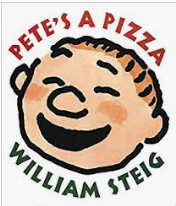
Pete’s a Pizza, by William Steig

Pete’s in a bad mood!  What can Dad do that will cheer him up?

Materials

  • 10 small paper plates
  • Ingredients to make playdough (Non-cook playdough ingredients; 2 cups self rising flour, 2 Tablespoons alum, 2 Tablespoons salt, 2 Tablespoons cooking oil, 1 cup plus 2 Tablespoons boiling water).
  • Playdough or pastry rollers/cutters

Vocabulary

  • Miserable (unhappy, sad)

Before Reading the Story

Tell the children that your story today is about pizza.  Ask the children to raise their hands if they like pizza.  Let them talk about their favorite pizza ingredients, places they eat pizza, or any pizza experience that they might have had.  Introduce the story.

Language Development/Speaking & Communicating; develops increasing abilities to use and understand language to communicate information, experiences, ideas, feelings, opinions, needs, questions; and for other varied purposes.

Reading the Story

This story has a funny plot. As you read, make sure the children can see the pictures so that they can better understand the humor.

Literacy/Book Knowledge & Appreciation; shows growing interest and involvement in listening to and discussing a variety of fiction, non-fiction, and poetry.

After Reading the Story

Ask the children if they remember what kind of a mood was Pete in at the beginning of the story (miserable, sad, mad, lonely). Now ask the children when a friend is feeling miserable or sad, what can they do to make them feel better? (I could give them a hug, I could play with them, I want to be a pizza!).

Social & Emotional Development/Social Relationships; progresses in responding sympathetically to peers in need, upset, hurt, or angry; and in expressing empathy or caring for others.

Discovery

Make play dough!  Let the children help knead the dough until soft and pliable. Use the non-cooking ingredients above and mix and knead them together or use your favorite playdough recipe and let the children do the kneading of the dough.

Science/Scientific Methods & Skills; begins to use senses and a variety of tools and simple measuring devices to gather information, investigate materials, and to observe processes and relationships.

Music and Movement

Sing The Pizza Song to Do You Know the Muffin Man?sung to Do You Know the Muffin Man?

Do you like a cheese pizza?

A cheese pizza, a cheese pizza?

Do you like a cheese pizza?  

Eat it if you do!

Sing several times changing the toppings. The children can pretend to eat the pizza if they like the toppings you are singing about.

Creative Arts/Music; participates with increasing and enjoyment in a variety of music activities, including listening, singing, finger plays, games, and performances.

Sing, If You’re Happy and You Know It.  

If You’re Happy and you know it clap your hands.

If you’re happy and you know it clap your hands.

If you’re happy and you know it, then you really ought to show it,

If you’re happy and you know it clap your hands.

Sing about angry, miserable, tired, etc.

Creative Arts/Music; participates with increasing and enjoyment in a variety of music activities, including listening, singing, finger plays, games, and performances.

Blocks

Encourage the children to act out the story.  First they will need to make the table out of blocks.  Give them some colored paper to represent the cheese and pepperoni.  They can tear it and then take turns turning each other into pizzas.

Literacy/Book Knowledge & Appreciation; demonstrates abilities to retell and dictate stories from books and experiences: to act out stories in dramatic play; and to predict what will happen next in a story.

Art

Do you have playdough wheels in your play dough supply?  Or do you have a pastry wheel at home?  Use these to dip into paint and allow the children to roll back and forth across a piece of circle shaped paper.

Creative Arts/Art; gains ability in using different art media and materials in a variety of ways for creative expressions and representation.

Sand and Water

Put flour into the table today with a couple of sifters and plates.  This will be messy but the flour has a wonderful silky feel. Make sure the children do not add any water or you will have an even bigger mess.

Social & Emotional Development/Self-Control; demonstrates increasing capacity to follow rules and routines and use materials purposefully, safetly, and respectfully. AND Approaches to Learning/Initiative & Curiosity; chooses to participate in an increasing variety of tasks and activities.

Library and Writing

Have the children trace around a small paper plate to make a circle.  Let the children use markers to color a pizza.  Encourage them to cut their pizza in half. Ask them how many halves make a whole pizza?  Older children can be challenged to cut their pizza into quarters.  How many quarters make a whole pizza?

Mathematics/Number & Operations; develops increased abilities to combine, separate, and name “how many” concrete objects. AND Mathematics/Number & Operations; begins to associate number concepts, vocabulary, quantities, and written numerals in meaningful ways.

Dramatic Play

Let the children pretend to cook today.  You could set up a pizza parlour for the children to play in, there are lots of ideas on the internet on how to do this. You could even close the center for play today and use it as a real pizza making station. Make English Muffin pizzas with the children. Give each child a half of an english muffin. Let them spoon some pizza sauce or spaghetti sauce onto their muffin. Then let them load it with ingredients that they like. Place in the oven on 350 until the cheese melts.

Science/Scientific Methods & Skills; begins to use senses and a variety of tools and simple measuring devices to gather information, investigate materials, and to observe processes and relationships.

Math and Manipulatives

Write a number 1-10 on 10 paper plates.  For younger children you might add corresponding dots also.  Give the children checkers, poker chips, or plastic dots.  Ask them to put the correct number of dots onto each plate. They can pretend to be making pepperoni pizza.

Mathematics/Numbers & Operations; begins to make use of one-to-one correspondences in counting objects and matching groups of objects.

Outdoor Play

Pete wanted to go outside and play ball with his friends.  Take the balls outside today to practice, bouncing, kicking, and catching.

Physical Health & Development/Gross Motor Skills; demonstrates increasing abilities to coordinate movements in throwing, catching, kicking, bouncing balls, and using the slide and swing.

Transitions

Remind the children that in the story, Pete was feeling miserable but then his Dad made him feel better by playing the pizza game with him. Ask the children to tell you something that they can do when they see someone who is feeling miserable. (I tickle my baby when she cries, I could hug you, My Mommy gives me candy, I tell Jamie “I will play with you”).

Social & Emotional Development/Social Relationships; progresses in responding sympathetically to peers who are in need, upset, hurt, or angry; and in expressing empathy or caring for others.

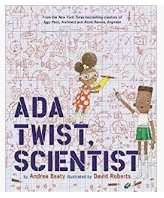
Ada Twist, Scientist, by Andrea Beatty

Ada Twist did not talk until she was three and then her world was filled with how and why questions.  This book gives young children an introduction into what being a scientist is all about.

Materials

  • 1 index card per child with their name written on it.
  • 5-8 baggies with cotton balls inside. Before class, make smell bags by either putting  a liquid onto the cotton balls or adding a powder. I have used; shampoo, perfume, lemon juice, pickle juice, onion powder, oregano, thyme, baby powder.
  • 2 diet colas
  • 1 packet of mint Mentos
  • White vinegar
  • Baking soda
  • Many colored shapes; triangle, circle, square, and rectangles of various sizes.
  • A tray or two of ice cubes

Vocabulary

  •  Frazzled-Tired and weary
  • Chaos-A giant mess
  • Quivered-Shook
  • Dazed-Bewildered, to not know what to think
  • Traits-Behaviors
  • Stench-Gross smell
  • Research-to study or investigate something
  • Hypothesis-to make a guess about something
  • Fiction-Not real, fake

Before Reading the Story 

Ask the children if they know what a scientist does. (He/she is an inventor or a researcher. Talk about how scientists invent things to make life easier. Name some inventions that the children use in your classroom. Someone had to invent the scissors that you use to cut paper. Someone had to invent the cups we use at lunch to drink out of. And a scientist researched and figured out how to make the cold/warm air blow from the vents in our classroom. Scientists make the world a better place for everyone. Tell the children that there are two questions every scientist asks, can they guess what they are? How? and why? Have the children repeat the words how? and why? Introduce the story.

Social & Emotional Development/Knowledge of Families & Communities; develops growing awareness of jobs and what is required to perform them.

Reading the Story 

On the page where Ada’s parents yell “STOP!” Ask the children if they can guess why her parents said no. As you finish the book, ask the children to come up with something that they think has a gross and stinky stench. List their answers on a piece of paper and hang it on the wall.

Literacy/Book Knowledge & Appreciation; demonstrates progress in abilities to retell and dictate stories from books and experiences; to act out stories in dramatic play; and to predict what will happen next in a story.  

After Reading the Story 

Ask the children if they can remember two questions that every scientist asks (how? And why?). Ask the children if they recall what Ada was investigating (what made the stinky stench). Ask the children if they have any why questions or how questions. Write them down and over the next few days, encourage the children to help think of the answers or show the children how to look up answers with a resource book or the computer. With young children you do not need the scientifically correct answer as much as showing them how to find an answer. (Why does my brother always get more candy than me?  How come my cat meows to wake me up?)  Let other children respond to the questions and answer them according to their personal experiences.

Language Development/Speaking & Communicating; progresses in abilities to initiate and respond appropriately in conversations and discussions with peers and adults.  AND Science/Scientific Skills & Methods; begins to describe and discuss predictions, explanations, and generalizations based on past experiences.

Discovery 

Tell the children that today you are going to investigate stinky smell. Put the smell baggies into the science center today for the children to experience. Can they guess any of the smells? Are there any that they like or dislike?

Science/Scientific Skills & Methods; begins to describe and discuss predictions, explanations, and generalizations based on past experiences.

Music and Movement

 Sing Rhyming Words Sound the Same sung to Loopdy Loo

Rhyming words sound the same (clap, clap)
Rhyming words sound the same.
Rhyming words sound the same (clap, clap)
Rhyming words sound the same.

(Now make a chanting sounding word such as house and see if the children can make a word that rhymes. For younger children I have added pictures of rhyming words to help them visualize the rhyme).

Literacy/Phonological Awareness; shows growing awareness of beginning and ending sounds of words.

Play Teacher May We? Have the children stand in a large circle. Ask a child to show you a movement (jumping, flapping arms, etc.) Then help all the children to say “Teacher may we”? The teacher then says “Only if _______can make a word that rhymes with ______ (frog, wig, and). The child makes the rhyme and everybody does the movement.

Literacy/Phonological Awareness; shows growing awareness of beginning and ending sounds of words.  AND Physical Health & Development/Health Status & Practices; participates actively in games, outdoor play, and other forms of exercise that enhance physical fitness.

 Blocks

 Put out any alphabet blocks or cubes you might have and encourage the children to find the letters in their name as they build today. If you do not have alphabet blocks, put sticky notes onto the blocks with letters written on them.

Literacy/Alphabet Knowledge; identifies at least 10 letters of the alphabet, especially those in their own name.

 Art

Put out the many shapes of triangles, circles, squares, and rectangles along with glue sticks. Give children a piece of paper and encourage them to make objects using the shapes. Add magic markers for embellishing.

Mathematics/Geometry & Spatial Sense; progresses in ability to put together and take shapes apart.

Sand and Water

Fill the table with water today, then ask the children what they think will happen if you add ice cubes to the water? Let them hypothesis and then add the cubes and see if they were correct.

Science/Scientific Knowledge; shows increased awareness and beginning understanding of changes in materials and cause-effect relationships.

Library and Writing

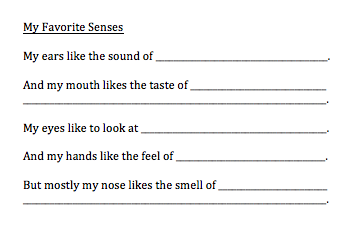
Use the My Favorite Senses sheet. Fill one out for each child. Suggest that they illustrate one of their favorite senses.

Literacy/Early Writing; begins to represent stories and experiences through pictures, dictations, and in play.  AND Literacy/Early Writing; develops understanding that writing is a way of communicating for a variety of purposes.

 Dramatic Play

 Let the children invent their own play today. Observe where it goes and how the children respond to one another.

Social & Emotional Development/Cooperation; develops increasing abilities to give and take interactions; to take turns in games or using materials; and to interact without being overly submissive or directive.

Math and Manipulatives

Put out a bowl of puff balls or other small manipulative. Encourage the children to take a handful and guesstimate how many puff balls they have in their hand. Then have the child count out the manipulatives in their hand. Ask the child, “did you have more, less, or the exact amount”?

Mathematics/Number & Operations; begins to use language to compare numbers of objects with terms such as more, less, greater than, fewer, equal to.

Outdoor Play

In the book, Ada does a science investigation in her classroom by making a geyser. On the playground take the following ingredients and try it as a class. You will need several bottles of diet soda/coke and mint Mentos. Ask the children what they think will happen when the mint Mentos are put into the soda? Have the children stand back, open the soda and quickly put 5-7 Mentos into the bottle. You can continue experimenting with different sodas or the amount of Mentos added.

Have the children make a big volcano in the sand box. Put a small pail in the center and let the children take turns putting several tablespoon of baking soda in the pail. Next add a cup of white vinegar and see what happens.

Which was more impressive, the geyser or the volcano?

Science/Scientific Skills & Methods; develops increased ability to observe and discuss common properties, differences, and comparisons among objects and materials.

Transitions

Point to one of the pages where the blocks spell out ADA’s name. Ask the children if they recognize any of the letters. Then take the index cards with the children’s names on them and hold them up one at a time. Can the children recognize their name in print? Can they name any of the letters in their name?

Literacy/Alphabet Knowledge; identifies at least 10 letters of the alphabet, especially those in their own name.

Dear Parents- Today we read a book about a girl scientist who asked many how and why questions.  When your child asks you these questions, help them find the answer by looking on the computer or sharing your experience/knowledge.  

Resources

Screen Shot 2018-08-20 at 11.25.21 PM