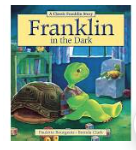
Franklin in the Dark, by Paulette Bourgeois

            Franklin turtle is afraid of being in small dark places.  How will he ever get into his shell to sleep?  In this story Franklin finds out that lots of other animals have fears also and learns how to be brave.

Materials

  • A shoe box with a 2 inch hole cut out of one end
  • Flashlight
  • Paper plate per child.
  • Head, feet, tail pattern
  • Scavenger Hunt cards
  • Scarf or cloth napkin per child
  • Yarn cut into 12 inch pieces, 4 per child.

Vocabulary

  • Brave (to show courage when you have to do something really scary or hard)
  • Afraid (to be frightened or scared of something)

Before Reading the Story

            Look at the front cover with the children; ask the children how they think Franklin is feeling, why?  Say, “I always thought turtles were supposed to be in their shell, I wonder why Franklin is not?”  Let the children respond.

Language Development/Listening & Understanding; demonstrates increasing ability to attend to and understand conversations, stories, songs, and poems.

While Reading the Story

            As you turn the pages that show the duck, the lion, the bird, and the bear, stop and ask the children, “why do you think the duck is wearing water wings?  The lion is wearing earmuffs, the bird is wearing a parachute, and the bear is wearing a snowsuit?”

Language Development/Speaking & Communicating; develops increasing abilities to understand and use language to communicate information, experiences, ideas, feelings, opinions, needs, questions; and for other varied purposes.

When you get to the page where Franklin goes to bed and says Goodnight, ask the children how do you think Franklin solved his fear of small dark places? 

Approaches to Learning/Reasoning & Problem Solving; develops increasing ability to find more than one solution to a question, task, or problem. AND Literacy/Book Knowledge & Appreciation; demonstrates progress in abilities to retell and dictate stories from books and experiences; to act out stories in dramatic play; and to predict what will happen next in a story.

After Reading the Story

            Tell the children about one time that you were scared and what you did to help you be brave.  Allow the children to share ways that they have been brave.

Language Development/Speaking & Communicating; develops increasing abilities to understand and use language to communicate information, experiences, ideas, feelings, opinions, needs, questions; and for other varied purposes. AND Social & Emotional Development/Self-Concept; demonstrates growing confidence in a range of abilities and expresses pride in accomplishments.

Discovery

            Have the children take turns putting classroom objects in the shoe box with a hole at one end.  Another child can then take a flashlight and look in the hole and name the object.  Can you see what is in there?  Can you name the color that you see?  How many legs do you see on the animal?  What kind of person-helper do you see in the box?

Science/Scientific Skills & Methods; begins to use senses and a variety of tools and simple measuring devices to gather information, investigate materials, and observe processes and relationships.

Music and Movement

            Explain to the children that you are going to try to act out different feelings while moving.  Ask the children if they can move like they are afraid.  Ask them to try to move like they are angry, sad, excited, tired, surprised.  There is no right way to do this; it is all about experimenting with movement and feelings.  If you like, give each child a scarf to help them act out with.

Creative Arts/Movement; expresses through movement and dancing what is felt and heard in various musical tempos and styles. AND Approaches to Learning/Reasoning & Problem Solving; develops increasing ability to find more than one solution to a question, task, or problem.

            Sing If You’re Happy and You Know It.  Try different verses using a variety of emotions; scared, angry, brave.

Approaches to Learning/Reasoning & problem Solving; develops increasing abilities to classify, compare, and contrast objects, events, and experiences.

Blocks;

            Challenge the children to make a ‘dark space’. Congratulate them on any structure they make that has an enclosed space that could be dark.

Approaches to Learning/Reasoning & Problem Solving; develops increasing ability to find more than one solution to a question, task, or problem.

Art;

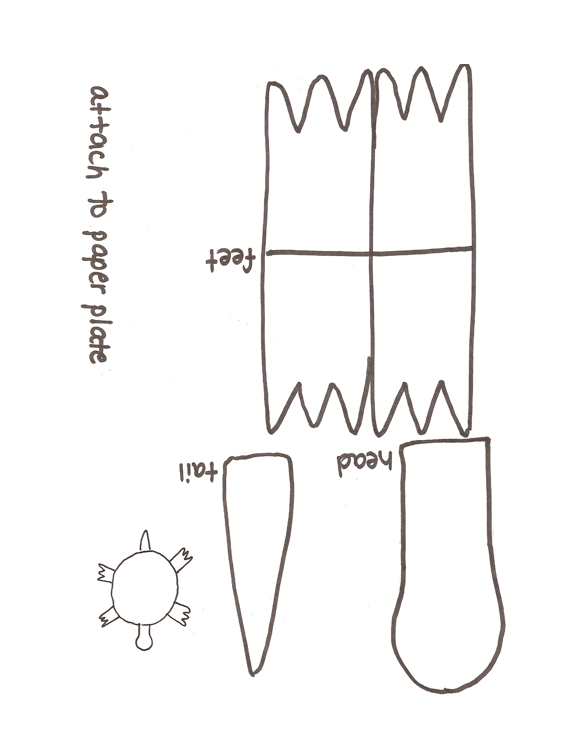
            Make turtles out of paper plates.  Show the children how to draw lines that divide the plate into quarters or eighths.  Encourage them to color each section a different color or to make a pattern.  Give each child a page with the head, feet, and tail.  Older children can cut these out themselves.  Glue these onto the bottom of the decorated paper plate. 

Physical Health & Development/Fine Motor Skills; grows in hand-eye coordination in building with blocks, putting together puzzles, reproducing shapes and patterns, stringing beads, and using scissors.

Sand and Water

            Do a float and sink activity.

Science/Scientific Skills & Methods; begins to participate in simple investigations to test observations, discuss and draw conclusions, and form generalizations.

Library and Writing

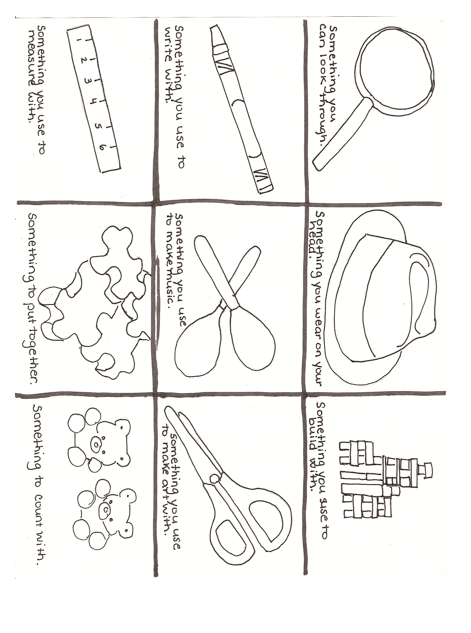
            Make a scavenger game to play with your children.  Use the cards provided and have the children find objects that fit into each category. 

Approaches to Learning/Engagement & Persistence; shows growing capacity to maintain concentration over time on a a task, question, set of directions or interactions, despite distractions and interruptions. AND Approaches to Learning/Reasoning & Problem Solving; develops increasing ability to find more than one solution to a question, task, or problem.

Dramatic Play

            Encourage the children to put on the dress ups like the bear in the story, practice buttoning, zipping, and Velcro. 

Physical Health & Development/;Fine Motor Skills; develops growing strength, dexterity, and control needed to use tools such as scissors, paper punch, stapler, and hammer. AND Social & Emotional Development/Self-Concept; develops growing capacity for independence in a range of activities, routines, and tasks.

Math and Manipulatives

            Tell the children that they can make parachutes like the bird wore in the story.  Give each child a scarf or cloth napkin and show them how to tie a knot with the yarn to each corner.  How many corners are there?  How many pieces of yarn will you need?  After they tie the corners, they can take the four loose ends and tie them around a rubber animal or person.  Take them outside and see if they work.

Mathematics/Number & Operations; begins to use one-to-one correspondence in counting objects and matching groups of objects. AND Physical Health & Development/;Fine Motor Skills; develops growing strength, dexterity, and control needed to use tools such as scissors, paper punch, stapler, and hammer.

Outdoors Play

            Let the children use wagons that they can push, and pull (like Franklin pulled his shell)

Physical Health & Development/Health Status & practices; progresses in physical growth, strength, stamina, and flexibility.

Transitions

Ask the children if they can remember what Franklin was afraid of? What were the other animals afraid of? What can you do if you are afraid?

Literacy/Book Knowledge & Appreciation; demonstrates progress in abilities to retell and dictate stories from book s and experiences; to act out stories in dramatic play; and to predict what will happen next in a story.

Resources
Five Little Monkeys Sitting in a Tree, Eileen Christelow

            Teasing is not nice as these five monkeys learn. This is a fun counting/subtraction book based on a popular finger play.

Materials

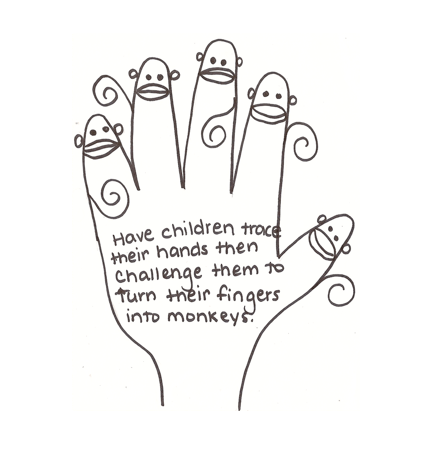
            Drawing monkey directions and number line 1-5****

            A basket the children can use for picnic play

            A deck of cards.

Vocabulary

  •  Snooze (a nap)
  •  Scolds (to tell somebody off, to speak angrily to another)
  • Tease (to make somebody mad on purpose or to be purposely hurtful)

Before Reading the Story

            Tell the children that you want to talk to them about teasing.  Ask them if they know what it means to tease somebody.  Ask them how they feel when somebody teases them.  After the children have shared their experiences about teasing, tell them that you are going to play a game.  Have them make a thumbs up sign and tell them that when you hear a kind idea make a thumbs up.  Do the same for thumbs down and a teasing story.  Make up scenarios or use ones you have seen in your classroom and ask the children if it is a thumbs up or thumbs down?  After you have run several scenarios pass the children, older children might like to try making one up.  (You are playing in the blocks and another child comes in and goes right up to your building and knocks it down and laughs, is this a thumbs up, or thumbs down?  You are getting some water to put into the water table and you spill some on the floor by accident.  Another child comes over with a paper towel and helps you wipe it up, is this a thumbs up/down?  You fell down while running on the playground and someone laughs at you, thumbs up/down?)

Social & Emotional Development/ Self-Control; develops growing understanding of how their actions affect others and begins to accept consequences of their actions.

Reading the Story

            Tell the children that your story today is about 5 little monkeys who tease.  Hold up the cover and read the title.  Ask the children if anyone can guess who the monkeys might be teasing?

Literacy/Book Knowledge & Appreciation; demonstrates growing abilities to retell and dictate stories from books and experiences; to act out stories in dramatic play; and to predict what will happen next in a story.

After Reading the Story

            Ask the children why the mother monkey was scolding her children?  Do you think teasing is nice?  Why should we not tease (it hurts peoples feelings, it could make somebody mad, sad, cry).  What should you do if somebody is teasing you?  Have the children practice saying “Stop It, I don’t like that!”  Have them practice saying it loud.  Tell them if you as the teacher hear a child say this (Stop it I don’t like that) that you will come over to where they are and help them.  Have everyone practice saying it again.  Say it again loudly.

Literacy/Book Knowledge & Appreciation; demonstrates growing abilities to retell and dictate stories from books and experiences; to act out stories in dramatic play; and to predict what will happen next in a story. AND Social & Emotional Development/Self-Control; shows progress in expressing feelings, needs, and opinions in difficult situations and conflicts without harming themselves, others, or property.

Discovery

            Bring in parts of trees and magnifying glasses.  Help the children to name the bark, branch, bough, leaf, bud, and seed of the trees. Draw a large tree and label the different parts. You can show the children as you discuss.

Science/Scientific Skills & Methods; develops growing abilities to collect, describe, and record information through a variety of means, including discussion, drawings, maps, and charts.

Music and Movement

          Teach the children 5 Little Monkeys https://kcls.org/content/five-little-monkeys-sitting-in-a-tree/

Mathematics/Number & operations; begins to use one-to-one correspondence counting objects and matching groups of objects.

            Do the Crocodile, Crocodile chant.

Crocodile, crocodile long and green

Crocodile, crocodile with teeth so mean

He snapped at a fish

He snapped at a bee

He snapped at a frog

And he snapped at me.

He caught that fish

He caught that bee

He caught that frog

But he did not catch me!

Whew

Creative Arts/Music; participates with increasing interest and enjoyment in a variety of music activities, including listening, singing, finger plays, games, and performances.

            Gather all the children into a circle and play Monkey See, Monkey Do.  One person starts off as the leader and everyone mimics their movements.  Take turns being the leader. https://www.youtube.com/watch?v=ZdCLvwK8I6c

When (name) claps, claps, claps her hands

The monkeys clap, clap, clap their hands

Monkey see, Monkey do

Monkey do the same as you (point to the next leader.)

Begin again saying the person’s name and letting them choose the next action

Social & Emotional Development/Cooperation; develops increasing abilities to give and take in interactions; to take turns in games and using materials; and to interact without being overly submissive or directive.

Blocks

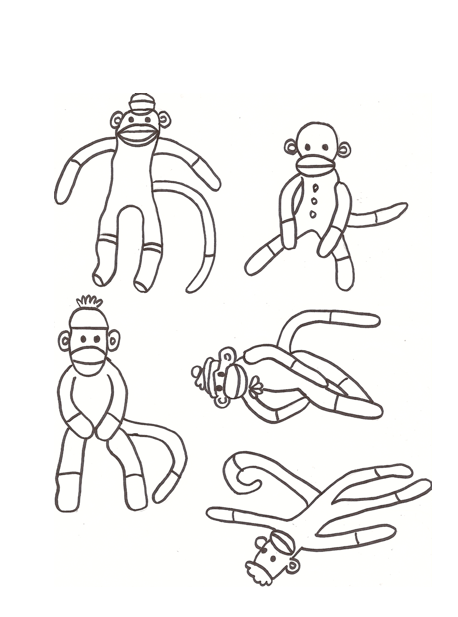
            Draw 5 monkeys, or let the children draw their own.  Cut around the monkey shapes and put a piece of tape onto the back.  The children can build with blocks and then add the 5 monkeys to swing from their structures. For older children, ask them if they can do the % Monkeys finger play/poem using the monkeys on their structure.

Literacy/Book Knowledge & Appreciation; demonstrates abilities to retell and dictate stories from books or experiences; to act out stories in dramatic play; and to predict what will happen next in a story.

Art

            Put sand into the paint at the easel today.  When it dries the surface will be a rough texture like a crocodiles back.  Put out green, brown, and white paint to simulate a crocodiles coloring.

Creative Arts/Art; gains ability in using different art media and materials in a variety of ways for creative expression and representation.

Library and Writing

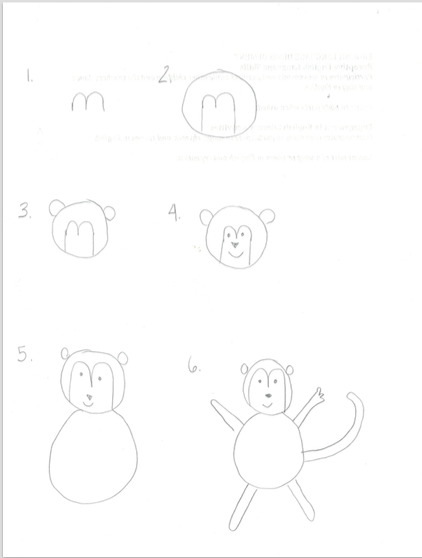
            Show the children the How to Draw a Monkey.  Encourage them to try to follow the steps and make five monkeys.  Have them write their numbers beside.

Literacy/Early Writing; develops understanding that writing is a way of communicating for a variety of purposes. AND Language Development/Listening & Understanding; shows progress in understanding and following simple and multiple-step directions.

Sand and Water

            Put water into the table today.   Add several long blocks that the children can pretend are crocodiles.  They can bob these up and down or pour water over them. If you have counting bears or similar manipulatives, add these also. How many counting bears can float on the back of the block?

Creative Arts/Dramatic Play; shows creativity and imagination in using materials and in assuming different roles in dramatic play situations. AND Mathematics/Number & Operations; demonstrates increasing interest and awareness of numbers and counting as a means for solving problems and determining quantity.

Dramatic Play

            Bring in a basket and a towel or blanket.  The children can pretend to go on a picnic supper.

Creative Arts/Dramatic Play; participates in a variety of dramatic play activities that become more complex and extended.

Math and Manipulatives

            Bring in a deck of cards.  Take out all the face cards.  Shuffle the cards and pass them out evenly between 2-4 players.  Have the children put their pile of cards face down in front of them.  On the count of three, everyone turns over their top card.  The person with the highest number gets to take all the cards and put them in a second pile beside them.  If two or more players turnover the same number, they must slap their card and say SNAP!  The one who says snap first gets to take all the cards and put them beside them.  Play until one person has all the cards or the children lose interest.

Mathematics/Number & Operations; begins to associate number concepts, vocabulary, quantities, and written numerals in meaningful ways.

Outdoor Play

            If you have a tree or structure to climb, let the children pretend to be the monkeys and the teacher can go about snapping like a crocodile at them.

Creative Arts/Dramatic Play; participates in a variety of dramatic play activities that become more complex and extended.

Transitions

            As children move on to the next activity, hold up 1-5 fingers and say 4-1=? (Four take away one equals how many?)  Do different combinations and have the children figure out the math equation.  Make sure to use only 1-5 unless your children are older then try 1-10.  Use your fingers as a visual cue to help the children.

Mathematics/Number & Operations; develops increasing abilities to combine, separate, and name “how many” concrete objects.

Resources
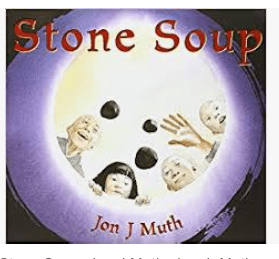
Stone Soup, by Jon J Muth

When hungry strangers come to town, everyone shares a small amount of their food to make a delicious soup which the whole town can enjoy.

Materials

  • Oil pastels
  • Rock collection
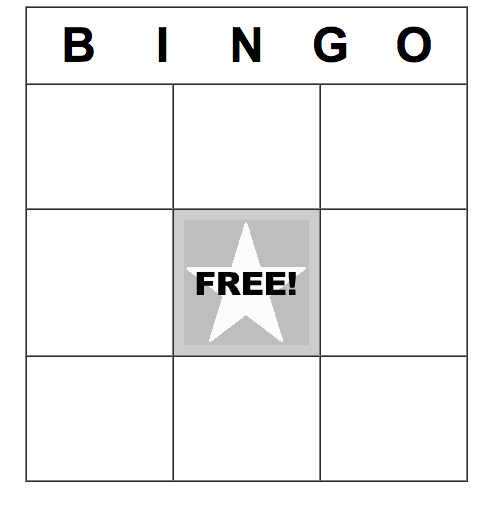
  • Make ahead BINGO cards
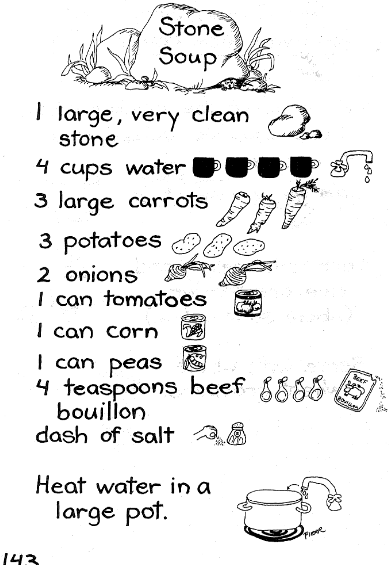
  • Crockpot and ingredients found in Resources.
  • 3-4 pots to use throughout the room today
  • Several plastic bowls and two soup ladles
  • Looking Down & Up cards

Vocabulary

  • Monk (like a minister or religious person)
  • Famine (where there is not enough food and everyone is hungry)
  • Suspicious (not trusting)
  • Scholar (someone who does research and is very smart)

Before Reading the Story

Ask the children how many of them like soup? What kinds of soups do you like to eat? Hold up the cover of the book and read the title. Ask the children if they can guess what they are looking into? What do you think they will do with the pot? Introduce the story.

Literacy/Book Knowledge & Appreciation; demonstrates progress in abilities to retell and dictate stories from books and experiences; to act out stories in dramatic play; and to predict what will happen next in a story. AND Social & Emotional Development/Self-Concept; begins to develop and express awareness of self in terms of specific abilities, characteristics, and preferences.

Reading the Story

On the page where the monks first enter the village, ask the children why they think everyone closed their windows?  (The villagers did not trust anyone)

Approaches to Learning/Reasoning & Problem Solving; develops increasing abilities to classify, compare and contrast objects, events, and experiences. AND Language Development/Speaking & Communicating; progresses in abilities to initiate and respond appropriately in conversation and discussions with peers and adults.

After Reading the Story

Remind the children that the villagers each shared some of their food to make the delicious soup for everyone. Spend a moment talking about sharing.  Point out any acts of sharing that you have recently seen in your classroom (Jamie shared a red marker with Sue when hers stopped working.  Thank you Jamie for sharing). Ask the children to think of a time when they shared with another person. How did it make you feel? How did it make the other person feel? What kinds of things are more fun to do when you share them with another person?

Language Development/Speaking & Communicating; progresses in abilities to initiate and respond appropriately in conversation and discussions with peers and adults. AND Social & Emotional Development/Cooperation; increases abilities to sustain interactions with peers by helping, sharing, and discussion.

At the end of the story, the villagers said that sharing makes everyone feel richer and happy.  As you see children sharing throughout the day, thank them for their generous spirit and thoughtfulness.

Discovery

Put out a rock collection for the children to compare and sort. Add magnifying glasses.

Mathematics/Patterns & Measurement; shows increasing abilities to match, sort, put in a series, and regroup objects according to one or two attributes such as shape or size.

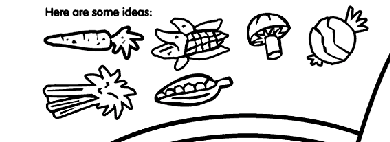
Nutrition bingo. Ahead of time use the BINGO card and the veggie pictures to make BINGO cards. Remember to make each on different. Make a master card of all the veggies that you have glued to the BINGO cards to use for the draw pile.

Approaches to Learning/Engagement & Curiosity; grows in abilities to persist in and complete a variety of tasks, activities, projects, and experiences.

Bring in a crock pot and the ingredients needed to make your own classroom stone soup.

Music and Movement

Bring your plastic veggies to the carpet and sing, The Soup is Boiling Up. https://www.youtube.com/watch?v=Hx6ZdPysVeA

Tell the children that you know how to make chocolate soup and sing. https://www.youtube.com/watch?v=cRFTzna6bGE

Creative Arts/Music; participates with increasing interest and enjoyment in a variety of music activities including; listening, singing, finger plays, games, and performances.

Tell the children that you are going to pretend to buy items to put into your soup. Have the children name items that go into the soup (real or funny) and count! https://www.youtube.com/watch?v=Pt0jjke_Jns

Approaches to Learning/Reasoning & Problem Solving; develops increasing ability to find more than one solution to a question, task, or problem.

Open the page that shows after the banquet with the musicians playing instruments.  Tell the children that you would like to bring out your instruments, play and sing songs at the children’s requests.

Creative Arts/Music; experiments with a variety of musical instruments.

Blocks

Remind the children that the monks came to a village (community, town).  Challenge the children to build a village using the blocks today.  If you have people figures, you can add these to the center to enhance the village.  Add paper and pencil in case someone would like to add any signs to the buildings.

Social & Emotional Development/Knowledge of Families & Communities; begins to express and understand concepts and language of geography in the contexts of the classroom, home, and community.

Art

Give the children a piece of white construction paper with one of the foods from the story printed or drawn on it (use black permanent marker).  Let the children color the food item using the oil pastels.  When they are finished, show them how to use watery watercolors to paint over their food.  The watercolors will not stick where the oil pastel is making the oil pastels pop.  You might want to practice once before you help the children so that you can get the right watery watercolor.

Creative Arts/Art; gains ability in using different art media and materials in a variety of ways for creative expression and representation.

Sand and Water

Fill the pot with water and put into in the sensory table today along with the plastic bowls and ladils. Show the children how to ladil the soup carefully into the bowls without spilling.

Physical Health & Development/Fine Motor Skills; develops growing strength, dexterity, and control needed to use tools such as scissors, paper punch, stapler, and hammer.

Library and Writing

Alphabet soup.  Put a pot in the center with magnet letters.  The children can take turns pulling out a letter and naming.

Literacy/Alphabet Knowledge; identifies at least 10 letters of the alphabet, especially those in their own name.

Dramatic Play

Add stones and a big pot for making stone soup.  Act out story.  Ask different children to add a food from your play food.

Literacy/Book Knowledge & Appreciation; demonstrates progress in abilities to retell and dictate stories from books and experiences; to act out stories in dramatic play; and to predict what will happen next in a story.

Math and Manipulatives

Remind the children that the cover of the book had everyone looking down into the pot. Explain that you have a sorting game where the children must sort if they are looking down or up. Use the cards in Resources.

Mathematics/Geometry & Spatial Sense; builds an increasing understanding of directionality, order, and positions of objects, and words such as up, down, over, under, top, bottom, inside, outside, in front, and behind.

Outdoor Play

If you have a parachute, bring it out with several balls. Have the children stand around the edges of the parachute and toss the balls into the center. The children must try not to let the balls roll out of the parachute ans it moves up and down.

Physical Health & Development/Health Status & Practices; participates actively in games, outdoor play, and other forms of exercise that enhance physical fitness.

Transitions

Remind the children that In the story, the youngest monk asked, “what makes you happy”?  Ask the children this same question and write their responses onto a piece of paper to hang on the wall.  “Things that make us happy”.

Social & Emotional Development/Self-Concept; begins to develop and express awareness of self in terms of specific abilities, characteristics, and preferences.

Resources