Bringing the Rain to Kapiti Plain, by Verna Aardema

            This story takes place on the great Kapiti Plain that is need of rain.  The story can be a good jumping board for water thoughts, both the cycle of water and conservation.

Materials

  • National Geographic or other magazines with African animals inside.
  • Mylar, cut into strips
  • A globe or map of the world

Vocabulary

  • Herdsman (like a cattle farmer in the United States, he makes sure the cow are safe and healthy).          
  •  The Plain (kind of like living out in the country)
  • Drought (when the rain does not come for a very long time and all the plants and animals begin to get sick and there is hardly any water to drink)          

Before Reading the Story

            Ask the children if they know why water is so important?  Make a list of the children’s responses (to drink, to take a bath or shower, to wash my clothes. To cook spaghetti and other food, to brush teeth, water plants, flush).  Talk to the children about the importance of not wasting water.  If you see the sink left running, we need to turn it off. Explain that we do not want to waste water because then what would happen (It would all be gone and you could not get a drink).  Depending upon where you live, this discussion could easily go into drought concerns and water conservation.  The idea is to make sure the children are aware that water is important and that we need to take care of the water.

Science/Scientific Knowledge; expands knowledge of and respect for their bodies and the environment.

Reading the Story

           As you introduce the story, show the children where Africa is on the globe or map.  Talk about how it is very far away on the other side of the world.  Take a moment and do a picture walk through the book. Have the children name all the animals that they see in the pictures.  Ask them if these animals are like the animals they see around their neighborhoods or woods.  Let the children know that these are called African animals.  Go back to the cover and show/point out the cows.   Do these look like the cows we have here?  Why do you think that Ka-pit is watching the cows?  What do farmers get from cows (milk, meat, leather, ice cream). So cows are pretty important animals both here and in Africa.  Let’s find out how the rain is brought to Kapiti Plain and why.

Science/Scientific Knowledge; expands knowledge of and abilities to observe, describe, and discuss the natural world, materials, living things, and natural processes.  AND Literacy/Book Knowledge & Appreciation/shows growing interest and involvement in listening to and discuss ing a variety of fiction and non-fiction books and poetry.

After Reading the Story

            Open up the book to the page that starts “These are the cows, all hungry and dry”.  Lead a discussion on the importance of drinking water everyday.  Ask the children to look at the cows, what does it mean that they were dry (they wanted a drink, their tongues were stuck).  Ask the children questions about being thirsty (have you ever been so thirsty that your tongue felt like it was sticking? When you are outside running and you get thirsty what should you do?  How many glasses of water should you drink to keep your insides lubed? (8)  What happens when you do not get enough water to drink (I am thirsty, I get a headache).  

Physical Health & Development/Health Status & Practices; builds awareness and ability to follow basic health and safety rules such as fire safety, traffic and pedestrian safety, and responding appropriately to potentially harmful objects, substances, and activities.

Discovery

            Pictures of Africa; the people, the animals, the land. Talk with the children and compare the likenesses and differences to life in the United States.

Mathematics/Patterns & Measurement; begins to make comparisons between objects based on a single attribute,  AND Approaches to Learning/Reasoning & problem Solving; develops increasing abilities to classify, compare, and contrast objects, events, and experiences.

Music and Movement

            Use your instruments and have a thunderstorm.  Start off playing softly and become louder as the thunder storm grows.  Then you can bring the instruments back down to soft again.

Creative Arts/Music; experiments with  a variety of musical instruments.

            Sing the song, Rain is Falling, to Frere Jacque

Rain is falling, rain is falling
All around, all around
It’s raining on the tree tops; it’s raining on the tree tops
And the ground, and the ground

Creative Arts/Music; participates with increasing interest and enjoyment in a variety of music activities, including listening, singing, finger plays, games, and performances.

             If you have rain sticks, this would be a good day to let the children experiment with them.

Creative Arts/Music; experiments with  a variety of musical instruments.

            In the story Ki-pat stands on one leg while he watches the cows.  Let’s pretend we are herdsmen in Africa and see how long we can stand on one leg.  Try other balance activities (Put one hand on the floor and lift one leg in the air, stand on tip toe, stand on your heels, put both hands and one leg on the ground and one leg in the air, etc.).

Physical Health & Development/Health Status & Practices; progresses in physical growth, stamina, strength, and flexibility.

            Put out some wrist bells and do a rain dance. 

            If you are fortunate to get mylar (those silver balloons) cut them into strips, it makes a wonderful rain storm.  It sounds like rain when you crinkle it and it’s fun to toss up in the air.

Approaches to Learning/Initiative and Curiosity; chooses to participate in an increasing variety of tasks and activities.

Blocks

            Put out any African animals that you have as well as any others.  Encourage the children to build a lake for the animals to get a drink at.  The children can sort the animals by like kinds or line them up smallest to largest.

Mathematics/Patterns & measurement; shows increasing abilities to match, sort, put in a series, and regroup objects according to one or two attributes such as shape or size.

Art

            Put out magazines and encourage the children to cut out animals and glue them to paper.  Encourage them to look for pictures of African animals.

Physical Health & Development/Fine Motor Skills; develops growing strength, dexterity, and control needed to use tools such as scissors, paper punch, stapler, and hammer.

Sand and Water

            Scooping and pouring water play.  Do you have pitchers that can sound like rain when poured?  If not, you can make simple rain makers by punching holes in the bottom of a plastic container (cottage cheese container).

Science/Scientific Skills & Methods; begins to use senses and a variety of tools and simple measuring devices to gather information, investigate materials, and observe processes and relationships.

Library and Writing

          Tell the children that they are going to find ‘secret messages’ written in the clouds.  From white paper cut out cloud shapes.  Use a white crayon to write a message for each child (Hello Jamie).  Let the children paint with watercolors over their cloud, to turn it dark like a rain cloud. Watch their surprise when they see a message with their name.  Encourage them to read the message or the letters.

Literacy/Alphabet Knowledge; identifies at least 10 letters of the alphabet, especially those in their own name.  AND Literacy/Early Writing; develops understanding that writing is a way of communicating for a variety of purposes.

Dramatic Play

            Add large scarves or pieces of fabric to the center so the children can try to make robes like Ki-pat in the story. 

Creative Arts/Dramatic Play; shows growing creativity and imagination in using materials  and in assuming  different roles in dramatic play situations.

Math and Manpiluatives

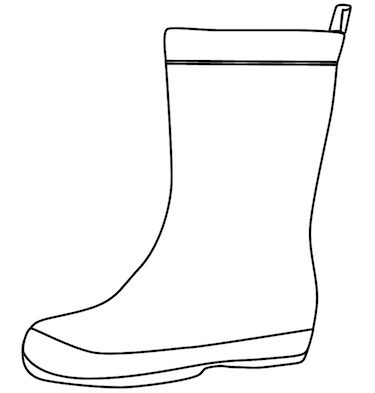
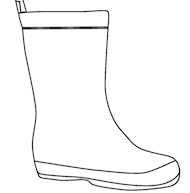
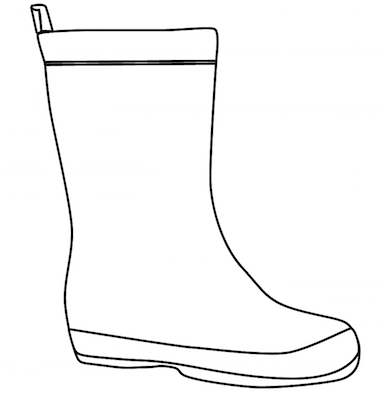
           Make copies of the boots and decorate the left and right to match.  Put all the boots out on the table and ask the children to find the pairs of boots.  As they make their matches talk to them about the colors or patterns that are on the boot.

Mathematics/ Patterns & Measurement; shows growth in matching, sorting, putting in series, and regrouping objects according to one or two attributes such as color, shape, or size.

            Make sets of right footed boot in small, medium, and large.  Decorate each set the same.  Challenge the children to find the three boots that match and put them in order from small to large.

Mathematics/ Patterns & Measurement; shows growth in matching, sorting, putting in series, and regrouping objects according to one or two attributes such as color, shape, or size.

Outdoor Play

            In the story Ki-pat shot an arrow into the sky.  Take bean bags and pretend that they are arrows and throw them into the sky.  See if you can catch them.  Play catch with another child, throw the bean bags at a target (perhaps a large cloud shape).

Physical Health & Development/Large Motor Skills; demonstrates increasing abilities to coordinate movements in throwing, catching, kicking, bouncing balls, and using the slide and swing.

Transitions

           This story is written with many rhymes.  Say a word and the child must say another word that rhymes with it before going off to the next activity.

Literacy/Phonological Awareness; progresses in recognizing matching sounds and rhymes in familiar words, games, songs, stories, and poems.

Resources
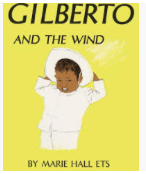
Gilberto and the Wind, by Marie Hall Ets

Gilberto goes out to play with the wind.  What he finds is Wind can be a moody friend.

Materials

  • Several empty toilet paper tubes
  • Plastic straws
  • Several ping pong balls or large puffballs
  • 26 Clothespins and a drying rack. If you do not have a drying rack, you could attach a piece of yarn to make a clothesline.

Vocabulary

  • Invisible (You can not see it but it is still there)

Before Reading the Story

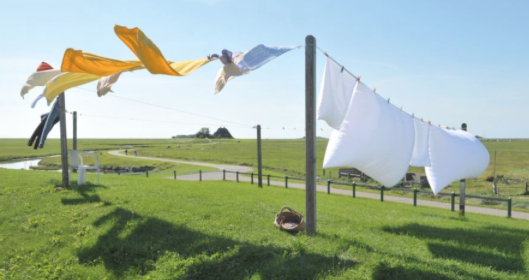
Ask the children to look out the window and tell you what they see.  If someone mentions that they see something that is moving ( a tree branch) ask them what they think is making it move.  Explain to the children that the wind is always moving things but that the wind is invisible. We can not see the wind but we can see what it is moving.  How else can we tell if the wind is around? (You can hear it, you can feel it)  Recite the following poem to the children.  The Wind, Christina Rossetti.

Who has seen the wind?

Neither I nor you;

But where the leaves hang trembling,

The wind is passing through.

Who has seen the wind?

Neither you nor I;

But when the trees bow down their heads,

The wind is passing by.

Language Development/Listening & Understanding; demonstrates increasing ability to attend to and understand conversations, stories, songs, and poems.

Reading the Story

As you read give the children opportunity to talk about similar experiences they might have had.

Science/Scientific Knowledge; expands knowledge of and abilities to observe, describe, and discuss the natural world, materials, living things, and natural processes.

After Reading the Story

This might be a good day to talk to the children about severe weather and your school policy in case of.  Do you and your children know what to do and where to go if there is a tornado?

Physical Health & Development/Health Status & Practices; builds awareness and ability to follow basic health and safety rules such as fire safety, traffic and pedestrian safety, and responding appropriately to potentially harmful objects, substances, and activities.

Discovery

Let the children use bubbles in the center today.  Give them small containers of solution.  You can make simple bubble blowers from pipe cleaners. As they blow the bubbles, talk about how their breath is like the wind and pushes the bubbles to move. (Blowing bubbles is difficult for children to learn to do. Show then how to gently blow by blowing on the back of their hand.

Science/Scientific Skills & Methods; begins to use senses and a variety of tools and simple measuring devices to gather information, investigate materials, and observe processes and relationships.

Music and Movement

Have the children stand up and spread out.  They should be standing far enough apart that with their arms outstretched they are touching nobody. As you recite the poem, Wind, the children can move their arms like a windmill round and round.

Blow and turn then blow again, Round and round the windmill spins.

Whooshing fast, then creaking slow

Come on wind and make us go!

(Play with moving your arms fast and slow).

Language Development/Listening & Understanding; demonstrates increasing ability to attend to and understand conversations, stories, songs, and poems.

Tell the children that you are going to pretend to be trees on a windy day.  Plant your roots into the ground because they are strong.  Use your arms to be the branches.  First the wind is just a breeze and you hardly move at all.  Then the wind gets gusty and you bend and over and come back up.  Then the wind gets blustery and you don’t know which way to move so your branches (arms) are swirling all around as you bend and come back up.

Creative Arts/Dramatic Play; participates in a variety of dramatic play activities that become more extended and complex. AND Language Development/Listening & Understanding; understands an increasingly complex and varied vocabulary.

Look back over the story and challenge the children and yourself to act out more wind scenarios.

Creative Arts/Dramatic Play; participates in a variety of dramatic play activities that become more extended and complex.

Blocks

Ask the children to build a fenced around a large area of your block center with the blocks. Inside the fenced area build small tunnels and halls. (Think mini golf course). After the children have finished building, give them each a ping pong ball and challenge them to blow it around the fenced area, trying to go under or through the blocks.

Approaches to Learning/Engagement & Persistence; demonstrates increasing ability to set goals and develop follow through on plans.

Art

Water down several colors of tempera paint.  Place a small spoonful onto a piece of paper.  The child uses a straw to blow the paint across the paper.  Make sure to have the children practice blowing out a few times before they begin.  Plastic straws work best.

Creative Arts/Art; gains ability in using different art media and materials in a variety of ways for creative expression and representation.

Library and writing

Make letters of the alphabet on pieces of paper (white like the white sheets in the story or fancy shirts).  Hang a clothesline and encourage the children to clothespin the letters to the line in the proper order.  Make sure to put out an alphabet line where the children can easily see it.

Literacy/Alphabet Knowledge; knows that letters of the alphabet are a special category of visual graphics that can be individually named. AND Identifies at least 10 letters of the alphabet, especially those in their own name.

Sand and Water

Put water into the table today with small boats. Encourage the children to pretend to be the wind and blow the boat across the water table.

Science/Scientific Skills & Methods; begins to use senses and a variety of tools and simple measuring devices to gather information, investigate materials, and observe processes and relationships.

Dramatic Play

Hang pictures of different kinds of weather events in the center for the children to use as a jumping board to their play. For a more permanent look, turn these pictures into window scenes.

Science/Scientific Skills & Methods; begins to use senses and a variety of tools and simple measuring devices to gather information, investigate materials, and observe processes and relationships.

Math and Manipulatives

Collect a variety of lightweight objects ( a feather, piece of yarn, paperclip, a leaf, a cotton ball, a piece of wadded up paper).  Show the children how to put the toilet tube over their mouth and blow hard!  Have the children take turns blowing the different objects.  For older children they can measure how far an object went by using a ruler or chain links.  Now add some heavier items.  How does the weight of an object affect the way it moves when it is blown?

Mathematics/Patterns & Measurement; shows progress in using standard and non-standard measures of length and area of objects. AND Science/Scientific Skills & Methods; develops increasing abilities to observe and discuss common properties, differences, and comparisons among objects and materials.

Outdoor Play

Look for evidence of the wind.  Do you see the wind moving anything?  Stand very still, is it moving anything on your body? Can you feel the wind upon your skin?

Science/Scientific Skills & Methods; develops increasing abilities to observe and discuss common properties, differences, and comparisons among objects and materials.

Bring your bubbles and wands outside. Can the children tell what direction the wind is blowing by looking at the bubbles floating? Can they pop the bubbles before they reach the ground? Can they catch a bubble on a bubble wand without popping it?

Physical Health & development/Fine Motor Skills; grows in hand-eye coordination in building with blocks, putting together puzzles, reproducing shapes and patterns, stringing beads, and using scissors.

Transitions

Tell the children that in the story the wind moved many objects.  Ask the children to recall something in the story that the wind moved or something from their own lives.

Literacy/Book Knowledge & Appreciation; demonstrates progress in a bilities to retell and dictate stories from books and experiences; to act out stories in dramatic play; and to predict what will happen next in a story.

Resources

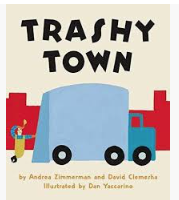
Trashy Town, by A.Zimmerman & D.Clemesha

Mr. Gilly has an important job to do.  He collects the trash all about town and takes it to the dump.  Children will enjoy repeating the “Dump it in” stance that runs throughout the story.

Materials

  • Recycled junk (ask the parents to send in donations: explain that you are going to use these for building 3 dimensional art work).
  • Several rolls of masking tape
  • 2-3 fish nets or small sieves
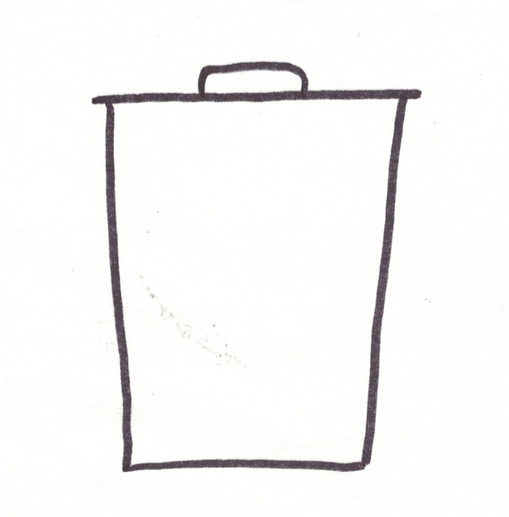
  • Picture of a garbage can
  • Pictures of shapes to sort
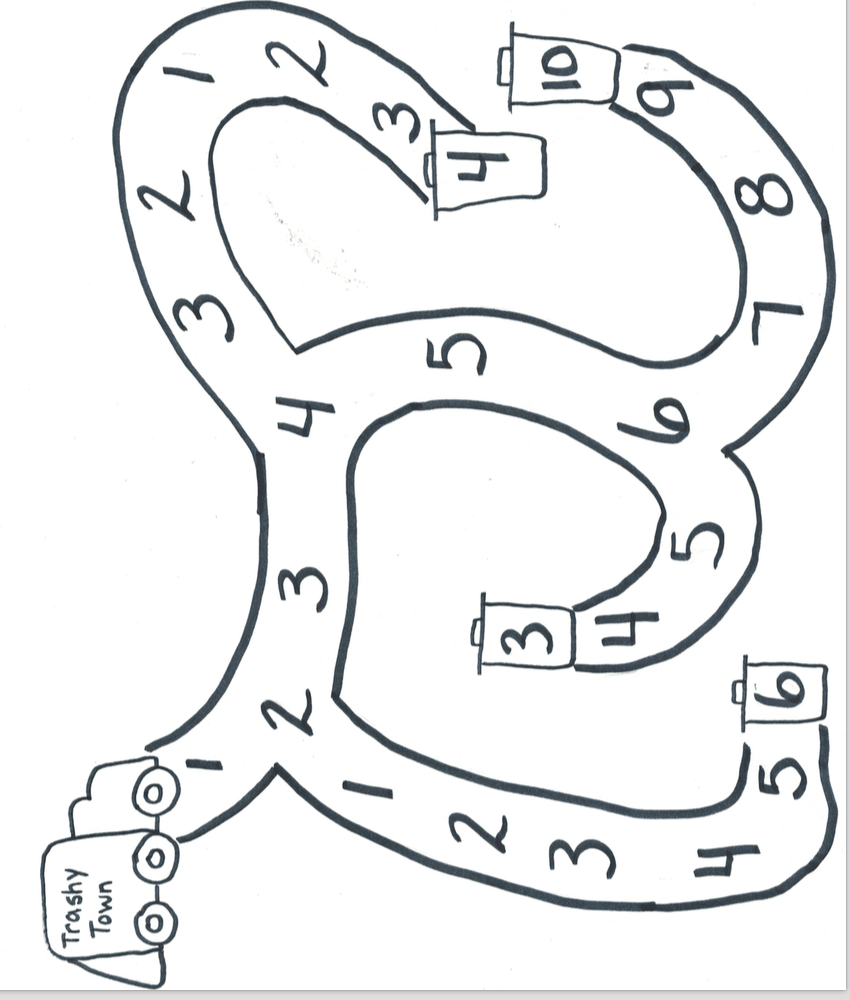
  • Map around town 1-10

Vocabulary

  • Trash  (another name for garbage and litter)
  • Trashman  (someone whose job it is to collect the garbage from around the town).

Before Reading the Story

Explain to the children that you need them to help tell the story today.  Recite the stance; “Dump it in, smash it down, drive around the Trashy Town!”  Have the children practice reciting it back several times until it is familiar.  Explain to the children that when you do a-thumbs up in the story, it will be their turn to recite the stance.  As you read, give a thumbs-up at all the appropriate times and repeat the stance with the children.

Language Development/Listening & Understanding; shows progress in understanding and following simple and multi-step directions. AND Approaches to Learning/Initiative & Curiosity; chooses to participate in an increasing variety of tasks and activities.

Reading the Story

When you get to the page where Mr. Gilly puts on his heavy gloves, stop and ask the children why they think the trash man needs to wear heavy gloves?  (He’s gonna get his hands dirty, Garbage is stinky!).  After Mr. Gilly has cleaned-up all of Trashy Town, he goes home.  When the story says there is only one more thing to clean, stop before turning the page and ask the children if they can guess what the last item that needs cleaning is.  Ask the children if they can remember the places where Mr. Gilly picked up the trash.  Then do one final reciting of the stance; “Dump it in, smash it down, drive around the Trashy Town”!

Literacy/Book Knowledge & Appreciation; demonstrates progress in abilities to retell and dictate stories from books and experiences; tpo act out stories in dramatic play; and to predict what will happen next in a story.

After Reading the Story

Tell the children that being a trashman is an important job. Ask the children to give examples of why (It keeps our town clean, so the flies do not come, because garbage smells, because the rats like garbage, because garbage is gross).  Talk with them about the importance of keeping your centers neat.  Do you label your selves for easy cleanup?  If so, encourage the children to check the center shelves today and make sure they are putting everything away in its proper spot.  Use this day to reorganize your shelves with the children’s help.

Literacy/Early Writing; develops understanding that writing is a way of communicating for a variety of purposes. AND Physical Health & Development; builds awareness and ability to follow basic health and safety rules such as fire safety, traffic and pedestrian safety, and responding appropriately to potentially harmful objects, substances, and activities.

Discovery

If your center recycles, have the children sort the paper products from the rest of the trash and put into a separate container.

Mathematics/Patterns & Measurement; shows increasing abilities to match, sort, put in a series, and regroup objects according to one or two attributes such as shape or size.

Music and Movement

Teach the children the following poem,

After I eat I scrape, scrape, scrape

To get the food off my plate, plate, plate.

Sing Save the Cans to the tune of Row,Row, Row Your Boat

Save, save, save the cans

Throw them in the bin.

We can help save our earth,

If we all pitch in.

Save, save, save the paper/plastics/bottles

Science/Scientific Knowledge; shows increased awareness and beginning understanding of changes in materials and cause-effect relationships.

Blocks

Encourage the children to use the blocks today to build a road that they can drive toy vehicles across.  Can they make a bridge to go over/under another part of the road?  Can they make a tunnel to drive the vehicles through? 

Approaches to Learning/Reasoning & Problem Solving; grows in recognizing and solving problems through active exploration, including trial and error, and interactions and discussions with peers and adults.

Art

Put out all the recycled junk that you have collected and show the children how to use strips of masking tape to hold the different pieces together making a sculpture of some kind.  When the children have finished taping their sculpture, they can glue small beads, baubles, and such on to add more dimensions and then finally drip paint over the sculpture.  This can become a 2-3 day project depending on how involved the children become.  I have cut many 2-4 inch strips of masking tape and stuck around edge of table for children to have easier access for their building. 

Physical Health & Development/Fine Motor Skills;grows in hand-eye coordination in building with blocks, putting together puzzles, stringing beads, reproducing shapes and patterns, and using scissors. And Approaches to Learning; Engagement & Persistence; grows in abilities to persist in and complete a variety of tasks, activities, projects, and experiences.

Sand and Water

Fill the table with water today and add objects that float and sink.  Give the children fishnets and have them remove the ‘garbage’ from the water and sort it by things that float and things that sink.

Science/Scientific Methods & Skills; begins to use senses and a variety of tools and simple measuring devices to gather information, investigate materials, and observe processes and relationships.

Library and Writing

Give a child a copy of the map around town.  Show the child how to use a pencil to follow the numbers 1-10 to get from beginning to end.

Mathematics/Number & Operation; begins to associate number concepts, vocabulary, quantities, and written numerals in meaningful ways. AND Literacy/Early Writing; experiments with a growing variety of writing tools and materials, such as pencils, crayons, and computers.

Dramatic Play

Add several pairs of gloves, boxes or small wastebaskets, and crumpled newspaper.  The children can pretend to collect trash and dump it from one container to another.   As your day progresses you could ask the children in the dramatic play center to come help with trash around the room.  Maybe they could sweep the sand that fell on the floor and pick up any paper that is trash from the art area.   If you have a small waste basket that has a foot peddle, these are fun for the children to use.

Social & Emotional Development/Cooperation; develops increasing abilities to give and take in interactions; to take turns in games or using materials; and to interact without being overly submissive or directive.

You could tell the children that they are trash collectors as they clear their meal plates and throw them in the garbage.  (Thank you trashman Lolly for keeping our room clean and safe).

Physical Health & Development; builds awareness and ability to follow basic health and safety rules such as fire safety, traffic and pedestrian safety, and responding appropriately to potentially harmful objects, substances, and activities.

Math and Manipulatives

Make a copy of 3 garbage cans.  On each, draw a shape.  Make one a circle, one a triangle, and one a square.   The children then sort pictures onto the appropriate garbage can.  When they are finished, help them name the shapes.  For older children you might try using three-dimensional shapes and label the cans, cylinder, pyramid, and cube.

Mathematics/Geometry & Spatial Sense; shows growth in matching, sorting, putting in series, and regrouping objects according to one or two attributes such as color, shape, or size.

Outdoor Play

Make a path on the sidewalk; using chalk make 26 1×1 foot squares that connect like a chain.  In the first square write the letter A and continue down the chain writing the letters in alphabetical order.  The children can then jump from square to square as they sing/recite the alphabet song.  If they miss a letter, name it for them and have them repeat it back to you.  If they miss two, then they must go back to the beginning and start again.

Literacy/Alphabet Knowledge; identifies at least 10 letters of the alphabet, especially those in their own name.

Put out a trashcan and many balls of wadded up newspaper.  The children can practice throwing the newspaper balls into the trashcan.  As they make a shot, have them move back 2 steps and try from this new position.

Physical Health & Development/Gross Motor Skills; demonstrates increasing abilities to coordinate movements in throwing, catching, kicking, bouncing balls, and using the slide and swing.

Transitions

Do riddles with the children today about a variety of jobs.  Ask the children’s parents what they do for a career and try to incorporate these into riddles also.  Is the child aware of what their parent does for a living?

  • I wear special clothes to protect me from fire and smoke.  I spray water from a hose.
  • I help people who are hurt or sick.  I ride in an ambulance.
  • I give people tickets who are not driving safely because my job is to keep everyone safe.
  • I plan fun things for my friends to do.  I make sure that they are staying safe and learning new things.
  • I use a scanner to help people buy food.  I use my math skills to give them back change.
  • I help people find good books to read.  I put books back on the shelves when people bring them back.
  • I deliver letters to people’s homes.  I have to make sure all the mail goes to the right address.
  • I ride in a truck and pick up every bodies garbage.  I am strong because I lift the heavy cans.
  • I fix cars that are broken.  I have a lift that picks the cars up so I can look underneath them.
  • I drive a big yellow vehicle.  It takes children to and from school.

Social & Emotional Development/Knowledge of Families & Communities; develops growing awareness of jobs and what is required to perform them.

Resources