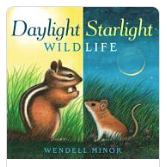
Daylight Starlight Wildlife, by Wendell Minor

This book explores animals that are diurnal/awake during the day and those that are nocturnal/awake at night.  Mr. Minor has painted beautiful lifelike pictures to bring this story alive.

Materials

  • Star cutouts
  • Tissue paper in 1-inch squares
  • Animal cards to sort
  • 1-2 small flashlights
  • 1-4 small blankets or towels from dramatic center
  • Packet of star stickers

Vocabulary

  • Soars- flies high in the sky
  • Kits-baby rabbits are called kits
  • Forage-to look for food
  • Luminous-glowing or shimmering
  • Fearless- to be unafraid
  • Sprightly-active, always moving
  • Scope-checking out
  • Diurnal-awake during the day
  • Nocturnal-awake during the night

Before Reading the Story

Tell the children that you are going to read a book about nocturnal animals (animals who come out at night) and diurnal animals (animals who come out during the day). Have the children repeat the words. Ask them if they can think of an animal that might be nocturnal, remind them that nocturnal means to come out at night. Then ask them if they can think of an animal that is diurnal. Allow them a chance to brainstorm and write their responses on a piece of paper.   Look at the cover; Ask the children if they can tell which side represents daylight and which represent the night or starlight? How can they tell? (It’s yellow like the sun, it’s got stars and the moon on it). Ask them if they can name the animal that is diurnal, nocturnal. Introduce the book.

Science/Scientific Knowledge; expands knowledge of and abilities to observe, describe, and discuss the natural world, living things, and natural processes.

Reading the Story

Stop on the first page and see how many of the animals the children can name. Stop on the page with the red fox and ask the children if they can see what he is pouncing on (a mouse, dinner). Take your time turning the pages, allowing the children the opportunity to share any experiences they might have about the animal/s on the page.

Science/Scientific Knowledge; expands knowledge of and abilities to observe, describe, and discuss the natural world, living things, and natural processes.  AND Language Development/Speaking & Communicating; develops increasing abilities to understand and use language to communicate information, experiences, ideas, feelings, opinions, needs, questions; and for other varied purposes.

After Reading the Story

Post your list from before reading the story onto the wall and re-read it aloud to the children. Ask them if they can recall any other animals that might have been mentioned in the story. When they name an animal, ask if it should be written on the nocturnal side or the diurnal side?

Mathematics/Patterns & Measurement; shows growth in matching, sorting, putting in series, and regroup objects according to one or two attributes such as color, shape, or size.

Discovery

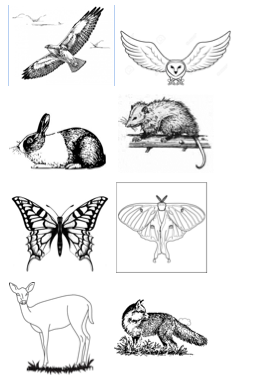
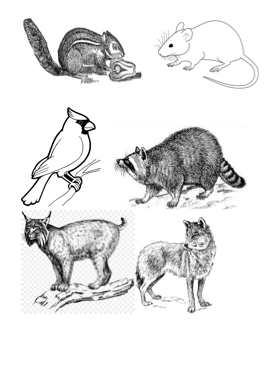
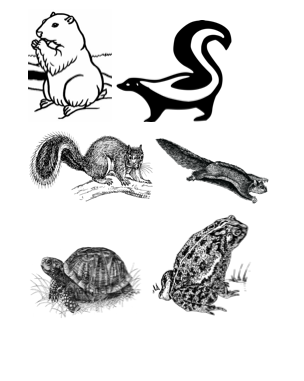
Cut around the many animal cards and put into a bowl. Put out one piece of dark paper with the word ‘nocturnal’ written across the top and one piece of light paper with the word ‘diurnal” written across the top. The children can take the animal cards and sort them onto the correct sheet of paper. Once they are finished, ask them if they can name the animals.

Mathematics/Patterns & Measurement; shows growth in matching, sorting, putting in series, and regroup objects according to one or two attributes such as color, shape, or size.

Music and Movement

Remind the children that nocturnal/night and diurnal/day are opposites. Sing Everything I Always Say to Pop Goes the Weasel verse. https://www.youtube.com/watch?v=FtfpkI-2CKg

Everything I always say, you always say the opposite.
When I say up, you say down.
Everything I always say, you always say the opposite.
When I say diurnal, you say nocturnal.

(As you sing and name the first half of the opposite, stop and see if the children can name the 2nd half. Continue naming opposites until the children loose interest).

Do the following as a chant.

Left foot, right foot I am cool                                Tap left foot and right foot accordingly.
Left foot, right foot I learned at school.                                    
Do left hand, right hand, left ear, eye, nostril, etc                                                                                                                                                                                                                                                                                   

Social & Emotional Development/Self-Concept; begins to develop and express awareness of self in terms of specific abilities, characteristics, and preferences.

Blocks

Encourage the children to use the blocks to make patterns.   Show them how to stand a rectangle block, square block, rectangle block, square block, etc.

Mathematics/Patterns & Measurement;enhances abilities to recognize, duplicate, and extend simple patterns using a variety of materials.

Art

Make stained glass windows by laying a sheet of waxed paper on the table. Put out many 1-inch square of tissue paper and a cup/bowl of glue and a paintbrush for each child. Show them how to paint the glue onto the tissue paper and then lay a piece of tissue paper on top of the waxed paper. Continue painting on the glue and adding tissue paper. As the pieces of tissue paper overlap, new colors will appear. Encourage the children to paint the tissue paper on flat instead of balled. Allow it to dry flat. When it is dry, cut a star shape out of black construction paper. Staple the child’s tissue art behind the star cutout. These look lovely in a sunny window.

Creative Arts/Art; develops growing abilities to plan, work independently, and demonstrate care and persistence in a variety of art project.

Sand and Water

Add baby dolls, a washcloth and several dish towels for bathing the babies.  While the children are bathing the babies, ask them if they take a bath or shower at home?  Do they take it in the morning/day or at night?   

Social & Emotional Development/Knowledge of Families & Communities; develops growing awareness of jobs and what is required to perform them.

Library and Writing

Put the book into the center and add a flashlight for fun reading.

Literacy/Book Knowledge & Appreciation; shows growing interest in reading related activities, such as asking to have a favorite book read; choosing to look at books; drawing pictures based on stories; asking to take a book home; going to the library; and engaging in pretend reading with other children.

Dramatic Play

Darken your dramatic corner as much as possible and tell the children that you have added some blankets to the center so they can pretend that it is nighttime. Ask them what else they might need and help them to supply what you can and to problem solve those items you cannot supply. (My group said they needed more books and toothbrushes. We got more books but problem-solved using their fingers as pretend toothbrushes). Encourage them to act out their nighttime rituals.

Social & Emotional Development/Knowledge of Families & Communities; progresses in understanding similarities and respecting differences among people such as genders, race, special needs, culture, language, and family structure.

Math and Manipulatives

Bring a dice and the star stickers to the table. Give each child a half a piece of dark construction paper. Let the children take turns rolling the dice and adding that many stars on to their paper. When children have had 4 turns, help them to count the number of stars on their paper. With a white pencil or crayon write their name and the number of stars they counted. (Kerry has 17 stars).  If your children are wild dice rollers, bring a box top or a cubby to roll the dice into.

Mathematics/Numbers & Operations; develops increasing ability to count to 10 and beyond.  AND Mathematics/Numbers & Operations;  begins to use one-to-one correspondence in counting objects and matching groups of objects.

Outdoor Play

Take the book out onto the playground and re-read the story. Open the book and go through the pages having the children act out the different animal walks or flights.

Physical Health & Development/Gross Motor Skills; shows increasing levels of proficiency, control, and balance in walking, climbing, running, jumping, hopping, skipping, marching, and galloping.

Transitions

Play category with the children. Say the word nocturnal/during the night or diurnal/during the day and the child must name something they do during that period.

Approaches to learning/Reasoning & Problem-Solving; develops increasing ability to find more than one solution to a question, task, or problem.  AND Language Development/Speaking & Communicating; uses an increasingly complex and varied spoken vocabulary.

Resources

Screen Shot 2018-08-14 at 5.55.43 PM
Screen Shot 2018-08-14 at 5.54.34 PM
Screen Shot 2018-08-14 at 5.55.06 PM
Screen Shot 2018-08-14 at 5.54.50 PM

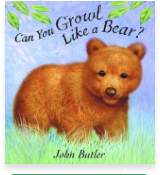
Can You Growl Like A Bear? By John Butler

The illustrations are both large and lovely allowing the children to get a close up view of a variety of animals.  The children will enjoy making the animals noises as you read through the pages.   My classroom enjoyed using this book before naptime as the children and animals settle down for sleep.

Materials

  • Pictures of animals
  • A scarf for each child
  • Several boxes shoebox sized to one large enough a child could sit in
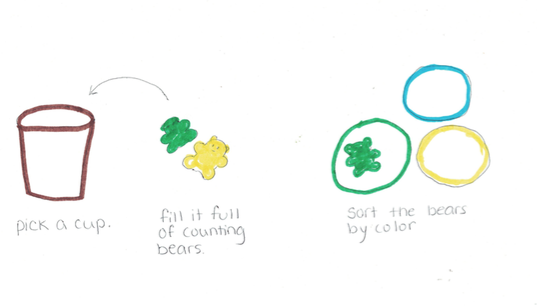
  • Counting bear instruction sheet. Make several copies

Vocabulary

  • Tramping (walking with big heavy steps)
  • Basking  (lying in the sun enjoying how it feels)
  • Slinking  (creeping, tiptoeing)

Before Reading the Story

Go through the book ahead of time and make sure you have thought how you will present each animal sound to the children.

Make up riddles about animals that the children are familiar with. Give several hints and then use the animals’ voice/sound as the final clue. (I’m thinking of an animal that likes to be pet, has long whiskers, and says meow. I’m thinking of an animal that lives near the water and catches insects with its long tongue. It says rivett).

Approaches to Learning/Reasoning & Problem Solving; develops increasing abilities to classify, compare, and contrast objects, events, and experiences.

Reading the Story

On the very first pages where the author asks us to “Listen to the animals…Speak up loud and clear”, ask the children if they can name all the animals on the two pages.  After each page, stop and allow the children to make the animal noises as they present themselves on each page.  Give the children an opportunity to comment about any animal page (I saw an elephant at the zoo and he was really, really, big).

Approaches to Learning/Initiative & Curiosity; grows in eagerness to learn about and discuss a growing range of topics, ideas, and tasks.

After Reading the Story

Tape the pictures of the real animals onto the flannel board.  Keep them in an orderly fashion and close together as you are going to cover all the pictures and remove one so the children cannot see which you have removed.  Show the children the board with one removed; can anyone identify the removed animal?  When it has been identified, have all the children make the animals sound and continue playing Who’s Missing? Until the children grow tired of it.

Language Development/Speaking & Communicating; uses an increasingly complex and varied spoken vocabulary.

Discovery

Put the book and the picture cards from After Reading the Story into the center today for the children to look at and talk about.  Add any other animal picture cards that you might have.  Ask the children to sort the cards by those animals with four few and those who do not have four feet, those with fur, or those that are carnivores.

Mathematics/Patterns & Measurement; shows growth in matching, sorting, putting in a series, and regrouping objects according to one or two attributes such as shape or size.

Music and Movement

In the book the bear was rolling in the snow.  Put out a nap mat, large pillow, etc. and tell the children that they are going to do rolls like a bear in the snow.  Have one child at a time come up and roll across the nap mat/pillow.  After they have had a turn rolling, ask if anyone would like to try to do a somersault?  https://www.google.com/search?client=safari&rls=en&ei=lGYPXdm2OeHl_Qbo-br4Bw&q=how+to+do+a+somersault+kid&oq=how+to+do+a+somersault&gs_l=psy-ab.1.1.0l10.3413.10293..12878…0.0..0.101.1557.21j1……0….1..gws-wiz…..0..0i67j0i131.lISOND5GaPE#kpvalbx=1    You might have to help a child by gently pushing them over once they are in a safe position.

Physical Health & Development/Health Status & Practices; progresses in physical growth, strength, stamina, and flexibility.

Find a CD that has a variety of musical tempos.  Give each child a scarf to hold and turn on the music.  Show the children how to use the scarf to move up and down to the music.  Can they make a circle with the scarf above their head that moves with the music?  What other ways can they use to scarf and move to the music?  Can they throw the scarf up in the air and catch it?  Explore using scarfs to music.

Creative Arts/Movement; shows growth in moving in time to different patterns of beat and rhythm in music.

Blocks

Put out any wild animals you have today and encourage the children to make a zoo.  Can they put all the like kinds of animals in one pen?  Which pen has the most animals?  Which has the least? 

Mathematics/Patterns & Measurement; shows growth in matching, sorting, putting in a series, and regrouping objects according to one or two attributes such as shape or size. AND Mathematics/Number & Operations; demonstrates increasing interest and awareness of numbers and counting as a means for solving problems and determining quantity.

Art

If you have plastic animal stencils tape these to your easel paper today.  The children can fill in the shapes with paint.

Sand and Water

Put dry sand in the table today and add any small objects that you have that are made with metal (colored disks with metal edges, magnet marbles, magnet alphabet letters/numbers, old keys, or large washers).  Bury the objects in the sand and give the children magnet wands to search through the sand for objects.  Put out a small bowl for them to put their collection into.  If using letters/numbers, can the child identify the items that they found in the sand?  If using disks/washers, can the child count how many objects they found in the sand?

Mathematics/Number & Operations; begins to use one-to-one correspondence in counting objects and matching groups of objects. AND Literacy/Alphabet Knowledge; identifies at least 10 letters of the alphabet, especially those in their own name.

Library and Writing

Play word lines with the children.  Give each child a piece of blank paper and a marker.  Explain that you are going to practice making lines that go from the left side of the paper to the right side of the paper.  On each child’s paper mark an L for the left, and an R for the right.  Now tell them that they are going to have to listen carefully for the direction and then make a line as you call it.  You should do the same thing so that the children can have a model.  Say, draw a line from L-R that is dotted.  Draw a line from L-R that is wavy.  Continue making different kinds of lines.  You can then have the children take turns suggesting what kinds of lines to draw. Kinds of lines include; dotted, wavy, thin, zigzag, diagonal, straight, curved, spiral, thick, parallel, straight, vertical, horizontal.

Language Development/Listening & Understanding; shows progress in understanding and following simple and multiple-step directions. AND Language Development/Listening & Understanding; understands an increasingly complex and varied vocabulary . AND Literacy/Early Writing; experiments with a growing variety of writing tools and materials, such as pencils, crayons, and computer.

Dramatic Play

Encourage bedtime rituals by adding boxes that the children can use for beds and blankets.  Add stuffed animals and books for the children to read to each other and their animals.

Creative Arts/Dramatic Play; shows growing creativity and imagination in using materials and in assuming different roles in dramatic play situations. AND Literacy/Book Knowledge & Appreciation; shows growing interest in reading-related activities, such as asking to have a favorite book read; choosing to look at books; drawing pictures based on stories; asking to take books home; going to the library; and engaging in pretend-reading with other children.

Math and Manipulatives

Use counting bears to play a sorting game.  Make copies of the instructions and read them with the children.  Then let the children begin.  Can they follow the directions without teacher direction? 

Language Development/Listening & Understanding; shows progress in understanding and following simple and multiple-step directions. AND Mathematics/Geometry & Spatial Sense; shows growth in matching, sorting, putting n a series, and regrouping objects according to one or two attributes such as color, shape, or size.

Outdoor Play

Do lots of animal’s walks outside today.  If you have a climbing structure, swing like the chimp, pretend to swim quickly around the playground like a dolphin, float from one spot to another like the bee, tramp with big steps like the elephant, and slink slowly like the leopard.  What other animal walks can you include?  Ask the children to help think up other animal movements.  (How might a horse move, or a squirrel?).

Physical Health & Development/Gross Motor Skills; shows increasing levels of proficiency, control, and balance in walking, climbing, running, jumping, hopping, skipping, marching, and galloping.

Transitions

Play Which is Bigger?  Use two animals and ask the children to name, which is bigger, a bear or a cat?  A bumblebee or an ant?   Use, which is smaller, taller, and shorter.

Mathematics/Number & Operations; begins to associate number concepts, vocabulary, quantities, and written numerals in meaningful ways. AND Approaches to Learning/Reasoning & Problem Solving; develops increasing abilities to classify, compare, and contrast objects, events, and experiences.

Resources


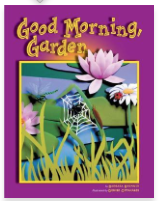
Good Morning Garden, by Barbara Brenner

Everyone starts their day off a little different. In this story a little girl starts off her day by greeting all the things she finds in her garden.

Materials

  • Silk flowers. If you have the ‘heads’ only, pipe cleaners work well for the stems. Just cut them down to an appropriate length.
  • 1 paper plate for every 3 children in classroom and one extra.
  • Pipe cleaners cut into various lengths for both sand/water play and manipulatives.

Vocabulary

  • Plant (flowers, vegetables, trees, and shrubs that mainly grow in the ground)
  • Dew (droplets of water that form on plants and other objects through condensation)
  • Neighborhood (a place where several or many families live)
  • Living (alive)
  • Inanimate (not alive)

Introducing the Story

Begin a discussion on morning rituals.   Ask the children how they start their morning. What do you do first, next, and last. (My Daddy wakes me up and then I get dressed because I have to come to school). Let the children talk about all the things they do. As a child introduces a new activity, ask the other children if they do this too. (How many of you brush your teeth in the morning like Roger?). Tell the children that today you are going to read a story about a little girl who likes to start her day in a different way. Open up the book so the children can see the front and back covers and ask them if they can guess how this girl likes to start her day?

Approaches to Learning/Reasoning & Problem-Solving; develops increasing ability to find more than one solution to a question, task, or problem.

Reading the Story

Read the first page and state that the girl likes to go for a walk and say good morning to the things in her yard. Now as you go through the pages, ask the children if they can name some of the things in the yard. Use your finger to point out the items the young girl is saying good morning to.  Read slowly and allow the children to enjoy the pictures and add any discussion that is appropriate to the story. (Once I saw a bumblebee in my yard and I ran away cause it was gonna sting me).

Science/Scientific Knowledge; expands knowledge of and abilities to observe, describe, and discuss the natural world, materials, living things, and natural processes.

After Reading the Story

Open the book to any page and tell the children to look carefully at how the illustrator made the pictures. Explain to them Denise Ortakales is the illustrator and artist who cut all these little shapes of paper and glued them together to make these pictures. This technique is called paper sculpting. It takes a lot of practice to be able to cut this good; Denise Ortakales is a real artist.

Literacy/Book Knowledge & Appreciation; progresses in learning how to handle care for books; knowing to view one page at a time in sequence from front to back; and understanding that a book has a title, author, and illustrator.

Music and Movement

Sing The Itsy Bitsy Spider.

The Itsy Bitsy Spider climbed up the waterspout.         (make hands pretend to crawl up)
Down came the rain and washed the spider out.          (wiggle fingers to make rain motion)
Out came the sun and dried up all the rain                    (put hands over head fingers to fingers/thumb to thumb)
And the Itsy Bitsy spider, went up the spout again.    (make hands pretend to crawl up)

Change the Itsy Bitsy spider to the Teeny Tiny spider and sing it in a squeaky little voice doing tiny actions. Then sing it to the Humongous spider voice and do great big spider voice and actions.

Creative Arts/Music; participates with increasing interest and enjoyment in a variety if music activities, including listening, singing finger plays, games, and performances.

Put the paper plates on the floor and tell the children that they are going to pretend to be ants crawling about. When the music plays the children crawl about the room. Encourage them to crawl under the table, over the chair, beside the bookcase, walk on the blocks, jump over the stuffed animal, etc. When the music stops the children must quickly crawl to a paper plate (ant hole) where there is room for them. They must put one hand on the plate. When all the ants are in their ‘hole’, begin the music again.

Physical Health & Development/Large Motor Skills; shows increasing levels of proficiency, control, and balance walking, climbing, running, jumping, hopping, skipping, marching, and galloping.

Discovery

In this story, the girl said “good morning” to many living things. Ask the children if they can remember a few. Give the children magazines and scissors and ask them to cut out pictures of living things for you to put on a poster. If the children are cutting many living things pictures, you can change the directions to cut out inanimate objects (things that are not alive).   Depending on how involved the children get, you can glue their pictures to a poster board labeled, LIVING objects and/or INANIMATE objects.

Physical Health & Development/Fine Motor Skills; Grows in eye-hand coordination in building with blocks, putting puzzles together, reproducing shapes and patterns, stringing beads, and using scissors.

Blocks

The last page of the story shows a neighborhood. Show this page to the children in the block center and challenge them to build a neighborhood. Explain that each builder will need a house and whatever else they choose to put into their neighborhood.

Social & Emotional Development/Knowledge of Families & Community; begins to express and understand concepts and language of geography in contexts of classroom, home, and community.

Art

Cut several sheets of construction paper into ½ inch x 6 inch strips. Accordion some of the strips, curl some of the strips, and crease the ends ½” inch in on all of the strips at both ends. Use glue sticks and show the children how to apply the glue to the ½” creased ends of the strips and hold them while they count to 10 on a piece of black construction paper. This will make a 3-dimensional paper collage. Encourage the children to use many strips gluing them under and over each other. Remind them that will have to count to ten and hold the strip in place while the glue settles and sticks. When these are finished they are fun to hang from the wall as the paper sticks out off the wall.

Creative Arts/Art; begins to plan, work independently, and demonstrate care and persistence in a variety of art projects. AND Mathematics/Number & Operations; develops increasing ability to count in sequences to 10 and beyond.

Sand and Water

Add damp sand and plastic or silk flowers for planting. Add spoons and a watering can, and popsicle sticks for labeling what you are growing. If you have bean seeds or small puff balls, these can be used as ‘seeds’.

Creative Arts/Dramatic Play; shows growing creativity and imagination in using materials and in assuming different roles in dramatic play situations.

Library and Writing

Cut out several 3-4 inch shapes from cardboard (a circle, a square, and a triangle). Show the children how to hold the shape onto a piece of paper and trace around it with a marker. Next give the children scissors so they can practice cutting out the shapes. They can either glue them to paper or put them into an envelope for another days art project.

Physical Health & Development/Fine Motor Skills; develops growing strength, dexterity, and control needed to use tools such as scissors, paper punch, stapler, and hammer.

Dramatic Play

The story was about one girl’s morning rituals. Encourage the children to play out their morning rituals. Some children can be parents and some children. As you check in with the center, ask them about their own morning rituals to help guide the play along.

Social & Emotional Development/Knowledge of Families & Communities; progresses in understanding similarities and respecting differences among people such as gender, race, special needs, culture, language, and family structures.

Math and Manipulaties

Give the children play dough and pipe cleaners today. Challenge them to make a spider or insect. Can they roll out a long snake?

Physical Health & Development/Fine Motor Skills; develops growing strength, dexterity, and control needed to use tools such as scissors, paper punch, stapler, and hammer

Outdoor Play

Prep your playground several days ahead of time. Lay a piece of cardboard down in a shady location (the coolness underneath attracts insects). Put out several small dishes of fruit pieces that may help attract ants. On the day of your walk, take out paper and pencil, and magnifying glasses. Go for a Living Things walk and record what they children see on the paper to share in the classroom later.

Science/Scientific Knowledge; expands knowledge of and abilities to observe, describe, and discuss the natural world, materials, living things, and natural processes.

Transitions

Play Categories with the children. Name a category such as fruits, insects and bugs, animals that live in trees, etc. Each child must try to name something from the category before lining up or going to the next activity. For younger children, keep the categories simpler. Name red objects, things that fly, or you name an object and ask them if it is alive or inanimate. (chair, bird, television, etc.)

Approaches to Learning/Reasoning & Problem Solving; develops increasing abilities to classify, compare, and contrast objects, events, and experiences.

Dear Parents, today we read a book about all the wonderful living things out in a little girls neighborhood. Take your child for a walk about your yard or neighborhood and take time to see all the wonders of nature with your child.