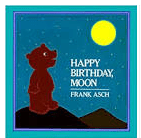
Happy Birthday Moon, by Frank Asch

            This is the story about a little bear who wants to share something special with the moon on its birthday.

Materials

  • Pictures of the moon in the sky at night to go with poem
  • Recipe card for Man in the Moon treats
  • Cream cheese and round crackers
  • Plastic knives to spread
  • Small box of raisins

Vocabulary

  • Echo (to repeat a sound)

Before reading the Story

            Talk to the children about what an echo is.  Sing an echo song (examples; There was a Man, Going on a Bear hunt).  Practice having the children echo back responses by naming letters while you hold up cards and say first, TEG, SFP, DBV

Literacy/Alphabet Knowledge; identifies at least 10 letters of the alphabet, especially those in their own name.

Tell the children that you are going to read a story and need their help to be the echo.

Reading the Story

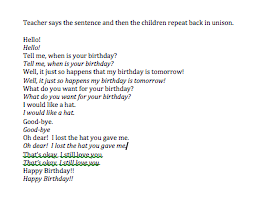
            As you read the story, stop when you get to the part where Bear shouts; “Hello!”  This time his own voice echoed off one of the mountains:” Hello!”  Tell the children that they are the echo now and repeat back all the things that Bear thinks the moon is saying.  Continue this way to the end of the story.  For older children you can write the echos on paper and hold up so the children can see the sentence as they echo back to you.

Language Development/Listening & Understanding; demonstrates increasing ability to attend to and understand conversations, stories, songs, and poems.

After Reading the Story

            Talk to the children about the moon.  When do you see the moon?  Does it always look the same?  The moon helps to light the sky at night.  What else helps to light the sky at night?  The moon looks like it is growing in the sky and then gets little again, this is called a moon cycle.  Read the poem, The Moon, anonymous.

Sometimes the moon is full           Hold up full moon picture

And shows a circle of light 

And sometimes the moon looks like          Hold up half moon picture

One half a ball at night.

Sometimes the moon is only                        Hold up new moon picture

A sliver and hardly more

But all the night the moon is out there

When you look out of your door

Science/Scientific Knowledge; develops growing awareness of ideas and language related to attributes of time and temperature. AND Language Development/Listening & Understanding; demonstrates increasing ability to attend to and understand conversations, stories, songs, and poems.

Discovery

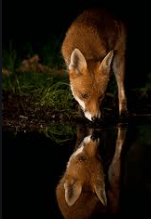
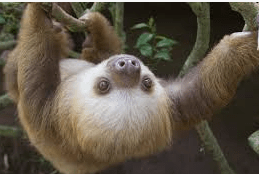
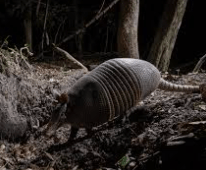
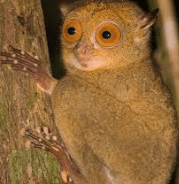
            Using books and magazines that depict nocturnal animal life. Help the children develop a list of animals that come out at night. Notice the eyes of many of the animals are large, better to see at night with.

Literacy/Book Knowledge & Appreciation; shows growing interest in reading-related activities, such as asking to have a favorite book read; choosing books to look at; drawing pictures based on stories; asking to take books home; asking to go to the library; and engaging in pretend reading with other children.

Music and Movement

Teach the children the chorus to I See The Moon. If you have time teach them the verses also. https://www.youtube.com/watch?v=d4ZOGGRGuTw

Teach songs with Echo like Frere Jacques https://www.youtube.com/watch?v=QblcSZcRDBA

Language Development/Listening & Understanding; demonstrates increasing ability to attend to and understand conversations, stories, songs, and poems.

Blocks

            In the story Bear climbed to the highest mountain.  Challenge the children to build a very tall structure. You might start this activity with the children using one inch cubes or small blocks instead of the unit blocks.

Approaches to Learning/Engagement & Persistence; grows in abilities to persist in and complete a variety of tasks, activities, projects, and experiences.

Art

            Cut out moon shapes from a manila folder.  Show children how to take 1 inch squares of tissue paper, crumple into small ball and glue it onto the moon shape.

Physical Health & Development/Fine Motor Skills; grows in hand-eye coordination in building with blocks, putting together puzzles, reproducing patterns and shapes, stringing beads and using scissors.

Sand and Water

            Put water in the table 2 inches deep.  Give the children lids, small plastic containers, and boats.  Show the children how to put counting bears on to the boats/containers, lids to make boats to float the bears.  How many bears can you put in a boat?

Mathematics/Number & Operations; begins to use one-to-one correspondence in counting objects and matching groups of objects. AND Physical Health & Development/Fine Motor Skills; grows in hand-eye coordination in building with blocks, putting together puzzles, reproducing patterns and shapes, stringing beads and using scissors.

Library and Writing

            Play the Man in the Moon only speaks in ‘m’ words.  With the children in a circle, go around taking turns thinking of words that start with the letter M.  Also try putting an ‘m’ sound as the first letter of each child’s name (Kerry=Merry, Roger=Moger)

Literacy/Phonological Awareness;showing growing awareness of beginning and ending sounds in words.

Dramatic Play

            Bedtime rituals.  Bring in blankets, pillows, books, night time pictures to hang on the wall.

Social & Emotional Development/Knowledge of Families & Communities; progresses in understanding similarities and respecting differences among people such as gender, race, special needs, culture, language, and family structures.

Math and Manipulatives

            Spread crème cheese on round crackers.  Add a man in the moon face using raisins.

Physical Health & Development/Fine Motor Skills; develops growing strength, dexterity, and control needed to use tools such as scissors, paper punch, stapler, and hammer.

Outdoor Play

            Let the children climb onto something tall (climber, box, log stump) and pretend that they are the moon.  Shout out a silly sentence and have them repeat it back to you

Language Development/Listening & Understanding; demonstrates increasing ability to attend to and understand conversations, stries, songs, and poems. AND Literacy/Book Knowledge & Appreciation; demonstrates ability to retell and dictate stories from books and experiences; to act out stories in dramatic play; and to predict what will happen next in a story.

Transitions

            Say a sentence and have the child repeat back to you.  This could be a long 12 syllable sentence of a silly sentence depending upon the child’s language skills.

Language Development/Listening & Understanding; demonstrates increasing ability to attend to and understand conversations, stries, songs, and poems

Resources

fox
owl
raccoon
lemur
sloth
jaguar
hedgehog
otter
armadillo
bat
wombat
tree frog
snake
lion

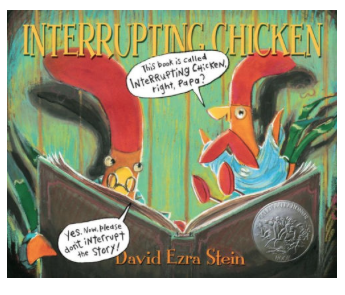
Interrupting Chicken, by David Ezra Stein

Little Red Hen cannot help but interrupt her bedtime stories. Find out how this changes the way the stories are told.

Materials

  • Collection of different kinds of bird feathers.
  • Cracked corn
  • Collection of feathers
  • Pictures to go with song I Had a Little Rooster

Vocabulary

  • Interrupt (to break into a conversation or to barge in)

Before Reading the Story

Talk about night time rituals.  When you get ready for bed what are some of the things that you do?  (brush teeth, take bath/shower,/wash my face/kiss good night/read stories.  Ask the children to raise their hand if a parent reads to them before bed.  Make a list of the children’s favorite stories.  Ask each child to name any favorite stories they may have.  “Our Favorite Books”  Brenda likes Chicka Chicka Boom Boom, Mark likes Mike Mulligan and the Steam Shovel

Literacy/Book Knowledge & Appreciation; progresses in learning how to handle and care for books; knowing to view one page at a time in sequence from front to back; and understanding that a book has a title, author, and illustrator.

Reading the Story

At each point where little red chicken interrupts and the story ends abruptly, ask the children if they liked that story, why or why not?

Social & Emotional Development/Self-Control; develops and understanding of how their actions affect others and begins to accept consequences for their actions.

After Reading the Story

Give examples of when to not interrupt.  The teacher is talking to everybody about what they are doing today.  You mom is on the telephone and you want to tell her something.  Talk about when it is ok to interrupt and when it is not.  Is it ok to interrupt when you are tired? If the house is on fire? You have to go to the bathroom? Someone made a face at you? Your friend is hurt and bleeding? Talk about how it makes you feel when you are interrupted. Talk about how to interrupt if you must (excuse, begging your pardon).

Approaches to Learning?Reasoning & Problem Solving; grows in recognizing and solving problems through active exploration, including trial and error, and in interactions and discussions with peers and adults. AND Social & Emotional Development/Self-Control; develops and understanding of how their actions affect others and begins to accept consequences for their actions.

Little Chicken just wanted to help the characters in the stories that her father was reading. Ask the children if they ever felt like they wanted to help someone out? Let them talk about their experiences.

Social & Emotional Development/Self-Control; develops growing understanding of how their actions affect others and begins to accept the consequences of their actions.

Discovery

Put out a variety of tools (scissors, pencil, phone, spoon, etc.  Ask the child which tool you would use to put food in your mouth, write your name etc.

Language Development/Listening & Understanding; understands an increasingly complex and varied vocabulary.

If you are lucky enough to have a collection of feathers, put it out with a magnifying glass for the children to examine today. Can they find two that match? Do any of the feathers have a pattern on them?

Science/Scientific Skills & Methods; develops increasing ability to observe and discuss common properties, differences, and comparisons among objects and materials.

Music and Movement

The Interrupting Song https://www.youtube.com/watch?v=AifKm6TsWJA

Sing This Is The Way We…. To the tune of Here We Go Round the Mulberry Bush. https://www.youtube.com/watch?v=FTgxW32ie5E

This is the way we scratch for worms, scratch for worms, scratch for worms. This is the way we scratch for worms so early in the morning. This is the way we peck for food, sit on our eggs, flap our wings, fly away.

Creative Arts/Music; Participates with increasing interest and enjoyment in a variety of music activities, including listening, singing, finger plays, games, and performances.

Relax with soft music.  Let whole body relax.  Pick up a child’s arm and let it fall, was it relaxed?  Like a rag doll.

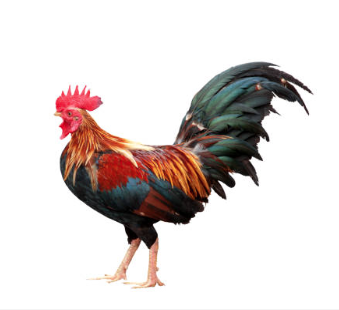
I had a little rooster https://www.youtube.com/watch?v=fBUg0HvWYx0

Art

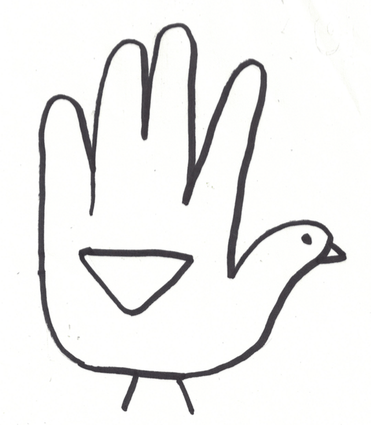
Trace around each child’s hands and show them how they can turn them into chickens.

Physical Health & Development/Fine Motor Skills; progresses in abilities to use writing, drawing, and art tools, including pencils, markers, chalk, paint brushes, and various technology.

Use feathers at the easel for paint brushes today.

Creative Arts/Art; gains ability in using different art media and materials in a variety of ways for creative expression and representation.

Sand and Water

Fill the table fill of a chickens favorite food, cracked corn. Use it to scoop and pour.

Library and Writing

Have child draw a picture.  Then ask them to tell you about their picture.  Write their dictation onto a piece of paper and staple it to their picture.

Literacy/Early Writing; begins to represent stories and experiences through pictures, dictation, and in play.

In the story, father rooster began reading three stories.  If you have these books in your school, add them to the center for the children to look at and ask you to read (Hansel and Gretel, Little red Riding Hood, Chicken Little)

Literacy/Book Knowledge & Appreciation; shows growing interest in reading-related activities, such as asking to have a favorite book read; choosing to look at books; drawing pictures based on books; asking to take books home; going to the library; and engaging in pretend reading with other children.

Dramatic Play

At nap time today make sure the children have access to books.  Let them use this prepping for naptime to read stories (to each other or to a stuffed animal.

Literacy/Book Knowledge & Appreciation; shows growing interest in reading-related activities, such as asking to have a favorite book read; choosing to look at books; drawing pictures based on books; asking to take books home; going to the library; and engaging in pretend reading with other children.

Bring in night time ritual materials for the children to play night time.  (blanket, box for bed, books, dressup pj’s, stuffed animals

Creative Arts/Dramatic Play; participates in a variety if dramatic play activities that become more extended and complex.

Math and Manipulatives

Play any board game or card game that you and your children are familiar with.  The idea is to practice taking turns.

Social & Emotional Development/Cooperation; develops increasing abilities to give and take in interactions; to take turns in games or using materials; and to interact without being overly submissive or directive.

Outdoor Play

Any game or activity where you stress the importance of taking turns.

Social & Emotional Development/Cooperation; develops increasing abilities to give and take in interactions; to take turns in games or using materials; and to interact without being overly submissive or directive.

Transitions

Tell the children that you are going to practice taking turns to go to the next activity. Ask the children to show you that they are ready. Call on those that you feel are ready and ignore those who are not following your rules. When all the children who did as they were asked have gone to the next activity, ask the remaining children why they are still sitting on the carpet? Remind them again to show you what they need to be doing. Call them as they follow the directions to go to the next activity. Keep reminding and calling children until everyone has moved. (I have the children sit with hands in their laps and mouths zipped closed).

Social & Emotional Development/Self-Control; develops growing understanding of how their actions affect others and begins to accept the consequences of their actions.

Resources

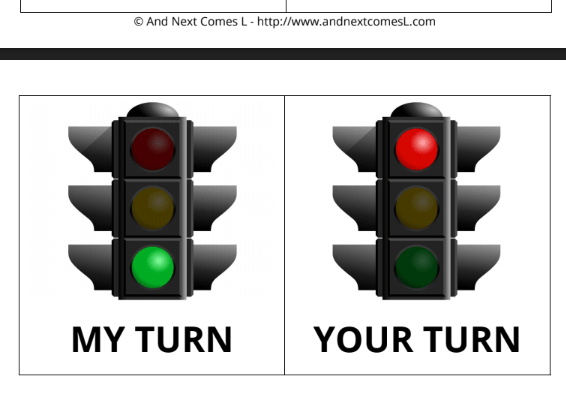
Use as a visual to help children learn to wait their turn.
handprint chicken

The Napping House, by Audrey Wood

            Naps are very important to help us grow.  This fun story is about a house that is napping, until a wakeful flea arrives, then everything goes crazy.

Materials

  • Copy of characters. Make into flannel pieces by covering with contact paper and taping to the board. Pictures come from; Projecto A casa sonolenta em LIBRAS

Vocabulary

  • Colored construction paper cut into one-inch lengths.
  • Construction paper that has been made into a weaving frame (see resources).

Before reading the story

            Hold up the cover of the book and say the title.  Ask the children why they think naps are important (we grow while we sleep, when we are tired we do not think as well, naps help us from getting crabby).  Talk about how the children sleep (Kerry always falls asleep first, Roger likes to read a book before he takes a nap, and Ryan you are usually the last to fall asleep).  Turn off the light if you have window light to darken the room slightly.

Social & Emotional Development/Self-Concept; begins to develop and express awareness of self in terms of specific abilities, characteristics, and preferences.

Reading the Story

            As you read the pages where everyone is sleeping, use a soothing voice and yawn as you turn the pages.  Point to each critter as they climb onto the bed.  When you get to the page where the flea bites the mouse, change your voice to one of surprise and a quicker pace.

After reading the story

            Ask the children if they noticed the flea in the first half of the story.  Go back through the pages and look for the flea.  Use the copy of the characters to put onto the bed in the correct order (Who was the first one on the bed?  Who was second, third, fourth, etc).

Literacy/Book Knowledge & Appreciation; demonstrates progress and abilities to retell and dictate stories from books and experiences; to act out stories in dramatic play; and to predict what will happen next in a story.

Discovery

            If you have nesting toys these would be good to put into the center.  I use the Russian nesting dolls and talk about smallest, bigger, bigger, and largest.

Mathematics/Patterns & Measurement; shows increasing abilities to match, sort, put in a series, and regroup objects according to one or two attributes such as color, shape, or size.

Music and Movement

            Put lullabies on during the day as background music.

Blocks

            Encourage the children to make a bed and load it up with animals.  How many animals can you get on the bed?  Can you put the cow on top of the tiger?

Mathematics/Number & Operations; demonstrates increasing interest and awareness of numbers and counting as a means for solving problems and determining quantity.

Art

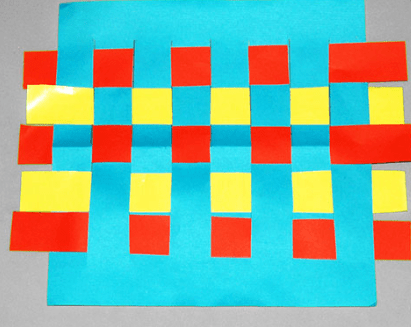
Make woven blankets. Fold a piece of construction paper in half the long length, one per child. Cut from the fold to approximately one inch from the outside edge. Open up, this is your weaving frame. Cut many one inch lengths of colored construction paper. Show the children how to take a length of colored paper and go under, over, under, over the weaving frame stripes. Take the next piece of colored paper and go over, under, over, under. Continue filling in the weaving frame.

Mathematics/Pattern & Measurement; enhances abilities to recognize, duplicate, and extend simple patterns using a variety of materials. AND Physical Health & Development/Fine Motor Skills; grows in hand-eye coordination in building with blocks, putting together puzzles, reproducing shapes and patterns, stringing beads, and using scissors.

Sand and Water

            Put out water and colanders or plastic containers with holes punched into the bottom to simulate rain.  Note that in the story it was raining outside the window. As they play, talk to them about rain. Talk about how it is important to be safe and come out of the rain if you hear thunder or see lightning.

Physical Health & Development/Health Status & Practices; builds awareness and ability to follow basic health and safety rules such as fire safety, traffic and pedestrian safety, and responding appropriately to potentially harmful objects, substances, and activities.

Library and Writing

            Give the children a piece of white paper and, tell them that you are going to tell them how to make a Mexican blanket.  Have them turn the paper the tall way (vertically).  On the top of the paper use a pencil and make an L on the left and an R on the right.  Model with your own piece of paper.  Tell, and show, the children to draw a blue dotted line from the left side to the right.  Next, tell and show them to draw a curly yellow line from the left side to the right.  Continue this using a variety of colors and different kinds of lines until they have filled their paper.  Use words that describe lines as you model ( dotted line, curly line, zig-zag line, straight line, thick line, wavy line). 

Language Development/Speaking & Communicating; uses an increasingly complex and varied vocabulary. AND Language Development/Listening & Understanding; show progress in understanding and following simple and multiple-step directions, AND Literacy/Early Writing; experiments with a growing variety of writing tools and materials, such as pencils, crayons, and computers.

Dramatic Play

            Use boxes and blankets to make beds.  Add stuffed animals. Encourage the children to act out the story.

Literacy/Book Knowledge & Appreciation; demonstrates progress and abilities to retell and dictate stories from books and experiences; to act out stories in dramatic play; and to predict what will happen next in a story.

Outdoor Play

            Tell the children that you are going to play a game of night and day.  Have the children sit in a circle.  Stand in the middle of the circle, holding your arms out and your hands up with your fingers spread.  Tell the children that your hands are the sun and when the sun is shining on them they are awake.  If your hands are not shining on them they are to pretend that they are asleep.  Slowly start turning in the circle and help them get the rhythm of the game.  As they are able to wake and sleep while you turn, speed up and slow down and see if they can keep up with your rhythm.

Approaches to Learning/Initiative & Curiosity; chooses to participate in an increasing variety of tasks and activities.

Transitions

Put a piece of tape on the backs of each of the napping house figures. Ask a child to put the dog over the cat or the grandmother under the mouse. Each child can have a turn moving pieces as they go to the next activity.

Mathematics/Geometry & Spatial Sense; builds an increasing understanding of directionality, order, and positions of objects, and words such as up, down, over, under, top, bottom, inside, outside, in front, behind.

Resources