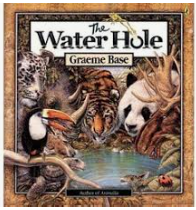
The Water Hole, by Graham Base

The animals are thirsty. Count your way 1-10 and watch what happens to the water hole! Oh, and look for the hidden frog on each page.

Materials

  • Cut out paper fish in several colors. Put a number on the fish 1-5 or 1-10. On the backside of the fish add the corresponding dots. On each fish, add a paperclip. Use a stick or ruler and attach a piece of yarn about 1 foot long. On the end of the yarn, tie a magnet. These will be the fishing poles (2 poles should be enough).
  • A variety of materials that will absorb water and those that will not. (cotton ball, paper towel, coffee filter, baby doll dress, cup of sand, cup of dirt, block, plastic toy)
  • Several eye droppers

Vocabulary

  • Delectable (another word for delicious or tasty).
  • Wallowing (stumbling about)
  • Floundering (splashing about)
  • Lumbering (bumping into each other and being clumsy)
  • Absorbed (to be sucked into or taken into the dry sand or other material)

Introducing the Story

Talk about the importance of drinking water everyday. Explain that we need to drink water to help our bodies and brains for playing and thinking. Explain that all living things need water. Ask the children if they think a dog is a living thing, a rock, a plant, a fish, a bed, a tree, and a car?

Approaches to Learning/Reasoning & Problem-Solving; develops increasing abilities to classify, compare, and contrast objects, events, and experiences.

Reading the Story

Hold up fingers that correspond to each page. Don’t forget to look for the frogs. On page three after reading, “But something was happening”, stop and see if the children can see what is happening (the water hole is getting smaller). When you get to page 10 and there is no water left, ask the children again what they think will happen?

Literacy/Book Knowledge & Appreciation; demonstrates abilities to retell aand dictate stories from books and experiences; to act out stories in dramatic play; and to predict what will happen next in a story. AND Language Development/listening & Understanding; demonstrates increasing ability to attend to and understand conversations, stories, songs, and poems.

After reading the Story

Ask the children ways in which they use water besides drinking it. Get out a piece of paper and list their responses. (I take a bath in water, I play in my sprinkler, My big brother washes the car, the fireman’s got water). Talk about the importance of drinking water throughout the day to stay hydrated.

Approaches to Learning/Reasoning & Problem Solving; develops increasing ability to find more than one solution to a question, task, or problem. AND Science/Scientific Knowledge; expands knowledge of and abilities to observe, describe, and discuss the natural world, materials, living things, and natural processes.

Music and Movement

Do animal walks with the children. Can they fly like a bird? Jump like a kangaroo? Hop like a rabbit? Gallop like a horse? Slither like a snake?

Physical Health & Development/Gross Motor Skills; shows increasing levels of proficiency, control, and balance in walking, climbing, running, jumping, hopping, skipping, marching, and galloping.

Discovery

Put out a variety of materials that will absorb water and several that will not. Add a small cup of water and several eyedroppers. Challenge the children to suck up some water into the eyedropper and squirt onto the various materials. Did the water absorb into the item or not? Can the children guess into which items the water will absorb before doing?

Physical Health & Development/Fine Motor Skills; develops growing strength, dexterity, and control needed to use tools such as scissors, paper punch, stapler, and hammer. AND Science/Scientific Methods & Skills; begins to uses senses and a variety of tools and simple measuring devices to gather information, investigate materials, and observe processes and relationships.

 Take the children outside and pour a cup of water onto the sidewalk. Take a piece of chalk and draw all around the edges of the puddle you created. Ask the children what they think will happen. Check back several minutes later, what happened to the water? Were the children able to predict correctly?

Approaches to Learning/Initiative & Curiosity; chooses to participate in an increasing variety of tasks and activities. AND Science/Scientific Knowledge; shows increased awareness and beginning understanding of changes in materials and cause-effect relationships.

 Blocks

Put out your animals today and encourage the children to build a waterhole for all the animals to drink. Encourage them to sort the animals by like kinds or from smallest to largest.

Mathematics/Geometry & Spatial Sense; shows growth in matching, sorting, putting in a series, and regrouping objects according to one or two attributes such as color, shape, or size.

Art

Encourage the children to draw animals using magic markers.

Creative Arts/Art; progresses in abilities to create drawings, paintings, models, and other art creations that are more detailed, creative, or realistic. AND Physical Health & Development/Fine Motor Skills; progresses in abilities to use writing, drawing, and art tools, including pencils, markers, chalk, paint brushes, and various forms of technology.

Sand and Water

Today just put out water and any materials that you have to just move the water from one container to another. Examples; funnels, pitchers, measuring cups and spoons, tubing, squeeze bottles, basters, and sponges.

Physical Health & Development/Fine Motor Skills; develops growing strength, dexterity, and control needed to use tools such as scissors, paper punch, stapler, and hammer.

Library and Writing

Put the number fish on the floor and show the children how to use the fishing pole with the magnet to ‘catch’ a fish. Can the child name the number on the fish? This can also be done with letters that you may be working on with your children.

Mathematics/Number & Operations; begins to associate number concepts, vocabulary, quantities, and written numerals in meaningful ways.

Math and Manipulatives

Any kind of counting manipulatives and small cups marked 1-5 or 1-10. The children then use the counters to fill the cups up with the correct amount of counters.

Mathematics/Number & Operations; begins to make use of one to o ne correspondence in counting objects and matching groups of objects.

Give each child pieces of paper, 1-5 or 1-10 depending upon the age of your children. On the top of each piece of paper write a number 1-5 or 1-10. Challenge the children to cut out shapes or draw objects 1-5 or 1-10 depending upon how large a number book you are making per child. If Juan is working on numbers 1-5, he should have 5 pieces of paper with a number written at the top of each.

Mathematics/Number & Operations; begins to make use of one to one correspondence in counting objects and matching groups of objects.

Outdoor Play

Bring any animals you might have out onto the playground. Have the children dig a large water hole and position the animals all around. If you have access to water you can have the children carry buckets of water to dump into the water hole. Ask the children what is happening to the water as it is dumped (it is being absorbed into the sand). Encourage the children to talk about the story and act out with the animals that you have. Remind them about the importance of drinking water everyday. Tell them, “Be Smarter, Drink Lots of Water”.

Literacy/Book Knowledge & Appreciation; demonstrates progress in abilities to retell and dictate stories from books and experiences; to act out stories in dramatic play; and to predict what will happen next in a story.

Bring drinking water out onto the playground. Several times throughout your play, call the children over to the ‘water hole’ and ask them if they would like a drink. Tell them, Be Smarter, Drink Lots of Water”.

Physical Health & Development; Health Status & Practices; builds awareness and ability to follow basic health and safety rules such as fire safety, traffic, and pedestrian safety, and responding appropriately to potentially harmful objects, substances, and activities.

Transitions

Name an animal and the child makes the corresponding animal sound. For older children challenge them to recall some of the animal sounds in the story.

Science/Scientific Knowledge; expands knowledge of and abilities to observe, describe, and discuss the natural world, materials, living things, and natural processes.

Resources

Dear Parent-today we read a story about animals drinking from the water hole.  Encourage your child to drink plenty of water as they play, especially on hot days. Remind them that they need water to keep their bodies lubed and hydrated.

Five Little Monkeys Sitting in a Tree, Eileen Christelow

            Teasing is not nice as these five monkeys learn. This is a fun counting/subtraction book based on a popular finger play.

Materials

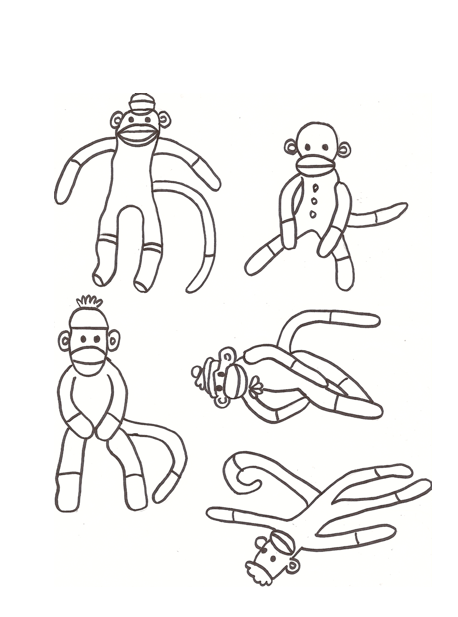
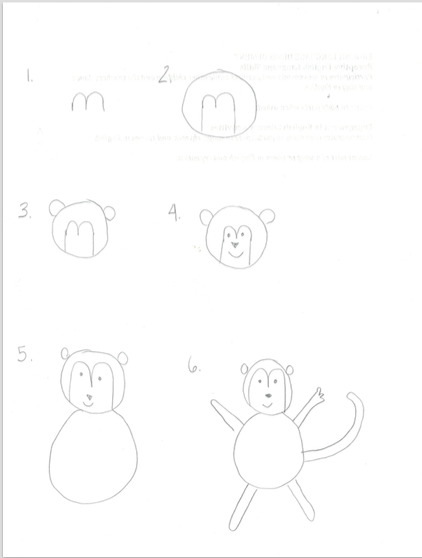
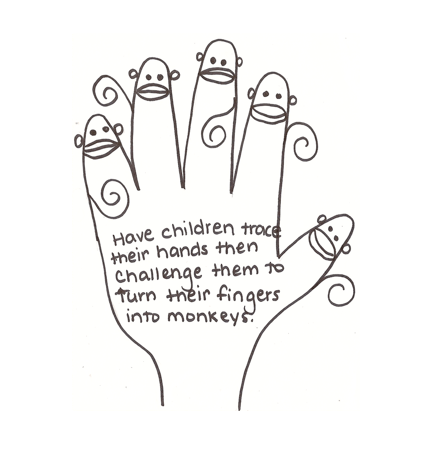
            Drawing monkey directions and number line 1-5****

            A basket the children can use for picnic play

            A deck of cards.

Vocabulary

  •  Snooze (a nap)
  •  Scolds (to tell somebody off, to speak angrily to another)
  • Tease (to make somebody mad on purpose or to be purposely hurtful)

Before Reading the Story

            Tell the children that you want to talk to them about teasing.  Ask them if they know what it means to tease somebody.  Ask them how they feel when somebody teases them.  After the children have shared their experiences about teasing, tell them that you are going to play a game.  Have them make a thumbs up sign and tell them that when you hear a kind idea make a thumbs up.  Do the same for thumbs down and a teasing story.  Make up scenarios or use ones you have seen in your classroom and ask the children if it is a thumbs up or thumbs down?  After you have run several scenarios pass the children, older children might like to try making one up.  (You are playing in the blocks and another child comes in and goes right up to your building and knocks it down and laughs, is this a thumbs up, or thumbs down?  You are getting some water to put into the water table and you spill some on the floor by accident.  Another child comes over with a paper towel and helps you wipe it up, is this a thumbs up/down?  You fell down while running on the playground and someone laughs at you, thumbs up/down?)

Social & Emotional Development/ Self-Control; develops growing understanding of how their actions affect others and begins to accept consequences of their actions.

Reading the Story

            Tell the children that your story today is about 5 little monkeys who tease.  Hold up the cover and read the title.  Ask the children if anyone can guess who the monkeys might be teasing?

Literacy/Book Knowledge & Appreciation; demonstrates growing abilities to retell and dictate stories from books and experiences; to act out stories in dramatic play; and to predict what will happen next in a story.

After Reading the Story

            Ask the children why the mother monkey was scolding her children?  Do you think teasing is nice?  Why should we not tease (it hurts peoples feelings, it could make somebody mad, sad, cry).  What should you do if somebody is teasing you?  Have the children practice saying “Stop It, I don’t like that!”  Have them practice saying it loud.  Tell them if you as the teacher hear a child say this (Stop it I don’t like that) that you will come over to where they are and help them.  Have everyone practice saying it again.  Say it again loudly.

Literacy/Book Knowledge & Appreciation; demonstrates growing abilities to retell and dictate stories from books and experiences; to act out stories in dramatic play; and to predict what will happen next in a story. AND Social & Emotional Development/Self-Control; shows progress in expressing feelings, needs, and opinions in difficult situations and conflicts without harming themselves, others, or property.

Discovery

            Bring in parts of trees and magnifying glasses.  Help the children to name the bark, branch, bough, leaf, bud, and seed of the trees. Draw a large tree and label the different parts. You can show the children as you discuss.

Science/Scientific Skills & Methods; develops growing abilities to collect, describe, and record information through a variety of means, including discussion, drawings, maps, and charts.

Music and Movement

          Teach the children 5 Little Monkeys https://kcls.org/content/five-little-monkeys-sitting-in-a-tree/

Mathematics/Number & operations; begins to use one-to-one correspondence counting objects and matching groups of objects.

            Do the Crocodile, Crocodile chant.

Crocodile, crocodile long and green

Crocodile, crocodile with teeth so mean

He snapped at a fish

He snapped at a bee

He snapped at a frog

And he snapped at me.

He caught that fish

He caught that bee

He caught that frog

But he did not catch me!

Whew

Creative Arts/Music; participates with increasing interest and enjoyment in a variety of music activities, including listening, singing, finger plays, games, and performances.

            Gather all the children into a circle and play Monkey See, Monkey Do.  One person starts off as the leader and everyone mimics their movements.  Take turns being the leader. https://www.youtube.com/watch?v=ZdCLvwK8I6c

When (name) claps, claps, claps her hands

The monkeys clap, clap, clap their hands

Monkey see, Monkey do

Monkey do the same as you (point to the next leader.)

Begin again saying the person’s name and letting them choose the next action

Social & Emotional Development/Cooperation; develops increasing abilities to give and take in interactions; to take turns in games and using materials; and to interact without being overly submissive or directive.

Blocks

            Draw 5 monkeys, or let the children draw their own.  Cut around the monkey shapes and put a piece of tape onto the back.  The children can build with blocks and then add the 5 monkeys to swing from their structures. For older children, ask them if they can do the % Monkeys finger play/poem using the monkeys on their structure.

Literacy/Book Knowledge & Appreciation; demonstrates abilities to retell and dictate stories from books or experiences; to act out stories in dramatic play; and to predict what will happen next in a story.

Art

            Put sand into the paint at the easel today.  When it dries the surface will be a rough texture like a crocodiles back.  Put out green, brown, and white paint to simulate a crocodiles coloring.

Creative Arts/Art; gains ability in using different art media and materials in a variety of ways for creative expression and representation.

Library and Writing

            Show the children the How to Draw a Monkey.  Encourage them to try to follow the steps and make five monkeys.  Have them write their numbers beside.

Literacy/Early Writing; develops understanding that writing is a way of communicating for a variety of purposes. AND Language Development/Listening & Understanding; shows progress in understanding and following simple and multiple-step directions.

Sand and Water

            Put water into the table today.   Add several long blocks that the children can pretend are crocodiles.  They can bob these up and down or pour water over them. If you have counting bears or similar manipulatives, add these also. How many counting bears can float on the back of the block?

Creative Arts/Dramatic Play; shows creativity and imagination in using materials and in assuming different roles in dramatic play situations. AND Mathematics/Number & Operations; demonstrates increasing interest and awareness of numbers and counting as a means for solving problems and determining quantity.

Dramatic Play

            Bring in a basket and a towel or blanket.  The children can pretend to go on a picnic supper.

Creative Arts/Dramatic Play; participates in a variety of dramatic play activities that become more complex and extended.

Math and Manipulatives

            Bring in a deck of cards.  Take out all the face cards.  Shuffle the cards and pass them out evenly between 2-4 players.  Have the children put their pile of cards face down in front of them.  On the count of three, everyone turns over their top card.  The person with the highest number gets to take all the cards and put them in a second pile beside them.  If two or more players turnover the same number, they must slap their card and say SNAP!  The one who says snap first gets to take all the cards and put them beside them.  Play until one person has all the cards or the children lose interest.

Mathematics/Number & Operations; begins to associate number concepts, vocabulary, quantities, and written numerals in meaningful ways.

Outdoor Play

            If you have a tree or structure to climb, let the children pretend to be the monkeys and the teacher can go about snapping like a crocodile at them.

Creative Arts/Dramatic Play; participates in a variety of dramatic play activities that become more complex and extended.

Transitions

            As children move on to the next activity, hold up 1-5 fingers and say 4-1=? (Four take away one equals how many?)  Do different combinations and have the children figure out the math equation.  Make sure to use only 1-5 unless your children are older then try 1-10.  Use your fingers as a visual cue to help the children.

Mathematics/Number & Operations; develops increasing abilities to combine, separate, and name “how many” concrete objects.

Resources

Every Buddy Counts, by Stuart J. Murphy

            What do you do when you wake up feeling lonely, crummy, yucky, and sad?  Count your friends and you will feel better!  This is a nice counting book to share with your children.

Materials

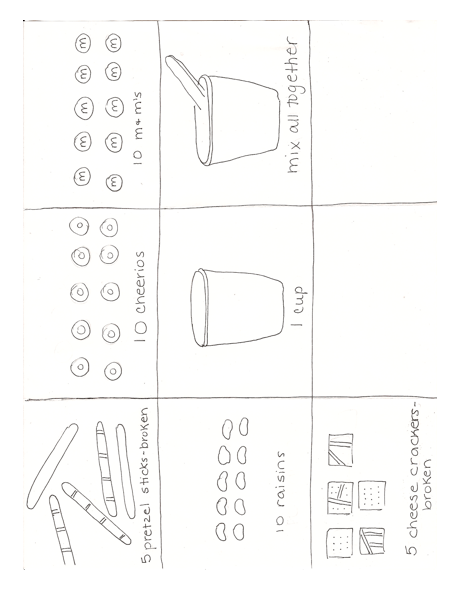
  • Rebus Gorp recipe card
  • Gorp ingredients for the class
  • Dice
  • Felt shapes and a flannel board

Vocabulary

  • More (to have extra, or spare)
  • Less (fewer)

Before Reading the Story

            Do several fingerplays or songs that you know that require some counting (5 Little Ducks, 1,2,3,4,5 I Caught a Fish Alive).

Mathematics/Number & Operations; develops increasing ability to count to 10 and beyond.

Reading the Story

            As you read the book, stop and have the children help count (Example; On the page for 7, count the aunts and uncles and the cars.  Are there more people or more cars?  On the eight page after counting the playmates, ask what the girl is holding in her hand, What is it used for?).

Mathematics/Number & Operations; begins to make use of one-to-one correspondence in counting objects and matching groups of objects. AND begins to use language to compare numbers if objects in terms such as more, less, greater than, fewer, equal to.

After Reading the Story

            Bring in a dice.  Take turns rolling the dice and having the children count how many dots.  Then let the child choose a movement for everyone to do that many times. (Kerry you rolled 3.  Kerry wants to do 3 kicks, everybody kick and count 1,2,3.).

Mathematics/Number & Operations; begins to make use of one-to-one correspondence in counting objects and matching groups of objects. AND Approaches to Learning/Reasoning & Problem Solving; develops increasing ability to find more that one solution to a question, task, or problem.

Discovery

            Make gorp using the rebus cards to count out ingredients.

Literacy/Early Writing; develops understanding that writing is a way of communicating for a variety of purposes.

Music and Movement

            Have the children start in a squatting position and begin to count 1-10.  As they count, they begin to stand up slowly until they get to 10 and are on tip toe with hands in the air.  Now start a 10 and work down to 1 getting smaller and smaller as they count.

Mathematics/Number & Operations; develops increasing ability to count to 10 and beyond.

            Teach the children the finger play 1,2,3,4,5 I Caught a Fish Alive.

            1,2,3,4,5                                    Hold up fingers as you count

            I caught a fish alive                      Point towards yourself

            6, 7, 8,9,10                                Hold up fingers as you count

            Then I threw him back again!        Pretend to throw fish

            What made you let him go?          Shrug shoulders up

            Because he bit my finger so!          Hands on hips with mad face

            Which finger did he bite?              Look of  surprise

            The little pinkie on the right         Hold up little pinkie and look sad

Language Development/Listening & Understanding; demonstrates increasing ability to attend to and understand conversations, stories, songs, and poems.

Blocks

            Challenge the children to make a set of stairs using 10 blocks.  What else can you make using only 10 blocks?

Mathematics/Number & Operations; begins to make use of one-to-one correspondence in counting objects and matching groups of objects. AND Approaches to Learning/Reasoning & Problem Solving; develops increasing ability to find more that one solution to a question, task, or problem.

Art

            Have the children trace around their hands, or they can trace around their friends hands.  Encourage them to embellish their hands with fingernails, rings, and bracelets or watches at the wrist.  When they are finished decorating their hands, show them how to write the numbers 1-10 and put a number above each finger.

Creative Arts/Art; progresses in abilities to create drawings, paintings, models, and other art creations that are more detailed, creative, or realistic.

Library and Writing

            Put out a variety of flannel board shapes and let the children make patterns or count.

Mathematics/Patterns & Measurements; enhances abilities to recognize, duplicate, and extend simple patterns using a variety of materials.

Sand and Water

            Put sand or water in the table.  Ask the children to use a measuring cup and count how many scoops it takes to fill a bowl.  Use several size measuring cups and a variety of containers to fill.  Which containers hold the most?  Which container holds the least?

Mathematics/Number & Operations; begins to use language to compare numbers if objects in terms such as more, less, greater than, fewer, equal to.

Math and Manipulatives

            Make a counting book with the children.  Give each child a paper with a number on it.  The children can draw or cut out pictures of objects to represent their number.  Do numbers 1-10.

Mathematics/Number & Operations; begins to make use of one-to-one correspondence in counting objects and matching groups of objects.

Dramatic Play

            Have the children set the table for two, three, and four.  They will have to count to make sure they have enough dishes and silverware.

Mathematics/Number & Operations; begins to make use of one-to-one correspondence in counting objects and matching groups of objects. AND Approaches to Learning/Engagement & Persistence; demonstrates increasing ability to set goals and develop and follow through on plans.

Outdoor Play

            Play Mother-May-I.  All the children stand at one side of the area.  The children take turns asking “Mother may I take (3) (jumps)?  Mother then says yes, or no you may only take (2) jumps.  The children work there way across to the other side of the play yard counting different movements. (Slides, tippy toe walks, giant steps, skips, jumps, twirls).

Mathematics/Number & Operations; begins to associate number concepts, vocabulary, quantities, and written numerals in meaningful ways.

Transitions

            Have the children count how many steps it takes to get from point A to point B.

Mathematics/Number & Operations; develops increasing ability to count to 10 and beyond.

Resources