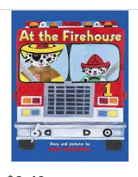
At the Firehouse, Anne Rockwell

This book introduces the children to what happens at a firehouse. It would be a good book to read before taking a field trip to the firehouse.

Materials

  •   Small syringes or spray bottles

Vocabulary

  •  Shiny (all bright and polished clean)
  • Glow in the dark
  • Extension ladder (something that gets longer and longer)
  • Exit (this way out/in case of a fire)

Before Reading the Story

Bring in a smoke detector and talk to the children about what it is and how it keeps us safe. Turn it on so they can hear the loud piercing sound. Talk about what they should do if they ever hear this sound at school or in their home.

Physical Health & Development/Health Status & Practices; builds awareness and ability to follow basic health and safety rules such as fire safety, traffic and pedestrian safety, and responding appropriately to potentially harmful objects, substances, and activities.

Reading the Story

Stop on the page that shows all the parts of a fire truck for a few moments and talk with the children about what the part is called and how it might be used.

Social & Emotional Development/Knowledge of Families & Communities; develops growing awareness of jobs and what is required to perform them.  AND Language Development/Speaking & Communicating; uses an increasingly complex and varied spoken vocabulary.

After Reading the Story

Have a pretend fire drill with your class. Do the children know where to go, what to do or not do when they hear the alarm? Do they know to walk versus run to the exit?

Physical Health & Development/Health Status & Practices; builds awareness and ability to follow basic health and safety rules such as fire safety, traffic and pedestrian safety, and responding appropriately to potentially harmful objects, substances, and activities.

Discovery

Bring in a smoke detector and show it to the children. Have the children cover their ears and then turn it on so they can hear the shrill sound. Talk about the sound that the smoke detector makes. Do you think you could hear it if you were sleeping? Talk about the fire alarm at your school. What do you do in case the alarm goes off at school? Practice having a fire evacuation with the children making sure to tell them what is going to happen before it happens so that they are prepared and will not become frightened.

Physical Health & Development/Health Status & Practices; builds awareness and ability to follow basic health and safety rules such as fire safety, traffic and pedestrian safety, and responding appropriately to potentially harmful objects, substances, and activities.

Music and Movement

Use masking tape to put a ladder design down on the floor. The children can use this for jumping or walking the lines.

Physical Health & Development/Gross Motor Skills; shows increasing levels of proficiency, control, and balance walking, climbing, running, jumping, hopping, skipping, marching, and galloping.

Sing Stop, Drop, and Roll to The Farmer in the Dell https://www.youtube.com/watch?v=1c0srtQUZtE

Stop, drop, and roll
If my clothes are on fire
I stop, drop, and roll.

Creative Arts/Music; participates with increasing interest and enjoyment in a variety of music activities, including listening, singing, finger plays, games, and performances.

Blocks

Add any fire trucks that you may have to the center. If you have none, draw a simple fire truck like that in the story and tape it to the side of the blocks. Encourage the children to be firemen and save the burning building.

Creative Arts/Dramatic Play; shows growing creativity and imagination in using materials and in assuming different roles in dramatic play situations.  AND Social & Emotional Development/Cooperation; increases abilities to sustain interactions with peers by helping, sharing, and discussion.

Art

Put out red, orange and yellow finger paint. Show the children how to make zig zags like fire flames. Also practice making circles and wavy lines.

Creative Arts/Art; progresses in abilities to create drawings, paintings, models, and other art creations that are more detailed, realistic, and creative.

Sand and Water

Fire persons use lots of water. Put out water today with small syringes and/or spray bottles. The children can practice putting out fires. Give them bowls to aim their spray at, or make bulls eyes using cardboard and markers so that when they hit the mark, the color bleeds.

Physical Health & Development/Fine Motor Skills; develops growing strength, dexterity, and control needed to use tools such as scissors, paper punch, stapler, and hammer.

Library and Writing

Put the book on the writing table and the children can try to draw their own fire trucks using the design on the balloons in the story. Take a moment and discuss and name all the parts of the fire truck.

Literacy/Early Writing; begins to represent stories and experiences through pictures, dictation, and in play.

Make EXIT signs that resemble those in your classroom. Ask the children to show you where the signs are, in the room and then practice writing the letters on a piece of paper.

Literacy/Early Writing; progresses from using scribbles, shapes, or pictures to represent ideas, to using letter-like symbols, to copying or writing familiar words such as their own name.

Dramatic play

Add some fire hats, jackets, and boxes to the center so the children can drive their own fire truck. If this is an extended unit they can take the box outside and paint it red.

Approaches to Learning/Initiative & Curiosity; approaches tasks and activities with increased flexibility, imagination, and inventiveness.

Math and Manipulatives

Bring in a play phone and have the children take turns practicing dialing 911.

Mathematics/Number & Operation; begins to associate number concepts, vocabulary, quantities, and writen numerals in meaningful ways.

Outdoor Play

Have a tricycle wash today or a chair wash to make them nice and shiny.

Social & Emotional Development/Cooperation; increases abilities to sustain interactions with peers by helping, sharing, and discussion.

Transitions

As the children prepare to go to the next center say, “My Firefighter Friend hold up a card with a child’s name written on it may go and fight a fire. Continue until all the children’s names have been held up.

Literacy/Alphabet Knowledge; identifies at least 10 letters of the alphabet, especially those in their own name.

Dear Parent-

            Today we talked about fire safety. Have you made an evacuation plan for your family in case of a fire or emergency? Find a spot away from the house to meet and practice getting there safely with your child.
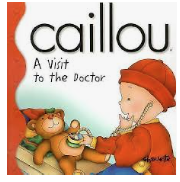
Caillou, A Visit to the Doctor, by Jaceline Sanschagrin

            Caillou is sick so his mother takes him to the doctor. This book gently describes a visit to the doctor’s office and helps remove some  of the  fears that children associate with a doctor and his office.

Materials

  • Hand Washing Chart
  •  Doctor equipment for flannel
  •  Small box of Q-tips
  •  Scale and Measuring tape
  •  Tongue depressors-many 

Vocabulary

  • Fever (When your body is feeling really hot and you feel sick)
  • Stethoscope (the tool the doctor uses to listen to your heart)
  •  Tongue depressor (the flat stick the doctor uses to look at the inside of your mouth and down your throat).                

Before Reading the Story

 Cut out each piece of the Doctor equipment pieces to the group.  Tape one piece at a time to a white board or flannel board.  Ask the children if they know the name of the tool and what it is used for?  After you have gone through all the pieces with the children, play What’s Missing?   Cover the board with a sheet and remove one flannel piece.  Ask the children if they can name what tool is missing?  Continue guessing what is missing and naming Doctor tools.  After you have finished playing this game, introduce the book. Show the front cover, what is the thing that  Caillou has in his hand?  Ask if anyone has ever been sick and had to go to the doctor.  Give the children several minutes to talk about their own experiences at the Doctor’s office.

Approaches to Learning/Initiative & Curiosity; grows in eagerness to learn about and discuss a growing range of topics, ideas, and tasks.

Reading the Story

 Point out Caillou’s face as you read the story.  Can the children tell how Caillou is feeling?  Can they make their facial expression match his?           

Social & Emotional Development/Social Relationships; progresses in responding sympathetically to peers who are in need, upset, hurt, or angry; and in expressing empathy or caring for others.

After Reading the Story

Tell the children that people can get sick from germs. Germs are all around and we get them by touching things and then putting our hands near our mouths.  Remind them that handwashing is the best way to be a germ buster.  With the children go through the steps of washing your hands the proper way and have the children act out the actions (turn on the water, wet your hands, apply the soap, scrub and scrub, do your fingers, do tops and bottoms, rinse your hands under the water, get a paper towel and dry your hands, turn off the water with the paper towel, throw the towel in the garbage).

Physical Health & Development/Health Status & Practices; sho0ws growing  independence in hygiene, nutrition, and personal care when eating, dressing, washing hands, brushing teeth, and toileting.

Discovery

 Measure and weigh the children.  Put a growth chart on the wall so they can visually see how tall they are.  To show weight, use 10 frames.  (If Kelly is 42 pounds you would use 4 10 frames and 2 squares cut from another 10 frame.

Mathematics/Number & Operations; begins to associate number concepts, vocabulary, quantities, and written numerals in meaningful ways.

Music and Movement

Teach the children the poem, Miss Molly.  Make actions to do along with the words.  

Miss Molly had a dolly who was sick, sick, sick

So she called for the Doctor to come quick, quick, quick

The Doctor came with his bag and his hat

And he knocked on the door with a rat-a-tat-tat

He looked at that dolly and he shook his head,

Miss Molly put that dolly straight to bed.

He wrote on a paper for a pill, pill, pill,

I’ll be back in the morning with my bill, bill, bill.

Creative Arts/ Music; participates with increasing interest and enjoyment in a variety of music activities, including listening, singing, finger plays, games, and performances.

I think this is called the Rhyme Time Band, find a good beat for yourself.

Shake your body part that rhymes with sand,

Rhymes with grand, rhymes with land.

Everybody shake your hand!

Now jiggle a part that rhymes with peg,

Rhymes with egg, and rhymes with beg.

Everybody, jiggle your leg!

Now circle a part that rhymes with smolder,

Rhymes with colder and with boulder.

Everybody circle your shoulder!

Now wink a part that rhymes with buy,

Rhymes with cry and rhymes with tie.

Everybody wink your eye!

Swing a body part that rhymes with farm,

Rhymes with charm, rhymes with harm.

Everybody swing your arm!

Now bend a part that rhymes with tree,

Rhymes with bee, and rhymes with me.

Everybody bend your knee!

Now twiddle a part that rhymes with drum,

Rhymes with crumb, and rhymes with gum.

Everybody twiddle your thumb!

And twist a part that rhymes with lips,

Rhymes with sips and rhymes with zips.

Everybody twist your hips!

Literacy/Phonological Awareness; progresses in recognizing matching sounds and rhymes in familiar words, games, songs, stories, and poems.  AND Language Development/Listening & Understanding; shows progress in understanding and following simple and multiple-step directions.

Blocks

 Add a bowl of tongue depressors to the center for creative building.

Approaches to Learning/Initiative & Curiosity; approaches tasks and activities with increased flexibility, imagination, and inventiveness.

Art

 Use Q-tips to paint with watercolors.

Physical Health & Development/Fine Motor SKills; progresses in abilities to use writing, drawing, and art tools, including pencils, markers, chalk, paint brushes, and various types of technology. AND Creative Expression/Art; begins to understand and share opinions about artistic products and experiences.

Sand and water

 Put a very small amount of sand into the table today and give the children tongue depressors to use as writing sticks.  Can they write the letters of their name in the sand? Can they make a D for doctor?

Literacy/Early Writing; progresses from using scribbles, shapes, and pictures to represent ideas, to using letter-like symbols, to copying or writing familiar words such as their own name.

Library and Writing

Put out the pictures of the doctor tools.  Can the children name the different tools?  Do they know what they are used for?  This is an individualized review of what you did at your story time today.

Approaches to Learning/Initiative & Curiosity; grows in eagerness to learn about and discuss a growing range of topics, ideas, and tasks.  AND Language Development/Speaking & Communicating; uses an increasing complex and varied spoken vocabulary.

Dramatic Play

 If you have a Doctor play set, put this out today.  Encourage the children to take turns being the Doctor and the Patient.  Can the patient articulate what they are pretending to be ill with?  Does the Doctor seem to have an understanding of what Doctor’s do?  You can also have the children use stuffed animals for their patients.  I like to purchase a box of cheap bandages that the children can apply to each other.   Remind the children not to put the thermometer into their mouth but perhaps under their arm or behind their knee. 

Social & Emotional Development/Knowledge of Families & Communities; develops growing awareness of jobs and what is required to perform them.  AND Language Development/Speaking & Communicating; develops increasing abilities to understand and use language to communicate information, experiences, ideas, feelings, opinions, needs, questions,; and for varied other purposes.

Math and manipulatives

Make a tongue depressor domino game.  Draw a colored line to divide the tongue depressor and put dots on each half.  The children can then use these to play dominos.

Mathematics/Number & operations; begins to make use of one-to-one correspondence in counting objects and matching groups of objects.

Outdoor Play

 If you have a wagon on the playground you can teach the children about paramedics.  The wagon can be the ambulance and you can use scarves as bandages for wounds.  

Social & Emotional Development/Knowledge of Families & Communities; develops growing awareness of jobs and what is required to perform them. 

Transitions

As you dismiss the children to the next activity have them take turns telling the steps for handwashing.  The first child tells step 1 and goes off, ask what comes 2nd, that child tells and goes off, etc.  If you finish all the steps, begin again.

Language Development/Listening & Understanding; demonstrates increasing ability to attend to and understand conversations, stories, songs, and poems.  

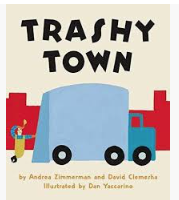
Trashy Town, by A.Zimmerman & D.Clemesha

Mr. Gilly has an important job to do.  He collects the trash all about town and takes it to the dump.  Children will enjoy repeating the “Dump it in” stance that runs throughout the story.

Materials

  • Recycled junk (ask the parents to send in donations: explain that you are going to use these for building 3 dimensional art work).
  • Several rolls of masking tape
  • 2-3 fish nets or small sieves
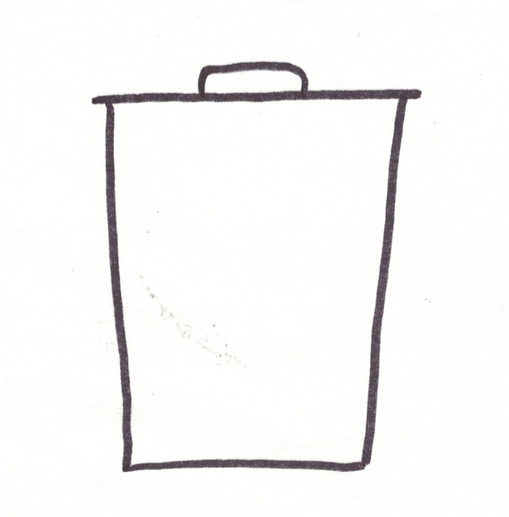
  • Picture of a garbage can
  • Pictures of shapes to sort
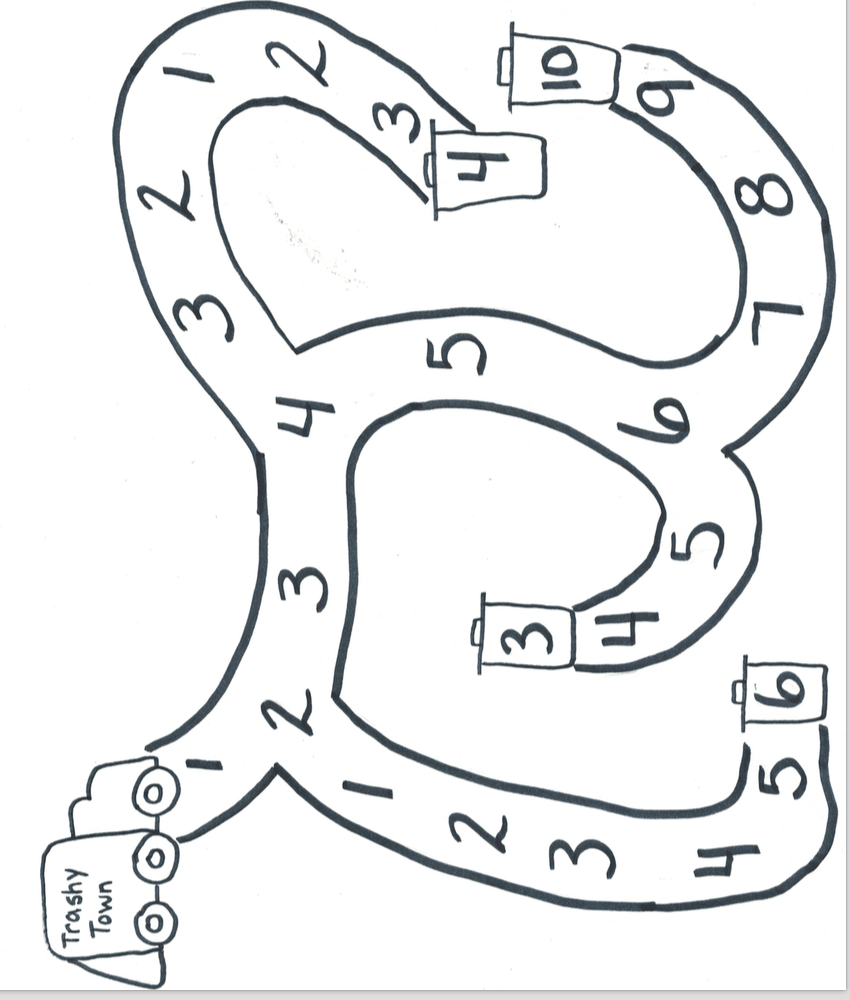
  • Map around town 1-10

Vocabulary

  • Trash  (another name for garbage and litter)
  • Trashman  (someone whose job it is to collect the garbage from around the town).

Before Reading the Story

Explain to the children that you need them to help tell the story today.  Recite the stance; “Dump it in, smash it down, drive around the Trashy Town!”  Have the children practice reciting it back several times until it is familiar.  Explain to the children that when you do a-thumbs up in the story, it will be their turn to recite the stance.  As you read, give a thumbs-up at all the appropriate times and repeat the stance with the children.

Language Development/Listening & Understanding; shows progress in understanding and following simple and multi-step directions. AND Approaches to Learning/Initiative & Curiosity; chooses to participate in an increasing variety of tasks and activities.

Reading the Story

When you get to the page where Mr. Gilly puts on his heavy gloves, stop and ask the children why they think the trash man needs to wear heavy gloves?  (He’s gonna get his hands dirty, Garbage is stinky!).  After Mr. Gilly has cleaned-up all of Trashy Town, he goes home.  When the story says there is only one more thing to clean, stop before turning the page and ask the children if they can guess what the last item that needs cleaning is.  Ask the children if they can remember the places where Mr. Gilly picked up the trash.  Then do one final reciting of the stance; “Dump it in, smash it down, drive around the Trashy Town”!

Literacy/Book Knowledge & Appreciation; demonstrates progress in abilities to retell and dictate stories from books and experiences; tpo act out stories in dramatic play; and to predict what will happen next in a story.

After Reading the Story

Tell the children that being a trashman is an important job. Ask the children to give examples of why (It keeps our town clean, so the flies do not come, because garbage smells, because the rats like garbage, because garbage is gross).  Talk with them about the importance of keeping your centers neat.  Do you label your selves for easy cleanup?  If so, encourage the children to check the center shelves today and make sure they are putting everything away in its proper spot.  Use this day to reorganize your shelves with the children’s help.

Literacy/Early Writing; develops understanding that writing is a way of communicating for a variety of purposes. AND Physical Health & Development; builds awareness and ability to follow basic health and safety rules such as fire safety, traffic and pedestrian safety, and responding appropriately to potentially harmful objects, substances, and activities.

Discovery

If your center recycles, have the children sort the paper products from the rest of the trash and put into a separate container.

Mathematics/Patterns & Measurement; shows increasing abilities to match, sort, put in a series, and regroup objects according to one or two attributes such as shape or size.

Music and Movement

Teach the children the following poem,

After I eat I scrape, scrape, scrape

To get the food off my plate, plate, plate.

Sing Save the Cans to the tune of Row,Row, Row Your Boat

Save, save, save the cans

Throw them in the bin.

We can help save our earth,

If we all pitch in.

Save, save, save the paper/plastics/bottles

Science/Scientific Knowledge; shows increased awareness and beginning understanding of changes in materials and cause-effect relationships.

Blocks

Encourage the children to use the blocks today to build a road that they can drive toy vehicles across.  Can they make a bridge to go over/under another part of the road?  Can they make a tunnel to drive the vehicles through? 

Approaches to Learning/Reasoning & Problem Solving; grows in recognizing and solving problems through active exploration, including trial and error, and interactions and discussions with peers and adults.

Art

Put out all the recycled junk that you have collected and show the children how to use strips of masking tape to hold the different pieces together making a sculpture of some kind.  When the children have finished taping their sculpture, they can glue small beads, baubles, and such on to add more dimensions and then finally drip paint over the sculpture.  This can become a 2-3 day project depending on how involved the children become.  I have cut many 2-4 inch strips of masking tape and stuck around edge of table for children to have easier access for their building. 

Physical Health & Development/Fine Motor Skills;grows in hand-eye coordination in building with blocks, putting together puzzles, stringing beads, reproducing shapes and patterns, and using scissors. And Approaches to Learning; Engagement & Persistence; grows in abilities to persist in and complete a variety of tasks, activities, projects, and experiences.

Sand and Water

Fill the table with water today and add objects that float and sink.  Give the children fishnets and have them remove the ‘garbage’ from the water and sort it by things that float and things that sink.

Science/Scientific Methods & Skills; begins to use senses and a variety of tools and simple measuring devices to gather information, investigate materials, and observe processes and relationships.

Library and Writing

Give a child a copy of the map around town.  Show the child how to use a pencil to follow the numbers 1-10 to get from beginning to end.

Mathematics/Number & Operation; begins to associate number concepts, vocabulary, quantities, and written numerals in meaningful ways. AND Literacy/Early Writing; experiments with a growing variety of writing tools and materials, such as pencils, crayons, and computers.

Dramatic Play

Add several pairs of gloves, boxes or small wastebaskets, and crumpled newspaper.  The children can pretend to collect trash and dump it from one container to another.   As your day progresses you could ask the children in the dramatic play center to come help with trash around the room.  Maybe they could sweep the sand that fell on the floor and pick up any paper that is trash from the art area.   If you have a small waste basket that has a foot peddle, these are fun for the children to use.

Social & Emotional Development/Cooperation; develops increasing abilities to give and take in interactions; to take turns in games or using materials; and to interact without being overly submissive or directive.

You could tell the children that they are trash collectors as they clear their meal plates and throw them in the garbage.  (Thank you trashman Lolly for keeping our room clean and safe).

Physical Health & Development; builds awareness and ability to follow basic health and safety rules such as fire safety, traffic and pedestrian safety, and responding appropriately to potentially harmful objects, substances, and activities.

Math and Manipulatives

Make a copy of 3 garbage cans.  On each, draw a shape.  Make one a circle, one a triangle, and one a square.   The children then sort pictures onto the appropriate garbage can.  When they are finished, help them name the shapes.  For older children you might try using three-dimensional shapes and label the cans, cylinder, pyramid, and cube.

Mathematics/Geometry & Spatial Sense; shows growth in matching, sorting, putting in series, and regrouping objects according to one or two attributes such as color, shape, or size.

Outdoor Play

Make a path on the sidewalk; using chalk make 26 1×1 foot squares that connect like a chain.  In the first square write the letter A and continue down the chain writing the letters in alphabetical order.  The children can then jump from square to square as they sing/recite the alphabet song.  If they miss a letter, name it for them and have them repeat it back to you.  If they miss two, then they must go back to the beginning and start again.

Literacy/Alphabet Knowledge; identifies at least 10 letters of the alphabet, especially those in their own name.

Put out a trashcan and many balls of wadded up newspaper.  The children can practice throwing the newspaper balls into the trashcan.  As they make a shot, have them move back 2 steps and try from this new position.

Physical Health & Development/Gross Motor Skills; demonstrates increasing abilities to coordinate movements in throwing, catching, kicking, bouncing balls, and using the slide and swing.

Transitions

Do riddles with the children today about a variety of jobs.  Ask the children’s parents what they do for a career and try to incorporate these into riddles also.  Is the child aware of what their parent does for a living?

  • I wear special clothes to protect me from fire and smoke.  I spray water from a hose.
  • I help people who are hurt or sick.  I ride in an ambulance.
  • I give people tickets who are not driving safely because my job is to keep everyone safe.
  • I plan fun things for my friends to do.  I make sure that they are staying safe and learning new things.
  • I use a scanner to help people buy food.  I use my math skills to give them back change.
  • I help people find good books to read.  I put books back on the shelves when people bring them back.
  • I deliver letters to people’s homes.  I have to make sure all the mail goes to the right address.
  • I ride in a truck and pick up every bodies garbage.  I am strong because I lift the heavy cans.
  • I fix cars that are broken.  I have a lift that picks the cars up so I can look underneath them.
  • I drive a big yellow vehicle.  It takes children to and from school.

Social & Emotional Development/Knowledge of Families & Communities; develops growing awareness of jobs and what is required to perform them.

Resources