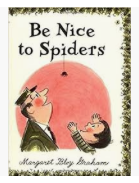
Be Nice to Spiders, by M. Bloy Graham

Helen the spider comes to the zoo and happily lives among the animals, until it’s time for the Mayor’s visit.  What happens when all of Helen’s webs are knocked down?  After reading the story children will be more aware of the benefit of spiders.

Materials

  • Play dough that is getting too dry for daily use.
  • Pipe cleaners in many colors cut into 3-4 inch sections.
  • Contact paper cut into 12-inch sections
  • A bag of plastic spiders or a bag of black beans to pretend to be spiders

Vocabulary

  • Matchbox (little tiny box, maybe it could hold one matchbox car or a piece of jewelry)
  • Ventilator (the vent, chimney like thing that you see on roofs)
  • Satisfied (feeling happy and contented)
  • Paradise (the perfect place for a spider to live)
  • Arachnid  (animals that have two body parts)
  • Prey (the next victim for lunch)
  • Sticky (when something gets stuck to something else upon contact)

Before Reading the Story

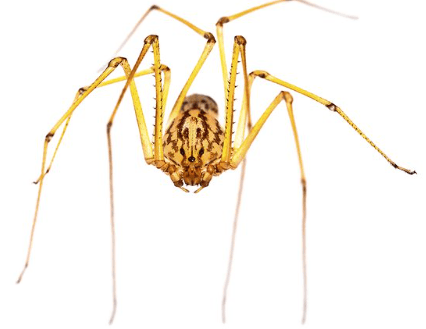
Ask the children if they help do chores at home?  Let them share anyway that they help out at home.  If they do not respond to your question ask if anyone is responsible for making their bed, taking care of a pet, brushing their teeth before bed?  Ask the children to help name some of the jobs you have at school to do (sweeper, plant watering, book straightener, etc.  Talk about jobs, why do we have them?  Why is it important to keep our room clean?  Do you have a custodian who comes in after hours?  Talk about their job.  Take a moment and help the children write a short note to the custodian that you can hang by the door.  (Thank you for cleaning our room, it looks pretty.  I like when our room smells good.  You wash the floor, my Mommy washes the floor at my house).  Explain to the children that today’s story is about a helper at the zoo.  Show the children the cover of the book and point to the spider.  Say this is Helen and she is the helper at the zoo.  Ask the children if they can guess how Helen helps?  Read the title and begin the story.

Social & Emotional Development/Knowledge of Families & Communities;develops growing awareness of jobs and what is required to perform them. AND Literacy/Early Writing; develops understanding that writing is a way of communicating for a variety of purposes.

Reading the Story

On the very first page when the zookeeper reads the note from Billy, stop and ask the children if they can guess what kind of pet might be in that little tiny box?  When Helen runs like lightning, use your hand to show how quickly.  When you get to the part that says, “the lions were annoyed but Helen was delighted”, stop and ask why they think Helen was so happy to see all those flies? (Spiders eat flies).  When the zookeeper tells the men to get rid of all the spider webs, stop and ask the children what they think is going to happen?

Literacy/Book Knowledge & Appreciation; demonstrates progress in abilities to retell and dictate stories from books and experiences; tpo act out stories on dramatic play; and to predict what will happen next in a story.

After Reading the Story

Ask the children if they remember why we should all be nice to spiders?  (They eat flies).   Talk to the children about some spider facts and safety.  1) Spiders belong to the family called Arachnids because they have two body parts.  Who knows how many body parts insects have (3)?  The world is full of many different kinds of spiders.  Some are poisonous and dangerous to people but many are not.  Spiders will bite if they are scared so please do not touch spiders.  Spiders have sticky feet that they can use to climb up trees and walls. 

Science/Science Knowledge; expands knowledge of and abilities to observe, describe, and discuss the natural world, materials, living things, and natural processes.

Discovery

Put out your old playdough today and many pipe cleaners cut in quarters.  Explain to the children that you are going to be making spiders.  Have them roll the play dough into a ball and then slightly flatten it.  Ask the children if they can remember how many legs a spider has (8)?  Have them count out eight legs and stick them into their spider.  Spiders also have 8 eyes.  The child can either poke 8 holes to represent eyes of add 8 googly eyes.  When the playdough dries, the children can paint their spiders. Or, make spiders from pinecones.

Science/Scientific Skills & Methods; develops growing abilities to collect, describe, and record information through a variety of means, including discussion, drawings, maps, and charts. AND Creative Arts/Art; progresses i abilities to create drawings, paintings, models, and other art creations that are more detailed, creative, or realistic.

Music and Movement

Sing The Eensy Weensy Spider.  Change it up by making a Teeny Tiny Spider and a Humongous Giant Spider.

Language Development/Speaking & Communicating; uses an increasingly complex and varied spoken vocabulary.

If you have a spider puppet or stuffed toy spider you can do the poem, Little Miss Muffet.

Choose a child to be Miss or Mr Muffet.  Put a pillow in the center of your group circle and have the child sit on it.  Begin the poem. At the “along came a spider”, allow another child to put the spider in front, behind, beside, on her head, in her lap.  The children must say where the spider is and the Muffit child can jump away.  The child who put the spider in a position is now the new Muffit and another child gets to place the spider.

            Little Miss/Mr Muffet

            Sat on a tuffet (another name for pillow)

            Eating her curds and whey (kind of like cottage cheese)

            Along came a spider

            Who sat down _____________her/him

            And frightened Miss/Mr Muffet away.

Mathematics/Geometry & Spatial Sense; builds an increasing understanding of directionality, order, positions of objects, and words such as up, down, over, under, top, bottom, inside, outside, in front, and behind.

Blocks

Use masking tape to make a large spider web design on the floor.  Challenge the children to use blocks to cover the spider web.  Are they able to find the correct sized blocks to fit upon the tape?  Can they make a pattern using several types of blocks?  Add any plastic insects that you might have today, or add several flies from the resource pattern.  The children can pretend to fly their insect and get caught in the web.

Mathematics/Patterns & Measurement; shows progress in using standard and non-standard measures for length and area of objects.

Art

Explain to the children that spider webs are sticky so that insects, like flies, get stuck in the web and cannot get out. The spider then eats the insect for lunch or dinner. Give each child a 12-inch section of contact paper that you have taken the backing off of.  Put it on the table sticky side up.  Give the children collage materials and let them make a sticky collage.  These are fun if you add small 3D items such as buttons, bottle caps, feathers, etc. 

Science/Scientific Knowledge; expands knowledge of and abilities to observe, describe, and discuss the natural world, materials, living things, and natural processes. AND Creative Arts/Art; gains ability in using different art media and materials in a variety of ways for creative expression and representation.

Sand and Water

Fill the table with sand today.  Add spiders and tongs/pincers and small containers.  The children use the tongs/pincers to dig through the sand and pickup the spiders.  How many spiders did you capture?  Who found the most spiders?  As the children dig for spiders you can review with them spider facts that you have learned.  If you do not have small plastic spiders to add to the table today, you could use of black beans. 

Physical Health & Development/Fine Motor Skills; develops growing strength, dexterity, and control needed to use tools such as scissors, paper punch, stapler, and hammer. AND Mathematics/Number & Operation; begins too use language to compare numbers of objects with terms such as more, less, greater than, fewer, and equal to.

Library and Writing

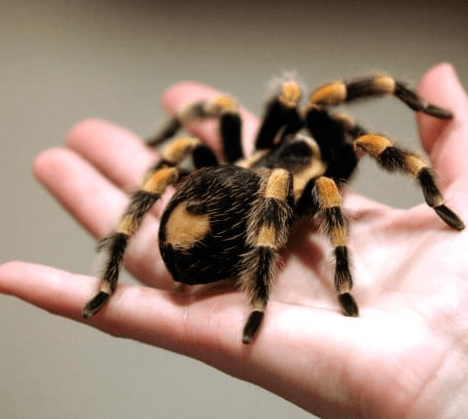
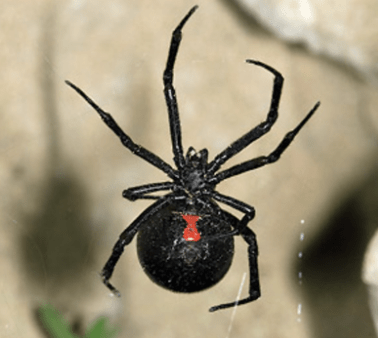
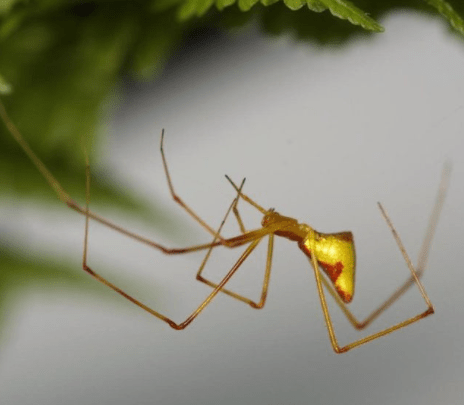
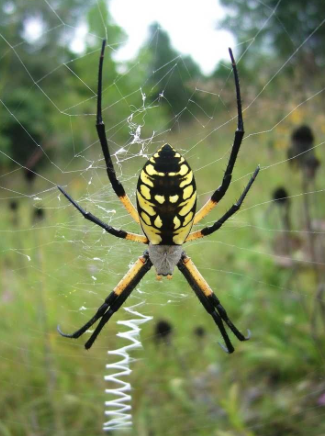
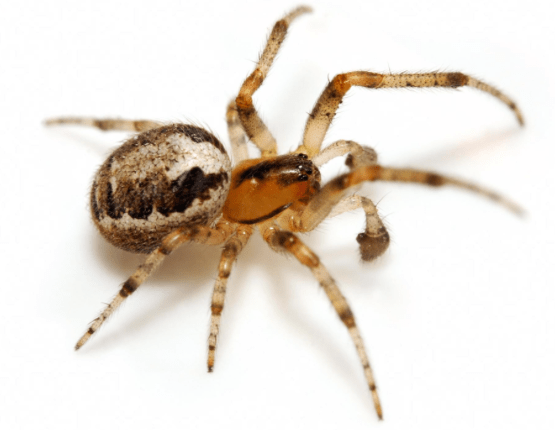
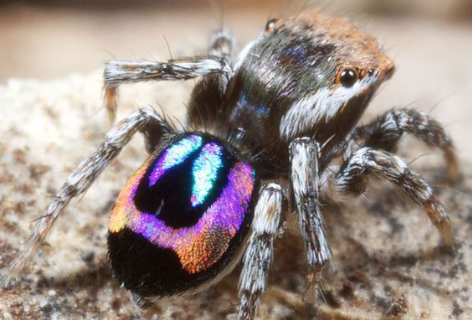
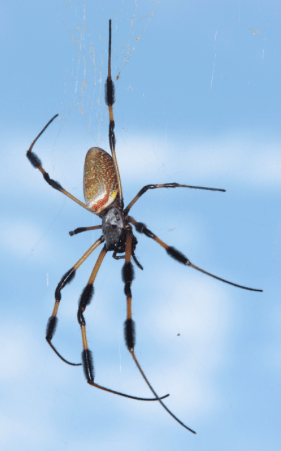
Get books or pictures of real spiders that the children can look at.  Notice how all spiders do not look the same however all have 8 legs and 8 eyes.

Literacy/Book Knowledge & Appreciation; progresses in learning how to handle and care for books; knowing to view one [page at a time in sequence from front to back; and understanding that a book has a title, author, and illustrator. AND Science/Scientific Knowledge; expands knowledge of and abilities to observe, describe, and discuss the natural world, materials, living things, and natural processes.

Dramatic Play

In the story, Helen was helping to keep the zoo clean by eating all the flies.  Give the children damp paper towels and a broom and allow them to help clean the dramatic center or any center.  Have them wipe the shelves with the damp towels and look for broken toys that should be tossed out.  If you have a non-electrical vacuum (sweeper brush), let the children use it to get the lint off the carpet.  (The children in my room loved using this piece of equipment and I had to finally put it up as a helper job).

Social & Emotional Development/Knowledge of Families & Communities; develops growing awareness of jobs and what is required to perform them.

Math and Manipulatives

Attach tape to a hula-hoop making a simple web type of design.  Turn the sticky side out and hang it against, or lean it against the wall.  Give the children puff balls (spiders) which they can throw at the hula-hoop target.  Let them count how many spiders stuck to the tape.

Physical Health & Development/Gross Motor Skills; demonstrates increasing abilities to coordinate movements in throwing, climbing, kicking, bouncing balls, and using the slide and swing. AND Mathematics/Number & Operation; begins to make use of one-to-one correspondence in counting objects and matching groups of objects.

Outdoor Play

If you have a large cemented area, draw a giant spider web with chalk.  This does not have to be fancy (see resources).  The children can then move from side to side by hopping or jumping on the triangles.  Or the children can walk the lines forward, backwards, or sliding.  This could also be done inside in your large group area using masking tape.

Physical Health & Development/Gross Motor Skills; shows increasing proficiency, control, and balance in walking, climbing, running, jumping, hopping,skipping, marching, and galloping.

Transitions

Play Bigger Than, Smaller Than.  Ask the children to tell you if something is bigger than or smaller than an object or animal. Is a cat bigger than or smaller than a cow?  Is a spider bigger than or smaller than a bead?  Is a cow bigger than or smaller than an Elephant?  Is an Elephant bigger than or smaller than an airplane?  Continue naming two objects and asking if the first is bigger or smaller than the second?

Mathematics/Geometry & Spatial Sense; shows growth in matching, sorting, putting in series, and grouping objects according to one or two attributes such as color, shape, or size.

Resources
Physical Health & Development/Gross Motor Skills; shows increasing proficiency, control, and balance in walking, climbing, running, jumping, hopping, skipping, marching, and galloping.  AND Language Development/Listening & Understanding; shows progress in understanding and following simple and multi-step directions.
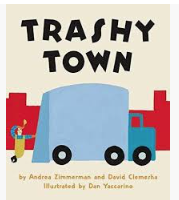
Trashy Town, by A.Zimmerman & D.Clemesha

Mr. Gilly has an important job to do.  He collects the trash all about town and takes it to the dump.  Children will enjoy repeating the “Dump it in” stance that runs throughout the story.

Materials

  • Recycled junk (ask the parents to send in donations: explain that you are going to use these for building 3 dimensional art work).
  • Several rolls of masking tape
  • 2-3 fish nets or small sieves
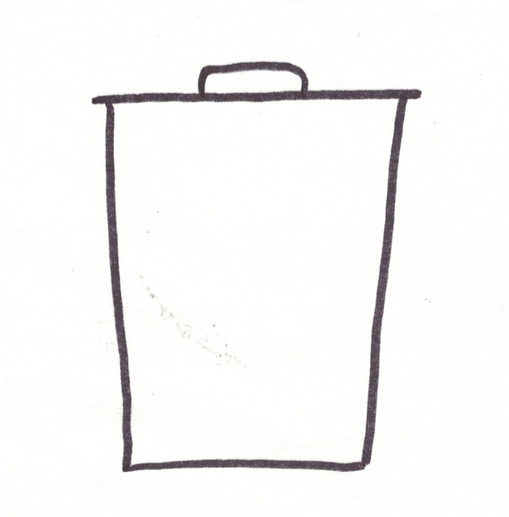
  • Picture of a garbage can
  • Pictures of shapes to sort
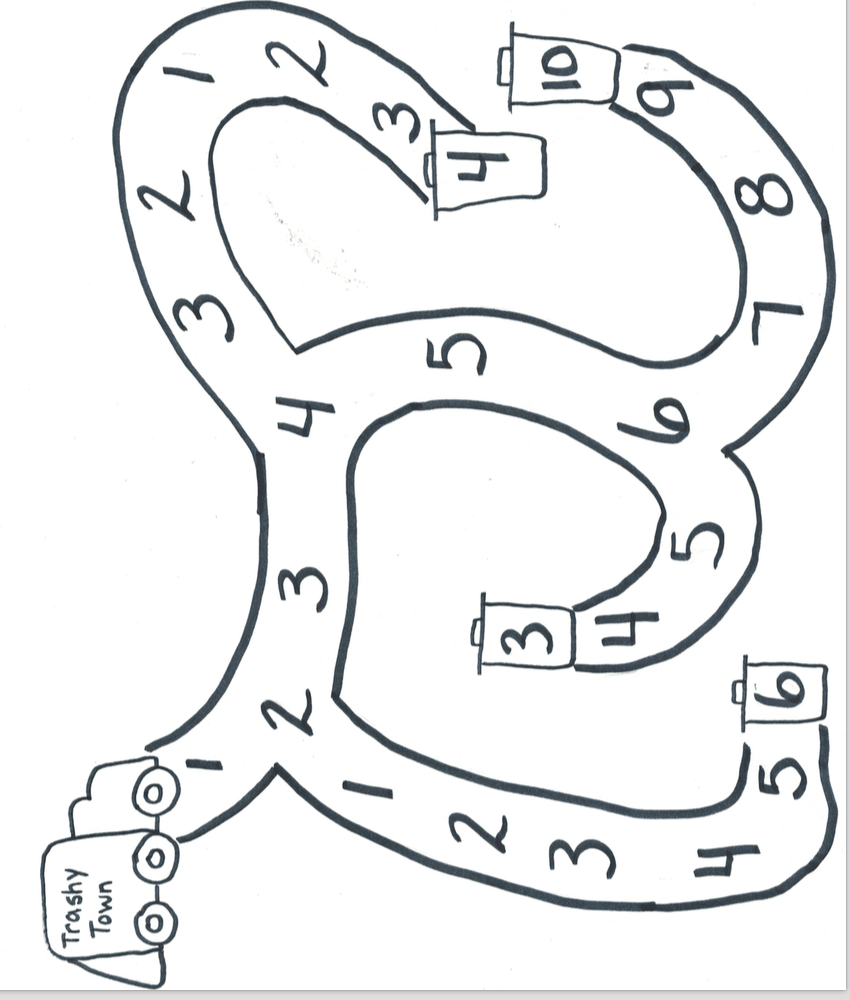
  • Map around town 1-10

Vocabulary

  • Trash  (another name for garbage and litter)
  • Trashman  (someone whose job it is to collect the garbage from around the town).

Before Reading the Story

Explain to the children that you need them to help tell the story today.  Recite the stance; “Dump it in, smash it down, drive around the Trashy Town!”  Have the children practice reciting it back several times until it is familiar.  Explain to the children that when you do a-thumbs up in the story, it will be their turn to recite the stance.  As you read, give a thumbs-up at all the appropriate times and repeat the stance with the children.

Language Development/Listening & Understanding; shows progress in understanding and following simple and multi-step directions. AND Approaches to Learning/Initiative & Curiosity; chooses to participate in an increasing variety of tasks and activities.
Reading the Story

When you get to the page where Mr. Gilly puts on his heavy gloves, stop and ask the children why they think the trash man needs to wear heavy gloves?  (He’s gonna get his hands dirty, Garbage is stinky!).  After Mr. Gilly has cleaned-up all of Trashy Town, he goes home.  When the story says there is only one more thing to clean, stop before turning the page and ask the children if they can guess what the last item that needs cleaning is.  Ask the children if they can remember the places where Mr. Gilly picked up the trash.  Then do one final reciting of the stance; “Dump it in, smash it down, drive around the Trashy Town”!

Literacy/Book Knowledge & Appreciation; demonstrates progress in abilities to retell and dictate stories from books and experiences; tpo act out stories in dramatic play; and to predict what will happen next in a story.

After Reading the Story

Tell the children that being a trashman is an important job. Ask the children to give examples of why (It keeps our town clean, so the flies do not come, because garbage smells, because the rats like garbage, because garbage is gross).  Talk with them about the importance of keeping your centers neat.  Do you label your selves for easy cleanup?  If so, encourage the children to check the center shelves today and make sure they are putting everything away in its proper spot.  Use this day to reorganize your shelves with the children’s help.

Literacy/Early Writing; develops understanding that writing is a way of communicating for a variety of purposes. AND Physical Health & Development; builds awareness and ability to follow basic health and safety rules such as fire safety, traffic and pedestrian safety, and responding appropriately to potentially harmful objects, substances, and activities.

Discovery

If your center recycles, have the children sort the paper products from the rest of the trash and put into a separate container.

Mathematics/Patterns & Measurement; shows increasing abilities to match, sort, put in a series, and regroup objects according to one or two attributes such as shape or size.

Music and Movement

Teach the children the following poem,

After I eat I scrape, scrape, scrape

To get the food off my plate, plate, plate.

Sing Save the Cans to the tune of Row,Row, Row Your Boat

Save, save, save the cans

Throw them in the bin.

We can help save our earth,

If we all pitch in.

Save, save, save the paper/plastics/bottles

Science/Scientific Knowledge; shows increased awareness and beginning understanding of changes in materials and cause-effect relationships.

Blocks

Encourage the children to use the blocks today to build a road that they can drive toy vehicles across.  Can they make a bridge to go over/under another part of the road?  Can they make a tunnel to drive the vehicles through? 

Approaches to Learning/Reasoning & Problem Solving; grows in recognizing and solving problems through active exploration, including trial and error, and interactions and discussions with peers and adults.

Art

Put out all the recycled junk that you have collected and show the children how to use strips of masking tape to hold the different pieces together making a sculpture of some kind.  When the children have finished taping their sculpture, they can glue small beads, baubles, and such on to add more dimensions and then finally drip paint over the sculpture.  This can become a 2-3 day project depending on how involved the children become.  I have cut many 2-4 inch strips of masking tape and stuck around edge of table for children to have easier access for their building. 

Physical Health & Development/Fine Motor Skills;grows in hand-eye coordination in building with blocks, putting together puzzles, stringing beads, reproducing shapes and patterns, and using scissors. And Approaches to Learning; Engagement & Persistence; grows in abilities to persist in and complete a variety of tasks, activities, projects, and experiences.

Sand and Water

Fill the table with water today and add objects that float and sink.  Give the children fishnets and have them remove the ‘garbage’ from the water and sort it by things that float and things that sink.

Science/Scientific Methods & Skills; begins to use senses and a variety of tools and simple measuring devices to gather information, investigate materials, and observe processes and relationships.

Library and Writing

Give a child a copy of the map around town.  Show the child how to use a pencil to follow the numbers 1-10 to get from beginning to end.

Mathematics/Number & Operation; begins to associate number concepts, vocabulary, quantities, and written numerals in meaningful ways. AND Literacy/Early Writing; experiments with a growing variety of writing tools and materials, such as pencils, crayons, and computers.

Dramatic Play

Add several pairs of gloves, boxes or small wastebaskets, and crumpled newspaper.  The children can pretend to collect trash and dump it from one container to another.   As your day progresses you could ask the children in the dramatic play center to come help with trash around the room.  Maybe they could sweep the sand that fell on the floor and pick up any paper that is trash from the art area.   If you have a small waste basket that has a foot peddle, these are fun for the children to use.

Social & Emotional Development/Cooperation; develops increasing abilities to give and take in interactions; to take turns in games or using materials; and to interact without being overly submissive or directive.

You could tell the children that they are trash collectors as they clear their meal plates and throw them in the garbage.  (Thank you trashman Lolly for keeping our room clean and safe).

Physical Health & Development; builds awareness and ability to follow basic health and safety rules such as fire safety, traffic and pedestrian safety, and responding appropriately to potentially harmful objects, substances, and activities.

Math and Manipulatives

Make a copy of 3 garbage cans.  On each, draw a shape.  Make one a circle, one a triangle, and one a square.   The children then sort pictures onto the appropriate garbage can.  When they are finished, help them name the shapes.  For older children you might try using three-dimensional shapes and label the cans, cylinder, pyramid, and cube.

Mathematics/Geometry & Spatial Sense; shows growth in matching, sorting, putting in series, and regrouping objects according to one or two attributes such as color, shape, or size.

Outdoor Play

Make a path on the sidewalk; using chalk make 26 1×1 foot squares that connect like a chain.  In the first square write the letter A and continue down the chain writing the letters in alphabetical order.  The children can then jump from square to square as they sing/recite the alphabet song.  If they miss a letter, name it for them and have them repeat it back to you.  If they miss two, then they must go back to the beginning and start again.

Literacy/Alphabet Knowledge; identifies at least 10 letters of the alphabet, especially those in their own name.

Put out a trashcan and many balls of wadded up newspaper.  The children can practice throwing the newspaper balls into the trashcan.  As they make a shot, have them move back 2 steps and try from this new position.

Physical Health & Development/Gross Motor Skills; demonstrates increasing abilities to coordinate movements in throwing, catching, kicking, bouncing balls, and using the slide and swing.

Transitions

Do riddles with the children today about a variety of jobs.  Ask the children’s parents what they do for a career and try to incorporate these into riddles also.  Is the child aware of what their parent does for a living?

  • I wear special clothes to protect me from fire and smoke.  I spray water from a hose.
  • I help people who are hurt or sick.  I ride in an ambulance.
  • I give people tickets who are not driving safely because my job is to keep everyone safe.
  • I plan fun things for my friends to do.  I make sure that they are staying safe and learning new things.
  • I use a scanner to help people buy food.  I use my math skills to give them back change.
  • I help people find good books to read.  I put books back on the shelves when people bring them back.
  • I deliver letters to people’s homes.  I have to make sure all the mail goes to the right address.
  • I ride in a truck and pick up every bodies garbage.  I am strong because I lift the heavy cans.
  • I fix cars that are broken.  I have a lift that picks the cars up so I can look underneath them.
  • I drive a big yellow vehicle.  It takes children to and from school.

Social & Emotional Development/Knowledge of Families & Communities; develops growing awareness of jobs and what is required to perform them.

Resources

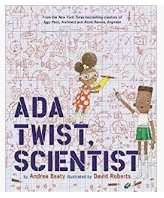
Ada Twist, Scientist, by Andrea Beatty

Ada Twist did not talk until she was three and then her world was filled with how and why questions.  This book gives young children an introduction into what being a scientist is all about.

Materials

  • 1 index card per child with their name written on it.
  • 5-8 baggies with cotton balls inside. Before class, make smell bags by either putting  a liquid onto the cotton balls or adding a powder. I have used; shampoo, perfume, lemon juice, pickle juice, onion powder, oregano, thyme, baby powder.
  • 2 diet colas
  • 1 packet of mint Mentos
  • White vinegar
  • Baking soda
  • Many colored shapes; triangle, circle, square, and rectangles of various sizes.
  • A tray or two of ice cubes

Vocabulary

  •  Frazzled-Tired and weary
  • Chaos-A giant mess
  • Quivered-Shook
  • Dazed-Bewildered, to not know what to think
  • Traits-Behaviors
  • Stench-Gross smell
  • Research-to study or investigate something
  • Hypothesis-to make a guess about something
  • Fiction-Not real, fake

Before Reading the Story 

Ask the children if they know what a scientist does. (He/she is an inventor or a researcher. Talk about how scientists invent things to make life easier. Name some inventions that the children use in your classroom. Someone had to invent the scissors that you use to cut paper. Someone had to invent the cups we use at lunch to drink out of. And a scientist researched and figured out how to make the cold/warm air blow from the vents in our classroom. Scientists make the world a better place for everyone. Tell the children that there are two questions every scientist asks, can they guess what they are? How? and why? Have the children repeat the words how? and why? Introduce the story.

Social & Emotional Development/Knowledge of Families & Communities; develops growing awareness of jobs and what is required to perform them.

Reading the Story 

On the page where Ada’s parents yell “STOP!” Ask the children if they can guess why her parents said no. As you finish the book, ask the children to come up with something that they think has a gross and stinky stench. List their answers on a piece of paper and hang it on the wall.

Literacy/Book Knowledge & Appreciation; demonstrates progress in abilities to retell and dictate stories from books and experiences; to act out stories in dramatic play; and to predict what will happen next in a story.  

After Reading the Story 

Ask the children if they can remember two questions that every scientist asks (how? And why?). Ask the children if they recall what Ada was investigating (what made the stinky stench). Ask the children if they have any why questions or how questions. Write them down and over the next few days, encourage the children to help think of the answers or show the children how to look up answers with a resource book or the computer. With young children you do not need the scientifically correct answer as much as showing them how to find an answer. (Why does my brother always get more candy than me?  How come my cat meows to wake me up?)  Let other children respond to the questions and answer them according to their personal experiences.

Language Development/Speaking & Communicating; progresses in abilities to initiate and respond appropriately in conversations and discussions with peers and adults.  AND Science/Scientific Skills & Methods; begins to describe and discuss predictions, explanations, and generalizations based on past experiences.

Discovery 

Tell the children that today you are going to investigate stinky smell. Put the smell baggies into the science center today for the children to experience. Can they guess any of the smells? Are there any that they like or dislike?

Science/Scientific Skills & Methods; begins to describe and discuss predictions, explanations, and generalizations based on past experiences.

Music and Movement

 Sing Rhyming Words Sound the Same sung to Loopdy Loo

Rhyming words sound the same (clap, clap)
Rhyming words sound the same.
Rhyming words sound the same (clap, clap)
Rhyming words sound the same.

(Now make a chanting sounding word such as house and see if the children can make a word that rhymes. For younger children I have added pictures of rhyming words to help them visualize the rhyme).

Literacy/Phonological Awareness; shows growing awareness of beginning and ending sounds of words.

Play Teacher May We? Have the children stand in a large circle. Ask a child to show you a movement (jumping, flapping arms, etc.) Then help all the children to say “Teacher may we”? The teacher then says “Only if _______can make a word that rhymes with ______ (frog, wig, and). The child makes the rhyme and everybody does the movement.

Literacy/Phonological Awareness; shows growing awareness of beginning and ending sounds of words.  AND Physical Health & Development/Health Status & Practices; participates actively in games, outdoor play, and other forms of exercise that enhance physical fitness.

 Blocks

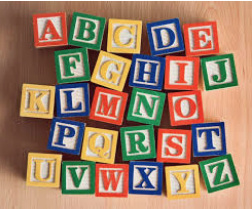
 Put out any alphabet blocks or cubes you might have and encourage the children to find the letters in their name as they build today. If you do not have alphabet blocks, put sticky notes onto the blocks with letters written on them.

Literacy/Alphabet Knowledge; identifies at least 10 letters of the alphabet, especially those in their own name.

 Art

Put out the many shapes of triangles, circles, squares, and rectangles along with glue sticks. Give children a piece of paper and encourage them to make objects using the shapes. Add magic markers for embellishing.

Mathematics/Geometry & Spatial Sense; progresses in ability to put together and take shapes apart.

Sand and Water

Fill the table with water today, then ask the children what they think will happen if you add ice cubes to the water? Let them hypothesis and then add the cubes and see if they were correct.

Science/Scientific Knowledge; shows increased awareness and beginning understanding of changes in materials and cause-effect relationships.

Library and Writing

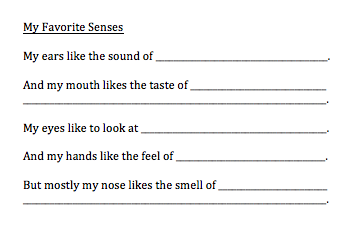
Use the My Favorite Senses sheet. Fill one out for each child. Suggest that they illustrate one of their favorite senses.

Literacy/Early Writing; begins to represent stories and experiences through pictures, dictations, and in play.  AND Literacy/Early Writing; develops understanding that writing is a way of communicating for a variety of purposes.

 Dramatic Play

 Let the children invent their own play today. Observe where it goes and how the children respond to one another.

Social & Emotional Development/Cooperation; develops increasing abilities to give and take interactions; to take turns in games or using materials; and to interact without being overly submissive or directive.

Math and Manipulatives

Put out a bowl of puff balls or other small manipulative. Encourage the children to take a handful and guesstimate how many puff balls they have in their hand. Then have the child count out the manipulatives in their hand. Ask the child, “did you have more, less, or the exact amount”?

Mathematics/Number & Operations; begins to use language to compare numbers of objects with terms such as more, less, greater than, fewer, equal to.

Outdoor Play

In the book, Ada does a science investigation in her classroom by making a geyser. On the playground take the following ingredients and try it as a class. You will need several bottles of diet soda/coke and mint Mentos. Ask the children what they think will happen when the mint Mentos are put into the soda? Have the children stand back, open the soda and quickly put 5-7 Mentos into the bottle. You can continue experimenting with different sodas or the amount of Mentos added.

Have the children make a big volcano in the sand box. Put a small pail in the center and let the children take turns putting several tablespoon of baking soda in the pail. Next add a cup of white vinegar and see what happens.

Which was more impressive, the geyser or the volcano?

Science/Scientific Skills & Methods; develops increased ability to observe and discuss common properties, differences, and comparisons among objects and materials.

Transitions

Point to one of the pages where the blocks spell out ADA’s name. Ask the children if they recognize any of the letters. Then take the index cards with the children’s names on them and hold them up one at a time. Can the children recognize their name in print? Can they name any of the letters in their name?

Literacy/Alphabet Knowledge; identifies at least 10 letters of the alphabet, especially those in their own name.

Dear Parents- Today we read a book about a girl scientist who asked many how and why questions.  When your child asks you these questions, help them find the answer by looking on the computer or sharing your experience/knowledge.  

Resources

Screen Shot 2018-08-20 at 11.25.21 PM