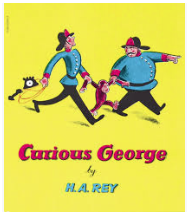
Curious George, by H.A. Rey

Children everywhere have fallen in love with this curious little monkey and his adventures.  This is the first book in the series.  Read as George leaves the jungle and is introduced to the Man in the Yellow Hat. 

Materials

  •  An instrument that can go quickly up and down the scales such as a                                  (keyboard, whistle slide, xylophone)

Vocabulary

  •  Curious (always wanting to know about things)
  •  Deck (the floor across the front of a boat)
  •  Fascinated (very curious)

Before Reading the Story

On the page where George lands on the telephone pole, stop and let the children see if they can find the man with the yellow hat.  Ask them what they think will happen next?

Literacy/Book Knowledge & Appreciation;  demonstrates progress in abilities to retell and dictate stories from books and experiences; to act out stories in dramatic play; and to predict what will happen next in a story.
After Reading the Story

 Ask the children if they remember why George was sent to prison (he made a false call to the fire department).  Talk to the children about the telephone.  It is not a toy but is used to call and talk to people.  Explain to the children when we call 911.  Let the children practice dialing 911.

Physical Health & Development/Health Status & Practices; builds awareness and ability to follow basic health and safety rules such as fire safety, traffic and pedestrian safety, and responding appropriately  to potentially harmful objects, substances, and activities.

Discovery

Bring in a globe or map and show the children where Africa is.  Bring in some pictures of  animals in their jungle habitat.  Explain that monkeys live in jungles.

Language Development/Listening & Understanding; demonstrates increasing ability to attend to and understand conversations, stories, songs, and poems.  AND Social & Emotional Development/Knowledge of Families & Communities; begins to express and understand concepts and language of geography in the contexts of the classroom, home, and community.

Music and Movement

 Play Up and Down with the children.  Explain to the children that if the instrument goes up the scale, they are to stand up.  If the instrument slides down the scale, they are to move down.  Use varying speeds and amounts of up and down. The children must listen and then act accordingly.

Creative Arts/Movement; expresses through movement and dancing what is felt and heard in various musical tempos and styles.

Blocks

Encourage the children to build stairs to add to their block structures.

Approaches to Learning/Engagement & Persistence; demonstrates increasing ability to set goals and develop and follow through on plans.

Art

Show the children how to trace around a small circular object on construction paper.  After they have traced several circular shapes onto a variety of colors, encourage them to cut them out and glue them to a piece of light blue paper. They can then add “strings” by drawing lines and make a balloon collage.

Physical Health & Development/Fine Motor Skills; progresses in abilities to use writing, drawing, and art tools, including pencils, markers, chalk, paint brushes, and various types of technology.  AND Physical Health & Development/Fine Motor SKills; develops growing strength, dexterity, and control needed to use tools such as scissors, paper punch, stapler, and hammer.

Library and Writing;

M is for Monkey.  What other words can the children think of that start with the letter M?  Make a list of the words that the children come up with.

Literacy/Phonological Awareness; shows growing awareness of beginning and ending sounds in words.

Sand and Water

Add spray bottles to the water today.  The children can aim at something in the water table and spray it.  Or attach a target to the wall behind the table for the children to practice aiming and spraying.

Physical Health & Development/Fine Motor Skills; grows in hand-eye coordination in building with blocks, putting together puzzles, reproducing shapes and patterns, stringing beads, and using scissors.

Dramatic Play

Bring in a straw hat and a monkey stuffed animal or puppet if you have one.  The children can then make their own Curious George adventure.

Literacy/Book Knowledge & Appreciation;  demonstrates progress in abilities to retell and dictate stories from books and experiences; to act out stories in dramatic play; and to predict what will happen next in a story.
Math and Manipulatives

Curious George wanted a red balloon but grabbed all of them instead.  Sort something by colors.  Put all the red in this pile, all the yellow here, and the purple over here.

Mathematics/Patterns & Measurement; shows increasing abilities to match, sort, put in a series, and regroup objects according to one or two attributes such as shape or size.

Outdoor Play

Practice walking a balance beam.  If you do not have something like a balance beam that you can walk, draw a line about 10 feet long with a piece of chalk.  Encourage the children to walk the line, jump, slide, walk backwards. 

Physical Health & Development/Gross Motor Skills; shows increasing levels of proficiency, control, nad balance in walking, climbing, running, jumping, hopping, skipping, marching, and galloping.

Transitions

Ask the children questions about the story as they go off to the next activity.  (Who brought George home from Africa?  Who did George call on the telephone?  How did George get away from the prison?).

Literacy/Book Knowledge & Appreciation;  demonstrates progress in abilities to retell and dictate stories from books and experiences; to act out stories in dramatic play; and to predict what will happen next in a story.

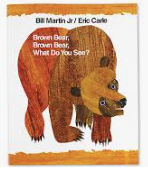
Brown Bear, Brown Bear, What Do You See? by Bill Martin Jr.

A classroom favorite that can be used to help reinforce colors as well as the importance of eyes.

Materials

  • Large blocks of frozen ice (freeze Tupperware’s ahead of time)
  •  Box of rock salt
  • Food coloring
  • Eyedroppers

Vocabulary

  • Glasses (those things people wear on their face to help them                    see better)
  • Ophthalmologist (a doctor who takes care of your eyes)

Before Reading the Story

Ask the children what we use our eyes for (to see things, to know what color it is, to read a book).  Share with the children some ways to keep your eyes safe (don’t rub them when something like sand gets inside, never look right at the sun, give your eyes plenty of rest at night).

Physical Health & Development/Health Status & Practices; builds awareness and ability to follow basic health and safety rules such as fire safety, traffic and pedestrian safety, and responding appropriately to potentially harmful objects, substances, and activities.

Reading the Story

This is such a nice predictable book that the children can easily join in the reading.

Literacy/Book Knowledge & Appreciation; shows growing involvement in listening to and discussing  a variety of ficvtion and non-fiction and poetry.

After Reading the Story

Cut out a shape for each child.  Use a variety of colors.  Give each child a color shape and tell them that they are going to go on a hunt to find something in the room that is the same color as their color shape. When everyone is back at the circle have them tell the color and the name of the object.

Approaches to Learning/Engagement & Persistence; grows in ability to persist in and complete a variety of tasks, activities, projects, and experiences.  AND Mathematics/Geometry & Spatial Sense; sows growth in matching, sorting, putting in a series, and regrouping objects according to one or two attributes such as color, shape, or size.

Discovery

 Ask the children if you can blindfold them. While blindfolded, have the children try a variety of activities such as putting several small objects into a container, picking up a pencil and drawing a picture, building with legos, buttoning a sweater, using a spoon to put cereal into their mouths, etc.  While they are trying these activities, talk to them about the importance of our eyes.  Remind them that our eyes allow us to see what we are doing and what things are.  People who cannot see with their eyes are blind.  Blind people need to learn about the world through their other senses.

Science/Scientific Skills & Methods; begins to participate in simple investigations to test observations, discuss and draw conclusions, and form generalizations.

Music and Movement

Chant the following poem, My Eyes Can See/Mis ojos pueden ver

            My eyes can see.                                     Mis ojos pueden ver
            My mouth can talk                                 Mi boca puede hablar
            My ears can hear                                    Mis oidos pueden o’ir
            My feet can walk.                                   Mis pies pueden andar
            My nose can sniff                                   Mi nariz puede olfatear
            My teeth can chew                                Mis dientes pueden masticar
            My lids can flutter                                  Mis parpados pueden pestanear
            My arms hug you                                    Mis brazos te pueden abrazar.

Have the children point to each body part as you read the poem slowly.  After repeating the poem, allow the children a moment to talk about their preferences of smell and taste if they choose.

Language Development/Listening & Understanding; demonstrates increasing ability to attend to and understand conversations, stories, songs, and poems.  AND Social & Emotional Development/Self-Concept; begins to develop and express awareness of self in terms of specific abilities, characteristics, and preferences,

Blocks

Use colored blocks to play today.  Encourage the children to name the colors as they build.  Can they sort the colors, build with only one color, make a color patterns?

Mathematics/Patterns & Measurement; shows increasing abilities to match, sort, put in a series, and regroup objects according to one or two attributes such as shape or size.

Art

Make cards that show a circle of red + circle of blue = ?    Make the cards to use the primary colors and also black and white.  Hang the cards  up beside the easel and let the children solve the color mysteries.

Science/Scientific Skills & Methods; begins to participate in simple investigations to test observations, discuss and draw conclusions. and form generalizations.

Library and Writing

Ask the children to think of an animal that they would like to draw.  Ask them what their favorite color is.  Give them a crayon in their favorite color and have them draw the animal.  Afterwards label their picture “________,_______ what do you see?  I see a (color)___(animal)___looking at me”.  These can be put together into your own class book.

Literacy/Book Knowledge & Appreciation; shows growing interest in reading-related activities, such as asking to have a favorite book read,; choosing to look at books; drawing pictures based on stories; asking to take books home; going to the library; and engaging in pretend-reading with other children.

If you have a camera you could let each child take a picture of something in the classroom.  On the top write, “______, ______what do you see”?  On the bottom write, “I see _______(a puzzle, the little doll, my lego car), that’s what I see”.

Literacy/Book Knowledge & Appreciation; shows growing interest in reading-related activities, such as asking to have a favorite book read,; choosing to look at books; drawing pictures based on stories; asking to take books home; going to the library; and engaging in pretend-reading with other children.

Sand and Water

 Put the large block of ice in the water table. Pour a little bit of rock salt over the top.  Put food coloring into small cups or bowls.  Show the children how to suck up the colored water into the eye dropper and then squeeze it out on top of the ice.  The colors will mix as the children experiment with the droppers.

Science/Scientific Skills & Methods; begins to use senses and a variety of tools and simple measuring devices to gather information, investigate materials, and observe processes and relationships.  AND Physical Health & Development/Fine Motor Skills; develops growing strength, dexterity, and control needed to use tools such as scissors, paper punch, stapler, and hammer.

Dramatic Play

Add sunglasses and glasses frames without the lenses.  Make a simple eye chart using a capital E facing up, down, left, and right.  The children can pretend to be an opthamologist and someone who needs glasses.

Creative Arts/Dramatic Play; participates in a variety of dramatic play activities that become more extended and complex.  AND Social & Emotional Development/Knowledge of Families & Communities; develops growing awareness of jobs and what is required to perform them.

Math and Manipulatives

 Sorting objects by color.

Mathematics/Geometry & Spatial Sense; shows growth in matching, sorting, putting in a series, and regrouping objects according to one or two attributes such as color, shape, or size.

Outdoor Play

Play I Spy by describing children and what they are doing. (I spy with my little eye someone digging in the sand with red pants and gym shoes on).  The child names the friend.

Approaches to Learning/Reasoning & Problem Solving; develops increasing abilities to classify, compare, and contrast objects, events, and experiences.

Transitions

Play I Spy with the children by describing objects in the room.  (I spy with my little eyes something that is made of plastic and it’s blue, and we sit on it at the table).

Approaches to Learning/Reasoning & Problem Solving; develops increasing abilities to classify, compare, and contrast objects, events, and experiences.

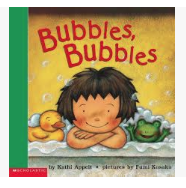
Bubbles, Bubbles by Kathi Appelt

            After a day getting dirty, a little girl enjoys her bath with a mound full of bubbles and rhyming verse.

Materials

  •             2-3 12 oz.clear soda/water bottles
  •             Food coloring
  •             Baby oil
  •             Bubbles and several wands (make wands out of pipe cleaners if               none are available)
  •             Bubblewrap, several pieces about a foot long
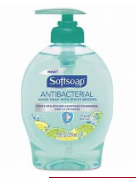
  •             Things that help keep our bodies clean
  •             Several dish towels or small bath towels

Vocabulary

  •             Sphere (a round solid circle shape like a ball or a globe)

Before Reading the Story

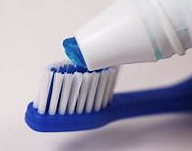
           Talk to the children about the importance of keeping our bodies clean.  Why do you think it is important to keep your hands and face clean ?(to look pretty, to keep the germs away), to keep your hair clean? (so you don’t get those itchy bugs), to keep your teeth clean? (so we don’t get cavities and our teeth won’t fall out).  Hold up the pictures of the things that help keep your body clean one at a time.  Ask the children to name the item and pantomime how to use it.

Physical Health & Development/Health Statu & Practices; shows growing independence in hygiene, nutrition, and personal care when eating, dressing, washing hands, brushing teeth, and toileting.  AND Science/Scientific Knowledge;shows increased awareness and beginning understanding of changes in materials and cause-effect relationships. 

Reading the Story

            Practice reading so that you get the rhythm of the verse to flow like a poem.

Language Development/Listening & Understanding; demonstrates increasing ability to attend to and understand conversations, stories, songs, and poems.

After Reading the Story

            Put out all the pictures of items that help keep your body clean where the children can all see them.  Cover them with a towel and take on item away.  Ask the children if they can name which item is missing and then pantomime how it is used.

Approaches to Learning/Initiative & Curiosity; chooses to participate in an increasing variety of tasks and activities.  AND Science/Scientific Knowledge; expands knowledge of and respect for their bodies and the  environment.

Discovery

            Make bubble bottles to put into the center.  Fill a clear 12 oz. soda/water bottle ½ full of water. Add food coloring of choice.  Now fill the rest of the bottle with baby oil and seal the lid closed with tape.  Show the children how to shake the bottle and observe what happens when all the ingredients mix together.

Science/Scientific Skills & Methods; begins to uses senses and a variety of tool sand simple measuring devices to gather information, investigate materials, and observe processes and relationships.

Music and Movement

            Have the children get into pairs and hold hands. Tell them that they are a little bubble and encourage them to float around the room without bumping into furniture. Give them a moment to float as a pair and then have groups of children softly bump into each other and make a bigger bubble.  Continue until everyone is part of a giant bubble and then say 1,2,3, POP!  And everyone fall down.

Language Development/Listening & Understanding; shows progress in understanding and following simple and multiple-step directions.

            Play Slippery Soap which is like Simon Says but instead say Slippery Soap says wash your knee, Slippery Soap says wash your forehead, etc.

Language Development/Listening & Understanding; shows progress in understanding and following simple and multiple-step directions.

           Cd’s with bath time songs such as Rubber Duckie https://www.youtube.com/watch?v=cDy4PZPMDwU or I Took a Bath in a Washing Machine https://www.youtube.com/watch?v=65Moz_FSkRwto dance to.

Creative Arts/ movement; expresses through movement and dancing what is felt and heard in various tempos and styles.

Blocks

            Tell the children that a car wash is like taking a bath for a car.  See if the children can build a car wash.  Make a sign and suggest to them that the car needs to go in the front and out the back (building tunnels).  Can they line the cars up first, second, last?  

Mathematics/Geometry & Spatial Sense; builds an increasing understanding of directionality, order, and positions of objects, and words such as up, down, over, under, top, bottom, inside, outside, in front, behind.

Art

            Let the children paint the sheets of bubble wrap using tempera paints in any color design they choose.  After they have finished painting, take a sheet of paper and carefully lay it down on top of the bubble wrap and gently pat the paper. Pull the paper up and you have a bubble design transfer.  Wipe down the bubble wrap and begin again.

Creative Arts/Art; gains ability in using different art media and materials in a variety of ways for creative expression and representation.

Sand and Water

            Add bubbles to the water today and let the children bath the dolls.  Make sure to include towels so they can dry the dolls and then dress them into warm jammies.

Physical Health & Development/Health Status & Practices; shows growing independence in hygiene, nutrition, and personal care when eating, dressing, washing hands, brushing teeth, and toileting.  

Library and Writing

           Cut out 2-inch circles from white paper.  Encourage the children to practice writing the letter B on each circle/bubble and then name a B word that you can write on the edge of their circle/bubble.  Let them glue all their bubbles onto a piece of colored paper to make a bunch of bubbles. Older children can out their own circles that they have traced onto the paper.

Literacy/Phonological Awareness; shows growing awareness of beginning and ending sounds of words. AND Physical Health & Development/Fine Motor Skills;develops dexterity, strength, and control needed to use tools such as scissors, paper punch, stapler, and hammer.

Dramatic play

           Bring in a box large enough for the children to sit in. Add a towel or two, some water toys, and a back scrub brush.  The children can pretend to take a bath.

Creative Arts/Dramatic Play; participates in a variety of dramatic play activities that become more extended and complex. 

Math and Manipulatives

            Play a shape game with the children.  Make sure they can identify a circle shape and then teach them the word sphere.  Ask the children to look about the classroom or in magazines for circles and spheres. Note that the bottom of a cup is a circle but the plastic tomato looks kind of like a sphere.

Mathematics/Geometry & Spatial Sense; begins to recognize, describe, compare, and name common shapes, their parts and attributes.

Outdoor play

            Bring bubbles and bubble wands outside.  Let the children try to pop the bubbles as they float by.  Can you tell which way the wind is blowing by watching where the bubbles float? Have all the children stand behind you  Blow a bunch of bubbles and then the children can run out and try to pop them before they hit the ground.  Give the children wands and see if they can catch a bubble on their wand.  Let the children practice blowing bubbles.  Who can blow the biggest bubble, who can blow the most bubbles at one time?  Try to hold a bubble with dry hands then try to hold a bubble with wet hands, what happens?

Science/Scientific Skills & Methods; begins  to participate in simple investigations to test observations, discuss and draw conclusions, and form generalizations.

Transitions

Put up a graph that shows those who take showers/those who take baths.  Have the children come up and write their name on the graph as to which they take at home, a bath or a shower.

Literacy/Early Writing; progresses from using scribbles, shapes, or pictures to represent ideas, to using letter-like symbols, to copying or writing familiar words such as their name.  Language Development/Listening & Understanding; understands an increasing complex and varied vocabulary.

Resources