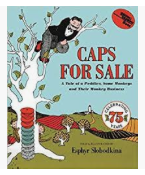
Caps for Sale, by Esphyer Slobodkina

A peddler  goes out to sell his caps and he falls asleep under a tree. When he wakes up, his caps are gone!  Who could have taken them?  Read this classic children’s story to discover the mystery of what became of the caps.

Materials

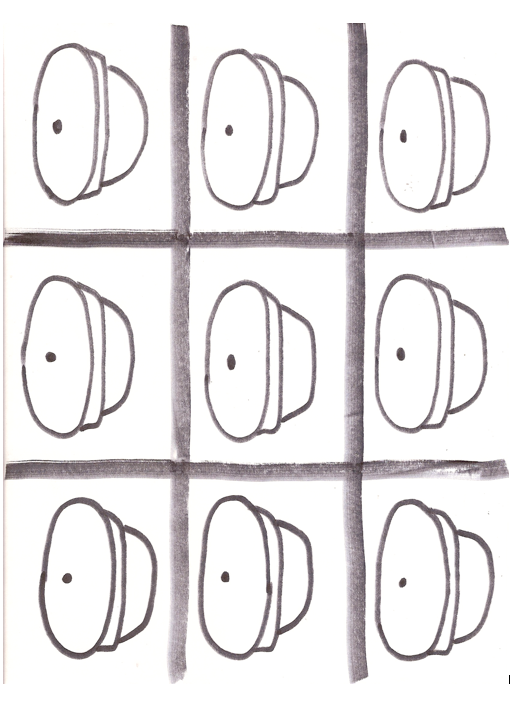
  •             Caps page
  •             If you have a cap, bring it in and wear it while you tell the story.
  •             1 paper plate per child

Vocabulary

  •             Peddler (a salesman who sells an item door to door)
  •             Cap (a kind of hat)

Before Reading the Story

Ask the children if they have a hat at home. Can they tell you about their hat? Does it serve a purpose (I have to wear my ball hat when I watch my big brother play little league, I wear my hat to keep the sun out of my eyes when I go fishing.  I have a hat I wear when I get dressed up on Sunday).  

Social & Emotional Development/Knowledge of Families & Communities; progresses in understanding similarities and respecting differences among people such as gender, race, special needs, culture, language, and family structure.

Reading the Story

If you have a cap type hat, bring it in and wear it while telling the story.  Introduce the book and note who is behind the tree. Ask the children to predict what they think is going to happen.   When you read the page where he is refreshed and rested, ask the children if they notice anything different (all but one cap is gone). 

Literacy/Book Knowledge &  Appreciation; demonstrates progress in abilities to retell and dictate stories from books and experiences; to act out stories in dramatic play; amd to predict what will happen in a story next. 

After Reading the Story

Talk about the book with the children. Does anyone remember what a cap is?  Where do you wear a cap?  Did the peddler sell any of his caps?  Why did he want to sell his caps?  Have you ever been very hungry, how did it make you feel?  What happened when the peddler took a nap?  Why do you think he got so angry?  What did the monkeys do when he stomped his foot?  How did the peddler get all his hats back from the monkeys? What did the peddler call out as he walked with the hats on his head?  

Literacy/Book Knowledge &  Appreciation; demonstrates progress in abilities to retell and dictate stories from books and experiences; to act out stories in dramatic play; amd to predict what will happen in a story next.  AND Language Development/Speaking & Communicating; develops increasing abilities to understand and use language to communicate information, experiences, ideas, feelings, opinions, needs, questions; and for other varied purposes.

Ask thechildren if they would like to act out the story.  If so, choose a peddler and have all the other children pretend to be monkeys. 

Literacy/Book Knowledge &  Appreciation; demonstrates progress in abilities to retell and dictate stories from books and experiences; to act out stories in dramatic play; amd to predict what will happen in a story next.   AND Creative Arts/ Dramatic Play; shows growing creativity and imagination in using materials and assuming different roles in dramatic play situations.

Discovery

Make a color match game.  Use the caps pattern and make caps of various colors.  On an index card write the color names using the coordination color marker or crayon.  The children can then sort the caps by color.  Use a copy machine to enlarge and shrink the cap page to make a sort game by size.   

Mathematics/Geometry & Spatial Sense; shows growth in matching, sorting, putting in series, and regrouping objects according to one or two attributes such as color, shape, or size.

Music and Movement

Let the children take turns leading in this Monkey See, Monkey Do song.

When you shake, shake, shake your fist

The monkey shakes, shakes, shakes his fist

Monkeys see and monkeys do

Monkeys do the same as you!

(Jump up and down, twirl around, touch your toes, stomp your foot)

Creative Arts/ Music; participates with increasing interest and enjoyment in a variety of music activities, including listening, singing, finger plays, games, and performances.  

In the story, the peddler balances a huge amount of caps upon his head.  Get out the beanbags and let the children practice balancing bean bags on different parts of their bodies while moving to music.  Who can balance more than one? Can you balance your bean bag on your head, shoulder, foot?

Physical Health & Development/Gross Motor Skills; shows increasing proficiency, control, and balance while walking, climbing, running, jumping, hopping, skipping, marching, and galloping.

Sing  I’ve Got a Penny

I’ve got a penny, I’ve got a penny

I’ve got a penny shiny and new.

I’m going to buy all kinds of _______

That’s what I’m going to do!

(Children can fill in blank with what they will buy. You can let the children pick coins out of a container and then the child must name the coin and the class can sing about the coin value in place of a penny.  I’ve got a nickel, I’ve got a dime, quarter).

Approaches to Learning/Reasoning & Problem Solving; develops increasing ability to find more than one solution to a question, task, or problem.

Blocks

In the story the Peddler stacked his hats. Encourage the children to do stacking today.  How many blocks tall can they stack before the pile falls over? If using wooden blocks make sure to set a height rule.

Physical Health & Development/ Fine Motor Skills; grows in eye-hand coordination in building with locks, putting together puzzles, reproducing shapes and patterns, stringing beads and using scissors.  AND Mathematics/Number & Operations; begins to make use of one-to-one correspondence in counting objects and matching groups of objects.

Art

Put out paper plates and collage materials.  The children can design their own hats to wear. Attach long pieces of yarns in two places opposite.  These can be used to tie the hat under the child’s chin. 

Creative Arts/ Art; gains ability in using different art media and materials in a variety if ways for creative expression and representation.

Library and Writing

Caps starts with the /c/ sound.  What other words can the children think of that start with this sound?  Make a list. 

Literacy/Phonological Awareness; shows growing awareness of beginning and ending sounds in words.

Sand and Water

Fill the table with water today and encourage the children to wash any hats that you may have in your classroom.  As they wash can they identify the person who might wear the hat or the purpose of wearing the hat? 

Social & Emotional Development/Knowledge of Families & Communities; develops growing awareness if jobs and what is required to perform them.

Dramatic Play

Make sure to include play money and a cash register in the center today.  As the children play, talk to them about the coins and their values.  Bring in a set of real coins to match the play coins to. Add any extra hats and caps that you might have. 

Mathematics/Patterns & Measurement; shows increasing abilities to match, sort, pit in a series, and regrouping objects according to one or two attributes such as color, shape, or size.

Math and Manipulatives

Use the caps page to color and cut out primary color caps.  Make a pattern with the caps and then see if the children can follow with more caps or a manipulative in the same colors (Unifix cubes).  Practice making patterns today. 

Mathematics/Patterns & Measurement; enhances ability to recognize, duplicate, and extend simple patterns using a variety of materials.

Outdoor Play

Play a mimic type game.  You can play similar to Simon Says but instead of Simon telling the children what to do, the Peddler tells them.  “The Peddler says turn around, the Peddler says run to the tree and back”. 

Language Development/ Listening & Understanding; shows progress in understanding and following simple and multiple-step direction.  AND Physical Health & Development/Health Status & Practices; progresses in physical growth, strength, stamina, and flexibility.

Transitions

 Make enough copies of the hats for each child.  Color them according to colors that you might be working on with your group of children.  I use between 4-6 colors.  Tape all of these to a flannel board or the wall where everyone can see them.  Say the following poem and either point to a child/monkey or name them.

            Monkey,monkey in the tree.                     Rogermonkey, Roger monkey in the tree

           Give  the purple cap down to me.               Give the purple cap to me.

This is fun to do when you are teaching colors like silver, aqua, and violet.

Language Development/Listening & Understanding; understand an increasing complex and varied vocabulary. AND Social & Emotional Development/Cooperation; develops increasing abilities to give and take in interactions; to take turns in games and using materials; and to interact with others without being overly submissive or directive.

Dear Parent-

            Being able to copy and make patterns is an important skill to learn for later math acquisitions.  Find some objects in your house that you have multiples of (silverware, socks, colored paper clips, etc.) and make a pattern for your child to copy.   When they are able to copy your patterns, challenge them to make a pattern for you to copy.

Resources
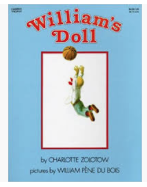
William’s Doll, Charlotte Zolotow

William wants a doll! His family thinks that there is something wrong with William. But his wise Grandmother buys William a doll and tells them all exactly why a doll is a perfect present for William.

Materials

  • Several pictures of babies.
  • Old toy catalogs.
  • Two or three bath towels and washcloths.
  • Medium sized box, basket, or garbage can

Vocabulary

  • Cradle (to make like a bed for the baby out of your arms)
  • Nonsense (it means that’s silly)

Before Reading the Story

Ask the children to describe some of their favorite toys. While discussing, ask the other children if it’s a toy they might like to play with also. Then ask is there any toys that only boys can play with or only girls can play with. If a child responds with a yes, ask them why they think that. Then steer the conversation to say that all toys are for all children.

Social & Emotional Development/Self-Concept; begins to develop and express awareness of self in terms of specific abilities, characteristics, and preferences.

Reading the Story

When you get to the part where William states he wants a doll, ask the children what they think about this? Can boys play with dolls, why or why not? What do you think will happen if William gets a doll for his birthday?

Science/Scientific Skills & Methods; begins to describe and discuss predictions, explanations, and generalizations based on past experiences.

After Reading the Story

Ask the children why they think it was good for William to get a doll for his birthday (so he can practice being a father). After a short discussion about what William did with his doll, take out a piece of paper and ask each child what they like to do with their father/father figure (My Dad takes me to get French fries. My Uncle John takes me to the park to swing on the swings. My biggerest brother gives me a ride on his bike).

Social & Emotional Development/Knowledge of Families & Communities; progresses in understanding similarities and respecting differences among people such as genders, race, special needs, culture, language, and family structures.

Discovery

Show the children pictures of babies. Ask them to think of things that they can do now that they could not do when they were a baby (I can ride a bike. I can eat crunchy food and my sister can only drink from her bottle).

Language Development/Speaking & Communicating; progresses in abilities to initiate and respond appropriately in conversation and discussions with peers and adults.

Music and Movement

When I was one year old,                          Children crouch down
I was very, very small                                 Put hands close together to show smallness
But now I’m 4 years old                              Hold up 4 fingers
And I’ve grown up big and tall!               Children stand up and put hands over head

Language Development/Listening & Understanding; demonstrates increasing ability to attend to and understand conversations, stories, songs, and poems.

Blocks

Add people and family props to the center. Encourage the children to build a home for the family/people. Ask them if they can add a window, a door, and a roof to their structure but praise any ‘house’ that they build.

Approaches to Learning/Reasoning & Problem Solving; grows in recognizing and solving problems through active exploration, including trial and error, and interactions and discussions with peers and adults.

Art

Put out old toy catalogs for the children to cut out toys they like for home and for the classroom (wish list).

Physical Health & Development/Fine Motor Skills; grows in eye-hand coordination in building with blocks, putting together puzzles, reproducing patterns and shapes, stringing beads, and using scissors.

Library and Writing

Ask the children to draw a picture of their father/father figure. What kinds of special things do you like to do with your father/father figure? Write their dictations on the bottom.

Literacy/Early Writing; begins to represent stories and experiences through pictures, dictation, and in play.

Sand and Water

Put warm water in the table today and let the children bath your classroom baby dolls. Give the children wash clothes and dish towels for drying and washing.

Social & Emotional Development/Knowledge of Families & Communities; develops growing awareness of jobs and what is required of them.

Dramatic Play

Parent play; add dolls, doll clothes, and any baby items you might have. Especially encourage the boys to use the dramatic center today.

Creative Arts/Dramatic Play; participates in a variety of dramatic plays activities that become more extended and complex.

Math and Manipulatives

Sorting bears or other sorters in small, medium, and large. Put out three bowls and encourage the children to sort by size. Call the small bears the babies, the medium bears the little sister/brother, and the biggest bears the big sister/brother. After they have sorted them, ask them to count how many of each they have in the bowl. Count along with them if they are beginner counters.

Mathematics/Numbers & Operations; develops increasing ability to count in sequence to 10 and beyond. ALSO Mathematics/Patterns & Measurement; shows growth in matching, sorting, putting in series, and regrouping objects according to one or two attributes such as color, shape, or size.

Outdoor Play

Give the children a small ball or bean bag to throw into a box, basket, or can. Have the children back up three paces and throw the ball into the container. As they take their turn, ask them to think of a word that starts with the letter sound of their name or any letters that you are working on (Can you think of a word that starts with the R sound like in your name Roger? Can you think of a word that starts with the letter S sound /s/s/s/). After a round, move back two more steps and continue in the same manner.

Literacy/Phonological Awareness; shows increasing ability to discriminate and identify sounds in spoken language.

Transitions

Ask the children to name family members as they go off to another activity. (Roger, what is your mother’s name? What is your big sister’s name?). Do they know the names of their parents? Do they know their own last name? If not, help them to practice naming these.

Social & Emotional Development/Knowledge of Families & Communities; develops ability to identify personal characteristics, including gender and family composition.

Dear Parent-Today we read the story William’s Doll. In it, William wanted a doll so that he could practice being a father. Talk to your child about some of the things you liked to do when your were their age. Ask your child what they like to do best at school; who do they play this with, or do they like to play this alone?

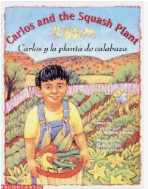
Carlos and the Squash Plant, by Jan Romero Stevens

Carlos likes to help his parents farm their garden but he doesn’t like washing up afterwards.  His mother has warned him that he better wash up or he might grow a squash plant out of his ear.  Find out what becomes of Carlos and if he listens to his mother’s warning.

Materials

  •             Small bar soaps, cut a larger one into quarters
  •             A variety of nail brushes
  •             A squash that is in season or squash seeds
  •             Several hats, preferably straw

Vocabulary

  •             Ay caramba (Oh my goodness!)

Before Reading the Book

Sometimes our parents tell us to do things that we do not want to do. Ask the children for examples.  If none are given ask them if their parents tell them it is time to go to bed, time to brush their teeth,time to turn off the TV.  Explain that parents tell their children what to do to help keep them safe and healthy. 

Physical Health & Development/Health Status & Practices; shows growing independence in hygiene, nutrition, and personal care when eating, dressing, hand washing, brushing teeth, and toileting.

Show the children the cover of the book and ask them if they think they can tell what the story is about.  Look at the boys face, how do you think he feels?  Now turn the book over and show the back page. Look at the boys face, how do you think he feels now?  Ask the children why he might be feeling this way.  Turn the book back over and begin.  

Language Development/Speaking & Communicating; develops increasing abilities to understand and use language to communicate information, experiences, ideas, feelings, opinions, needs, questions; and for other varied purposes.

Reading the Book

As you read, ask the children questions; Carlos did not listen to his mother? What do you think will happen?  Why do you think Carlos is wearing the hat?  Do you think his Mother knows there is a plant growing from his ear?  How do you think Carlos will get the squash plant to disappear? 

Approaches to Learning/Logic & Reasoning; develops increasing ability to find more than one solution to a question, task, or problem.  AND Social & Emotional Development/Self-Control; develops growing understanding of how their actions affect others and begins to accept the consequences of their actions.

                       
After Reading the Book

Talk to the children about the importance of bathing (cause you will be all stinky, the germs will get on you).  Ask the children if they think a squash could really grow out of your ear?  What does a seed need to grow? 

Science/Scientific Knowledge; expands knowledge of and respect for their bodies and the environment.  And Science/Scientific Knowledge; expands knowledge  of and abilities to observe, describe, and discuss the natural world, materials, living things, and natural processes.

Give all the children a paper towel.  Tell them that you are going to play a game like Simon Says but it is called Slippery Soap. Call out “Slippery Soap says to wash your elbow!”.  The children then take the paper towel and pretend to wash their elbow.  Continue,as you would play Simon Says.   Include such body parts as knuckles, ankle, thigh, abdomen, gums, eye brow, etc.

Language Development/Listening & Understanding; understands an increasingly complex and varied vocabulary.

Discovery

If it is the right time of year, get some squash seeds or bean seeds to plant in cups. 

Science/Scientific Skills & Methods; begins to participate in simple investigations to test observations, discuss and draw conclusions, and form generalizations.

Bring in a squash that is in season.  Let the children use all their senses to describe the squash. 

Science/Scientific Skills & Methods; begins to use senses and a variety of tools and simple measuring devices to gather information, investigate materials, observe processes and relationships.

Make the Calabacitas recipe in the back of the book. 

Science/Scientific Skills & Methods; begins to use senses and a variety of tools and simple measuring devices to gather information, investigate materials, observe processes and relationships.

Music and Movement

 Teach the children the poem/song  Dig a Little Hole

Dig a little hole                                                              Pretend to dig a hole

And you put the seed in.                                              Pretend to drop a seed into the hole

Cover it with dirt                                                          Pretend to cover the hole

And let the sun shine in                                               Arms overhead to make sun

Add a little water                                                         Wiggle fingers like rain

And keep it fed

Pretty soon a little plant will show its head          Make a hole with one hand touching finger                                                                                                to thumb.  As the other hand pushes                                                                                                            through the hole.

Creative Arts/Music; participates with increasing interest and enjoyment in a variety of music activities including listening, singing, finger plays, games, and performances.  

Blocks

Carlos planted a garden where he grew his squash plants.  Challenge the children to build a fence to go around a pretend garden.  Can they make a pattern in their fence using the blocks?  

Mathematics/Patterns & Measurement; enhances abilities to recognize, duplicate, and extend simple patterns using a variety of materials.

Art

Make a ‘vine’ several feet long using green construction paper.  Draw simple leaf shapes on several shades of green paper that the children can cut out and tape to your vine.  Make several star shapes for the squash flowers and squash shape, these the children cut out and tape to the vine also. 

Physical Health & Development/Fine Motor Skills;grows in hand-eye coordination in building with blocks, putting together puzzles, reproducing shapes and patterns, stringing beads, and using scissors.

Sand and Water

 Water play today.  Add small bars of  soap and nail brushes.  

Physical Health & Development/Health Status & Practices; shows growing independence in hygiene, nutrition, and personal care when eating, dressing, hand washing, brushing teeth, and toileting.

Library and Writing

Carlos’s mother used a recipe to make calabacitas, a favorite food for Carlos. Ask the children if one of their parents cook a favorite food for them?  Ask the child to tell you how his parent cooks this food and write down what he/she says.  Put all the “recipes” together for a classroom cookbook.

Literacy/Early Writing; develops understanding that writing is a way of communicating for a variety of purposes.  AND Social & Emotional Development/Self-Concept; begins to develop  and express awareness of self in terms of specific abilities, characteristics, and preferences.

Dramatic Play

 Put out several straw hats that the children can use to act out the story.  If you do not have straw hats, use baseball caps. Explain to the children that when working out in the hot sun, it is important to protect your head and skin from sunburn.

Literacy/Book Knowledge & Appreciation; demonstrates progress and abilities to retell and dictate stories from books and experiences; to act out stories in dramatic play; and to predict what will happen next in a story.

Math and Manipulatives

 The squash plant growing in Carlos’ ear kept getting longer and longer.  Work with the children today using a ruler.  Show them how the numbers tell how many inches long something is.  Help the children to measure toys in the room. Reinforce the concept of an inch by using the 1-inch cubes to double-check the measurements of the ruler. 

Mathematics/Patterns & Measurement; shows progress in using a standard and non-standard measures for length and the area of an object.

Outdoor Play

Let the children use shovels to make long straight rows in the dirt to pretend to be planting a garden.  Or if you are able, begin a real garden in the play yard.  

Mathematics/Patterns & Measurement; enhances abilities to recognize, duplicate, and extend simple patterns using a variety of materials.  AND Physical Health & Development/Health Status & Practices; progresses in physical growth, strength, stamina, and flexibility.

Transitions

Have the children show you how they can wash their hands.  Have them pretend and go through the motions of proper hand washing.  

Physical Health & Development/Health Status & Practices; shows growing independence in hygiene, nutrition, and personal care when eating, dressing, hand washing, brushing teeth, and toileting.

Dear Parent,  Good hand washing techniques are important to your child’s health.  Ask your child to show you the easy steps to better health.  1) Turn on the water and wet hands.  2) Apply soap to your hands.  3) Scrub hands in circular motions creating soap lather on the palms, the tops, around the wrists, and between the fingers.  4) Rinse the soap from your hands.  5) Dry your hands with a paper towel or towel.  6) Use a corner of the towel to turn off the water so as not to touch your clean hands on the water knob.