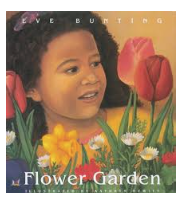
Flower Garden, Eve Bunting

           This is a wonderful book about spring and a little girls gift to her mother.  It is inspiration to those who live in the city and a reminder of the joy that plants bring to people everywhere.

Materials;

  • Silk flowers (these can often be gotten at craft stores for a few dollars. If they do not have stems, cut pipe cleaners into 6-8 inch pieces and attach to the silk flower heads.)
  • Petal Power game
  • Gardening catalogs or spring fliers from local garden stores
  • At least one real flowering plant

Vocabulary

  • Trowel ( a shovel for planting flowers or vegetables)
  • Jamboree ( a celebration, in the story it is a celebration of colors!)

Before reading the Story

            Show the children the cover of the book.  Ask them if they have ever helped plant a garden before?  Where do you get the plants?  What did you have to do to make the garden? What do you have to do to take care of the garden?  If you live in the city, this might be more difficult for the children to answer.  In that case, talk about if they have ever seen a flower garden?  Did you like it?  What did you like/not like about it?  Where did you see the garden?

Science/Scientific Knowledge; expands knowledge of and abilities to observe, describe, and discuss the natural world, materials, living things, and natural processes.

Reading the Story

           As you read the story, ask who, what, where, when, and why questions.  (Where are the girl and her father going with the flowers, what are they going to do? Why are they lighting candles?  Whose birthday do you think it is? What time of year is this story taking place?)

Language Development/Speaking & Communicating; develops increasing abilities to understand and use language to communicate informations, experiences, ideas, feelingsw, opinions, needs, questions,; and for other varied purposes.

After Reading the Story

            Talk about the sequence of the story.  Where did the story start? (In the store), then where did they go? (On the bus).  Where does this story take place? (in the city).  Where did the girl live? (High in the building).  Who was the last one to come home?  What special day was it?  Does anyone know when their special birth date is?

Literacy/Book Knowledge & Appreciation; demonstrates progress in abilities to retell and dictate stories from books and experiences; to act out stories in dramatic play; and to predict what will happen next in a story.

Discovery

           Put the real flower/s into the center today.  Encourage the children to uses their senses to tell you about the flower.  Let the children take it out of the container so they can see the roots.  Talk about what a plant needs to live and grow (water, dirt, air, and sunshine). Encourage them to draw the plant showing the various parts, including the roots.

Science/Scientific Skills & Methods; develops growing abilities to collect, describe, and record information through a variety of means including discussion, drawings, maps, and charts.

Music and Movement

           Sing or chant, Dig a Little Hole

You dig a little hole Pretend to dig a hole

And you put the seed in. Drop a pretend seed into the hole

And you cover it with dirt, Use hands to cover pretend hole

And let the sun shine in. Arms over head to make a circle

You give a little water Wiggle fingers over hole to make rain

And keep it fed,

Pretty soon a little plant will show its head. Bring one hand up through the other

Language Development/Listening & Understanding; demonstrates increasing ability to attend to and understand conversations, stories, songs, and poems.

            Go through the motions of making a birthday cake with the children and then sing Happy Birthday.

Language Development/Listening & Understanding; demonstrates increasing ability to attend to and understand conversations, stories, songs, and poems. AND Approaches to Learning/Initiative & Curiosity; chooses to participate in an increasing variety of tasks and activities.

Blocks

            In the story, the girl and her father planted the flowers in a window box.  Encourage the children to build a long window box out of blocks.  If you have enough silk flowers/plants, you could add these to the block center today.

Approaches to Learning/Engagement & Persistence; demonstrates increasing ability to set goals and develop and follow through on them.

Art

            Give each child a piece of brown paper and tell them to pretend that this is their window box.  Put out gardening catalogs and let the children cut and glue what their window box would look like.

Physical Health & Development/Fine Motor Skills; develops growing strength, dexterity, and control needed to use tools such as scissors, paper punch, stapler, and hammer.

Library and Writing

            Encourage the children to make cards for family members, friends, or a staff person.  Show them how to fold the paper in half.  Encourage them to draw a lovely flower design on the front.  Open it up and you can help them write a message or they can write/scribble their own message.  Make sure they sign the card.

Literacy/Early Writing; develops understanding that writing is a way of communicating for a variety of purposes. AND Literacy/Early Writing; progresses from using scribbles, shapes, or pictures to represent ideas, to using letter-like symbols, to copying or writing familiar words such as their own name.

Sand and Water

            Add dirt to the table along with several garden trowels or shovels.  Add silk plants, or real plants for the children to pretend to plant.  Bring in several containers that the children can use for the garden box.

Creative Arts/ Dramatic Play; participates in a variety of dramatic play activities that become more extended and complex.

Dramatic Play

            Add silk flowers and a plastic vase ( a water bottle works) so the children can arrange some cut flowers for the table or counter.

Math and Manipulatives

           Play Petal Power.  Give each child a potted plant from the resource page.  Cut out a quantity of petals in various colors and place in the center of the table.  Take turns rolling the dice.  The child counts the number on the dice and takes that many petals from the pile and places on her circle.  Play until all the petals are used up. Use glue sticks as you play to make your pots part of a wall display afterwards.

Mathematics/Number & Operations; begins to use one-to-one correspondence in counting objects and matching groups of objects. AND Social & Emotional Development/Cooperation; develops increasing abilities to give and take in interactions; to take turns in games and using materials; and to interact without being overly submissive or directive.

Outdoor Play

            Look for signs of nature growing around your playground.  Help the children to name the plants that they see.  That is a Loblolly Pine, that is a Dandelion, that is Oregano.

Science/Scientific Knowledge; expands knowledge of and abilities to observe, describe, and discuss the natural world, materials, living things, and natural processes.

Transitions

            Show the children the page where the Mother sees her garden.  Ask the children if the Mother liked her present?  Ask the children what they would like to get their Mother for her birthday?

Approaches to Learning/Reasoning & Problem Solving; develops an increasing ability to find more that one solution to a question, task, or problem.

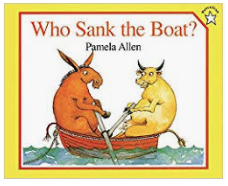
Who Sank the Boat? By, Pamela Allen

Five friends decide to go for a boat ride… This book is a who done it for preschoolers.  Will they be able to figure out who sank the boat? 

Materials

  • Plastic lids of various sizes.
  • A dishwashing tub
  • Naptime mat or blanket
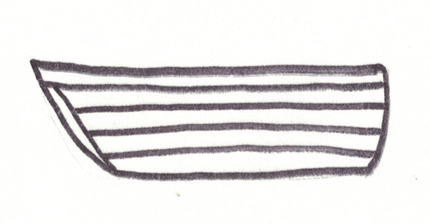
  • Boat picture for writing center
  • Boat picture to cut around for art

Vocabulary

  • Bay (harbor or cove)
  • Tilted (to make the boat angle crookedly)
  • Din (lots of loud noise)
  • Bow (the front of the boat)
  • Flutter (to make the boat go up and down)

Before reading the Story

Show the children the front of the book.  Ask if any have ever been in a boat?  What are these animals not doing for safety?  (Wearing a life preserver).  Talk about what a life preserver does.  Do you ever wear one when you are swimming?  Always wear a life preserver in a boat, it’s the law.

Physical Health & Development/Health Status & Practices; builds awareness and ability to follow basic health and safety rules such as fire safety, traffic and pedestrian safety, and responding appropriately to potentially harmful objects, substances, and activities.

Reading the Story

On the page where the reader is first asked, “Do you know who sank the boat”?  Stop and let the children make a prediction about who they think will sink the boat and why.  Each time the author asks, “Do you know who sank the boat”? stop and let the children change their prediction if they like.

Approaches to Learning/Reasoning & problem Solving; develops increasing abilities to classify, compare, and contrast objects, events, and experiences.

As the different animals are getting into the boat, can the children name the expressions? (fear, nervousness, relief). Can they tell you about a time that they felt these emotions?

Language Development/Speaking & Communicating; develops increasing abilities to understand and use language to communicate information, experiences, ideas, feelings, opinions, needs, questions,; and for other varied purposes.

After Reading the Story

Ask the children to name the 5 animals that were in the boat.  Ask the children if they think just one animal sank the boat, why?  Now ask the children if they noticed what was happening to the boat each time an animal friend got in.  Go back through the pages and show them how the boat is getting lower and lower in the water.  Ask them if they know what is causing the boat to sink?

Science/Scientific Knowledge; shows increased awareness and beginning understanding of changes in materials and cause-effect relationships.

Discovery

Do a float and sink experiment.  Bring a variety of objects from the classroom over to a large tub of water.  Ask the children to predict if it will float or sink.  Can they explain why they think so?

Science/Scientific Skills; begins to participate in simple investigations to test observations, discuss and draw conclusions, and form generalizations.

Music and Movement

Sing Row Row Row Your Boat https://www.youtube.com/watch?v=7otAJa3jui8  After singing it through once or twice, ask the children to get a partner and sit facing each other holding hands. Now sing a verse and have the children rock back and forth. Have the children sit back to back and row the boat. Sit side by side. What other ways can the children think to row the boat with their partner?

Creative Arts/Movement; shows growth in moving to different patterns of beat and rhythm in music.

In the story there were lots of rhymes today.  Who remembers what rhyming words are?  Sing Rhyming Words Sound the Same 

Rhyming words sound the same (clap, clap)

Rhyming words sound the same. (clap, clap)

Rhyming words sound the same (clap, clap)

Rhyming words sound the same. (clap, clap)

Say a word and see if the children can name a rhyming word. Bring in pictures of rhyming words. Put half the rhymes up on a board where everyone can see them and then each time you sing, hold up a picture from the other half of the rhyming words. Can the children see and name the rhyming words?

Literacy/Phonological Awareness; progresses in recognizing matching sounds and rhymes in familiar words, games, songs, stories, and poems.

Blocks

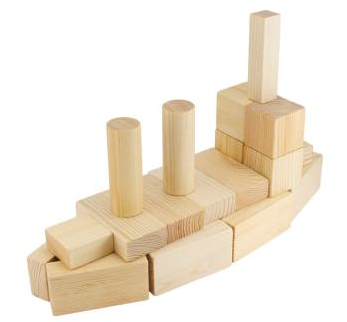
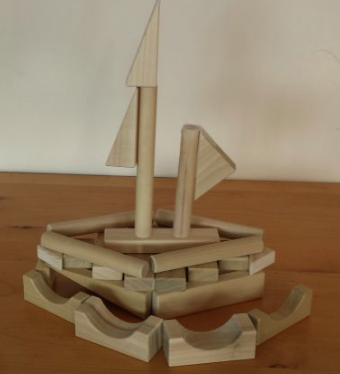
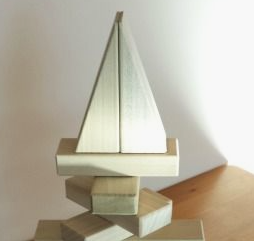
Challenge the children to make boats out of blocks. Print and hang pictures of block boats.  Challenge your children to read the model and make their own boats from blocks.

Approaches to Learning/Engagement & Persistence; grows in ability to persist and complete a variety of tasks, activities, projects, and experiences.

Art

Watercolor paints.  Can you paint a lake?  Give each child a simple boat shape to cut out and glue onto their lake picture when it is dry.

Creative Arts/Art; gains ability in using different art media and materials in a variety of ways for creative expression and representation. AND Physical Health & Development/Fine Motor Skills; develops growing strength, dexterity, and control needed to use tools such as scissors, paper punch, stapler, and hammer.

Cut out various sized squares, rectangles, and triangles from assorted papers.  Encourage the children to put them together to make boats.  Glue to paper.

Approaches to Learning/Engagement & Persistence; demonstrates increasing ability to set goals and develop and follow through on plans. AND Mathematics/Geometry & Spatial Sense; progresses in ability to put together and take apart shapes.

Sand and Water

Add water to the table today along with the counting bears and plastic lids.  Show the children how to float the lid like a boat.  How many counting bears can they get on the boat before it tilts and sinks?

Mathematics/Number & Operations; demonstrates increasing interest and awareness of numbers and counting as a means for solving problems and determining quantity.

Library and Writing

Give the children a copy of the boat picture.  Encourage them to draw friends, either real or imaginary in the boat. Ask them to tell you about their boat and write their words underneath.

Literacy/Early Writing; begins to represent stories and experiences through pictures, dictation, and play.

Dramatic Play

Use a mat or blanket to pretend it is a boat.  Remind the children about water safety, wear a life preserver.  Talk to the children about boat safety.  What were the animals NOT wearing that they should have been?  Life preservers.  Use scarves to be pretend life preservers.  The children can drape them over their shoulders and pretend to be out in a boat. Add fishing poles and a picnic lunch.

Creative Arts/ Dramatic Play; participates in a variety of dramatic play activities that become more extended and complex.

Math and Manipulatives

Today would be a good day to reintroduce your children to the balance scale. Put out a bowl of one inch cubes and a variety of small objects to weigh. How many cubes does a plastic banana weigh? How many cubes does a rock weigh? Can you find something that weighs less than a one inch cube?

Mathematics/Number & Operations; begins to make use of one-to-one correspondence in counting objects and matching groups of objects.

Outdoor Play

If you are doing this unit in the summer, have a water day on the playground!  Set up sprinklers for the children to run through.

Bring your paint outside today.  Hang a large piece of bulletin board paper on the fence today.  Bring out paper plates.  Pour paint onto the plate and use sponge rollers to make a body of water.  When it dries you can use it for the background of the children’s boats made in art.

Creative Arts/Art; gains ability in using different art media and materials in a variety of ways for creative expression and representation.

Transitions

As the children prepare to go to the next activity ask each one to name an object that is heavier than a _____. Also try lighter than a _______, bigger than a ______, smaller, Longer/shorter.

Mathematics/Patterns & Measurement; begins to make comparisons between several objects based on a single attribute.

Resources

First The Egg, by L. Vaccaro-Seeger

This simple story shows how things transform from one thing into another.  The simple text and bold pictures make transformation of animals and things so much easier for young children to comprehend.

Materials

  • 1-2 Cheese Graters
  • 1 bar of Ivory hand soap
  • 2 rolls of toilet paper

Vocabulary

Before Reading the Story

Go over your daily schedule with the children.  Talk about how first you do this and then you do that.  (First we eat breakfast and then we have a group time.  First we use the bathroom and then we go outside).  Use words first, next then, and after.

Science/Scientific Knowledge; develops growing awareness of ideas and language related to attributes of time and temperature.

Reading the Story

Read the book slowly allowing the children to fill in the words if they can.  Pause before turning to the pages that start with ‘then’.

Science/Scientific Knowledge; expands knowledge of and abilities to observe, describe, and discuss the natural world, materials, living things, and natural processes. AND Language Development; develops increasing abilities to understand and use language to communicate information, experiences, ideas, feelings, opinions, needs, questions; and for varied other purposes.

After Reading the Story

Ask the children if they can recall all the transformations in the book.  If they can not recall, use the book and say, “First the ____ Then the see if the children can fill in the then.

Language Development/Speaking & Communicating; progresses in abilities to initiate and respond appropriately in conversation and discussions with peers and adults.

Discovery

Put out any books or materials that you have about life cycles and transformation.

Literacy/Book Knowledge & Appreciation; shows growing interest in reading-related activities, such as asking to have a favorite book read; choosing to look at books; drawing pictures based on stories; asking to take books home; going to the library; and engaging in pretend-reading with other children.

Music and Movement

Teach the poem, Dig a Little Hole

Dig a little hole                                  Follow the poem to make actions

And put the seed

Cover it with dirt

And let the sun shine in.

Add a little water

And keep it fed,

Pretty soon a little plant

Will show its head.

Roly Poly Caterpillar               Make actions to words

Roly Poly Caterpillar into a corner crept.

Spun a blanket around himself

Then for a long time slept.

Roly Poly Caterpillar waking by and by

Found he had beautiful wings

And was changed to a butterfly.

Science/Scientific Knowledge; shows increased awareness and beginning understanding of changes in materials and cause-effect relationships.

Blocks

Add the book Changes, Changes by P. Hutchins.   Go through it with the children talking about all the changes that the blocks go through.  Then leave the center and see what the children choose to make.  Observe, did they make changes, changes in their play?

Mathematics/Geometry & Spatial Sense; progresses in ability to put together and take apart shapes.

Art

Put out primary colored paints today.  As the children prep for painting, tell them , “first you mix the yellow and red and then you get the orange”.

Science/Scientific Skills & Methods; begins to describe and discuss predictions, explanations, and generalizations based on past experiences.

Sand and Water

Tell the children that today you are going to make clean mud with them.  Give a child the cheese grater and let them begin to grate the ivory soap bar into the water table.  While this child is grating soap, others can be tearing apart toilet paper, one square at a time and dropping it into the water table.  After all the soap has been grated and the toilet tissue torn, add a little water and start mixing up the soap and toilet paper.  Continue adding more water until you have a smooth and slippery consistency.  The toilet paper should be sculptable at this point.  Let the children experiment sculpting in the medium.

Creative Arts/Art; gains ability in using different art media and materials in a variety of ways for creative expression and representation.

Library and Writing

If you have any sequencing cards put them out today.

Mathematics/Patterns & Measurement; shows increasing abilities to match, sort, put in a series, and regroup objects according to one or two attributes such as size or shape. AND Literacy/Print Awareness & Concepts; demonstrates increasing awareness of concepts of print, such as that reading in English moves from top to bottom and from left to right, that speech can be written down, and that print conveys a message.

Dramatic Play

Watch how the children choose to use the center today.  Try to use the first/then in conversation with the children.  I see that first you are making dinner and then you will eat it.  I see that you are getting the baby dressed what will you do then?  Oh, you are first putting on the red dress and then will you add some sparkle jewelry?  

Science/Scientific Knowledge; develops growing awareness of ideas and language related to attributes of time and temperature.

Math and Manipulatives

Any kinds of pattern play materials that you may have today.

Mathematics/Patterns & Measurement; enhances abilities to recognize, duplicate, and extend simple patterns using a variety of materials.

Outdoor Play

Play Transformation.  Suggest that the children make themselves very small.  Now tell them to transform into something very long.  Transform into something very tall, humongous, teeny tiny, tall, that moves slowly, moves quickly, is jumpy, hardly moves at all, etc.

Language Development/Listening & Understanding; understands an increasingly complex and varied vocabulary.

Transitions

Call the children to line up or move to the next activity two at a time.  First Alison, then Sean.  First Ryan, then Paula.  First Jamie, then Kim.

Language Development/Listening & Understanding; shows progress in understanding and following simple and multiple-step directions.