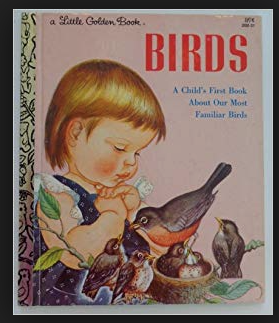
Birds: A Child’s First Book About Our Most Familiar Birds, Jane Werner Watson

This book helps children learn about the wonders and cycles of birds as it moves through the seasons.    

Materials

  •             Plastic Easter eggs, one per child
  •            Bird identification book
  •             Loaf of bread
  •             Peanut Butter
  •             Birdseed
  •             Portable Chalkboard and chalk
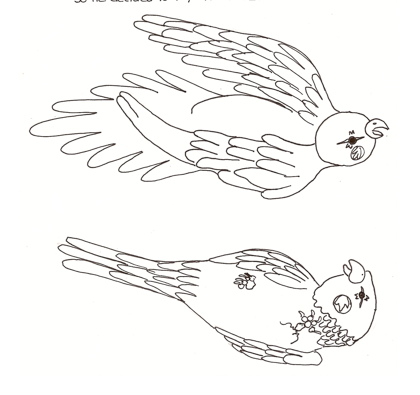
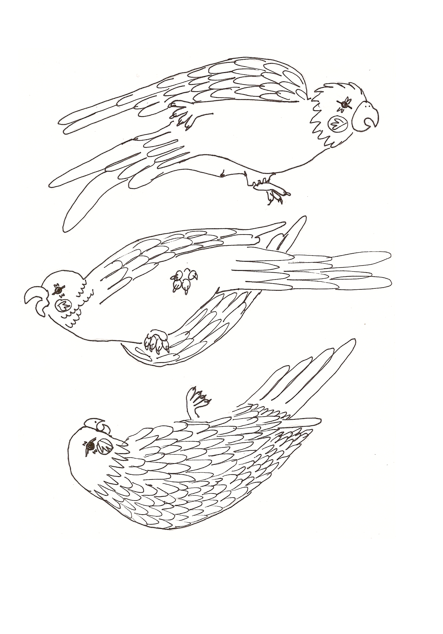
  •             5 parrots poem parrots
  •             Variety of circles and triangles to make bird collage
  •            Pictures of birds from nest to adult
  •             A handful of plastic worms and/or plastic insects. 

Vocabulary

  •             Bills (the beak or mouth of a bird)
  •             Migrate (to go to another place for part of the year)
  •             Feeding tray (a bird feeder)
  •            Broods (the eggs in the nest that will hatch and baby birds will                come out)
  •             Oviparous (animals that hatch from eggs)

Before Reading the Story

Pass out the plastic eggs.  Use them to play a placement game.  Can you put the egg under your chin, on top of your foot, behind your back, next to your shoulder,in front of your nose?  When you are finished, ask the children if they can name an animal that comes from an egg.  Let them name as many as they can.  Tell the children that all animals that hatch from eggs are called oviparous animals.   Hold up the book and show the frontcover.  Can you guess which oviparous our story is about today?  Let the children guess.    Can anyone name the kind of bird that is on the cover (robin red breast)?

Science/Science knowledge; expands knowledge of and abilities to observe, describe, and discuss the natural world, materials, living things, and natural processes.  AND Language Development/Listening  Understanding; shows progress in understanding and following simple and multiple-step directions.

Reading the Story

While  reading, take time on each page to let the children make comments and to name the different kind of birds.

Science/Science knowledge; expands knowledge of and abilities to observe, describe, and discuss the natural world, materials, living things, and natural processes. 

After Reading the Story

Ask the children if they remember any of the names of the birds.  Explain that they are all birds but each has a special name.  Just like you are all children but you each have a special name. Put up a chalk board where all the children can see.  Begin writing a child’s name calling out the letters as you do.  Ask the children whose name is this?  Continue doing until you have written and called out all the children’s names.

Literacy/Alphabet Knowledge; identifies at least 10 letters of the alphabet, especially those in their own name.

Discovery

Remind the children that people can feed birds with bread and seeds.  Give each child a piece of bread and have them spread it with peanut butter.  After  they spread it with peanut butter they can sprinkle bird seed on top.  Put outside in a quiet location where the children can observe to see if the birds come to eat.  When birds do come, be sure to have a book available so you can look up the names. 

Physical Health & Development/Fine Motor Skills; grows in hand-eye coordination in building with blocks, putting together puzzles, reproducing shapes and patterns, stringing beads and using scissors.   AND Approaches to Learning/Engagement & Persistence; grows in abilities to persist in and complete a variety of tasks, activities, projects, and experiences,

At toothbrushing time, go back to the book and look at several bird pictures.  Note the bills/beaks and ask the children if they see any teeth.  Tell the children that birds do not have teeth however we do and we need to take good care of  them so brush well.

Physical Health & Development/Health Status & Practices; shows growing independence in hygiene, nutrition, and personal care when eating, dressing, washing hands, brushing teeth, and toileting.

Music and Movement

Make a copy of the 5 parrots and teach your children the following flannel poem.

5 Pretty Parrots

5 pretty parrots sitting by the door,
1 flew away and then there were 4.
4 pretty parrots sitting in a tree,
1 flew away and then there were 3
3 pretty parrots didn’t know what to do,
1 flew away and then there were 2
2 pretty parrots having lots of fun,
1 flew away and then there was 1.
1 pretty parrot sitting all alone,
So he decided to fly on home.

Put up the 5 parrots on the flannel board and take them away one at a time while you say the poem.

Mathematics/Number & Operations; begins to associate number concepts, vocabulary, quantities, and written numerals in meaningful ways.

Blocks

Make two sets of same kind blocks with a child. The first set arrange in a row.  The second set arrange 5 blocks in a column   Ask the child which set they think has more?  Then have them count the sets. Now encourage the child to make their own set of 5 blocks.  How many ways can they make it? (stacking, 2+3, haphazardly, like dominos on end, etc).  Have the child count the sets to make sure that they all contain 5 blocks each and congratulate him/her for using their brain to make so many sets of 5.

Mathematics/Numbers & Operations; develops increased abilities to combine, separate, and name “how many” concrete objects.  AND Approaches to Learning/Reasoning & Problem Solving; develops increasing ability to find more than one solution to a question, task, or problem.

Art

Make bird collages using several sizes of circles and triangles.  Put out markers to embellish the children’s bird collages.

Approaches to Learning/Reasoning & Problem Solving; develops increasing ability to find more than one solution to a question, task, or problem.

Sand and Water

Add mud, grass, and pieces of yarn or ribbon to the table.  Let the children build birds nests.  You can use bowls to help make the form.  Put these out into the sun until they dry.

Science/Scientific Skills & Knowledge; develops growing abilities to collect, describe, and record information through a variety of means, including discussion, drawings, maps, and charts.

Dramatic Play

Put out several boxes large enough for the children to get into.  Bring in rubber worms and plastic insects.  The children can pretend to be birds and feed their babies.

Creative Arts/Dramatic Play; shows growing creativity and imagination in using materials and in assuming different roles in dramatic play situations.

Math and Manipulatives

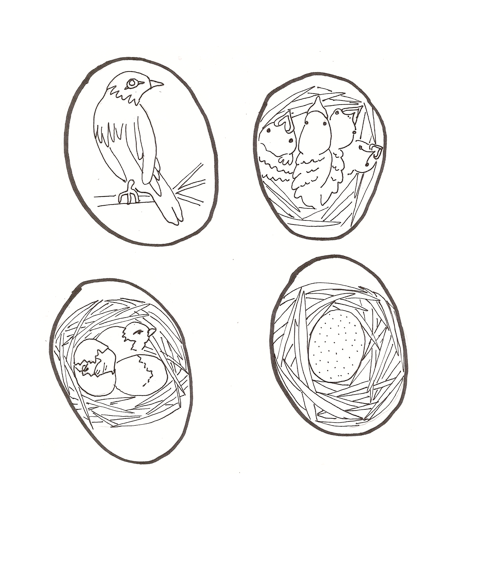
Put the bird cards in order from first to last. Ask the children to talk about the order, what happens first, second. last?  Ask the children questions about bird life cycles and see how much they really know.  Ask them to share any experiences they have watching birds from their home or on the playground.  (My cat ate a bird once, I sawed the bird on the fence by the playground, The Mommy feeds her baby worms, gross!).  Write their answers down and use to begin a ‘What we know, want to know’ chart.

Science/Scientific Knowledge; expands knowledge of and abilities to observe, describe, and discuss the natural world, materials, living things, and natural processes.

Outdoor Play

Look for natural objects the children can use to make a nest and eggs.  Our playground is loaded with pine trees.  The children like to rake the pine needles and use the pinecones for eggs.  Perhaps your playground has grass clippings or leaves that could be raked into a nest.  Or you could bring in a bale of straw and spread it about for the children to make into a nest.  Rocks, small balls, and acorns can all be used for eggs.  Let the children use their imaginations to figure out how to begin this play.

Approaches to Learning/Reasoning & Problem Solving; develops increasing ability to find more than one solution to a question, task, or problem.  AND Creative Arts/Dramatic Play; shows growing creativity and imagination in using materials and in assuming different roles in dramatic play situations.

Transitions

           Tell the children that the word bird begins with the letter B.   Challenge the children to switch out the first letter in their name and replace it with the letter B (Kerry = Berry, Roger = Boger, Tammie = Bammie)

Literacy/Alphabet Knowledge; shows progress in associating the names of letters with their shapes and sounds.

Dear Parent- Today we read about birds and some of their habits.  Take your child for a short walk and see if you can find any birds.  Identify the breed if possible and then let your child share any information they may have about this type of bird or birds in general.  Share any knowledge that you might also and encourage your child to bring this information back to school to share with the class.

Resources
Better Not Get Wet Jesse Bear, by Nancy White Carlstrom

Jesse Bear wants to get wet.  But where can he find the best place to play in the water?  Jesse searches the house for sources of water.

Materials

  • Several sponges, Bucket of water, Piece of chalk
  • Eye droppers,food coloring, white coffee filters
  • Blocks of ice, freeze in Tupperware of various sizes and shapes
  • Beach props; towels, sunscreen, sunglasses, floppy hat

Vocabulary

Before Reading the Story

            Begin a discussion about summer and how to stay cool. Ask the children if they can think of ways that they stay cool and write their responses (I wear shorts, I eat popsicles, I play in the sprinkler).  Talk to the children about how it is unsafe to play in or near water without a parent present.  Introduce the book and explain to the children that Jesse Bear wants to play in the water but he knows he is not supposed to.  Do you think he will follow the rule?  Tell the children that they can help remind Jesse Bear by saying; “You better not get wet Jesse Bear”!  Have them practice several times and then while you read the story they can help remind Jesse Bear

Physical Health & Development/Health Status & Practices; builds awareness and ability to follow basic health and safety rules such as fire safety, traffic and pedestrian safety, and responding appropriately to harmful objects, substances, and activities.

Reading the Story 

Make sure to read the book rhythmically so the children can hear it as a poem.  Cue them when it is their turn to remind Jesse Bear, to better not get wet. 

Literacy/Book Knowledge & Appreciation; shows growing interest and involvement in listening to and discussing  a variety of fiction and non-fiction and poetry. 

When reading the story and a color is named, put the color up on a flannel board for the children to see.  For children who have experience with colors, let the children put the colors up on the flannel board.

Language Development/Listening & Understanding; understands an increasingly complex and varied vocabulary. AND Social & Emotional Development/Cooperation; develops increasing abilities to give and take in interactions; to take turns in games and using materials; and to interact without being overly submissive or directive.

After Reading the Story

Jesse Bear had to follow rules about not getting wet. Talk to the children about school rules. What are some of the school rules? Why do you think we have school rules? What might happen if people did not follow school rules? 

Physical Health & Development/Health Status & Practices; builds awareness and ability to follow basic health and safety rules such as fire safety, traffic and pedestrian safety, and responding appropriately to harmful objects, substances, and activities.  AND Social & Emotional Development/Self-Control; develops growing understanding of how their actions affect others and begins to accept the consequences of their actions.

Discovery

Put out ice blocks in waterproof containers. Put one ice block outside in a sunny spot, one outside in a shady spot, and one inside. Have the children observe the ice. What happens to it as it starts to melt? Which one melts fastest?  What does ice turn into?

Science/Science Knowledge; develops growing awareness of ideas and language related to attributes of time and temperature.

Music and Movement

Act out Swimming as you sing or chant. https://www.youtube.com/watch?v=gWaclnjjEtE

Swimming, swimming in the swimming hole
Days are hot and days are cold in the swimming hole
Breaststroke,sidestroke, fancy diving too
Don’t you wish you had nothing else to do?

Creative Arts/Music; participates with increasing interest and enjoyment in a variety of music activities, including listening, singing, finger plays, games, and performances.

Blocks

Build a swimming pool.  Challenge the children to build a pool in the shape of a circle, a triangle, a square, and a rectangle. 

Mathematics/ Geometry & Spatial Sense; progresses in ability to put together and take apart shapes.

Art

Give the children cups or ice cube trays filled with water and food coloring.  Give each child an eyedropper and show him how to suck the water and then drop it onto a white paper towel or a white coffee filter.  Watch the colors bleed/spread out. 

Physical Health & Development/Fine Motor Skills; develops growing strength, dexterity, and control needed to use tools such as scissors, paper punch, stapler. and hammer. 

Library and Writing

Ask the children to draw a picture of one of the activities that Jesse Bear was doing in the story.  Write their dictation/response to their illustration on the bottom of the picture.  These can later be put into a classbook. 

Literacy/Book Knowledge & Skills;demonstrates progress in abilities to retell and dictate stories from books and experiences; to  act out stories in dramatic play; and to predict what will happen next in a story.  AND Literacy/Early Writing; begins to represent stories and experiences through pictures, dictation, and in play.

Sand and Water

Fill the table with water today and put out objects that float and objects that sink.  As the children experiment with the objects that float or sink, repeat the following poem.

Splish, splash, splish, splash
Put in the pool for me
Something that you think can float/hold water/sink
Before I count to three.
1-2-3

Science/Scientific Skills & Knowledge; develops increased abilities to observe and discuss common properties, differences and comparisons among objects.  AND Science/Scientific Skills and Methods; begins to use senses and a variety of tools and simple measuring devices to gather information, investigate materials, and observe processes and relationships.

Dramatic Play

Bring in beach props; towels, empty suntan lotion bottle, sunglasses, radio. 

Creative Arts/Dramatic PLay; participates in a variety of dramatic play activities that become more extended and complex.  AND Approaches to Learning/Initiative & Curiosity; approaches tasks and activities  with increased flexibility, imagination, and inventiveness.

Math and Manipulatives

Ask the children to recall the animals in the story and to count how many there were. 

Mathematics/Numbers & Operations; demonstrates increasing interest and awareness if numbers and counting as a means for solving problems and determining quantity.  

Outdoor Play

Tell the children that today you are going to play a game called Splat.  Draw a circle, a triangle, a square, and a rectangle on the sidewalk with chalk. Make them fairly large.  Now make a line about 6 feet away.  Show the children how to dip the sponge into a bucket of water and then take it out and throw it onto a shape.  If necessary, move the line back.  You can also call out the shape that you want them to throw the sponge into.  Or you can toss sponges into the water table. 

Physical Health & Development/Gross Motor Skills; demonstrates increasing abilities to coordinate movements in throwing, catching, kicking, bouncing balls, and using the slide and swing.

Transitions

Have the children name a school rule or tell you about a rule from home. (We walk inside, Friends are for helping and not for hurting, I can’t go in the street by my house, I have to eat my vegetables or my Mom gets mad at me). 

Physical Health & Development/Health Status & Practices; builds awareness and ability to follow basic health and safety rules such as fire safety, traffic and pedestrian safety, and responding appropriately to harmful objects, substances, and activities. 

Dear Parent-

A child can drown in as little as 3-inches of water.  Please make sure to take time to talk to your child about water and pool safety.  Let them know that they may never play in  water without an adult present. 

Sounds All Around, by Wendy Pfeffer

There are so many kinds of sounds in our world. This book is a good introduction to the science of sound. It gives simple examples that many preschool children will be able to grasp.

Materials

  • Small boxes and Tupperware’s
  • A variety of rubber bands
  • A piece of rubber hosing (I had an old hose that broke)
  • 2 funnels and duct tape
  • Ear phones

Vocabulary

  • Vibrating (to shake back and forth very fast)
  • Howler Roars (loud howling sound)
  • Echolocation (listening to the sound waves or echo to find a location)
  • Sonar (a way to send sounds through the water)
  • Decibels ( how loud a sound is)

Before reading the story

Go through the five senses with the children.  Point to your eyes and ask what are these?  What are they used for?  Name me something that you see?  Do the ears last.  Tell the children that your story today is about your ears and all the sounds that they can hear.  Introduce the story.

Science/Scientific Knowledge; expands knowledge of and respect for their bodies and the environment.

Reading the Story

As you read, think about the sounds that the book is using.  Do you have a can of pencils that you can have close by to share the sound?  With the children make a quick clap or snap sound with your hands.  Have the children put their hands to their throat to feel the vibration and use your hand to show vibration on the page that talks about the inner ear bones.  On the page where it talks about echolocation, stop and allow the children the opportunity to repeat the word.

Science/Scientific Skills & Methods; begins to use senses and a variety of tools and simple measuring devices to gather information, investigate materials, and observe processes and relationships.

After Reading the Story

Remind the children about what kinds of voices you use throughout the day. Talk about using your whisper voice at rest time, your talking voice during free choice time, and your shouting voice during outdoor play.

Language Development/Speaking & Communicating; progresses in abilities to initiate and respond appropriately in conversation and discussions with peers and adults.

Sounds start in your throat and come out your mouth.  Hum the Alphabet Song with hand on adams apple.  What other sounds can you make using your bodies only? (clapping, clicking tongue, slapping thighs, etc).

Approaches to Learning/Reasoning & Problem Solving; develops  increasing ability to find more than one solution to a question,task, or  problem.  AND Creative Arts/Music; experiments with a variety of  instruments.

Discovery

Give the children the boxes/containers and many rubber bands.  Explain that they are to wrap the rubber bands around the boxes/containers to make a guitar like instrument. Let them experiment making different sounds by using loose fitting rubber bands and tight fitting rubber bands over a variety of paper and plastic containers.

Science/Scientific Skills & Methods/begins to participate in simple investigations to test observations, discuss and draw conclusions, and form generalizations. AND Creative Arts/Music; experiments with a variety of instruments.

Add stethoscope to listen to your heart.

Science/Scientific Skills & Methods; begins to use senses and a variety of tools and simple measuring devices to gather information, investigate materials, and observe processes and relationships.

Music and Movement

Play the YouTube Listen and Move by Greg and Steve .https://www.youtube.com/watch?v=j24_xH5uvdA

Language Development/Listening & Understanding; shows progress in understanding and following simple and multi-step directions.

Get out the musical instruments today and strike up a band.

Creative Arts/Music; experiments with a variety of musical instruments.

Use a tambourine to play Forward & Backward. Explain to the children that when you shake the tambourine, the children are to move forward. When you strike the tambourine the children are to move backwards. Try shaking and striking at different tempos and for varied lengths of time.

Creative Arts/Movement; shows growth in moving to different patterns of beat and rhythm in music. AND Language Development/Listening & Understanding; shows progress in understanding and following simple and multi-step directions.

Blocks

Put out wooden blocks today and help the children notice the sound they make as the children stack them or knock them over. Do different kinds of blocks make different sounds? Does the sound change by how high the blocks are stacked? Make sure to remind the children of any height stacking rule that you have in place.

Science/Scientific Skills & Methods; begins to use senses and a variety of tools and simple measuring devices to gather information, investigate materials, and observe processes and relationships.  AND Physical Health & Development/Fine Motor Skills;  grows in hand-eye coordination in building with blocks, putting together puzzles, reproducing shapes and patterns, stringing beads, and using scissors.

Art

Put music on near the easel today.  Use classical.  See if it effects how the child paints.

Creative Arts/Movement; expresses through movement and dancing what is felt and heard in various musical styles and tempos.

Sand and Water

If the season is right, fill the table with dry leaves today for the children to crunch. If not, find another medium that makes a noise for the children to listen to and experiment with today.

Science/Scientific Skills & Methods; begins to use senses and variety of tools and simple measuring devices to gather information, investigate materials, and observe processes and relationships.

Add water to the table today and have the children listen to the sounds of it as it pours. Try adding tall containers, funnels taped to pieces of plastic tubing, and metal objects.

Science/Scientific Skills & Methods; begins to use senses and variety of tools and simple measuring devices to gather information, investigate materials, and observe processes and relationships.

Library and Writing

Put out any books on tape that you might have. Show the children how to use the headphones and adjust the volume to hear. Or let the children listen to stories on the computer.

Literacy/Book Knowledge & Appreciation; shows growing interest in in reading related activities, such as having a favorite book read; choosing to look at books; drawing pictures based on stories; asking to take books home; going to the library; and engaging in pretend-reading with other children.

Dramatic Play

Make a sound traveler.  Use a piece of rubber hosing 4-8 feet long. (I used a piece of old hose that had developed a leak).  Attach a funnel to each end with the duct tape.  Put one funnel end in the dramatic center and the other into the center beside (mine happened to be blocks).  A child can then whisper talk to a child the next center over. Make sure to remind them that this is a whisper tube so they do not shout in each others ear. (My class liked to pretend that they were calling the firemen, the pizza guy, or talking to their family at work).

Creative Arts/Dramatic Play; shows growing creativity and imagination in using materials and in assuming different roles in dramatic play situations.

Math and Manipulatives

Put alphabet letters into a box or bag.  The child picks one without looking.  Can the child name the letter they have picked?  Make the letter sound with the child.  Can they think of a word that begins with that letter sound?

Literacy/Alphabet Knowledge; identifies at least 10 letters of the alphabet, especially those in their name. AND Literacy/Alphabet Knowledge; increases in ability to notice the beginning letters of familiar words.

Outdoor Play

Go outside with a clipboard and have the children sit quietly and listen for a moment.  What sounds did they hear?  Write their responses down and use it to talk about later at lunch. (Cars, birds, insects, the wind, voices)?

Science/Scientific Skills & Methods; begins to use senses and variety of tools and simple measuring devices to gather information, investigate materials, and observe processes and relationships.  Initiative & Curiosity; grows in eagerness to learn about and discuss a growing range of topics, ideas, and tasks.

Transitions

Ask each child to name either a loud sound or a very quiet sound. (This can be difficult for some children but I have had wonderful answers such as a “cat’s purr” and “that thing that broke up my driveway”).

Approaches to Learning/Reasoning & Problem Solving; develops increasing ability to find more than one solution to a question, tqask, or problem.

Resources

Steve Spangler makes a very cool water whistle that you might like to try with older children.