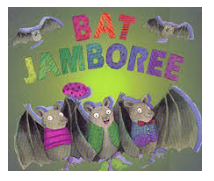
Bat Jamboree, Kathi Appelt

The bats are putting on a show that you won’t forget. Count along with the bats as they present their amazing Jamboree.

Materials

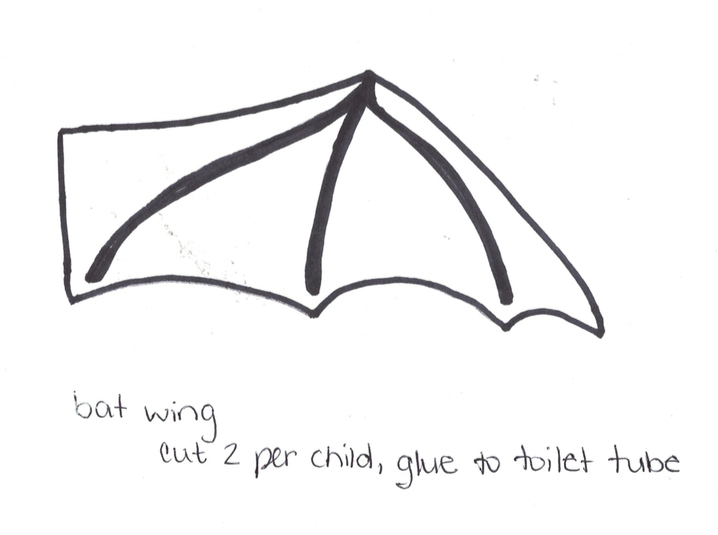
  •  Bat wings for toilet tubes
  •  Index cards
  • A bag of rice or birdseed

Vocabulary

  •  Jamboree ( a celebration with special entertainment)
  • Pyramid (A three dimensional triangle shape)

Before Reading the Story

Talk to the children about what is a Jamboree. What other name could we use instead? (Talent show, RIF celebration, parent night) If you have had any of these ask, “Do you remember when we sang to our parents at the PTO meeting/RIF celebration?”

Social & Emotional Development/Knowledge of Families & Communities; develops growing awareness of jobs and what is required to perform them.  AND Creative Arts/Music; participates with increasing interest and enjoyment  in a variety of music activities, including listening, singing, finger plays, games, and performances.

Reading the Story

As you read have the children count the bats on the pages from 1-10.

Mathematics/Number  Operations; develops increasing ability to count in sequence to 10 and beyond.

After Reading the Story

Ask the children what they might like to do if they were part of the Jamboree show. Teach them the song, Funny Bat. Call each child into the center of your circle and let them do a funny trick while everyone else sings.

Social & Emotional Development/Self-Concept; begins to develop and express awareness of self in terms of specific abilities, characteristics, and preferences.

Discovery

Bring in pictures and books of real bats for the children to examine. Look for how they are alike and how they are different.

Science/Scientific Knowledge; expands knowledge of and abilities to observe, describe, and discuss the natural world, materials, living things, and natural processes.

Music and Movement

Sung to the Farmer in the Dell  Funny Bat https://www.youtube.com/watch?v=ivw83QQk-Dk

As each child comes into the circle to take their turn, encourage them to do a trick. My children like to take a large pillow and do somersaults and log rolls.

There was a funny bat,
His/her name was____________
Watch him/her do a funny trick
At the jamboree.

Creative Arts/Music; participates with increasing interest and enjoyment  in a variety of music activities, including listening, singing, finger plays, games, and performances.

Blocks

Write the numbers 1-10 on index cards. Put them on the floor. Show the children how to stack 1 block on the 1 card, 2 blocks on the 2 card. Put out a blank card and ask them to see and count how many blocks they can stack onto it without the blocks falling. Graph the results. One inch cubes or small blocks works best.

Mathematics/Number & Operations; begins to associate number concepts, vocabulary, quantities, and written numerals in meaningful ways.

Art

Let each child paint a toilet paper black or brown. Cut out wings and let the children glue them on top. When the bats are dry, attach a string and hang them from the ceiling.

Physical Health & Development/Fine Motor Skills; develops growing strength, dexterity, and control needed to use tools such as scissors, paper punch, stapler, and hammer.  AND  Language Development/Listening & Understanding; shows progress in understanding and following simple and multiple-step directions.

Sand and Water

Use rice or birdseed in the table today along with scoopers and several smallish containers .  Challenge the children to count how many scoops of rice/birdseed it takes to fill the various containers.  Ask them to count aloud as they scoop.  Which container holds more, container A or container B?

Mathematics/Number & Operations;demonstrates increasing interest and awareness of numbers and counting as a means of solving problems and determining quantity.

Library and Writing

Write the letters AT onto an index card. Explain to the children that this makes the /at/ sound. Give the children magnet letters and show them how to put one at a time in front of the AT. Can you tell what sound this new letter makes? Can you sound out the word that these letters make? Work closely with the children to help them see how letters make sounds and sounds make words.

Literacy/Alphabet Knowledge; shows progress in associating the names of letters with their shapes and sounds.

Dramatic Play

Put out costume supplies so the children can pretend that they are going to put on a show. Fun hats, bright shirts, sequence outfits, and colorful scarves.

Social & Emotional Development/Self-Concept; begins to develop and express awareness of self in terms of specific abilities, characteristics, and preferences.

Math and Manipulatives

Give the children number lines written on a piece of paper. Encourage the children to copy the numbers onto their own paper using markers or crayons.  They can then glue shapes beside the number making their own number graphs.

Mathematics/Number & Operations; begins to associate number concepts, vocabulary, quantities, and written numerals in meaningful ways.  AND Literacy/Early Writing; experiments with a  growing variety of writing materials and tools, such as crayons, pencils, and computer.

Outdoor Play

Swoop and fly to the playground like bats.

Physical Health & Development/Health Status & Practices; participates actively in games, outdoor play, and other forms of exercise that enhance physical fitness.

Transitions

On a whiteboard or chalkboard write several letters, shapes, and numbers.  Call the children to come one at a time and circle either a letter, a shape, or a number with a chalk or marker.

Literacy/Alphabet Knowledge; shows progress in associating the names of letters with their shapes and sounds. AND Mathematics/Number & Operations; begins to associate number concepts, vocabulary, quantities, and written numerals in meaningful ways.

Resources
Screen Shot 2018-11-07 at 1.15.37 PM

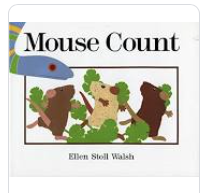
Mouse Count, by Ellen Stoll Walsh

One day some mice were playing in a field when along came a snake looking for his dinner.  Will the mice be eaten or will they be able to get away?  This is a fun book to count through.

Materials

  • 10 mice
  • Dice
  • 10 ping-pong balls or bouncy balls
  • Sand pail
  • Variety of puff balls
  • Tongs, tweezers, pinchers
  • Construction paper to coordinate with the color of the puffballs.
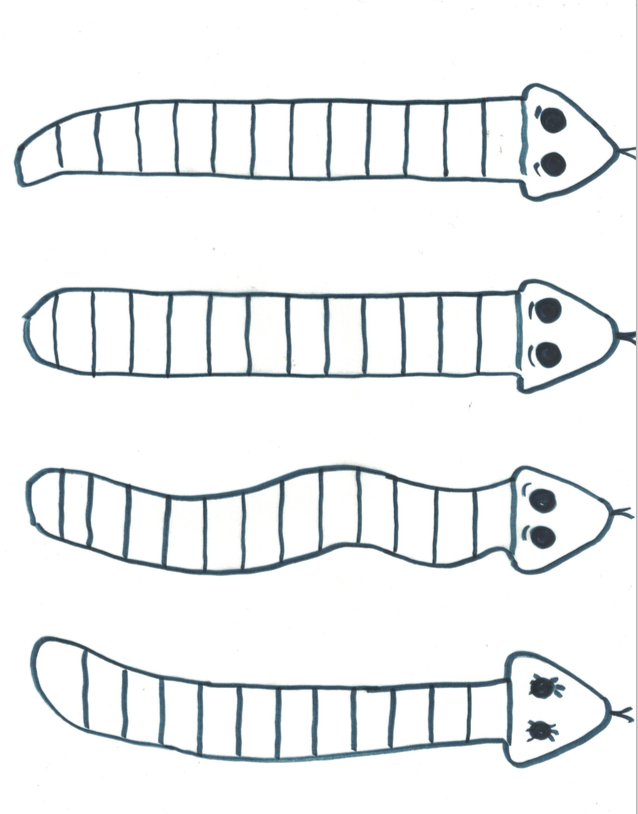
  • Snake page
  • Yardstick. clip board, paper, and pencil

Vocabulary

Before Reading the Story

Count how many children are in class today.  Count how many girls, how many boys.  Which has more? 

Mathematics/Number Operations; begins to use language to compare numbers of objects with terms such as more, less, greater than, fewer, and equal to.

Reading the Story

Print out 10 mice. As you read the story, tape on the wall the number of mice as the snake counts. Have the children help you count.

Mathematics/Number & Operations; develops increasing ability to count in sequence to 10 and beyond.

After Reading the Story

Draw a large jar on a white board or chalk board.  Use the mice to show simple addition and subtraction.  Start with 2 mice in the jar.  The first child states how many.  Then she rolls a dice and adds that many more mice to the jar.  The classroom counts along with; 2,3,….and states the new number.  Another child comes up and rolls the dice.  They subtract that many mice from the jar, counting down as they go; 8,7,6,5….  If it is a negative zero number, just call it zero.  The children take turns rolling the dice.  The first child adds mice to the jar, the next child takes mice away from the jar.  The 4th child adds mice to the jar, the next child takes mice from the jar.  Always have the child begin with the number of mice in the jar (they do not need to count from 0 to ___.  They just start by saying the number in the jar at the beginning of their turn and then count either up or down.

Mathematics/Number & Operations; begins to associate number concepts, vocabulary, quantities, and written numerals in meaningful ways.

Discovery

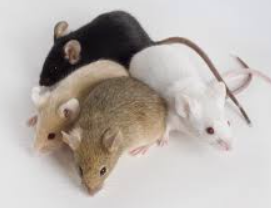
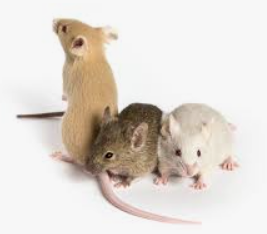
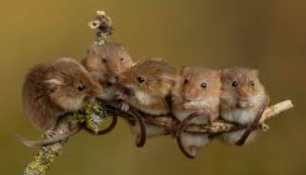
Use the many pictures of mice to make a matching game (make 2 sets of mice) or make one set of mice for comparing and counting.

Science/Scientific Knowledge; expands knowledge of and abilities to observe, describe, and discuss the natural world, materials, living things, and natural processes.

Music and Movement

Sing, How Many Fingers? https://www.youtube.com/watch?v=xNw1SSz18Gg I just count the hands verses and end the song with the last line being, “clap, clap, clap your hands, clap your hands together”.

Count to 10 and back again. Have the children get in a squatting position. Count to 10 and back again. On “Blast off” everyone jump up.

1-2-3-4-5-6-7-8-9-10. 10-9-8-7-6-5-4-3-2-1 blast off!

Blocks

Put the 10 ping-pong balls into the sand pail. Let the children/snakes take turns dumping the pail and then the children collect all the mice and put them back into the pail as quickly as possible. Ask them to count while they drop each mouse into the pail. When the children/snakes are tired or dumping and gathering, suggest they try tossing the ping-pong balls into the pail.

Mathematics/Number & Operations; develops increasing ability to count in sequence to 10 and beyond. AND Approaches to Learning/Engagement & Persistence; grows in abilities to persist in and complete a variety of tasks, activities, projects, and experiences.

Art

Use play dough today to practice rolling out snakes, making mice by rolling balls of play dough, and making a pinch pot to hold the mice.

Literacy/Book Knowledge & Appreciation; demonstrates progress in abilities to retell and dictate stories from books and experiences; to act out stories in dramatic play; and to predict what will come next in a story.

Sand and Water

Add a variety of puffballs , tongs/pincers/tweezers, and color coordinated bowls or paper squares. SHow the children how to use the tongs to pick up the puffball mice and place them in the coordinating bowl. Once they have collected all the mice, ask them to figure out which color has the most and the least puffball mice.

Physical Health & Development/Fine Motor SKills;grows in hand-eye coordination in building with blocks, putting puzzles together, reproducing shapes and patterns, stringing beads, and using scissors.

Library and Writing

Show the children how to use the snakes to make patterns using crayons or markers.

Literacy/Early Writing; experiments with a growing variety of writing tools and materials, such as pencils, crayons, and computers. AND Mathematics/Patterns & Measurement; enhances abilities to recognize, duplicate, and extend simple patterns using a variety of materials.

Dramatic Play

Remind the children that in the story, the snake was looking for mice to eat for his supper.  Ask the children what kinds of foods they like to eat for their supper?  Encourage the children to cook their favorite meal and call you back when it is ready to eat. 

Creative Arts/Dramatic Play; shows growing creativity and imagination in using materials and in assuming diffrent roles in dratic plasy situations. AND

Social & Emotional Development/Cooperation; develops increasing abilities to give and take in interactions; to take turns while playing games or using materials; and to interact without being overly submissive or directive.

Math and Manipulatives

Do the After Reading the Story activity again but with a small group of children instead of the whole group. Give each child some puffballs and a copy of the jar so that they can work individually with the teacher interacting.

Mathematics/Number & Operations; begins to associate number concepts, vocabulary, quantities, and written numerals in meaningful ways.

Outdoor Play

Take a yard stick out on the playground with you and practice doing jumps. Draw a line in the dirt/sand and show the children how to do a running broad jump. Measure how far each child jumps. Now do a standing jump, measure how far the child jumps. Try a backwards jump. Measure each child’s jump and record it on the paper.

Physical Health & Development/Gross Motor Skills; shows increasing levels of proficiency, control, and balance in walking, climbing, running, jumping, hopping, skipping, marching, and galloping. AND Mathematics/Patterns & Measurement; shows progress in using standard and non-standard measures of length and area of objects.

Transitions

Write a number on each mouse so that there is one mouse for each child in your room, starting with 1 and going to…17. Give each child a mouse, but not in order., On your dry erase board or chalkboard, write the #1. The child with the 1 mouse lines up or can go to the next activity. Write #2 ont he board,the child with the #2 mouse lines up or goes to the next activity. Continue until you have written and called a number for every child inthe classroom. Collect the mice and use throughout the day to move from one activity to the next.

Mathematics/Number & Operations; begins to associate number concepts, vocabulary, quantities, and written numerals in meaningful ways.

Resources
snakes for pattern play

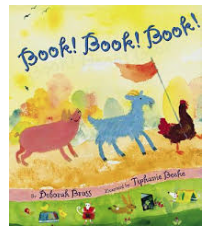
Book! Book! Book!, by Deborah Bruss

 Everybody is happy on the farm until the children go back to school.  Now the animals are bored and are looking for something to do.  Follow their adventure as they try to check a book out of the library.

Materials

Vocabulary

  •                   Bored (tired and annoyed because something is not                                    interesting)
  •                   Librarian (the person who works at the library to take care                      of all the books.)

Before Reading the Story

                  Talk to the children about things they like to do.    Ask them to think of a place where they cannot do things they like to do (at the doctor’s office, at my grandma’s).  How did this make you feel?  (sad, mad, bored).  Explain that today’s story is about some animals that got bored on the farm.  Let’s find out what they do to have fun.

Language Development/Speaking & Communicating; develops increasing abilities to understand  and use language to communicate information, experiences, ideas, feelings, opinions, needs, questions; and for varied other purposes.

Reading the Story

                  When you get to the part where the animal speaks to the librarian, wait a second and give the children the opportunity to make the animal sounds first.

Literacy/Book Appreciation & Knowledge; shows interest and involvement in listening to and discussing  a variety of fiction and non-fictions books and poetry.

After Reading the Story

                  Ask the children to help recall all the animals that were in the story.  There were two animals in the story that did not talk to the librarian, can you think who they were?

Literacy/Book Appreciation & Knowledge; shows interest and involvement in listening to and discussing  a variety of fiction and non-fictions books and poetry.

Discovery

                  Bring in a variety of paper types for the children to explore.  Bring in some rough homemade type paper,tissue paper, tracing paper, graph paper, cardboard, lined, etc.  Let the children use colored pencils and feel the differences and variations of the paper types as they practice writing their names.

Literacy/Early Writing; progresses from using scribbles, shapes, or pictures to represent ideas, to using letter-like symbols, to copying or writing familiar words such as their own name.  AND Physical Health & Development/Fine Motor Skills; progresses in a bilities to use writing , drawing, and art tools, including pencils, markers, chalk, paint brushes, and various types of technology.

Music and Movement

                  Practice doing different kinds of walking with the children.  What does it look like to clip clop in, to plod in, to amble, to flap on in.

Approaches to Learning/Reasoning & Problem Solving; develops increasing ability to find more than one solution to a question, problem, or task.

                  Sing Read Me A Story, to the tune of Found a Peanut. https://www.youtube.com/watch?v=RmxzJVUXR7E

Read me a story, read me a story
Read me a story please oh please.
I’d love to hear one, I’d love to hear one
Read me a story, please oh please.

Creative Arts/Music; participates with increasing interest and enjoyment in a variety of music activities, including listening, singing, finger plays, games, and performances.

Blocks

                  Put out any farm animals you might have today.  Encourage the children to sort them by like kinds and then build a fence around each kind.  Which animal has the most inside the fence?  If you do not have enough farm animals, include any animals that you might have and then have the children sort them by those that would live ona farm and those that would not.

Mathematics/Number & Operations; Geometry  Spatial Sense; shows growth in matching, sorting, putting in a series, and regrouping objects according to one or two attributes such as color, shape, or size.  AND Mathematics/Number  Operations; begins to use language to compare numbers of objects with terms such as more, less, greater than, fewer, equal to.

Art

                  Give the children sheets of paper that are 2-inches by 5-inches.  Let them decorate these and call them book markers.

Creative Arts/Art; develops growing abilities to plan, work independently, and demonstrate care and persistence in a variety of art projects.

Library and Writing

                  Talk to the children about some of the books you have read recently to the class.  Ask the children to draw a picture about one of their favorite books.  When they are finished, write the title of the book underneath.

Literacy/Early Writing; begins to represent stories and experiences through pictures, dictation, and in play.

Sand and Water

                  Add bubbles and soap bars to the water. Explain to the children that we must always have clean hands when we look at books.  Watch them as they show you their hand washing technique.

Physical Health & Development/Health Status & Practices; shows growing independence in hygiene, nutrition, and personal care when eating, dressing, washing hands, brushing teeth, and toileting.

Dramatic Play

                  Ask the children how many of them have ever been to the library.  If there is a library locally, plan a field trip to take your children there.  Tell the children that you are going to let them each borrow a school library book overnight.  Let them pick a book and sign their name to paper with the title of the book they are borrowing.

Literacy/Early Writing; develops understanding that writing is a way of communicating for a variety of purposes.  AND Literacy/Book Knowledge & Appreciation; shows growing interest in reading-related activities, such as asking to have a favorite book read; choosing to look at books; drawing pictures based on stories; asking to take books home; going to the library; and engaging in pretend reading with other children.

Math and Manipulatives

                  Ask the children to help you clean your library center today.  Have them take the books of the shelf and dust.  When they begin to put the books back on the shelf, show them how to put the title facing outwards and so the pages are not bent or stuffed into another book.  Have them go through the books and look for any that might need repair.  For older children, you can have them sort the books by like kind.

Social & Emotional Development/Cooperation; shows increasing abilities to use compromise and discussion in working, playing, and resolving conflicts with peers.  AND Literacy/Book Knowledge & Appreciation; progresses in learning how to handle and care for books; knowing to view one page at a time in sequence from front to back; and understanding that a book has a title, author, and illustrator.  AND Mathematics/ Pattern & Measurement; shows increasing abilities to match, sort, put in a series, and regroup objects according to one or two attributes such as shape or size.

Outdoor Play

                  Bring a basket of books outside and a sheet to sit on.  Spread out and enjoy reading.

Literacy/Book Knowledge & Appreciation; progresses in learning how to handle and care for books; knowing to view one page at a time in sequence from front to back; and understanding that a book has a title, author, and illustrator. 

Transitions

                  Encourage the children to walk in a nice straight line like the animals in the story.

Language Development/Listening  Understanding; shows progress in understanding and following simple and multiple-step directions.