Arthur’s Eyes, by Marc Brown

Arthur was having some problems seeing until his parents took him to the optometrist. After that, Arthur was having a problem with his friends teasing him about his new glasses. How does Arthur solve his problem about having to wear glasses? If you have a child, or children in your classroom that must wear glasses, this book may help them feel better about themselves.

Materials

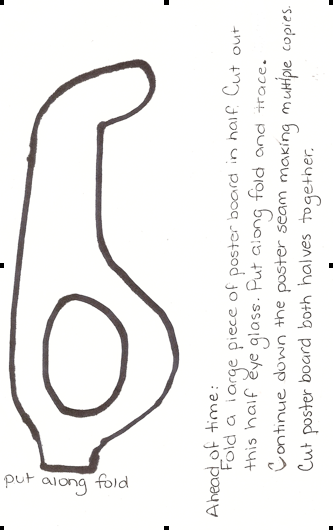
  • Eyeglass shape to use for making glasses

Vocabulary

  • Blind (to not be able to see with your eyes)
  • Optometrist (a doctor who takes care of your eyes)
  • Concentrate (to think about something really hard)

Before Reading the Story

Play a 5 senses game with the children. I’m thinking of something I use to smell the good foods we will eat at lunch. I’m thinking of something I use to hear my favorite song on the radio. I’m thinking of something I use to see who is coming in the door. When you do the riddle about eyes, stop and tell the children that sometimes people’s eyes do not see at all. This is called being blind. Ask the children to cover their eyes with their hands. How many fingers am I holding up? You can’t tell because you cannot see my fingers, this is like being blind. Sometimes people’s eyes are just not strong enough and so they cannot see very well. When this happens they wear glasses. Does anyone know anyone who wears glasses? Tell the children that today’s story is about an aardvark that had to get glasses to help him see better.

Social and Emotional Development/Knowledge of Families & Communities; progresses in understanding similarities and respecting differences among people such as genders, race, special needs, culture, language, and family structures.  AND Language Development/Listening & Understanding; demonstrates increasing ability to attend to and understand conversations, stories, songs, and poems.

Reading the Story

Stop on the page where Arthur is at the optometrists’ office. Spend a moment talking about what an eye examine is like (the optometrist might shine a light in your eyes, or a puff of air). Stop again on the page where Arthur and his friends are waiting for the school bus. How do you think Arthur feels when his friends make fun of his new glasses? What would you do if your friend had to wear new glasses?

Social & Emotional Development/Social Relationships; progresses in responding sympathetically to peers who are in need, upset, hurt, or angry; and in expressing empathy or caring for others.

After Reading the Story

Lead any discussion the children might have about glasses. Then tell the children that sometimes people wear glasses for other reasons also (sunglasses, eye protection/mowing lawn, working with tools, goggles are like glasses to see underwater)

Language Development/Listening & Understanding; understands an increasingly complex and varied vocabulary.  AND Approaches to Learning/Initiative & Curiosity; grows in eagerness to learn about and discuss a growing range of topics, ideas, and tasks.

Discovery

Put out magnifying glasses and interesting objects. Explain that some glasses make things look bigger so they are easier to see. You can also put out color paddles.

Science/ Scientific Skills & Methods; begins to use senses and a variety of tools and simple measuring devices to gather information, investigate materials, and observe processes and relationships.

Music and Movement

Chant, My Eyes Are Little Windows

 My eyes are little windows and through them I can see.
The birds and trees and flowers that are beautiful to me.

(The children can help name things that they feel are beautiful that you can then sing about. Make sure to write their ideas on a piece of paper and hang it up on the wall).

Literacy/Print Awareness & Concepts; develops growing understanding of the different functions of forms of print such as signs, letters, newspapers, lists, messages, and menus.

Blocks

Practice making letters with the blocks E,A,H,L,M,T etc.

Literacy/Early Writing; experiments with a growing variety of writing tools and materials, such as pencils, crayons, and computers.

Art

Put out a vase of flowers or a bowl of fruit. Give the children drawing materials and ask them to see if they can draw what they see.

Creative Arts/ Art; progresses in abilities to create drawings, paintings. models, and other art creations that are more detailed, creative, or realistic.  AND Science/Scientific Skills & Methods; develops growing abilities to collect, describe, and record information through a variety of means, including discussion, drawings, maps, and charts.

Decorate a pair of eyeglasses with stickers and markers.

Sand and Water

Hide alphabet magnet letters in the sand. As the children find them they can match them to a letter chart.

Literacy/Alphabet Knowledge; shows progress in associating the names of letters with their shapes and sounds.

Library and Writing

Have the children make their own eye charts. Start by making an E, and then turn it to face different directions. After they have finished their eye charts they can practice pointing the direction of the E with their fingers while they cover one eye.

Social & Emotional Development/Knowledge of Families & Communities; develops growing awareness of jobs and what is required to perform them.

Dramatic Play

Make an optometrists office. Bring in some old eyeglass or sunglass frames, make an eye chart, and add a small pen flashlight.

Social & Emotional Development/Knowledge of Families & Communities; develops growing awareness of jobs and what is required to perform them. 

Math and Manipulatives

Make a graph of several different colored glasses. Ask the children to decide what color they would want and to mark the graph. Count which color is the most popular, which color has the fewest votes, which has the most girls, boys, etc.

Mathematics/Patterns & Measurement; begins to make comparisons between several objects based on a single attribute.  AND Mathematics/Number & Operations; begins to use language to compare numbers of objects with terms such as more, less, greater than, fewer, equal to.

Outdoor Play

Teach the children to play Four Square. Mark out a large box shape with chalk on the sidewalk, the bigger the better but at least 10×10. Divide this box into quarters. Each person stands in his or her own space/quarter of box. Take a ball and bounce it to a child. It must bounce in their space. The child tries to catch the ball and then bounce it into another’s space. This is a game of bounce and catch. You can also divide your large square in half if there is not a space big enough for four players.

Physical Health & Development/Large Motor Skills; demonstrates increasing abilities to coordinate movements in throwing, catching, kicking, bouncing balls, and using the slide and swing.

Transition

I spy with my little eye, something in the room that is shaped like a circle, square, is the color blue, begins with the letter sound R, etc.  Language Development/Listening & Understanding; demonstrates increasing ability to attend to and understand conversations, stories, songs, and poems.

Dear Parent,

            Today we read a story about an aardvark that needed to get glasses in order to see properly. Play a seeing game with your child. Say, “I spy with my eyes something that is. …(Describe something within your vision and see if your child can guess what it is you’re describing). I spy with my eyes something that is tall and has four legs. We have a cushion on it to sit on. It is made of wood and is beside the table. Can you guess?

Resources
Screen Shot 2018-09-09 at 2.45.38 PM

Abuelo and The Three Bears, by Jerry Tello

This is the classic Three Bears but with a multi-culture twist. Read the original story and then use this to compare.

Materials

  • Tortillas, beans, salsa
  • Popsicle sticks
  • Bear Masks
  • Hot and cold cards

Vocabulary

  • At the end of the story all the Spanish words are translated.
  • Grumpy (grouchy and in a bad mood)
  • Stubborn (very determined and going to do it your way no matter what)
  • Family Reunion (when all the members of an extended family get together for a party)

Before Reading the Story

Ask the children if they ever have large family meals or meals where relatives and friends come to eat. What kinds of things do your parents make for these meals? (My Dad cooks spaghetti and Uncle Mark comes to my house, When Grandma came at Christmas we had turkey and cookies).

Social & Emotional Development/Knowledge of Families & Communities; progresses in understanding similarities and respecting differences among people such as genders, race, special needs, culture, language, and family structures.

Reading the Story

Make sure you stop and help the children understand the Spanish words.

Language Development/Listening & Understanding; understands a n increasingly complex and varies vocabulary.

After Reading the Story

Make a venn diagram and compare this story with the traditional Three bears. What are the similarities, what are the differences?

Literacy/Book Knowledge & Appreciation; shows growing interest and involvement in listening to and discussing a variety of fiction and non-fiction books and poetry.

Discovery

Bring in some tortillas and salsa for the children to try. Make some frijoles to put onto the tortillas. If a child is a picky eater, encourage them to try a new food.

Approaches to Learning/Initiative & Curiosity; chooses to participate in an increasing variety of tasks and projects.

Music and Movement

Sing People in a Family, sung to Frere Jaques. https://www.youtube.com/watch?v=7FXH36epPnY

People in a family, people in a family
Eat together, eat together
People in a family, eat together
All day long, all day long.
People in a family, people in a family
Laugh together, laugh together
People in a family, laugh together
All day long, all day long

(ask the children to help think of other things that families do together.

Social & Emotional Development/Knowledge of Families & Communities; progresses in understanding similarities and respecting differences among people such as genders, race, special needs, culture, language, and family structures.  AND Approaches to Learning/Reasoning & Problem Solving; develops increasing ability to find more than one solution to a question, task, or problem.

Tap out patterns in sets of three and see if the children can copy you. (3 claps or 1 clap, 2 stamps, etc.)

Creative Arts/Movement; shows growth in moving in time to different patterns of beat and rhythm in music.  

Blocks

Challenge the children to make a bed and/or a chair for blocks big enough for a stuffed animal and then themselves.

Approaches to Learning/Engagement & Persistence; demonstrates increasing ability to set goals and develop and follow through on plans.  AND Approaches to Learning/Reasoning and Problem Solving; grows in recognizing and solving problems through active exploration, in trial and error, and interactions and discussions with peers and adults.

Art

Remind the children that Abuelo said Trencitas came back later to glue Ositos chair back together. Put out Popsicle sticks and glue and ask the children if they can build something from wood.

Creative Arts/Art; gains ability in using different art media and materials in a variety of ways for creative expression and representation.

Library and Writing

Have the children dictate a recipe that their parent cooks to you. They can either draw the food or find a picture and cut it out. (My Mom makes me tuna sandwiches. She opens the can and puts it in a bowl. Put in 5 spoons of mayonnaise and some little pickle pieces. She puts a shake of that stinky stuff and mixes it all together. I like to eat it on bread with cheese).   

Social & Emotional Development/Knowledge of Families & Communities; progresses in understanding similarities and respecting differences among people such as genders, race, special needs, culture, language, and family structures.

Sand and Water

Add dampened sand to the table today and some cooking utensils and plates.  The children can pretend to cook various foods.

Creative Arts/Dramatic Play; shows growing creativity and imagination in using materials and in assuming different roles in dramatic play situations.

Dramatic Play

Add three bear masks and encourage the children to act out this or the traditional version of the three bears story. Add three bowls, three chairs and three blankets to represent beds.

Literacy/Book Knowledge & Appreciation; demonstrates progress in abilities to retell and dictate stories from books and experiences; to act out stories in dramatic play; and to predict what will happen next in a story.

Math and Manipulatives

Sort things by those that are hot and those that are cold.

Mathematics/Patterns & Measurement; shows increasing abilities to match, sort, put in a series, and regrouping objects according to one or two attributes such as shape or size.

Outdoor Play

Encourage the children to have a family reunion.  Help them figure what role they will play (aunt, grandparent, cousin, baby, father, etc).

 Social & Emotional Development/Knowledge of Families & Communities; progresses in understanding similarities and respecting differences among people such as genders, race, special needs, culture, language, and family structures. 

Transitions

As the children go off to the next activity, play categories.  Have them name one of their favorite foods, a food they eat for breakfast, a food their parent cooks, or a food they like to eat at a restaurant.

Social & Emotional Development/Self-Concept; begins to develop and express awareness of self in terms of specific abilities, characteristics, or preferences

Resources

Screen Shot 2018-09-09 at 1.37.20 PM

All About Seeds, by Susan Kuchalla

This book uses simple pictures and words to describe how plants grow. It is a good introduction book to spring and planting.

Materials

  • Materials for planting flower or vegetable seeds.
  • Variety of produce and a knife to cut them in half.
  • Plastic lids from cool whip type containers.
  • A variety of larger seeds (beans, split peas, popcorn)
  • A journal for recording a seed sprouting and growth cycle.
  • A good sized piece of contact paper (2-3 feet long)
  • A small bag of birdseed

Vocabulary

  • Planted (to put something into the ground to grow)
  • Produce (fruits and vegetables).

Before Reading the Story

Ask the children if their family has ever planted a garden?  Let the children discuss what they planted, where they planted, and how they planted.  Afterwards, introduce the book.

Social & Emotional Development/Knowledge of Families & Communities;develops growing awareness of jobs and what is required to perform them.

Reading the Story

As you read, point to the corresponding pictures and allow the children time to comment on anything that they see.

Science/Scientific Knowledge; shows increased awareness and beginning understanding of changes in materials and cause-effect relationships.  AND Literacy/Book Knowledge & Appreciation; shows growing interest and involvement in listening to and discussing a variety of fiction and non-fiction books and poetry.

After Reading the Story

Ask the children if you planted an acorn, what kind of a plant would it grow? What if you planted the seeds from an apple, could it make a peach tree? Give each child a bean seed, a damp paper towel and a ziplock baggie. Have the children place their bean seed on the damp paper towel and seal it in the baggie. Tell them that you are going to watch the seeds for the next several days to see what happens. Use the recording log in library/writing to track the seeds development for the next few days.

Approaches to Learning/Reasoning & Problem Solving;grows in recognizing and solving problems through active exploration, including trial and error, and interactions and discussions with peers and adults.

Discovery

Bring in a variety of produce. Cut the produce in half and let the children count the seeds of each. Let the children guess if a produce will have a large or small seed/s inside. Good produce includes an apple, an avocado, a squash plant, a banana, etc. Talk with the children about the seeds that they see. What size, shape and quantity.

Mathematics/Number & operations; begins to associate number concepts, vocabulary, quantities, and written numerals in a meaningful way.

Music and Movement

Dig a Little Hole, act out as recite
Dig a little hole and you put the seed in.
You cover it with dirt and let the sunshine in.
Add a little water and keep it fed,
Pretty soon a little plant will show its head.

Creative Arts/Music; participates with increasing interest and enjoyment in a variety of music activities, including listening, singing, finger plays, games, and performances.

Sing Where Oh Where Are All The Children?  act out as you sing or recite
Where oh where are all the children?                clap to rhythm
Way down yonder in the apple orchard.            point thumb towards back
Picking apples, put them in the basket               climb ladder and pick apples
Picking apples, put them in the basket.              climb ladder and pick apples
Picking apples, put them in the basket,              climb ladder and pick apples
Way down yonder in the apple orchard.           point thumb towards back

How would you act out; cutting lettuce, twisting tomatoes, carrying pumpkins, etc?

Creative Arts/Music; participates with increasing interest and enjoyment in a variety of music activities, including listening, singing, finger plays, games, and performances.  AND Creative Arts/Movement; expresses through movement and dancing what is felt and heard in various musical tempos and styles.

Blocks

Try something different today.  Tape a good size sheet of contact paper to the wall with the sticky side out.  Put out your smaller/lighter blocks and let the children experiment ‘sticking’ them to the wall.  Challenge them to make a flower or a tree using the small/light blocks.

Social & Emotional Development/Self-Concept; demonstrates growing confidence in a range of abilities and expresses pride in accomplishments. AND Mathematics/Geometry & Spatial Sense; progresses in ability to put together and take shapes apart.

Art

Have the children pour glue into the plastic lid. Let them use the “seeds” (beans, split peas, popcorn) to make a mosaic in the glue. When it is dry, punch a hole and hang them with a piece of string.  

Creative Arts/Art; develops growing abilities to plan, work independently, and demonstrate care and persistence in a variety of art projects.

Library and Writing

Help the children make a blank book for them to record how a seed begins to sprout and grow.  The recording will be an on-going project over several days depending upon what type of seed you choose to sprout. The book does not have to be big or fancy, several pieces of paper stapled together will work.

Science/Scientific Skills & Methods; develops growing abilities to collect, describe, and record information through a variety of means, including discussion, drawings, maps, and charts.

Sand and Water

Fill the table with birdseed and allow the children to pour and scoop.  (Note:  from my own experiences, the children seem to want to pour this up high and splash it into the table.  Remind them about your safety rules of seed must stay in the table and not on the floor).

Social & Emotional Development/Self-Control; demonstrates increasing capacity to follow rules and routines and use materials purposefully, safely, and respectfully.

Dramatic Play

As the children play in the kitchen with the food, encourage them to name the foods that have seeds.

Science/Scientific Knowledge; expands knowledge of and abilities to observe, describe, and discuss the natural world, materials, living things, and natural processes.

Math and Manipulatives

Count the number of seeds inside a variety of produce. Draw a picture of each produce and then have the children help count how many seeds were inside. Write the number next to the picture and let a child draw seed representations.

Mathematics/Number & Operations; demonstrates increasing interest and awareness if numbers and counting as a means for solving problems and determining quantity.  AND Mathematics/Number & Operations; begins to use one-to-one correspondence in counting objects and matching groups of objects.

Outdoor Play

Bring you planting supplies outside and let the children plant flower or vegetable seeds.

Science/Scientific Skills & Methods; begins to use senses and a variety of tools and simple measuring devices to gather information, investigate materials, and observe processes and relationships.  AND Social & Emotional Development/Knowledge of Families & Communities;develops growing awareness of jobs and what is required to perform them.

Transitions

Play I’m thinking of…. A fruit that grows in a tree and is round and orange and sweet to eat.  A vegetable that grows on a vine and we had it for lunch yesterday.  A vegetable that grows under ground and it makes french fries.  A fruit that you drink in a juice.  A vegetable that is crunchy when you bite it.  

Language Development/Listening & Understanding; understands an increasing complex and varied vocabulary.  AND Approaches to Learning/Reasoning & Problem Solving; develops increasing abilities to classify, compare, and contrast objects, events, and experiences.

Dear Parent- today we read a book about seeds and how they grow.  Planting a garden with your child can be lots of fun and encourages healthy eating.  You do not have to grow a big garden, try a single tomato plant or a simple row of green beans.