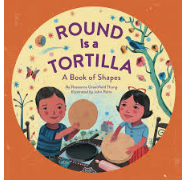
Round is a Tortilla, A book of Shapes, by Roseanne Greenfield Thong

A little girl looks around to discover that shapes are everywhere! She sees different shapes in her home, her food, and all around her town. This is a nice book to reinforce and review shapes in the children’s world.

Materials

  • Bubbles and bubble blowers
  • Pack of tortillas, cheese block, cheese grater (you will also need a cookie sheet and access to an oven)
  • Alphabet letters
  • Plastic containers in various shapes and sizes
  • Medium sized Shapes cut from a manilla file or thin cardboard (circle, square, rectangle, triangle, and oval)
  • A basket with various items that will roll and not roll down a ramp. (car, small ball, pencil, plastic fruit, water bead, plastic container, etc).

Vocabulary

  • There is an index at the back of the book which defines all the Spanish words in the story.

Before reading the Story

Go through the book and see if there are any shapes that the children in the room may not know. Introduce these shapes by drawing the on a whiteboard and talking about their attributes. Have the children draw the shapes in the air. (A circle has no corners, it just goes around and around and around. An oval is like a circle because it has no corners but it goes long and around and long and around).

Mathematics/Geometry & Spatial Sense; begins to recognize, describe, compare, and name common shapes, their parts and attributes.

Reading the Story

As you read the story, use your finger to trace around the objects that are mentioned so the children can see the shape. Encourage them to draw the shape in the air with their finger.

Mathematics/Geometry & Spatial Sense; begins to recognize, describe, compare, and name common shapes, their parts and attributes.

After Reading the Story

Go back through the book doing a picture walk. This time not talking about the shapes but about what is happening on each page. On each page stop and ask the children what is happening. (Look at these two people, can you tell what they are doing? (dancing). Yes, these musical notes coming out of the trumpet shows us they are making music. What are they dancing around? (hats). Can you tell what time of day it is? (It’s night because I see the moon). What is this man holding? What is he standing upon? Why do you think he climbed the ladder holding a camera?).

Literacy/Book Knowledge & Appreciation; demonstrates progress in abilities to retell and dictate stories from books and experiences; to act out stories in dramatic play; and to predict what will happen next in a story.

Discovery

Explain to the children that you are going to make quesadillas today. Give each child a rectangle cube of cheese to grate onto their circle tortilla. Take these to the kitchen and ask the cook to put them into the oven until the cheese melts.

Physical Health & Development/Fine Motor Skills; develops growing strength, dexterity, and control needed to use tools such as scissors, paper punch, stapler, and hammer.

Music and Movement

Put out your musical instruments for the children to play/experiment with today. Can they see any shapes in the instruments? Can they make any interesting music/sounds with the instruments?

Creative Arts/Music; experiments with a variety of instruments. AND Mathematics/Geometry & Spatial Sense; begins to recognize, describe, compare, and name common shapes, their parts and attributes.

Teach the children the fingerplay, Lines.

One straight finger makes a line. Hold up 1 index finger

2 straight lines make a ‘T’ sign. Cross index fingers

3 lines makes a triangle there, Form triangle with index fingers and thumbs

And one more will make it a square. Flip one hand and form a square

Mathematics/Geometry & Spatial Sense; progresses in ability to put together and take apart shapes.

Jack Hartmann has a shape naming game that you could copy and use with your class. https://www.youtube.com/watch?v=QaF84YHNQNg

Mathematics/Geometry & Spatial Sense; begins to recognize, describe, compare, and name common shapes, their parts and attributes.

Put on the Shape Shifting video and have the children dance along with. https://www.youtube.com/watch?v=56PgJHYyEGE

Mathematics/Geometry & Spatial Sense; begins to recognize, describe, compare, and name common shapes, their parts and attributes. AND Creative Arts/Movement; expresses through movement and dancing what is felt and heard in various musical tempos and styles.

Blocks

If your shelves are not already labeled by types of blocks, do so and encourage the children to put them back in their proper space. Can they name any of the blocks by shape as they clean-up or play?

Mathematics/Geometry & Spatial Sense; begins to determine whether two shapes are the same size and shape.

Show the children how to make a ramp using the blocks, or make one before the children enter the center. Ask each child to gather three items from around the classroom that they think will roll down the ramp. Have them predict if the item will roll or not roll down the ramp. Ask them why they think an item rolls or not rolls. (It has a round side so it rolls. It only has flat sides so it cannot roll).

Science/Scientific Skills & Methods; begins to participate in simple investigations to test observations, discuss and draw conclusions, and form generalizations. AND Mathematics/Number & Operations; begins to make use of one-to-one correspondence in counting objects and matching groups of objects.

Art

Cut out many colored shapes ahead of time and let the children collage them onto a piece of paper. For older children you might encourage them to make objects using shapes.

Creative Arts/Art; begins to understand and share opinions about artistic products and experiences.

Library and Writing

Place the medium size shapes that you have cut from the manilla folder onto a paper and show the children how to use a marker to draw around (this is a stencil). After they have drawn the shape, encourage them to cut it out with scissors. Let them color the shapes they cut out if they choose.

Physical Health & Development/Fine Motor Skills; progresses in abilities to use writing, drawing, and art tools, including pencils, markers, chalk, paint brushes, and various forms of technology.

Sand and Water

Bring in 6-10 plastic containers with lids. Try to bring in containers of different shapes. The children can then match bottoms to tops and fill with dampened sand. When it is full, have them take the top back off and show them how to 1-2-3 flip the container over to make a 3D shape from the dampened sand.

Mathematics/Geometry & Spatial Sense; begins to determine whether two shapes are the same size and shape. AND Physical Health & Development/Fine Motor Skills; grows in hand-eye coordination in building with blocks, putting together puzzles, reproducing shapes and patterns, stringing beads, and using scissors.

Hide your alphabet letters in dry sand today. The children can dig for letters. Can they find any letters in their name? Can they name any of the letters?

Literacy/Alphabet Knowledge; knows the letters of the alphabet are a special category of visual graphics that can be named individually. AND Literacy/Alphabet Knowledge; identifies at least 10 letters of the alphabet, especially those in their own name.

Dramatic Play

As the children play in the center today, stop by and ask them if they can find something that is round or square. Don’t forget to ask them about 3D shapes such as cylinders, cubes, cones, and spheres. If they cannot find an item in the center, show them one and explain why it is called the shape it is called. (This soup can is a cylinder because it has circles on the ends and straight lines on the sides).

Mathematics/Geometry & Spatial Sense; begins to recognize, describe, compare, and name common shapes, their parts and attributes.

Math and Manipulatives

Put out a set of dominos for the children to play today.

Mathematics/Number & Operations; begins to make use of one-to-one correspondence in counting objects and matching groups of objects.

Outdoor Play

Give the children bubbles and bubble blowers today. As they blow the bubbles ask them what shape the bubbles are. Show the children that if they stand with their backs to the breeze, they will get more bubbles that float longer.

Science/Scientific SKills & Methods; begins to use senses and a variety of tools and simple measuring devices to gather information, investigate materials, and observe processes and relationships.

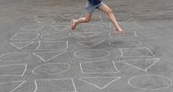
Play Jump Across the River. On the cement draw a variety of shapes large enough for a child to jump on. Make the shapes close enough for children to be able to jump onto several shapes from one spot. Have the children take turns trying to jump from one side of the river to the other by jumping on the shapes that you call out (jump onto the circle, jump onto a square, jump back onto the circle, jump onto a rectangle, etc).

Mathematics/Geometry & Spatial Sense; begins to recognize, describe, compare, and name common shapes, their parts and attributes. AND Language Development/Listening & Understanding; shows progress in understanding and following simple and multiple-step directions.

Transitions

Play, I’m Thinking Of. Think of things around your school or home that are familiar to the children. Use descriptive words to help them figure out what it is. Ask them to wait to answer until you have finished explaining the object. (I’m thinking of something that is on our playground. It has petals that you put your feet on and make the circle wheels go round and round. I’m thinking of something that hangs on our wall. It is round and has numbers and tells us when it is time to go outside or eat our lunch or get up from our nap. I’m thinking of a kind of candy that is shaped oval like a bean. It comes in many colors and many flavors and I like the orange ones best).

Language Development/Listening & Understanding;demonstrates increasing ability to attend to and understand conversations, stories, songs, and poems. AND Social & Emotional Development/Cooperation; develops increasing abilities to give and take in interactions; to take turns in games and using materials; and to interact without being overly submissive or directive.

Resources
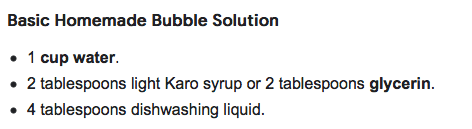
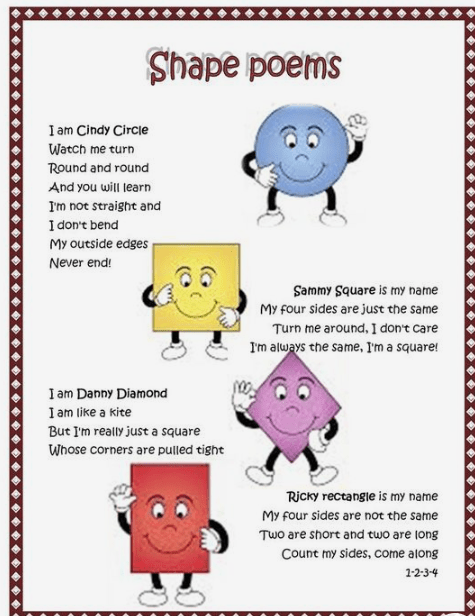
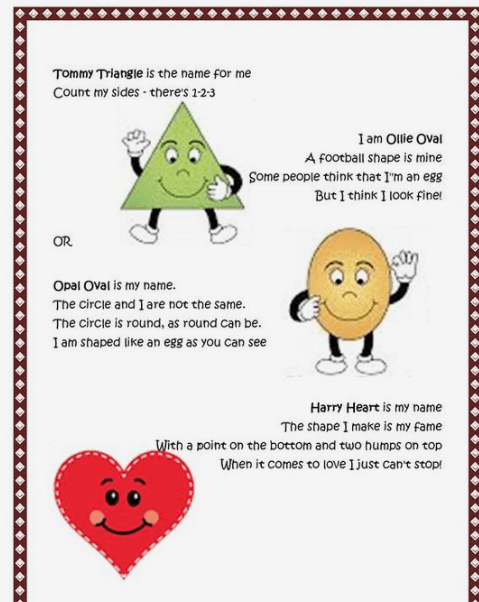
I do not use these poems but they can help you to explain shape attributes to the children

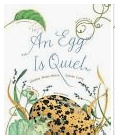
An Egg Is Quiet, by Dianna Aston

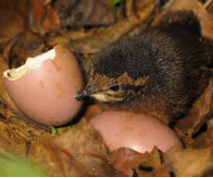
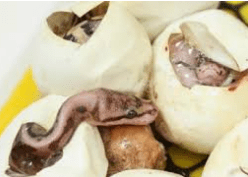
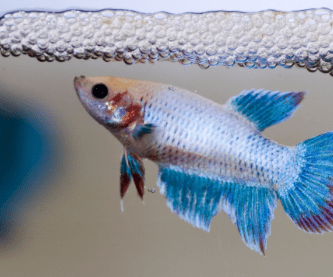
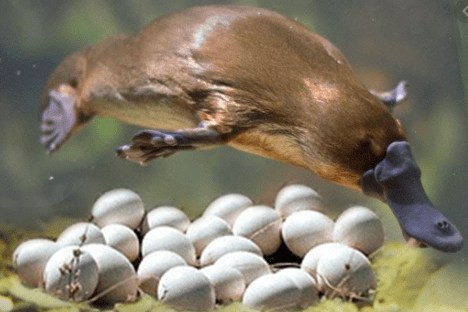
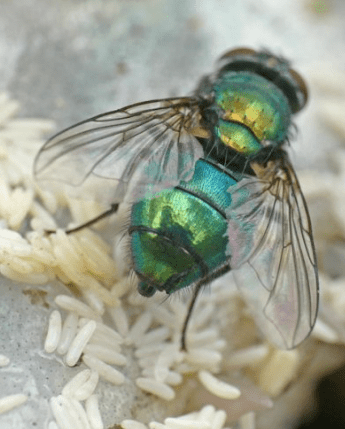
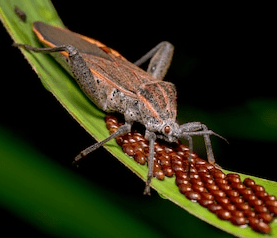
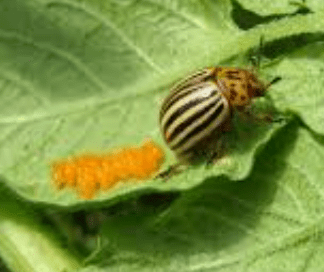
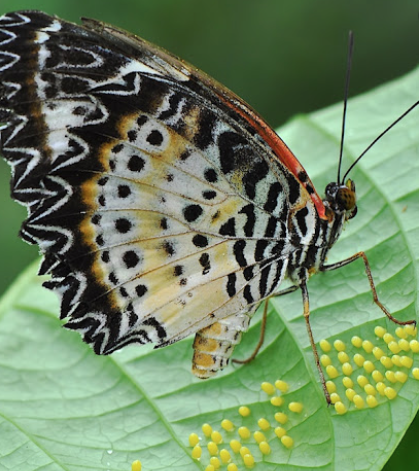
The beautiful pictures in this book introduce children to the variety of eggs and teaches about their colors, shapes, sizes, and textures. Along the way it gives information into many of the eggs that oviparous animals lay.

Materials

  • Two hard boiled egg
  • Plastic eggs
  • 2 small stones, several moistened water beads, 2 bottle tops filled with school glue, 2 bits of paper, 2 bits of sandpaper
  • blanket or box big enough for a child to crouch inside
  • Balance Scale
  • Cleaned egg cartons. Ask parents to save for you, the more the merrier

Vocabulary

  • Shapely (to have a pleasing shape)
  • Incubate (to sit on an egg in order for it to hatch)
  • Tubular (long, round, and hollow like a tube. Show children a toilet paper roll that you will use in art)
  • Clever (to be good at something like camouflaging)
  • Camouflage (to blend into one’s environment)
  • Textured (rough and smooth are textures)
  • Gooey (sticky like school glue or honey)
  • Yolk (The yellow or orange part of the egg, it gives food to the baby inside)
  • Albumen (The white part of the egg, is like a pillow to protect the baby inside)
  • Hatch (to break out of the egg)
  • Oviparous (Animals that hatch from eggs)
  • Fossilized (when something alive dies and becomes hard as a rock, such as a dinosaur egg)
  • Transformation (to change from one shape to another)

Before Reading the Story

Put the hard boiled egg into a small cloth or paper bag and bring to your circle time. Hold the bag up and tell the children that today you are going to read about something that is inside your bag. Hold the bag up so the children can see how small the bag is. Allow them to guess what is inside. When they guess, or you have given them a moment to guess, pull the egg out and show it to them. Ask the children if they can name the shape of the egg and the color. Ask them if they think all eggs look alike? Open the book to the cover page and show them all the different kinds of eggs and explain that these are pictures of the many kinds of eggs that are laid by their mothers. So many kinds of eggs, let’s read and find out. Introduce the book.

Approaches to Learning/Reasoning & Problem Solving; develops increasing abilities to classify, compare and contrast objects, events, and experiences. AND Mathematics/Geometry & Spatial Sense; begins to recognize, describe, compare, and name common shapes, their parts and attributes.

Reading the Story

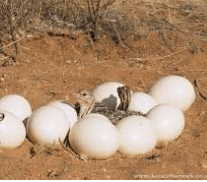
On the page where it states,”An egg is colorful” stop and point to several eggs asking is anyone wearing the color blue like this egg? Is anyone wearing speckles or spots like this egg? Look at this tiny egg, is anyone wearing yellow like this egg? On the page where the author says eggs can be clever, ask the children if they know what this means? Explain that an egg is clever because it knows how to hide in plain sight. When something is hiding in plain sight it is called camouflage. Ask the children if they can see the camouflaged eggs on the page? On the page where eggs come in different sizes, stop and ask a child to come up and hold their hand over the ostrich egg to help children see how big eggs can be.

Language Development/Listening & Understanding; understands an increasingly complex and varied vocabulary.

After Reading the Story

Ask the children to share with you something they learned about eggs from the story. Write their responses down on a piece of paper that you can later hang on the wall. Bring out your hard boiled egg again and tell the children that sadly there is no animal growing inside this egg but that you want to show them the different parts of the egg. Open the book back to the page where it says, An egg is giving. Hold your egg up and ask the children if they know what this outside part is called (shell)? Tell the children that the shell is the animals home. Peel the egg and ask the children if they remember the name of the white of the egg (albumen)? Repeat that this is the pillow that protects the egg. Use a butter knife to cut the egg in half and ask the children if they recall what the yellow part of the egg is called (yolk)? Remind them that this is where the animal inside would get its food. Rename and point to each part of the egg and encourage the children to repeat the name after you.

Language Development/Listening & Understanding; understands an increasingly complex and varied vocabulary. AND Science/Scientific Knowledge; expands knowledge of and abilities to observe, describe, and discuss the natural world, materials, living things, and natural processes.

Discovery

Make copies of the different oviparous animals that lay eggs. Put them inside the plastic eggs. The children can then open the eggs and name the animal inside. Encourage them to say the sentence; This oviparous animal is a ______.

Language Development/Speaking & Communicating; uses an increasingly complex and varied spoken vocabulary.

In the book it says that eggs are textured. Add textures to the center for the children to feel and name. (hard like a stone, soft and rubbery like a moistened water bead, gooey like a bit of school glue in a bottle top, smooth like a piece of paper, and rough like sandpaper.

Language Development/Speaking & Communicating; uses an increasingly complex and varied spoken vocabulary. AND Science/Scientific Skills & Methods; begins to use senses and a variety of tools and simple measuring devices to gather information, investigate materials, and observe processes and relationships.

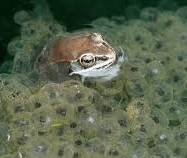
If you are lucky, bring in a real bird nest (eggs not included) for the children to examine. Bring in frog eggs (found in larger puddles or shorelines in the spring).

Science/Scientific Knowledge; expands knowledge of and abilities to observe, describe, and discuss the natural world, materials, living things, and natural processes.

Music and Movement

Teach the children the poem, Peck, Peck, Peck.

Peck, peck, peck

On the warm brown egg.

Out comes a foot,

Out comes a leg.

How does the chick who’s not been about,

Discovery the secret on how to get out?

(Have the children take turns getting inside the box/under the blanket and pretend to hatch).

Language Development/Listening & Understanding; demonstrates increasing ability to attend to and understand conversations, stories, songs, and poems.

Teach the children the song, Everything I Always Say to the chorus of Pop Goes the Weasel. https://www.youtube.com/watch?v=Sazc2J5MO7M

Everything I always say,

You always say the opposite.

When I say up,

You say down.

(include opposites quiet/noisey, rough/smooth, large/small)

Language Development/Speaking & Communicating; progresses in ability to initiate and respond appropriately in conversation and discussion with peers and adults.

Hatching Chickens fingerplay

5 eggs and 5 eggs are underneath the hen. Hold up one hand and then the other

5 eggs and 5 eggs and that makes 10. Hold up all 10 fingers

The hen keeps the eggs warm for 3 long weeks, Hold up 3 fingers

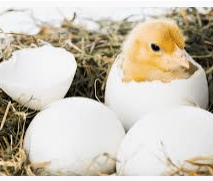
Then snap goes the shells with tiny little beaks. Snap fingers

Crack, crack the shells go, the chicks everyone Clap 4 times

Fluff out their feathers in the warm spring sun. Wiggle fingers

Mathematics/Number & Operations; begins to associate number concepts, vocabulary, quantities, and written numbers in meaningful ways.

While doing opposites, put on Hap Palmer’s song about Slow and Fast and let the children move accordingly. https://www.youtube.com/watch?v=_0bKHPEll_Q

Language Development/Listening & Understanding; shows progress in understanding and following simple and multiple-step directions.

Blocks

Add cleaned and empty egg cartons to the center for the children to add to their building today.

Approaches to Learning/Initiative & Curiosity; approaches tasks and activities with increased flexibility, imagination, and inventiveness.

Art

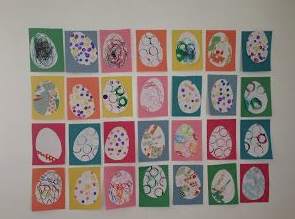
Make large egg shapes to put at the easel today. Give the children toilet paper tubes to dip in the paint and stamp onto the egg.

Creative Arts/Art; develops growing abilities to plan, work independently, and demonstrate care and persistence in a variety of art projects.

Use play dough today to play Transformation. Give each child a bit of playdough and ask them to roll it into a long snake shape. When they have done this, say “Transformation! now change it into a sphere/ball shape”. Transform again into a cube, oval, flattened. Between each shape change say “transformation”!

Language Development/Listening & Understanding; shows progress in understanding and following simple and multiple-step directions. AND Physical Health & Development/Fine Motor Skills; grows in hand-eye coordination in building with blocks, putting together puzzles, copying and reproducing shapes and patterns, stringing beads, and using scissors.

Library and Writing

Use the sequence cards to tell the story of the chicken eggs and the grocery store. https://www.aeb.org/images/PDFs/Educators/gk-hens-and-eggs.pdf

Literacy/Book Knowledge & Appreciation; demonstrates progress in abilities to retell and dictate stories from books and experiences; to act out stories in dramatic play; and to predict what will happen next in a story.

Sand and Water

Add dampened dirt, grass clippings, pieces of straw, yarn, small sticks, etc. to allow the children to sculpt out bird nests.

Creative Arts/Art; gains ability in using different art media and materials in a variety of ways for creative expression and representation.

Dramatic Play

Add clean empty egg cartons, plastic eggs, an egg whip, egg beater, spatula, and small frying pan to the center today.

Social & Emotional Development/Cooperation; shows increasing abilities to use compromise and discussion in working, playing, and resolving conflicts with peers.

Math and Manipulatives

Use the balance scale today to see how many cubes a hard boiled eggs weighs. If you do not have cubes, use another small manipulative. If you do not have a balance scale, you can make one using a hanger. https://www.youtube.com/watch?v=tK8mSIEtTUw

Mathematics/Patterns & measurement; shows progress in using standard and non-standard measures for length and area of objects.

Cut out many egg shapes in yellow, green, blue, and red. Use these for pattern making or for simple addition problems (2 blue eggs + 1 red egg = how many eggs in total?

Mathematics/Patterns & Measurement; enhances abilities to recognize, duplicate, and extend simple patterns using a variety of materials. AND Mathematics/Number & Operations; develops increased ability to combine, separate, and name “how many” concrete objects.

Outdoor Play

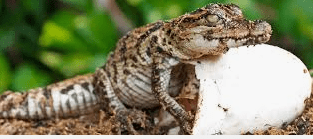
Have the children walk across a balance beam, we use the edges of our sandbox. Tell the children that as they walk alligator or shake eggs are hatching so do not fall! Can the children walk forward foot over foot, backwards, or slide across the balance beam?

Physical Health & Development/Gross Motor Skills; shows increasing levels of proficiency, control, and balance in walking, climbing, running, jumping, hopping, skipping, marching, and galloping.

Transitions

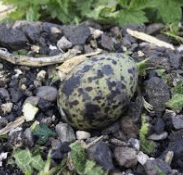
Ahead of time, hide various colored paper eggs around the room so that they blend with the environment a brown egg in blocks, a red egg on a red plate in dramatics). Remind the children that in the book the author talked about some eggs that camouflage into their environment. Show the children the picture of the tern egg hidden among the rocks. Tell the children that there are eggs hiding in the classroom. Let the children look for the eggs. When they find one bring it to you and have them name the color. This is a fun transition from outside to preparing for lunch or from waking from nap to going into centers.

Approaches to Learning/Engagement & Persistence; grows in abilities to persist in and complete a variety of tasks, activites, projects, and experiences.

Resources
Dear Parents, We have just finished reading a book about the many different kinds of eggs there are. Next time you go to the grocery store, take a moment and show your child the difference between small, medium, large, and extra large eggs!

Pictures of oviparous animals and their eggs

camouflaged Tern egg
Easel Art

Umbrella by Taro Yashima

Momo had a birthday and received new red boots and an umbrella. Unfortunately the days ae sunny and she can not use them! Momo learns to wait and anticipate the time when she can finally bring out her new boots and umbrella.

Materials

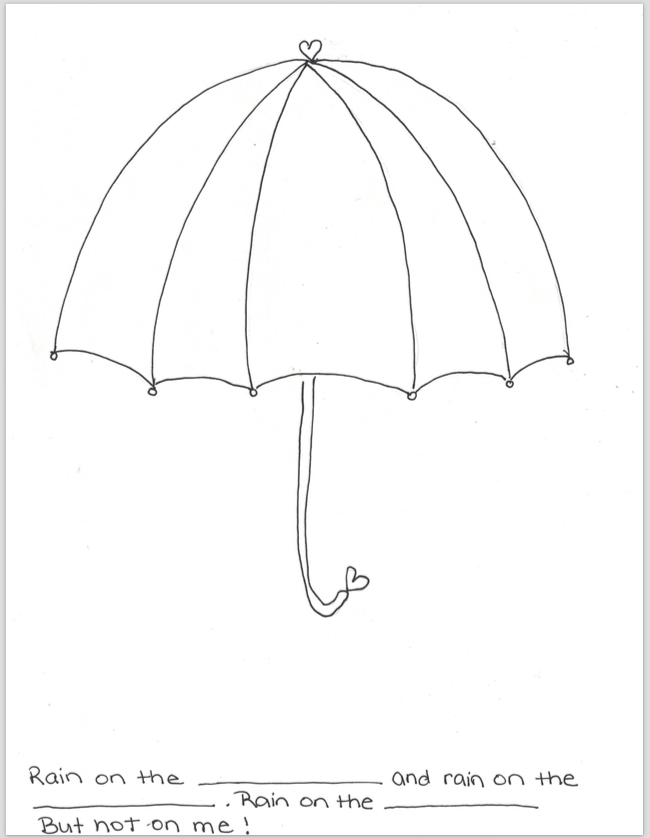
  • Copy of Rain on the Treetop poem for children to fill in.
  • Pictures of umbrellas
  • One umbrella and several bean bags
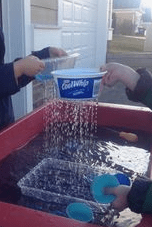
  • Several plastic containers with holes punched in the bottoms or small watering cans.
  • 1 Silhouette picture per child and dice
  • Flat sheet and clothes pins

Vocabulary

  • Japan (if you have a map or globe, show them where Japan is and also New York. How far is it from where your school is located, show them on the map).
  • Indian summer (In the fall time when the weather becomes unseasonably warm and sunny)

Before Reading the Story

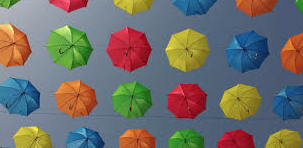
Hold up a picture of many umbrellas and ask the children if they know what these are? Then hold up a picture of one umbrella or bring in a real umbrella. Show the children or pantomime the motion of opening up the umbrella and placing it over your head. Encourage the children to do the same. Ask them again what this is called? When do you use an umbrella? What does the umbrella do? Do you use umbrellas in the house or outside? Why should you not open an umbrella inside the house?

Language Development/Speaking & Communicating; develops increasing abilities to understand and use language to communicate information, experiences, ideas, feelings, opinions, needs, questions; and for other varied purposes.

Reading the Story

On page 12 where Momo’s mother tells her to get up because of the rain coming, ask the children if they know what this means? (Momo can use her umbrella today!).

Literacy/Book Knowledge & Appreciation; demonstrates progress in abilities to retell and dictate stories from books and experiences; to act out stories in dramatic play; and to predict what will happen next in a story.

On page 16 where her doodle disappeared on the sidewalk, ask the children if they know what happened to it?

Science/Scientific Knowledge; shows increased awareness and beginning understanding of changes in materials and cause-effect relationships.

After Reading the Story

Ask the children if they hold their parents hand when they walk? How do you think Momo felt now that she was walking without holding on? (Like a grown-up, happy, like a big kid).

Language Development/Speaking & Communicating; develops increasing abilities to understand and use language to communicate information, experiences, ideas, feelings, opinions, needs, questions; and for other varied purposes.

Explain to the children that in the story Momo had to learn to wait, to have patience. Like when we are playing a class game and you have to wait your turn and it is hard because you are excited but you have to have patience. Ask the children if they can think of times when they had to have patience and wait? (When it was my birthday I had to wait for my birthday cake until after we ate dinner. My Grandma is coming and I am so excited. When my dog was gonna have puppies I had to wait and wait and have patience to see them. I want to play with the blue truck but Jimmy has it).

Language Development/Speaking & Communicating; develops increasing abilities to understand and use language to communicate information, experiences, ideas, feelings, opinions, needs, questions; and for other varied purposes.

Discovery

Give the children colored chalk or magic markers to draw/write their name onto a piece of paper. After they have finished their drawing, let them use a spray bottle filled with water to spray over their drawing/writing. Ask them to predict what they think will happen when the water touches the paper. Were they correct?

Science/Scientific Skills & Methods; begins to participate in simple investigations to test observations, discuss and draw conclusions, and form generalizations.

Music and Movement

Sing The Itsy Bitsy Spider. https://www.youtube.com/watch?v=kExtyaxao0U Make hand movements to go along with. Try changing itsy bitsy to great big, huge humongous, teeny tiny.

Physical Health & Development/Fine Motor Skills; grows in eye-hand coordination in building with blocks, putting together puzzles, reproducing shapes and patterns, stringing beads, and using scissors.

Bring out your instruments and encourage the children to shake, rattle, or roll them as you repeat the sound of raindrops that Momo heard on her umbrella.

Bon polo

bon polo

ponpolo ponpolo

bolo bolo ponpolo

bolo bolo ponpolo

boto boto ponpolo

boto boto ponbolo.

Creative Arts/Music; experiments with a variety of musical instruments.

Play Umbrella by Laurie Berkner and dance along. https://www.youtube.com/watch?v=dKtnSmDADuA

Creative Arts/Movement; expresses through movement and dancing what is felt and heard in various musical tempos and styles.

Teach the children the song and movements to Come Under My Umbrella. https://www.youtube.com/watch?v=r2Q8QziZMVg

Creative Arts/Music; participates with increasing interest and enjoyment in a variety of musical activities, including listening, singing, finger plays, games, and performances.

Blocks

Add people today. Encourage the children to build houses with roofs to get the people out of the rain.

Approaches to Learning/Reasoning & Problem Solving; grows in recognizing and solving problems through active exploration, including trial and error, and interactions and discussions with peers and adults.

Art

123 Homeschool4me.com has a cute and quick umbrella art craft using bubble wrap. https://www.123homeschool4me.com/bubble-wrap-rain-craft_71

Approaches to Learning/Engagement & Persistence; grows in abilities to persist in and complete a variety of tasks, activities, projects, and experiences.

Library and Writing

Teach the children the poem, Rain on the Treetops. After you have shared it with them, ask them to name things that the rain falls down on. Write their responses on the Umbrella picture in resources and encourage the children to decorate the umbrella and add raindrops.

Rain on the rooftops and rain on the trees.

Rain on the sidewalk but not on me!

Literacy/Early Writing; begins to represent stories and experiences through pictures, dictation, and in play. AND Approaches to Learning/Reasoning & Problem Solving; develops increasing ability to find more that one solution to a question, task, or problem.

Sand and Water

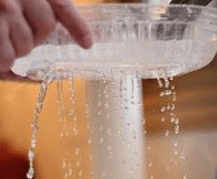
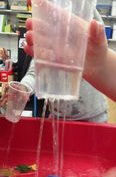
Bring in containers in which you have punched holes or watering cans so the children can make and hear rain. Make containers with different amount of holes and hole sizes. See resources.

Science/Scientific Skills & Methods; begins to use senses and a variety of tools and simple measuring devices to gather information, investigate materials, and observe processes and relationships.

Dramatic Play

Give the children the flat sheet and the clothes pins. Challenge them to build a fort that will keep them dry when the rain comes. If you have rubber jackets and boots, add these to your center today. Add a musical thunderstorm. https://www.youtube.com/watch?v=iIILT0eIWeA

Creative Arts/Dramatic Play; shows growing creativity and imagination in using materials and in assuming different roles in dramatic play situations.

Math and Manipulatives

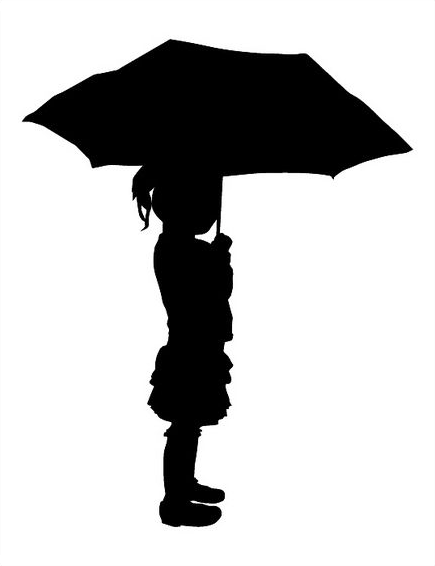
Give each child a silhouette picture of child with umbrella and a blue magic marker. The child rolls the dice and adds that many raindrops onto their picture. Play with several children at a time and have them take turns rolling the dice. Play until each child has had 5 turns rolling the dice.

Social & Emotional Development/Cooperation; develops increasing abilities to give and take in interactions; to take turns in games and using materials; and to interact without being overly submissive or directive. AND Mathematics/Number & Operations; begins to associate number concepts, vocabulary, quantities, and written numerals in meaningful ways. Begins to use one-to-one correspondence in counting objects and matching groups of objects.

Outdoor Play

Lay several hula hoops on the ground and tell the children that they are pretend puddles. Have the children practice jumping from one puddle to another. This could also be done on cement by using chalk to make puddles.

Physical Health & Development/Gross Motor Skills; shows increasing levels of proficiency, control, and balance in walking, climbing, running, jumping, hopping, skipping, marching, and galloping.

Open the umbrella and lay it upside down on the ground (like a basket). Make a mark on the ground that is the throwing line. Let the children take turns throwing three bean bags into the upside down umbrella. After each child’s turn, have them count how many bean bags are in the umbrella and how many bean bags are on the ground.

Physical Health & Development/Gross Motor Skills; demonstrates increasing abilities to coordinate movements in throwing, catching, kicking, bouncing balls, and using the slide and swing. AND Mathematics/Number & Operations; begins to use language to compare the number of objects with terms such as more, less, greater than, fewer, equal to.

Transitions

On a dry erase board or a large piece of paper draw 3 letters, 3 numbers, and 3 shapes. Dismiss the children one at a time by asking them to circle a letter, a number, or a shape. When 5-7 children have had a turn, make a new board. The idea is to see if the children are able to recognize what is a letter, a shape, and a number.

Literacy/Alphabet Knowledge; knows that the letters of the alphabet are a special category of visual graphics and can be individually named. AND Mathematics/Geometry & Spatial Sense; begins to recognize, describe, compare, and name common shapes, their parts and attributes.

Resources
Pictures for umbrella talk
Copy a silhouette onto a piece of computer paper, one per child