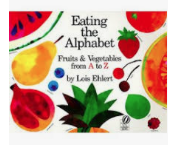
Eating the Alphabet, by Lois Ehlert

Teaching the alphabet is fun with this book that names fruits and vegetables from A-Z

Materials

  • Large sheet of paper with a simple watermelon slice shape drawn on it. Do not add seeds.
  • Dice
  • Colored tissue paper torn into about 1 inch squares, circles, organic shapes
  • A goodly amount of white school glue
  • 3 stalks of celery with the leaves
  • 3 cups about the size of a coffee cup
  • food coloring
  • If you have a class allowance, purchase several unusual fruits or vegetables.

Vocabulary

There are many fruits and vegetables in this book that may be unfamiliar to you or the children. There is a glossary at the end of the book to help you with fruits and vegetables that may be unfamiliar.

Introducing the Story

Start a conversation that talks about how not everybody likes or eats the same foods. Ask the children if they have ever tasted one of several fruits or vegetables, choose ones that are not as common that you may have tried. (For example; currants, eggplant, kiwifruit, swiss chard, and star fruit). Explain to the children that the world is full of different kinds of fruits and vegetables and people eat different foods throughout the world. Tell the children that this is an alphabet book that names many kinds of fruits and vegetables.

Social & Emotional development/Knowledge of Families & Communities; progresses in understanding similarities and respecting differences among people such as genders, race, special needs, culture, language, and family structures.

Reading the Story

Begin each letter by putting your finger under the letter and saying capital (A)____, small (a)_____, what fruits and vegetables begin with (A)____? Then ask the children if they can name any of the fruits/vegetables that begin with the letter. Take time to allow the children to talk about the different fruits/vegetables that they see on the page. (My Mom makes guacamole with avocado, I ate apricots from a can, I don’t like those long things).

Literacy/Alphabet Knowledge; knows the letters of the alphabet are a special category of visual graphics that can be individually named.

After Reading the Story

Using a chalkboard, whiteboard, or large sheet of paper attached to the wall; write a letter of a child in the room. Say I am thinking of child whose name starts with this letter. See if the children can recognize the letter and whose name starts with it. Then ask if anyone can think of another word that starts with that letter. Continue until you have done all the children in the rooms’ first name letter.

Literacy/Alphabet Knowledge; increases in ability to notice the beginning letters of familiar words. AND Literacy/Phonological Awareness; associates sounds with written words, such as awareness that different words begin with the same sound.

Music and Movement

Sing the Alphabet Song with the children. Sing it starting off in a very soft whisper voice and as you sing through the letters begin to raise your volume level until you are singing LOUDLY, not shouting. Then begin loudly and sing softer and softer until you are a whisper by the end of the song.

Language Development/Listening & Understanding; shows progress in understanding and following simple and multi-step directions.

Sing, There Is A Child At Our School to the tune of BINGO

There is a child at our school,
Can you guess his name-o
____ ____ _____ _____ _____,
____ ____ _____ _____ _____,
____ ____ ____ ______ _____,
Child’s name-o

I do this on a dry erase board so the children can see the letters as we sing them. Note: many children’s names have more/less than 5 letters so just make up the tune to fit the child’s letters of their name.

Literacy/Print Awareness & Concepts; recognizes a word as a unit of print, or awareness that letters are grouped to form words, and that words are separated by spaces.

Sing, Where Oh Where Are All The Children? to Way Down Yonder in the Paw Paw Patch. https://www.youtube.com/watch?v=xrSij2yg9Uc

Where oh where are all the children? Clap hands

Where oh where are all the children? Clap hands

Where oh where are all the children? Clap hands

Way down yonder in the apple orchard. Use thumb to point behind

Picking apples, put them in the basket Act out

Picking apples, put them in the basket. Act out

Picking apples, put them in the basket, Act out

Way down yonder in the apple orchard.

Name and act out picking different fruits and vegetables. (Cutting lettuce, lifting pumpkins, picking berries).

Science/Scientific Knowledge; expands knowledge of and abilities to observe, describe, and discuss the natural world, materials, living things, and natural processes.

Discovery

Take 3 celery stalks and place each in a cup of water colored with food coloring. Make sure the water is dark, 10 drops or more per cup. Put these into the discovery center. As the day goes on, check back to see what is happening to the celery. The water soaks up inside the celery and will turn the leaves different colors. Encourage the children to talk about what they are seeing take place and challenge them to draw on paper what is occurring to the celery.

Science/Scientific Skills & Methods; begins to participate in simple investigations to test observations, discuss and draw conclusions, and form generalizations. Develops a growing ability to collect, describe, and record information through a variety of means, including discussion, drawings, maps, and charts.

 Blocks

Give the children empty toy bins or shoe boxes and tell them to pretend that they are taking foods to the store. How many blocks can they get in their “truck”? Can they get more blocks in if they dump them in to the truck or stack them in to the truck?

Mathematics/Number & Operations; begins to use language to compare numbers of objects in terms such as more, less, greater than, fewer, equal to.

Art

On pieces of white paper (white construction paper works well) draw a simple fruit or vegetable with a black crayon or permanent marker. If you are an artist, ask the children what fruit/vegetable they would like to collage. If you are not a good artist, draw apples, potatoes, and bananas. Put the torn tissue paper pieces out on the table along with bowls of school glue. Give each child a paint brush and show them how to paint on the fruit/vegetable shape and then lay a piece of tissue paper on top. Continue filling in the shape. As the tissue paper overlaps it will make new colors and shades of color. Lay flat to dry. Or; draw the fruits and vegetables and then let the children color with oil pastels. After they have finished coloring, use watercolor paint to make a wash over the fruit/vegetable. The paint will not stick to the oil pastel. This can have a very lovely effect.

Creative Arts/Art; gains ability in using different art media and materials in a variety of ways for creative expression and representation.

Sand and Water

Put magnetic letters in the table today with enough sand to bury them. The children can use a spoon or magnet to search for the letters. As the children pull the letters from the sand, ask them if they can name the letter and/or make the letter sound.

Literacy/Alphabet Knowledge; shows progress in associating the names of letters with their shapes and sounds.

Library and Writing

Take a piece of paper and divide it in half. On one side write FRUIT and on the other write VEGETABLE. Explain to the children that it is important to eat fruits and vegetables every day to help keep our bodies healthy. At each meal for the next several days, ask the children if they can name any fruit or vegetable that is on their plate. Write them in the correct column. After a week, count how many fruits and vegetables your class has had served in the last week.

Mathematics/Number & Operations; demonstrates increasing interest and awareness of numbers and counting as a means for solving problems and determining quantity.

Dramatic Play

Encourage the children to pretend to make fruit or vegetable soup and sort out all the fruits and vegetables in your dramatic play area. Can they name each item? Ask them if they have ever eaten the item and then encourage them to talk about in what form. (I eat applesauce at my house, My Mommy mashes bananas for my baby brother to eat, I like orange juice).

Science/Scientific Knowledge; shows increased awareness and beginning understanding of changes in materials and cause-effect relationships. AND Approaches to Learning/Reasoning & Problem Solving; develops increasing abilities to classify, compare, and contrast objects, events, and experiences.

Math and Manipulatives

Hang the watermelon slice picture on the wall. Let the children take turns rolling a dice and then drawing that number of seeds onto the watermelon slice picture. This works best as a small group activity/game. Play until everyone has had several turns to roll the dice and add seeds to the watermelon shape.

Mathematics/number & Operations; begins to associate number concepts, vocabulary, quantities, and written numerals in meaningful ways.

Outdoor Play

Bring your plastic fruits and vegetables from the dramatic center outdoors today. Bury them in the sandbox for the children to dig up and name.

Social & Emotional Development/Cooperation; develops increasing abilities to give and take in interactions; to take turns in games or using materials; and to interact without being overly submissive or directive.

Transitions

On a large sheet of paper make 4-6 columns. At the bottom of each column, draw a fruit (apple, banana, orange, strawberry, watermelon). Ask the children to name which one they like best and write their name in the correct column. Later during another transition or waiting time you can talk about which fruit was liked the most, least, count how many children liked the banana best, etc.).

Social & Emotional Development/Self-Concept; begins to develop and express awareness of self in specific abilities, characteristics, and preferences. AND Mathematics/number & Operations; begins to associate number concepts, vocabulary, quantities, and written numerals in meaningful ways.

Dear Parent- Today we read Eating the Alphabet, a book about fruits and vegetables. Ask your child to name some fruits and then some vegetables for you. If your child is interested in writing, write his/her name at the top of a piece of paper and encourage him/her to copy it below. Congratulate them and name the letters in their name and those they have copied.

Lively Elizabeth, What Happens When You Push, by Mara Bergman

Elizabeth is considered ‘lively’.  What happens when one becomes too lively at school?  Find out what happens when one forgets about their personal space and lands upon another’s.

Materials

  • One toilet paper tube per child, cut in half
  • One rubber band per child, big enough to fit around two toilet paper tube halves.

Vocabulary

  • Scowl (frown and make an annoyed or angry face at someone)
  • Blame (to say something is someone’s fault)
  • Glare (to stare at someone)
  • Lively (very active and bouncy)
  • Goggles (a kind of glasses that protects your eyes from wind)

 Introducing the Story

Explain that today our story is about a girl named Lively Elizabeth. Open the book up so the children can see both the front and back cover. Ask them if they can guess what Lively means. Let the children give you their ideas and then explain that lively means being very active and bouncy. Imitate a lively child at the rug time. Ask the children if they like sitting next to a lively child, why/why not? Tell them it’s hard to pay attention when someone is being bouncy and active next to you. Ask them what they think will happen if Elizabeth is very active and bouncy inside? (She could get hurt. She could hurt someone. The teacher may get mad. She could knock something over). Tell the children, let’s find out and introduce the book.

Literacy/Book Knowledge & Appreciation; shows a growing interest and involvement in listening to and discussing a variety of fiction and non-fiction, and poetry.

Reading the Story

Shake your head and look upset as you read the first pages about how Elizabeth behaved. Watch the children’s faces to see if they react to this kind of behavior. (I see Roger shaking his head no; I do not think he likes how Elizabeth is behaving. Alison, you look mad, you don’t like when your friends act this way?) When you get to the part where Elizabeth pushes Joe Fitzhugh; ask the children what they think might happen. After the children have been allowed to share their ideas, continue reading. When you get to the part where Joe yells, “What have you done? You pushed me and hurt everyone!” stop again but this time ask the children how they think Joe is feeling.

Social & Emotional Development/Self Control; develops growing understanding of how actions affect others and begins to accept the consequences for their actions.

After Reading the Story

Tell the children that you want to spend a minute talking about your classroom rules. If you do not have any, make 3-5 rules with the help of the children.   After the children have finished discussing the rules, remind them that you have rules to help keep everybody safe and happy.

Social & Emotional Development/Self Control; demonstrates increasing capacity to follow rules and routines and use materials purposefully, safely, and respectfully.

Music and Movement

Put on music with different music styles and tempos and have a dance party.

Creative Arts/Movement; expresses movement through and dancing what is felt and heard in various musical tempos and styles

Discovery

Put out the toilet paper tube halves and some rubber bands. Show the children how to put two halves inside the rubber band to make goggles (these will look more like binoculars but the children will not mind). Put out markers if they would like to decorate them. Encourage the children to look through their goggles around the room or out the window and tell you something that they see. For older children you can put out a variety of rubber band sizes for the children to experiment with which works best. For younger children, or children who put things in their mouths, use masking tape to tape the two halves together.

Science/Scientific Skills & Methods; begins to use senses and a variety of tools and simple measuring devices to gather information, investigate materials, and observe processes and relationships.

Blocks

Encourage the children to build tall towers to knock down. If you have hard blocks, set a height rule for building (IE-no higher that your belly button).

Physical Health & Development/Fine Motor Skills; grows in eye-hand coordination in building with blocks, putting together puzzles, reproducing shapes and patterns, stringing beads and using scissors.

Art

Finger paint today; use either large sheets of paper or let the children finger paint right onto the table. Table painting is messy but fun. Put on music and let the children walk around the table pushing the finger paint along. Encourage them to reach to the center of the table and make a big circle. Can they write their name in finger paint? Make sure to put smocks on and give yourself 10 minutes to clean up at the end of the play. The children can help with the cleanup after you get the majority of the paint off the table.

Literacy/Early Writing; progresses from using scribbles, shapes, or pictures to represent ideas to using letter-like symbols, to copying or writing familiar words such as their name.

Sand and Water

Water with soap to make bubbles. Use whiskers or hand beaters to whip up a soapy froth.

Science/Scientific Methods; begins to use senses and a variety of simple tools and simple measuring devices to gather information, investigate materials, and observe processes and relationships.

Library and Writing

Give the children pieces of paper and ask them if they can think of any new rule that they would like to write. Have them illustrate the rule. Or, have the children illustrate one of your classroom rules.

Literacy/Early Writing; begins to represent stories and experiences through pictures, dictation, and in play.

Dramatic Play

Encourage children who do not normally play in this center to spend some time here today. Watch to see how they interact and who is the leader of the group.

Social & Emotional Development/Cooperation; shows increasing abilities to use compromise and discussion in working, playing, and resolving conflicts with peers.

 Math and Manipulatives

Bring out the dominos today. Not to match the number of dots but to stand end to end to make a row. When the row is standing, have the child gently knock the first domino into the second and watch the chain reaction as the dominos fall. Just like the children in the story! ).

Physical Health & Development/Fine Motor Skills; grows in eye-hand coordination in building with blocks, putting together puzzles, reproducing shapes and patterns, stringing beads and using scissors.

Outdoor Play

Bring out the balls today. Encourage lots of kicking, running, and catching bouncing balls.

Physical Health & Development/Gross Motor Skills; demonstrates increasing abilities to coordinate movements in throwing, catching, kicking, bouncing balls, and using the slide and swing.

Transitions

Teach the children to play; Thumbs Up, Thumbs Down. Make up a scenario about two children in the classroom. If it is an act of kindness, the children put their thumbs up. If it is an act of aggression or not following a rule, the children put their thumbs down. (Roger asked Jose for a turn and Jose let him have one. Kerry told Liz you are not my friend. Tammie was running in the classroom and hurt herself. Alison said thank you when Jose gave her the truck).

Social & Emotional Development/Social relationships; progresses in responding sympathetically to peers who are in need, upset, hurt, or angry; and in expressing empathy or caring to others.

Dear Parents- Today we read a book about the importance of following rules.  If you see your child following your rules (brush your teeth before bedtime, put your clothes in the hamper), thank them and tell them you are proud that they remembered the rule.  Catch your child being good and praise them for it.  Preschool children are still learning to act in socially acceptable ways and to follow rules.  Be consistent with your home rituals as this may help cut down on children not following your home rules.  Children like to know what is expected of them.

May I Bring A Friend? By Beatrice Schenk De Regniers

A little boy is invited to tea with the king and queen.  He does not want to come alone and asks if he may bring his friends. This fun story is told in rhyme.

Materials

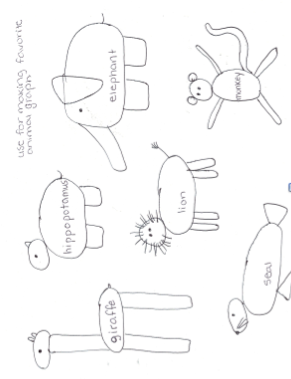
  • Animal Graph (the graph pictures were copied from a 5 year olds art)
  • Large pitcher and several herbal tea bags such as peppermint or lemon
  • One sheet of yellow construction paper per child to make a giraffe

Vocabulary

  • Evaporate (vanish/disappear, as into the dry sand)
  • Zoo (a home where many wild animals live)

Introducing the Story

Ask the children if they have ever invited a friend over to their house for a meal or to play. Allow them a few minutes to talk about any experiences they might have had. If you do not get any responses, tell the children about a time you invited someone over for a meal. Steer the conversation towards friendship and how sharing time together is fun whether at school or at home.

Language Development/Speaking & Communicating; develops increasing abilities to understand and use language to communicate information, experiences, ideas, feelings, opinions, needs, questions, and for other varied purposes.

Reading the Story

On the pages where the boy says, “So I brought a friend”, pause and encourage the children to say it along with you. Then turn the page and see if the children can name the animal that the boy brought along.

Language Development/Listening & Understanding; demonstrates increasing ability to attend to and understand conversations, stories, songs, and poems.

After Reading the Story

Challenge the children to name all the animals that were in the story today. Ask them where all the animals might live? Ask if anyone has ever been to the zoo? Give the children a moment to talk about any zoo experiences that they have had. Make a graph of all the animals that were in the story today and ask each child which one is their favorite. Write their name under the animal picture and hang on the wall. Count the votes for each animal and write the number beside.

Literacy/Book Knowledge & Appreciation; shows growing interest and involvement in listening to and discussing a variety of fiction and non-fiction books and poetry AND Mathematics/Number & Operations; Begins to associate number concepts, vocabulary, quantities, and written numerals in meaningful ways.

Music and Movement

Sing your days of the week song with the children. If you do not have a song you sing, make up a chant and teach it to them.

Mon-day, Tues-day,
Wednes-day, Thurs-day, Fri-day.
Sat-ur-day, Sun-day
The days of the week

(clap out the syllables as you sing or chant)

Literacy/Phonological Awareness; shows growing ability to hear and discriminate separate syllables in words.

Put on some music and do animal walks. Jump like a kangaroo, lumber like an elephant, use your hands to pull you like a seal, jump around like a monkey, stand on one leg like a flamingo, gallop like a horse.

Physical Health & Development/Gross Motor Skills; shows increasing levels of proficiency, control, and balance in walking, climbing, running, jumping, hopping, skipping, marching, and galloping.

Discovery

Remind the children that on Sunday the King and Queen invited the boy to come for tea. Fill a large pitcher with water and add 4-6 herbal tea bags. Explain to the children that you are going to make sun-tea. Put the pitcher out, covered, somewhere where there is some sun and let the children watch as the tea infuses into the water changing the color. Give it an hour or two and then let the children sample.

Science/Scientific Knowledge; shows increased awareness and beginning understanding of changes in materials and cause-effect relationships.

Blocks

Add animals to the center today. Encourage the children to make cages/fences and sort the animals by like kinds.

Mathematics/Geometry & Operations; shows growth in matching, sorting, putting in series, and regrouping objects according to one or two attributes such as color, shape, or size.

Art

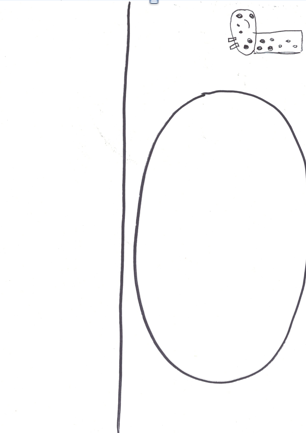
Tell the children that today you are going to make giraffes with long necks like the one that came for tea. Holding piece of construction paper the tall way, draw a line from top to bottom about 4 inches from the side. On the other part of the paper draw an oval. Let the children cut along the lines making a long strip and an oval. Show them how to attach the oval to the top of the strip, this is the giraffe’s head. Put out small plates of paint and show the children how to dip their finger and stamp up and down, up and down. These will become the spots of the giraffe. Have the children add a face with markers or paint.

Physical Health & Development/Fine Motor Skills; develops growing strength, dexterity, and control needed to use tools such as scissors, paper punch, stapler, and hammer.  AND  Language Development/Listening & Understanding; shows progress in understanding and following simple and multi-step directions.

Sand and Water

Ask the children if they can remember which animal in the story likes to swim in water most of the day (Seal). Tell the children they can be like the seals today and play in the water.  Put out your favorite water table toys today and let the children enjoy playing in it.

Literacy/Book Knowledge & Appreciation; demonstrates progress in abilities to retell and dictate stories from books and experiences; to act out stories in dramatic play; and to predict what will happen next in a story.

Library and Writing

On index cards, write the names of the children in your classroom, one per card. Encourage the children to find their name and their friends name and to practice writing them on their paper.

Literacy/Early Writing; progresses from using scribbles, shapes, or pictures to represent ideas, to using, letter-like symbols, to copying or writing familiar words such as their own name.

Dramatic Play

Encourage the children to pretend to cook today. As they are playing, ask them, “May I bring a friend?” and allow another child who might be interested to join the play. Challenge them to think about what they need to do to make room for another child in the center. Do they need more chairs, plates, etc.? Let the center fill up with more children than are normally allowed to play. What do they need to do to accommodate any extra friends? Watch carefully if the center starts to get too crowded and encourage them to problem solve instead of fight. We only have 5 plates but there are 6 of you, what should we do? (When I have done this, I have had children volunteer to share a plate and chair and to also leave the center.  I had one child suggest that she could eat out of a pan).

Mathematics/Number & Operations; begins to make use of one-to-one correspondence in counting objects and matching groups of objects.  AND  Social & Emotional Development/Cooperation; shows increasing abilities to use compromise and discussion in working, playing, and resolving conflicts with peers.

Math and Manipulatives

Use whatever classroom counters you might have. I use one-inch cubes to play. Ask the child to put 1-3 counters on the table. After they have done this, ask them to add one more. Then let the child count how many they have. Ask them to add one more and again count how many they have. Children who are able to count one more, you can ask them to add 2 more and when they get close to 10, ask them to take one away, now how many do you have?

Mathematics/Number & Operations; develops increased abilities to combine, separate and name “how many” concrete objects.

Outdoor Play

Add some water to the sandbox today and let the children experiment using damp sand to make sand cakes. Watch their faces as the water evaporates into the dry sand.   Explain to them that because the sand is dry, the water evaporates into it.  Add more water and see what happens.

Science/Scientific Knowledge; develops increased ability to observe and discuss common properties, differences, and comparisons among objects and materials.

Transitions

If you line up to go anywhere, ask the children if they would like to call a friend to join them. When there is only one child left say, “Oh good, a friend for me” and let that child be in line with you.

Social & Emotional Development/Cooperation; develops increasing abilities to give and take in interactions; to take turns in games or using materials; and to interact without being overly submissive or directive.

Dear Parents- Today we read a story about a boy and his friends. Ask your child who some of the boys friends were. Then ask them to tell you about who some of their friends are at school and what they enjoy doing together.

Resources

Screen Shot 2018-08-12 at 9.45.56 AM
Screen Shot 2018-08-12 at 9.45.13 AM