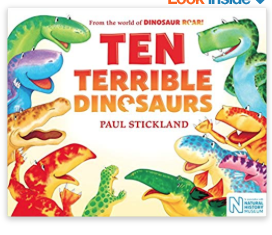
Ten Terrible Dinosaurs, by Paul Strickland

What child doesn’t like dinosaurs? This fun book will help children with their number awareness.

Materials

  • A variety of small dinosaurs

Vocabulary

  • Enormous (really, really big)
  • Spiky (sharp and pointed)
  • Elated (to be happy)
  • Feisty (acting pretty wild)
  • Weary (tired)
  • Carnivore (one who eats meat)
  • Herbivore (one who eats plants)
  • Canine teeth (the pointed tooth between the incisors and the molars, people have one on each side of their mouth.)

Before Reading the Story

Today the children will be exploring their teeth before reading the story. Make sure that the children have washed their hands appropriately before they come to the group today so that they will not be putting dirty fingers into their mouths. On a piece of paper, draw a large tooth. Ask the children if they know what it is? Talk for a moment about dental care (brushing, dentist visits, minimal sugars, and not using teeth to open things). After you have discussed dental care to your and the children’s satisfaction, point to the tooth you drew and ask the children if all teeth are shaped like this? (No, we have different kinds of teeth in our mouths to chew different kinds of food). Draw a pointy canine tooth. Tell them that some teeth are shaped like this and ask them to touch the tooth in their mouth that is pointy. Explain that this tooth is pointy so that it can tear and eat meat. People and animals that eat meat are called carnivores. Ask them to think about other animals that might have pointy teeth (dogs, cats, tigers, alligators). After each, if it is a meat eater say, “Yes, it’s a carnivore”. Have the children go back into their mouths and touch a back molar. Explain that some teeth are flat like these so that they can mash and chew plants. Tell them that people and animals that eat plants are called herbivores. Ask them to think of some animals that might be herbivores (horse, camel, elephant, rabbit). If it is a plant eater say, “Yes, it’s an herbivore. If the animal eats both meat and plants tell the children that it is both an herbivore and a carnivore and is called an omnivore. Let the children name animals and guess if it is a carnivore, herbivore, or omnivore.

Science/Scientific Skills & Measurements; begins to use senses and a variety of tools and simple measuring devices to gather information, investigate materials, and observe processes and relationships. AND Science/Scientific Knowledge; expands knowledge of and respect for their bodies and the environment.

Reading the Story

Tell the children that your story today is about a creature that is sometimes an herbivore and sometimes a carnivore. Read the title of the book and look at the dinosaurs on the cover. Point to each one and ask, could this one be a carnivore? (Only the ones with visible teeth count) When you get to the pages that say, “so then there were”…pause to see if the children can name the correct number.

Mathematics/Number & Operations; begins to associate number concepts, vocabulary, quantities, and written numerals in meaningful ways. AND Science/Scientific Methods & Skills; develops increased abilities wo observe and discuss common properties, differences and comparisons among objects and materials.

After reading the Story

Hold up 10 fingers and state, “10 take away one equals _____. Let down a finger. (take away one equals ____.) Continue down to zero.

Mathematics/ Numbers & Operations; demonstrates increasing interest and awareness of numbers and counting as a means for problem solving and determining quantities.

Discovery

Bring in pictures of dinosaurs or books about dinosaurs.

Literacy/Book Knowledge & Appreciation; shows growing interest and involvement in listening to and discussing a variety of fiction and non-fiction books and poetry.

Do a web search of dinosaur pictures to color and print off 4-5 realistic looking pictures for the children to talk about, compare, and color.

Literacy/Early Writing; experiments with a growing variety of writing tools and materials, such as pencils, crayons, and computers.

Music and Movement

Say, “Feel that shaking on the floor, must be the dancing of the dinosaurs!” Turn on some lively music and stomp, twist and dance to the music.

Creative Arts/Movement; expresses through movement and dancing what is felt and heard in various musical tempos and styles.

Blocks

Dinosaurs in blocks would be fun. If you do not have dinosaurs, cut out pictures from the internet and tape to your blocks.

Creative Arts/Dramatic play; shows growing creativity and imagination in using materials and in assuming roles in dramatic play situations.

Art

Move the chairs away from your art table and have the children stand around the edges. Tell them that you are going to be dancing, twirling, silly dinosaurs. Put out two primary colors of finger paint directly on the table and some lively music. As the children finger paint the tabletop, help them be aware that the two colors are mixing into a new one. Make sure to give yourself a little extra clean-up time. Children seem to really enjoy painting the table but it takes extra time to clean.

Science/Scientific Knowledge; shows increased awareness and beginning understanding of changes in materials and cause-effect relationships.

Library and Writing

Write D/d on a piece of paper. Point to and name the capital D and then do the same with the lower case d. Tell the children that D/d is the letter that begins the word dinosaur. Have the children practice making the D/d sound several times. Ask the children to think of as many D/d words as they can and write them on the paper repeating the /d/ sound and the word each time.

Literacy/Alphabet Knowledge; shows progress in associating names of letters with their shapes and sounds. AND Literacy/Phonological Awareness; shows growing awareness of beginning and ending sounds in words.

Sand and Water

Add small dinosaurs to the sand table. Dampen the sand so the children can make mountains, craters, and volcanoes. Add rocks and sticks to make a dinosaur diorama.

Approaches to Learning/Initiative & Curiosity; approaches tasks and activities with increased flexibility, imagination, and inventiveness.

Dramatic Play

As the children move about the room today, at intervals call out , “Dinosaurs Roar!” and encourage all the children to roar loudly with you. You could have the children roar for each other when they or you have seen someone do an act of kindness or friendship.

Social and Emotional Development/Social Relationships; shows progress in developing friendships with peers.

Math and Manipulatives

This would be a good day to put out any puzzles relating to dinosaurs, teeth, or numbers. If you have none of these, any puzzles will do, both table and floor.

Approaches to Learning/Engagement & Persistence; grows in abilities to persist in and complete a variety of tasks, activities, projects, or experiences.

Outdoor Play

Choose one child to be the ferocious, meat eating Tyrannosaurus Rex. The rest of the children can be the gentle plant-eating dinosaurs. The T Rex is “it” and chases the other dinosaurs . If they are caught, they must go stand by a tree and pretend to eat the leaves until the T Rex has caught three children and then a new T Rex is chosen.

Physical Health & Development/Gross Motor Skills; shows increasing levels of proficiency, control, and balance in walking, climbing, running, jumping, hopping, skipping, marching, and galloping. Mathematics/Numbers & Operations; begins to associate number concepts, vocabulary, quantities, and written numerals in meaningful ways. Develops increased abilities to combine, separate, and name “how many” concrete objects.

Transitions

As the children go to their next activity, ask them to make loud chomping sounds if they are an herbivore plant eater, roar if they are a carnivore meat eater, now stomp on off.

Literacy/Listening & Understanding; understands an increasingly complex and varies vocabulary.

Dear Parents, Help your child learn to count by doing this little dinosaur song. As you sing each number hold up the corresponding finger.

Ten Big Dinosaurs (To the Tune of “10 Little Indians”)

1 big, 2 big, 3 big dinosaurs,

4 big, 5 big, 6 big dinosaurs,

7 big, 8 big, 9 big dinosaurs,

Ten Big Dinosaurs!

They all lived a long, long time ago.

They all lived a long, long time ago.

They all lived a long, long time ago.

Now there are no more.

A Color of His Own, by Leo Lionni

Every animal has his own special color/s except the chameleon. He changes colors wherever he goes. This is the story of a chameleon that wanted to have a special color like all the other animals. It was not until he met another chameleon did he learn how special he really was.

Materials

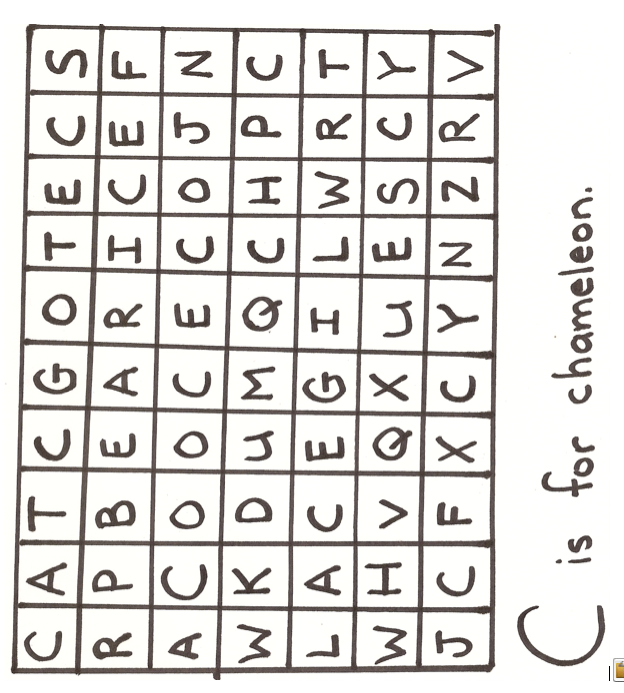
  • Seek and find letter C
  • Several sponges cut into small pieces.
  • Chameleons for hiding

Vocabulary

  • Chameleon (a kind of lizard that can change his color)
  • Heather (a kind of flowery bush)
  • Camouflage (to be able to hide or change color into the environment)

Before Reading the Story

Tell the children that you are going to play a same and different game today. Have two children (a boy and a girl) come up to the front of the group. Ask the other children to name ways that the two children are different. (He’s a boy, she has darker hair, he’s wearing pants and she’s wearing shorts). After the children have exhausted how the two children are different, ask them to tell you ways they are the same. (They both have arms and hands, they both are smiling, they are both tall).

Scientific Knowledge and skills; observes and discusses common properties, differences, and comparisons among objects.

Ahead of time, make a simple graph labeled, “Our Favorite Colors” and a name card for each child to stick on. Explain to the children that we are all alike in some ways but each of us is also special and different. Not all people like the same things. Pull out your Favorite Color Graph and hand out the name tags.  Ask the children to come up and put their name beside their favorite color. When everyone has done so, talk about the colors and how some people like one color better than another.

Literacy Knowledge and skills; recognizes print in everyday life, such as numbers, letters, one’s name, words, and familiar logos and signs. AND Social & Emotional Development/Self-Concept; begins to develop and express awareness of self in terms of specific abilities, characteristics, and preferences.

Reading the Story

Pause on each page so the children can name the colors.

After Reading the Story

After reading the story ask the children why the chameleon was unhappy at the beginning of the story? (He did not have his own special color). What happened to make the chameleon know he was perfect just the way he was? (The other chameleon said that that was the nature of chameleons). How did the story end? (Happily ever after) If you were a chameleon, what color/s would you like to be?

Social & Emotional Development/Social Relationships; progresses in responding  sympathetically to peers who are in need, upset, hurt, or angry; and in expressing empathy or caring for others. AND Literacy/Book  Knowledge & Appreciation; shows growing interest and involvement in listening to and discussing a variety of fiction and non-fiction, and poetry.

Discovery

Put out red, yellow, and blue stamp pads or paint in shallow dishes. Tell  the children that when you mix two colors of paint together you get a new color. Give each child a sheet of white paper. Ask them to dip their left hand in one color and their right hand in another color. Have them print their left hand on the left side of the paper and their right on the right. Ask them what color they think it will make when they mix the two colors together.  Then have them make a left hand print and put the right hand on top and mix. What new color did you make? On the bottom of the paper write color left + color right =_____. Have the child repeat the sentence back.  Have the children wash their hands before they try two other colors together and see what new color you can make.

Science/Scientific Skills & Methods; begins to participate in simple investigations to test observations, discuss and draw conclusions, and form generalizations.

Music and Movement

Explain to the children that chameleons move slowly.   Put on some slow music and have the children move slowly about the room while looking for an object that is a color on their shirt. Find the object and slowly bring it back to the carpet. Name the color. Put the music back on and the children can slowly go and put the object away.

Creative Arts/Movement;shows growth in moving in time to different patterns of beat and rhythm in music.

Blocks

If you have colored blocks or cubes, feature these in your center today.  As the children clean-up their structure, encourage them to clean by colors.  (Ryan you put all the red blocks away and Paula you can put the green blocks away).

Mathematics/Geometry & Spatial Sense; shows growth in matching, sorting, putting in series, and regrouping objects according to one or two attributes such as color, shape, or size.

Art

Explain to the children that the illustrator of the story made his pictures by doing sponge printing.   Put out small trays of red, blue, yellow, and white paint. Show the children how to sponge print by dipping the sponge lightly in the paint and then moving the sponge up and down, up and down on the paper.

Creative Arts /Art; gains ability in using different art media and materials in a variety of ways for creative expression and representation.

Library and Writing

Chameleons are very good at hiding because they blend/camouflage right in. Ask the children what letter chameleon starts with. Give children a Seek and Find page and ask them to take their favorite color and find all the C’s on the page.

Literacy/Alphabet Knowledge; increases in ability to notice the beginning letter of familiar words.

Sand and Water

Put water in the table today.  Ask the children at the table what color food coloring they would like you to add.  After they name the color, find a corner of the table and add their color.  As you add the second color in a different corner, ask the children what they think is going to happen to the colors when they get mixed.

Science/Scientific Skills & Methods; begins to participate in simple investigations to test observations, discuss and draw conclusions, and form generalizations.

Dramatic Play

Add many colorful dress-ups today (scarves, hats, jewelry)

Social & Emotional Development/Cooperation; increases abilities to sustain interactions with peers by helping, sharing, and discussion.

Math and Manipulatives

As the children are using the manipulatives today, encourage them to make patterns using color and naming the colors in their patterns.

Mathematics/Patterns & Measurement; enhances abilities to recognize, duplicate, and extend simple patterns using a variety of materials.

Outdoor Play

Make a number of chameleons in colors that are on your playground. Before the children go outside, hide these outside yet in plain view (put a yellow chameleon in a yellow bucket, a brown chameleon in the sand)). Tell the children that there are chameleons camouflaged about the playground today so while they are out they can be on the lookout for them. Bring out a pen and as the children find the chameleons and bring them to you, you can write their name on it. When you go back in the classroom, you can count who found the most.

Approaches to Learning/Engagement & Persistence; demonstrates  increasing capacity to maintain concentration over time on a task, question, set of directions or interactions, despite distractions and interruptions.

Transitions

Go back to your Favorite Color Graph and dismiss the children to the next activity by the colors that they chose.

Social & Emotional Development/Self-Concept; begins to develop and express awareness of self in terms of specific abilities, characteristics, and preferences.

Resources

Screen Shot 2018-08-13 at 7.06.00 AM
Screen Shot 2018-08-13 at 7.07.11 AM
Screen Shot 2018-08-13 at 7.08.17 AM
Screen Shot 2018-08-13 at 7.09.23 AM

Katy and the Big Snow, by Virginia Lee Burton

Materials

  • Small bag of flour
  • Small cars or construction vehicles
  • Extra hats, mittens, and scarves
  • Stack of newspaper ripped in half
  • cotton balls and several pinching clothespins

Vocabulary

  • Crawler Tractor (a tractor type vehicle that has a continuous roller instead of wheels)
  • Steadily (slowly and gradually not stopping along the way)

Introducing the Story

Ask the children to raise their hands if they like to play I the snow. Let them talk about some of the things they like to do in the snow. Next tell them that some people have to work in the snow. Getting to work can be very hard if there is a lot of snow on the ground. Our story today is about a helper named Katy who moves all the snow from the roads. I wonder how she does it? Let children have a chance to respond if they choose to.

Science/Scientific Knowledge; develops growing awareness of ideas and language related to attributes of time and temperature. AND Language Development/Speaking & Understanding; develops increasing abilities to understand and use language to communicate information,experiences, ideas, feelings, opinions, needs, questions; and for other varied purposes.

Reading the Story

While reading, stop on the page after you read, “Katy had to stay home, not enough snow”. Ask the children how they think Katy might have felt. As Katy begins shoveling out the town, encourage the children to repeat ‘Follow me!” along with Katy.

Language Development/Speaking & Understanding; develops increasing abilities to understand and use language to communicate information,experiences, ideas, feelings, opinions, needs, questions; and for other varied purposes.

After Reading the Story

Tell the children that Katy was big and strong and moved all the snow so that the adults could go to work and the buses and cars could bring children to school. Katy is kind of a hero and a good friend to the whole town. Ask the children if they have ever helped someone to do something hard. Listen as they tell about their own experiences. (One time I helped my brother to shovel the snow on our sidewalk. I helped my grandma to make a cake. I had to stir and stir. I was really good).

Social & Emotional Development/Self-Concept; begins to develop and express awareness of self in terms of specific abilities, characteristics, and preferences.

Music and Movement

Play Follow the Leader; making an obstacle course. Have the children follow you around, under, over, beside, behind, across, and inside parts of your classroom, playground, and school.

Mathematics/Geometry & Spatial Sense; builds an increasing understanding of directionality, order, and position of objects, and words such as up, down, over, under, top, bottom, inside, outside, in front, and behind.

Discovery

Bring in a container of snow and watch as it melts. Do you see any objects in the snow? What happens to the snow? When the snow has melted, tell the children that you are going to put it back outside. Ask them what they think will happen to the melted snow now? When it is frozen, bring it back inside for the children to watch it melt again. What happened to the melted snow? Did it turn back into snow?

Science/Scientific Skills; begins to participate in simple investigations to test observations, discuss and draw conclusions, and form generalizations.

 Blocks

Add vehicles and encourage the children to make roads by laying blocks end to end for them to drive upon. Encourage the children to make some of the buildings that are in and around town (police station, library, grocery store, etc.).   Bring index cards, markers, and tape over so that the children can make signs to go with the buildings if they choose to.

Social & Emotional Development/Knowledge of Families & Communities; begins to express and understand concepts and language of geography in the contexts of the classroom, home, and community. AND Literacy/Early Writing; progresses from using scribbles, shapes, or pictures to represent ideas, to using letter-like symbols, to copying and writing familiar words such as their own name.

Art

Give the children pieces of construction paper to draw houses. Encourage them to add windows and a door as well as write their name on their house. When all have finished making a house, put them together on a map type background and hang low on the wall. Label each child’s house so they can use their finger to trace how to get from their house to a friends house.

Literacy/Print Awareness & Concepts; recognizes a word as a unit of print, or awareness that letters grouped to form words, and that words are separated by spaces.

Sand and Water

Dump the flour into the sand and water table today and pretend that it is snow. The children can use small vehicles or even shovels to pretend to push the snow aside. I would recommend that the children wear smocks and though flour is easy to wash from clothes, it is messy. Remind the children to not add water to the table!

Social & Emotional Development/Self Control; demonstrates increasing capacity to follow rules and routines and to use materials purposefully, safely, and respectfully. AND Literacy/Book Knowledge & Appreciation; demonstrates progress in abilities to retell and dictate stories from books and experiences; to act out stories in dramatic play; and to predict what will happen next in a story.

Library and Writing

Encourage the children to try to draw maps on how to get to the playground from your classroom or how your room is divided into centers (birds eye view)

Social & Emotional Development/Knowledge of Families & Communities; begins to express and understand concepts and language of geography in the contexts of the classroom, home, and community.

Dramatic Play

Bring in extra hats, mittens, and scarves so the children can pretend to go play out in the snow. Give them ½ sheets of newspaper and show them how to crumple it up into a ball. These make fun and safe snowballs for a snowball/paper fight.

Creative Arts/Drama; participates in a variety of dramatic play activities that become more extended and complex.

Math and Manipulaties

Put out a bowl of cotton balls along with a few clothespins or tongs. Label 5 plastic cups 1-5 with marker. Explain to the children that they must use the tongs to put the correct number of snowballs into each cup by using the clothespins or tongs. Encourage them to work in pairs.   One child can put the snowballs into the cups and the other child can count them as they go in. When they have filled the cups, empty them back into the bowl and trade places as picker upper and counter.

Mathematics/Numbers & Operations; begins to use one-to-one correspondence in counting objects and matching groups of objects.

Outdoor Play

If there is snow on the playground, challenge the children to roll really large snowballs (like you are making a snowman). As they work, tell them that they must be as strong as Katy like in the story.

Physical Health & Development/Large Motor Skills; demonstrates increasing abilities to coordinate movements.

Transitions

Ask each child to name something they like to do on snowy days as they line up or move to the next activity (I like to eat snow. I like to watch cartoons.). Encourage the children to answer using complete sentences.

Language Development/Speaking & Communicating; develops increasing abilities to understand and use language to communicate information, experiences, ideas, feelings, opinions, needs, questions; and for other varied purposes.

Dear Parents, Today we read a book about a helper named Katy who plowed all the snow from the streets of town. Encourage your child to be a helper around the house. Thank them for their service and let them know that they are appreciated.