Sheep Out To Eat, by Nancy Shaw

            What happens when sheep go out to eat?  A restaurant disaster and a very silly story.

Materials

  •  Restaurant signs
  •  Schedule a field trip to a local restaurant if possible
  • Pictures of a variety of foods
  • Several nail scrub brushes

Vocabulary

  • Tea shop ( a restaurant where you can get tea to drink and little cakes) Menu (a list of foods that you can order)
  • Appetite (the desire to eat)
  • Tips (the money you leave on the table at the restaurant for the waiter or waitress)

Before Reading the Story

            Ask the children how many of them have ever been out to eat at a restaurant.  Talk about their experiences and help them learn the names of objects found in a restaurant (menu, booth, waiter, and tip).  

Social & Emotional Development/Knowledge of Families & Communities; develops growing awareness of jobs and what is required to perform them.

Reading the Story

            Stop on each page and talk through the pictures.  What is happening?  Do you see what the words are talking about? 

Literacy/Book Knowledge & Appreciation; shows growing interest and involvement in listening to and discussing a variety of fiction,and non-fiction books, and poetry.

After Reading the Story

            Use the restaurant signs to make a graph and ask the children to label their favorite restaurant.  Which one has the most votes?

Mathematics/Number & Operations; begins to use language to compare numbers of objects with terms such as more, less, greater than, fewer, and equal to.

Discovery

Bring in pictures of different kinds of foods.  Can the children name the foods?  Talk about the colors of the foods and where they fit on the food pyramid.  Ask the children to sort the cards by foods they like and foods they do not like.

Approaches to Learning/Reasoning & Problem Solving; develops increasing abilities to classify, compare, and contrast objects, events, and experiences. AND Social & Emotional Development/Self-Concept; begins to develop and express awareness of self in terms of specific abilities, characteristics, and preferences.

Music and Movement

Play the song, Tea Party by the L. Berkner and act out as she sings. https://www.youtube.com/watch?v=mLOkR_IP1w0 This could be done in the dramatic center today.

Sing I’m a Little Teapot and teach the children the movements. https://www.youtube.com/watch?v=AB4vzj93OGY

Creative Arts/Music; participates with increasing interest and enjoyment in a variety of music activities, including listening, singing, finger plays, games, and performances.

Blocks

            Challenge the children to build a restaurant.  Can they build the tables and add people to fill it in?

Creative Arts/ Dramatic Play; participates in a variety of dramatic play activities that become more extended and complex. AND Social & Emotional Development/Cooperation; shows increasing abilities to use compromise and discussion in working, playing, and resolving conflicts with peers.

Art

            Make placemats with the children.  Take a piece of construction paper and do an art activity of choice on it.  Then cover each with contact paper. Use these at meal time to determine who will sit where for the meal.

Approaches to Learning/Initiative & Curiosity; chooses to participate in an increasing variety of tasks and activities. AND Creative Arts/Art; develops growing abilities to plan, work independently, and demonstrate care and persistence in a variety of art projects.

Library and Writing

            Have the children help create a name for their dramatic play restaurant and a sign.  This could be a group coloring project.  Also have the children cut out food items and glue them on a poster board.  You can add amounts and this could be a billboard sign like many fast food restaurants.

Literacy/Early Writing; develops understanding that writing is a way of communicating for a variety of purposes.

Sand and Water

            Add water and nail scrub brushes along with some plastic vegetables and fruits.  The children can pretend to clean them for cooking. If you do not have nail scrub brushes use rags or paper towels.

Physical Health & Safety/Health Status & Practices; builds awareness and ability to follow basic health and safety rules such as fire safety, traffic and pedestrian safety, and responding appropriately to potentially harmful objects, substances, and activities.

Dramatic Play

            Play restaurant.  Add some carry out menus, a cash register, an apron, and a pad of paper to write the orders on. 

Creative Arts/ Dramatic Play; participates in a variety of dramatic play activities that become more extended and complex.

Math and Manipulatives

            Bring in several dollars worth of change for the children to sort.  Add magnifying glasses and talk with the children about what they see on each coin and the coins name.

Mathematics/Patterns & Measurement; shows increasing abilities to match, sort, put in series, and regroup objects according to one or two attributes such as shape or size. AND Language Development/Speaking & Communicating; develops increasing abilities to understand and use language to communicate information, experiences, ideas, feelings, opinions, needs, questions; and for other varied purposes.

Outdoor Play

            In the story the sheep ended up eating the grass outside the restaurant.  On the playground sit in the grass and smell it, touch it, chew a piece.  Help the children to become aware of grass using all of their senses.  Put a thick blade of grass between your two thumbs and make a whistle from it.

Science/Scientific Skills & Methods; begins to use senses and a variety of tools and simple measuring devices to gather information, investigate materials, and observe processes and relationships.

Transitions

            Ask the children to help you recall the story.  Who went to the restaurant, what kind of restaurant was it?  What did they order, then what happened?

Literacy/Book Knowledge & Appreciation; shows growing interest and involvement in listening to and discussing a variety of fiction and non-fiction, and poetry.
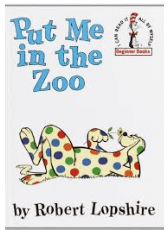
Put Me in the Zoo, by Robert Lopshire

This is a fun rhyming book that incorporates color and size.  It is a Dr. Suess Beginner Book and children all delight in this funny animal’s spot adventure.

Vocabulary

  • Spots (little daubs of color)
  • Zoo (a wildlife park where you can find many kinds of wild animals)

Materials Needed

  • Cardboard or poster board
  •  Music cd
  •  Non-fiction animal book
  • Bag of M&M’s or colored marking chips
  • Bar Graph
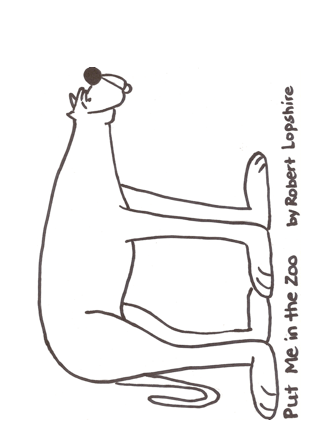
  • Picture of animal without spots

Introducing the story

Begin a conversation about the clothes that the children are wearing. Is anyone wearing red? green? blue? Is anyone wearing stripes? spots? a pattern? Show the children the cover of the book and ask them if they can guess what the story might be about. Can you guess which shape our story is about? (circle). Can you tell me anything else? (It’s about an animal, it has colors).

Language Development/Listening & Understanding; understands an increasingly complex and varied vocabulary.

Reading the Story

Slow down at the end of each page to see if the children can guess the rhyming word by listening to the clue.

Literacy/Phonological Awareness; progresses in recognizing matching sounds and rhymes in familiar words, games, stories, songs, and poems.

After Reading the Story

            Talk about spots.  What animals can they think of that have spots?  Do people have spots (freckles, birthmarks)?  What else can you think of that has spots?  Make a list of all the things they think of and attach it to the wall.

Science/Scientific Skills & Methods; Develops increased ability to observe and discuss common properties, differences, and comparisons among objects and materials.

Music & Movement

Use any color or shape songs that you have taught the children. Three Primary Colors https://www.youtube.com/watch?v=yu44JRTIxSQ Shapes Song https://www.youtube.com/watch?v=w6eTDfkvPmo

Creative Arts/Music; participates with increasing interest and enjoyment in a variety of music activities, including listening, singing, finger plays, games, and performances.

Ask the children to make a large group circle and then do group circle songs such as Looby Loo or Hokey Pokey. Can they form a circle with only verbal cues?

Language Development/Listening & Understanding; shows progress in understanding and following simple and multi-step directions.

Discovery

Bring in non-fiction books about animals. Challenge the children to look at the various animals for comparisons. (Can you find two animals with stripes? Can you find two animals with bumpy skin? Can you find some with spots?).

Science/Scientific Skills & Methods; Develops increased ability to observe and discuss common properties, differences, and comparisons among objects and materials.

Blocks

            Make a sign that says ZOO on an index card.  Show it to the children and tell them that you are going to put it in the block corner for the day.  Encourage the children to make a zoo by sorting like animals together and making enclosures around them.

Mathematics/Patterns & Measurement; shows increasing abilities to match, sort, put in a series, and regroup objects according to one or two attributes such as shape or size. AND Approaches to Learning/Engagement & Persistence; shows growing capacity to maintain concentration over time on a task, question, or set of directions or interactions despite distractions and interruptions.

Art

Ask the children to draw a picture of where they would put their spots if they could put them anywhere. After they have drawn their picture, use a stamp pad to make finger print dots on top. Dictate their responses. (I would put spots on my baby brother. I would put spots on the car).

Literacy/Early Writing; begins to represent stories and experiences through pictures, dictation, and in play.

Sand & Water

  Cut out a variety of circle sizes from cardboard.  Put these in the sand table.  Ask the children to sift through the sand to find all the circles.  Have them sort them by size.  With younger children you could cut out various color poster board and have them sort by color. 

Mathematics/Geometry & Spatial Sense; begins to determine whether or not two shapes are the same size.

Library and Writing

                  Cut out several 2 inch circles from cardboard.  Show the children how to hold it on a piece of paper and trace around it.  Encourage them to name the shape. 

Approaches to Learning/Engagement & Persistence; grows in abilities to persist in and complete a variety of tasks, activities, projects, and experiences.

Before the children begin cutting out circles, remind them about how to carry and use scissors correctly. 

Physical Health & Development/Health Status & Practices; builds awareness and ability to follow basic health and safety rules such as fire safety, traffic and pedestrian safety, and responding appropriately to potentially harmful objects, substances, and activities.

Ask the children to write one letter from their name on each circle as they cut them out (Kerry would need to cut out 5 circles).

Literacy/Alphabet Knowledge; identifies at least 10 letters of the alphabet, especially those in their own name. AND Physical Health & Development/Fine Motor Skills; progresses in abilities to use writing, drawing, and art tools, including pencils, markers, chalk, paint brushes, and various types of technology.

Math and Manipulatives

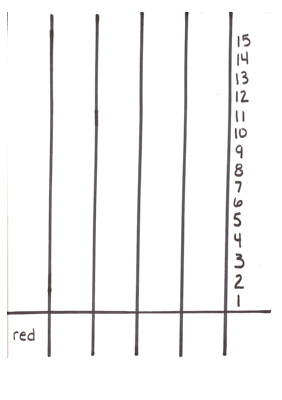
            Bring in a large bag of M&M’s, or a variety of colored chips. Give each child 10 and a bar graph.  Ask the children to sort the M&M’s onto a graph.    Ask them which color has the most?  How many greens do you have?  How many altogether?  Who in the group has the most brown’s?  Which is your favorite color?  When you are finished you can have them eat and count. 

Mathematics/Patterns & Measurement; shows increasing abilities to match, sort, put in series, and regrouping objects according to one or two attributes such as color or size. AND Mathematics/Number & Operations; begins to use language to compare numbers of objects with terms such as more, less, greater than, fewer, and equal to.

Outdoor Play

            On the playground lay hoola hoops on the ground.  Encourage the children to jump from hoop to hoop.  Play in the hoop, out of the hoop. 

Physical Health & Development/Gross Motor Skills; shows increasing levels of proficiency, control, and balance walking, climbing, running, jumping, hopping, skipping, marching, and galloping.

Transitions

Dismiss the children to the next activity by color. If you’re wearing yellow go wash your hands, line-up, or choose your center.

Language Development/Listening & Understanding; shows progress in understanding and following simple and multiple-step directions.

Resources

Rosie’s Walk, by Pat Hutchins

            Rosie decides she’d like to go for a walk and a hungry fox follows her.  Walk with Rosie around, across, under, through, and past the barnyard and find out if the fox gets her in the end.

Materials

  • Draw an oval egg shape about 7 inches long onto several colors of paper.
  • Animal walk maze
  • Magnet board and magnet wand

Vocabulary

  • Haycock (another word for haystack which is a pile of hay stacked up in a field and left to dry)
  • Mill (the factory where the wheat straw is made into flour)

Before Reading the Story

            Ask the children if they like to go for walks? Where do they walk, what do they see, who goes with them?  Tell them that today you are going to read a story about a chicken named Rosie who goes for a walk.  Show the children the cover of the book and ask them if they can guess what might happen while Rosie is out walking?

Literacy/Book Knowledge & Appreciation; demonstrates progress in abilities to retell and dictate stories from books and experiences; to act out stories in dramatic play; and to predict what will happen next in a story.

Reading the Story

            On each page where the author is telling what Rosie is doing, use your finger to show the preposition (across the yard, move your finger across the page).  Then point to the fox on that page and ask the children if they can guess what is going to happen to the fox?

Mathematics/Geometry & Spatial Sense; builds an increasing understanding of directionality, order, and positions of objects, and words such as up, down, over, under, top, bottom, inside, outside, in front, behind.

After Reading the Story

            Spend a minute talking about the fox in the story.  Why do you think he was following Rosie?  Do you think it was safe for Rosie to go out by herself?  Ask the children if they wanted to go out for a walk what should they do? (tell an adult).   Talk about strangers and how one should not go with strangers.  What would you do if a stranger came up to you and said to come with them?  Would you take candy from a stranger?

Physical Health & Development/Health Status & Practices; builds awareness and ability to follow basic health and safety rules such as fire safety, traffic and pedestrian safety, and responding appropriately to potentially harmful objects, substances, and activities.

Discovery

Make a magnet board by attaching the pictures of Rosie and the Fox to a magnet. On a piece of posterboard draw a simple path for the child to follow using the magnet. Give the child a second magnet to put under the posterboard. Show them how to move their hand to make the top Rosie magnet move along the page. Here are some simple instructions for a more elaborate magnet board. https://buggyandbuddy.com/creative-magnet-activity/

Physical Health & Development/Fine Motor Skills; progresses in abilities to use writing, drawing, and art tools, including pencils, markers, chalk, paint brushes, and various types of technology. AND Literacy/Early Writing; begins to represent stories and experiences through pictures, dictation, and in play.

Music and Movement

            Teach the children this traditional Mexican rhyme. It is used the same as children in the USA might use One potato, two potato or Eeny meeny miney moe.

La gallina Francolina, by Artuo Navarro

            La gallina Francolina                    Francolina, the hen

            Puso un huevo en la cocina.          Laid an egg in the kitchen.

            Puso uno, puso dos,                    She laid one, she laid two

            Puso tres, puso cuatro,                She laid three, she laid four

            Puso cinco, puso seis,                  She laid five, she laid six

            Puso siete, puso ocho,                  She laid seven, she laid eight

            Puso un pan de bizcocho!              She laid a good tasting cake!

Mathematics/Number & Operations; develops increasing ability to count to 10 and beyond. AND Language Development/Listening & Understanding; demonstrates increasing ability to attend to and understand conversations, stories, songs, and poems.

Blocks

            Bring a set of dominos to the block center.  Show the children how to stand them carefully on end close to each other making a domino trail.  When all the dominos are lined up in a row, gently push the first one.  This should cause the next to fall and all continue to fall making a domino trail.

Physical Health & Development/Fine Motor Skills;grows in eye-hand coordination in building with blocks, putting together puzzles, reproducing shapes and patterns, stringing beads, and using scissors.

Art

            Bring the book to the art table and note how all the illustrations have patterns.  Give the children materials that they can practice making patterns on paper.  You can use stamp pads and stampers or paint with various items to print repeated patterns (a cup turned upside down to make rows of circles)

Mathematics/Patterns & Measurement; enhances abilities to recognize, duplicate, and extend simple patterns using various materials.

Library and Writing

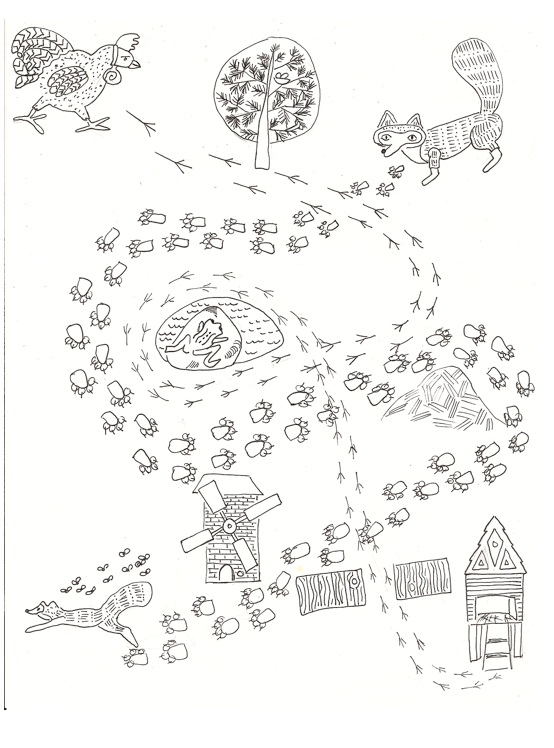
Make several copies of the maze, Rosie’s Walk.  Cover them with contact paper and give the children washable markers to trace the animal’s footprints around the page.

Physical Health & Development/Fine Motor Skills; progresses in abilities to use writing, drawing, and art tools, including pencils, markers, chalk, paint brushes, and various types of technology. AND Literacy/Early Writing; begins to represent stories and experiences through pictures, dictation, and in play.

            Go back through the book but this time instead of focusing on what Rosie does on each page; have the children talk about what the fox does on each page.  Put their thoughts down on paper and help the children write the foxes version of Rosie’s walk.

Literacy/Book Knowledge & Appreciation; shows growing interest in reading-related activities, such as asking to have a favorite book read; choosing to look at books; drawing pictures based on stories; asking to take books home; going to the library; and engaging in pretend-reading with other children.

Dramatic Play

            Add some stuffed farm animals to the center.  The children can pretend to gather eggs, milk a cow, and feed the various animals.

Creative Arts/Dramatic Play; shows growing creativity and imagination in using materials and in assuming different roles in dramatic play situations.

Math and Manipulatives

            Put out the colored egg shapes on paper and a variety of manipulatives.  Ask the children to each fill up their egg with the manipulative of their choice.  Count how many they could fit onto the egg shape.  No stacking only lying on the paper. (7 duplos fit on my egg, more then 11 puzzle pieces fit on my egg, 26 dots fit on my egg).  You can also use the egg shapes to have the children match items of the same color.

Mathematics/Number & Operations; develops increased abilities to combine, separate, and name “how many” concrete objects. AND Mathematics/Number & Operations; begins to use language to compare numbers of objects with terms such as more, less greater than, fewer, and equal to.

Outdoor Play

            Have the children help make an obstacle course on your playground.  Have the children go out of somewhere (the chicken coup), go across something (the yard), go around something (the pond), go over something (the haycock), go past something (the mill), go through something (the fence), and go under something (the beehives).  Label each part of the obstacle course according to Rosie’s walk.

Mathematics/Geometry & Spatial Sense; builds an increasing understanding of directionality, order, and positions of objects, and words such as up, down, over, under, top, bottom, inside, outside, in front, behind.

Transitions

            Bring a chair to the center of your circle.  As the children move to the next activity say a preposition and have them demonstrate as they go. (Go around the chair one time, jump behind the chair, go under the chair, sit on the chair and clap twice).

Mathematics/Geometry & Spatial Sense; builds an increasing understanding of directionality, order, and positions of objects, and words such as up, down, over, under, top, bottom, inside, outside, in front, behind. AND Language Development/Listening & Understanding; shows progress in understanding and following simple and multiple-step directions.

Resources