Firefighters, by Norma Simon

            This book is a good introduction to the many responsibilities of being a firefighter.

Materials

  • Any firefighter dramatic play materials you may have
  • Books or pictures of real fire persons in their fire fighting clothes, uniforms.
  • 2-3 turkey basters
  • Old hose cut into 3 foot sections

Vocabulary

  • Siren (the loud sounds that a fire truck or police car makes)
  • Masks (object that covers the firefighter’s face that allows them to breathe smoky air)
  • Teamwork (working together, i.e. to put out a fire)

Before Reading the Story

            With the children make a knowledge chart about what they know about firefighters and fire safety.   Do they know what a fireman wears to fight a fire, and why?  Do they know what the fireman connects his hose to for water supply?  

Language Development/Speaking & Communicating; develops increasing abilities to understand and use language to communicate information, experiences, ideas, feelings, opinions, needs, questions; and for other varied purposes. AND Social & Emotional Development/Knowledge of Families & Communities; develops growing awareness of jobs and what is required to perform them.

Reading the Story

            Take your time going through the pages and let the children discuss and ask questions as you read. 

Language Development/Speaking & Communicating; uses an increasingly complex and varied spoken vocabulary. AND Language Development/Speaking & Communicating; develops increasing abilities to understand and use language to communicate information, experiences, ideas, feelings, opinions, needs, questions; and for other varied purposes.

After Reading the Story

            Notice the page where the doctors/paramedics are helping make sure everyone is safe.  Tell the children that firefighters and doctors/paramedics are community helpers. Ask the children if they can think of any other community helpers.

Social & Emotional Development/Knowledge of Families & Communities; develops growing awareness of jobs and what is required to perform them.

Talk to the children about what you school’s procedures are if the fire alarm was to go off.  If appropriate, do a practice fire drill walking and talking through all the steps. 

Physical Health & Development/Health Status & Practices; builds awareness and ability to follow basic health and safety rules such as fire safety, traffic and pedestrian safety, and responding appropriately to potentially harmful objects, substances and activities.

Discovery

            Put  out pictures and books of real fire persons in their fire fighting outfits.  Try to especially find a picture of a fireman in his mask, as these are often frightening to the children.  Take time to look through the materials with the children and answer any questions they may have.  Ask them open-ended questions about the pictures and see if they can answer with logic and insight. 

Literacy/’Book Knowledge & Appreciation; shows growing interest and involvement in listening to and discussing a variety of fiction, non-fiction, and poetry. AND Language Development/Speaking & Communicating; develops increasing abilities to understand and use language to communicate information, experiences, ideas, feelings, opinions, needs, questions; and for other varied purposes.

Music and Movement

Do the fingerplay 10 Brave Firefighters

Ten brave firefighters sleeping in a row.

(hands by head sleeping)

Ding, dong, goes the bell

(pull the bell cord)

and down the pole they go.

(with hands together slide down the pole)

Off on the engine, oh, oh, oh!

(steer the fire engine)

Using the big hose, so, so, so.

(make a nozzle with hands to spray thehose)

When all the fire’s out, home so slow.

(walk very slow)

Back to bed, all in a row.

(hands by head sleeping)

Let’s count the ten brave firemen.1,2,3,4,5,6,7,8,9,10!

Creative Arts/Music; participates with increasing interest and enjoyment in a variety of music activities including listening, singing, finger plays, games, and performances. AND Mathematics/Numbers & operation; develops increasing ability to count to ten and beyond.

Blocks

            Bring out any fire trucks that you have and encourage the children to build a firehouse. 

Physical Health & Development/Fine Motor Skills; grows in hand-eye coordination in building with blocks, putting together puzzles, reproducing shapes and patterns, stringing beads and using scissors.

Art

            Finger-paint with red and yellow finger-paint.  Teach the children to make zigzag lines that look like fire.  Encourage them to draw a house and then make fire all around.  Talk about the kinds of lines that they make (zigzag, curved, looped, straight, wiggly, etc.).  

Creative Arts/Art; progresses in abilities to create drawings, paintings, models, and other art creations that are more detailed, creative, or realistic. AND Language Development/Speaking & Communicating; uses an increasingly complex and varied spoken language.

Library and Writing

            Give each child a copy of the fire hat picture.  Encourage them to write their name on their hat.  Let the children cut them out and staple onto a sentence strip to wear. 

Literacy/Early Writing; progresses from using scribbles and shapes, or pictures to represent ideas, ato using letter-like symbols, to copying or writing familiar words such as their own name. AND Physical Health & Development/Fine Motor Skills; develop[s growing strength, dexterity, and control needed to use tools such as scissors, paper punch, stapler, and hammer.

Sand and Water

            Add water to the table.  Put out turkey basters and show the children how to suck up the water and then spray it out.  Give the children either a small box to spray or a bowl to fill.  The object is to suck up the water and then spray it out.

Physical Health & Development/Fine Motor Skills; develop[s growing strength, dexterity, and control needed to use tools such as scissors, paper punch, stapler, and hammer.

Dramatic Play

            Add a fireman prop box.  This can include simple paper shaped fire hats or store bought fire suits.  Include several pieces of old hose that has been cut into three foot lengths.  Add gloves and boots if you have them.

Creative Arts/ Dramatic Play; participates in a variety of dramatic play activities that become more extended and complex.

Math and Manipulatives

            Play fireman memory.  Cut out 2 sets and contact the fire fighter cards. Flip them upside down and take turns flipping them over to make matches. 

Social & Emotional Development/Cooperation; develops increasing abilities to give and take in interactions; to take turns in games or using materials; and to interact without being overly submissive or directive.

Outdoor Play

            Let the children carry buckets of water.  You can either let them fill buckets and pour them into the sand or dirt for digging or you can have a bucket brigade relay game. 

Physical Health & Development/Gross Motor Skills; shows increasing levels of proficiency, control, nad balance in walking, climbing, running, jumping, hopping, skipping, marching, and galloping.

Transitions

            The book talks about how the fire fighters must look around and ask questions about how the fire might have started.  As the children prepare to go to the next activity, ask questions about personal safety, especially fire safety.  (If you heard the fire alarm, what would you do?  If you smelled smoke what would you do?  Do we run or walk during a fire drill? ) 

Physical Health & Development/Health Status & Practices; builds awareness and ability to follow basic health and safety rules such as fire safety, traffic and pedestrian safety, and responding appropriately to potentially harmful objects, substances and activities.

Resources

Dear Parent-

            Today we talked about fire safety.  It is important that your child understand that they should not hide in a closet or under a bed in the event of a fire.  Talk to your child about this scary yet important topic so that they know what and where to go if ever a fire were to occur ij your home.   Have a plan and include your child.


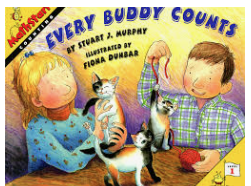
Every Buddy Counts, by Stuart J. Murphy

            What do you do when you wake up feeling lonely, crummy, yucky, and sad?  Count your friends and you will feel better!  This is a nice counting book to share with your children.

Materials

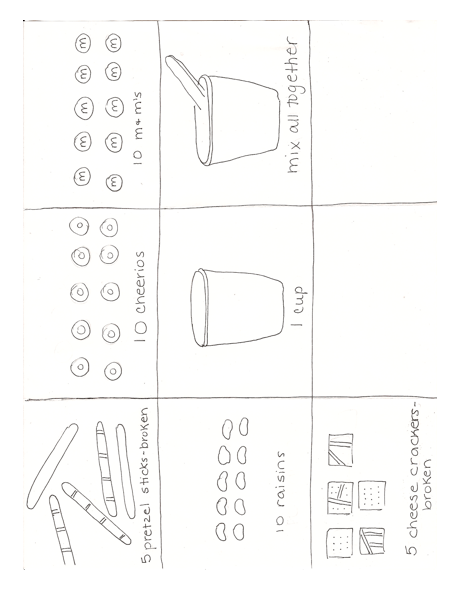
  • Rebus Gorp recipe card
  • Gorp ingredients for the class
  • Dice
  • Felt shapes and a flannel board

Vocabulary

  • More (to have extra, or spare)
  • Less (fewer)

Before Reading the Story

            Do several fingerplays or songs that you know that require some counting (5 Little Ducks, 1,2,3,4,5 I Caught a Fish Alive).

Mathematics/Number & Operations; develops increasing ability to count to 10 and beyond.

Reading the Story

            As you read the book, stop and have the children help count (Example; On the page for 7, count the aunts and uncles and the cars.  Are there more people or more cars?  On the eight page after counting the playmates, ask what the girl is holding in her hand, What is it used for?).

Mathematics/Number & Operations; begins to make use of one-to-one correspondence in counting objects and matching groups of objects. AND begins to use language to compare numbers if objects in terms such as more, less, greater than, fewer, equal to.

After Reading the Story

            Bring in a dice.  Take turns rolling the dice and having the children count how many dots.  Then let the child choose a movement for everyone to do that many times. (Kerry you rolled 3.  Kerry wants to do 3 kicks, everybody kick and count 1,2,3.).

Mathematics/Number & Operations; begins to make use of one-to-one correspondence in counting objects and matching groups of objects. AND Approaches to Learning/Reasoning & Problem Solving; develops increasing ability to find more that one solution to a question, task, or problem.

Discovery

            Make gorp using the rebus cards to count out ingredients.

Literacy/Early Writing; develops understanding that writing is a way of communicating for a variety of purposes.

Music and Movement

            Have the children start in a squatting position and begin to count 1-10.  As they count, they begin to stand up slowly until they get to 10 and are on tip toe with hands in the air.  Now start a 10 and work down to 1 getting smaller and smaller as they count.

Mathematics/Number & Operations; develops increasing ability to count to 10 and beyond.

            Teach the children the finger play 1,2,3,4,5 I Caught a Fish Alive.

            1,2,3,4,5                                    Hold up fingers as you count

            I caught a fish alive                      Point towards yourself

            6, 7, 8,9,10                                Hold up fingers as you count

            Then I threw him back again!        Pretend to throw fish

            What made you let him go?          Shrug shoulders up

            Because he bit my finger so!          Hands on hips with mad face

            Which finger did he bite?              Look of  surprise

            The little pinkie on the right         Hold up little pinkie and look sad

Language Development/Listening & Understanding; demonstrates increasing ability to attend to and understand conversations, stories, songs, and poems.

Blocks

            Challenge the children to make a set of stairs using 10 blocks.  What else can you make using only 10 blocks?

Mathematics/Number & Operations; begins to make use of one-to-one correspondence in counting objects and matching groups of objects. AND Approaches to Learning/Reasoning & Problem Solving; develops increasing ability to find more that one solution to a question, task, or problem.

Art

            Have the children trace around their hands, or they can trace around their friends hands.  Encourage them to embellish their hands with fingernails, rings, and bracelets or watches at the wrist.  When they are finished decorating their hands, show them how to write the numbers 1-10 and put a number above each finger.

Creative Arts/Art; progresses in abilities to create drawings, paintings, models, and other art creations that are more detailed, creative, or realistic.

Library and Writing

            Put out a variety of flannel board shapes and let the children make patterns or count.

Mathematics/Patterns & Measurements; enhances abilities to recognize, duplicate, and extend simple patterns using a variety of materials.

Sand and Water

            Put sand or water in the table.  Ask the children to use a measuring cup and count how many scoops it takes to fill a bowl.  Use several size measuring cups and a variety of containers to fill.  Which containers hold the most?  Which container holds the least?

Mathematics/Number & Operations; begins to use language to compare numbers if objects in terms such as more, less, greater than, fewer, equal to.

Math and Manipulatives

            Make a counting book with the children.  Give each child a paper with a number on it.  The children can draw or cut out pictures of objects to represent their number.  Do numbers 1-10.

Mathematics/Number & Operations; begins to make use of one-to-one correspondence in counting objects and matching groups of objects.

Dramatic Play

            Have the children set the table for two, three, and four.  They will have to count to make sure they have enough dishes and silverware.

Mathematics/Number & Operations; begins to make use of one-to-one correspondence in counting objects and matching groups of objects. AND Approaches to Learning/Engagement & Persistence; demonstrates increasing ability to set goals and develop and follow through on plans.

Outdoor Play

            Play Mother-May-I.  All the children stand at one side of the area.  The children take turns asking “Mother may I take (3) (jumps)?  Mother then says yes, or no you may only take (2) jumps.  The children work there way across to the other side of the play yard counting different movements. (Slides, tippy toe walks, giant steps, skips, jumps, twirls).

Mathematics/Number & Operations; begins to associate number concepts, vocabulary, quantities, and written numerals in meaningful ways.

Transitions

            Have the children count how many steps it takes to get from point A to point B.

Mathematics/Number & Operations; develops increasing ability to count to 10 and beyond.

Resources

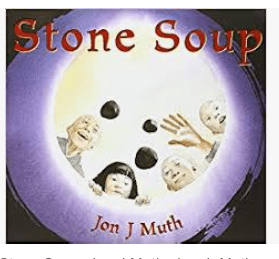
Stone Soup, by Jon J Muth

When hungry strangers come to town, everyone shares a small amount of their food to make a delicious soup which the whole town can enjoy.

Materials

  • Oil pastels
  • Rock collection
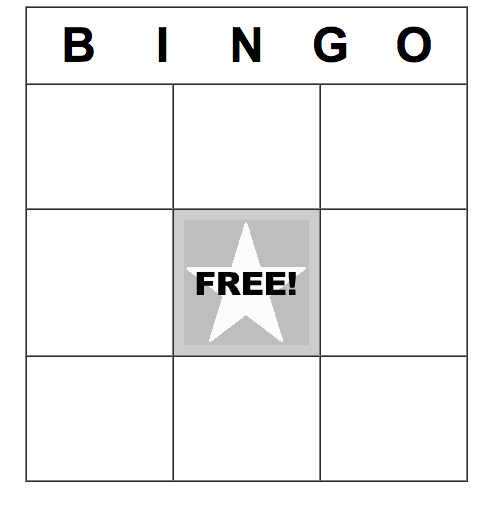
  • Make ahead BINGO cards
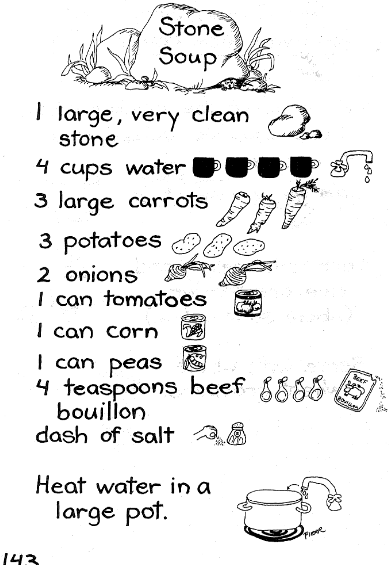
  • Crockpot and ingredients found in Resources.
  • 3-4 pots to use throughout the room today
  • Several plastic bowls and two soup ladles
  • Looking Down & Up cards

Vocabulary

  • Monk (like a minister or religious person)
  • Famine (where there is not enough food and everyone is hungry)
  • Suspicious (not trusting)
  • Scholar (someone who does research and is very smart)

Before Reading the Story

Ask the children how many of them like soup? What kinds of soups do you like to eat? Hold up the cover of the book and read the title. Ask the children if they can guess what they are looking into? What do you think they will do with the pot? Introduce the story.

Literacy/Book Knowledge & Appreciation; demonstrates progress in abilities to retell and dictate stories from books and experiences; to act out stories in dramatic play; and to predict what will happen next in a story. AND Social & Emotional Development/Self-Concept; begins to develop and express awareness of self in terms of specific abilities, characteristics, and preferences.

Reading the Story

On the page where the monks first enter the village, ask the children why they think everyone closed their windows?  (The villagers did not trust anyone)

Approaches to Learning/Reasoning & Problem Solving; develops increasing abilities to classify, compare and contrast objects, events, and experiences. AND Language Development/Speaking & Communicating; progresses in abilities to initiate and respond appropriately in conversation and discussions with peers and adults.

After Reading the Story

Remind the children that the villagers each shared some of their food to make the delicious soup for everyone. Spend a moment talking about sharing.  Point out any acts of sharing that you have recently seen in your classroom (Jamie shared a red marker with Sue when hers stopped working.  Thank you Jamie for sharing). Ask the children to think of a time when they shared with another person. How did it make you feel? How did it make the other person feel? What kinds of things are more fun to do when you share them with another person?

Language Development/Speaking & Communicating; progresses in abilities to initiate and respond appropriately in conversation and discussions with peers and adults. AND Social & Emotional Development/Cooperation; increases abilities to sustain interactions with peers by helping, sharing, and discussion.

At the end of the story, the villagers said that sharing makes everyone feel richer and happy.  As you see children sharing throughout the day, thank them for their generous spirit and thoughtfulness.

Discovery

Put out a rock collection for the children to compare and sort. Add magnifying glasses.

Mathematics/Patterns & Measurement; shows increasing abilities to match, sort, put in a series, and regroup objects according to one or two attributes such as shape or size.

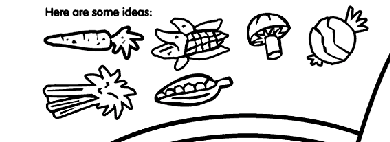
Nutrition bingo. Ahead of time use the BINGO card and the veggie pictures to make BINGO cards. Remember to make each on different. Make a master card of all the veggies that you have glued to the BINGO cards to use for the draw pile.

Approaches to Learning/Engagement & Curiosity; grows in abilities to persist in and complete a variety of tasks, activities, projects, and experiences.

Bring in a crock pot and the ingredients needed to make your own classroom stone soup.

Music and Movement

Bring your plastic veggies to the carpet and sing, The Soup is Boiling Up. https://www.youtube.com/watch?v=Hx6ZdPysVeA

Tell the children that you know how to make chocolate soup and sing. https://www.youtube.com/watch?v=cRFTzna6bGE

Creative Arts/Music; participates with increasing interest and enjoyment in a variety of music activities including; listening, singing, finger plays, games, and performances.

Tell the children that you are going to pretend to buy items to put into your soup. Have the children name items that go into the soup (real or funny) and count! https://www.youtube.com/watch?v=Pt0jjke_Jns

Approaches to Learning/Reasoning & Problem Solving; develops increasing ability to find more than one solution to a question, task, or problem.

Open the page that shows after the banquet with the musicians playing instruments.  Tell the children that you would like to bring out your instruments, play and sing songs at the children’s requests.

Creative Arts/Music; experiments with a variety of musical instruments.

Blocks

Remind the children that the monks came to a village (community, town).  Challenge the children to build a village using the blocks today.  If you have people figures, you can add these to the center to enhance the village.  Add paper and pencil in case someone would like to add any signs to the buildings.

Social & Emotional Development/Knowledge of Families & Communities; begins to express and understand concepts and language of geography in the contexts of the classroom, home, and community.

Art

Give the children a piece of white construction paper with one of the foods from the story printed or drawn on it (use black permanent marker).  Let the children color the food item using the oil pastels.  When they are finished, show them how to use watery watercolors to paint over their food.  The watercolors will not stick where the oil pastel is making the oil pastels pop.  You might want to practice once before you help the children so that you can get the right watery watercolor.

Creative Arts/Art; gains ability in using different art media and materials in a variety of ways for creative expression and representation.

Sand and Water

Fill the pot with water and put into in the sensory table today along with the plastic bowls and ladils. Show the children how to ladil the soup carefully into the bowls without spilling.

Physical Health & Development/Fine Motor Skills; develops growing strength, dexterity, and control needed to use tools such as scissors, paper punch, stapler, and hammer.

Library and Writing

Alphabet soup.  Put a pot in the center with magnet letters.  The children can take turns pulling out a letter and naming.

Literacy/Alphabet Knowledge; identifies at least 10 letters of the alphabet, especially those in their own name.

Dramatic Play

Add stones and a big pot for making stone soup.  Act out story.  Ask different children to add a food from your play food.

Literacy/Book Knowledge & Appreciation; demonstrates progress in abilities to retell and dictate stories from books and experiences; to act out stories in dramatic play; and to predict what will happen next in a story.

Math and Manipulatives

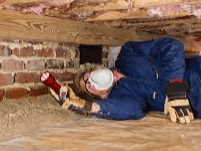
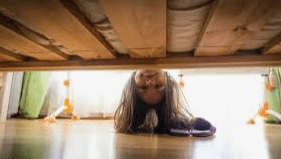
Remind the children that the cover of the book had everyone looking down into the pot. Explain that you have a sorting game where the children must sort if they are looking down or up. Use the cards in Resources.

Mathematics/Geometry & Spatial Sense; builds an increasing understanding of directionality, order, and positions of objects, and words such as up, down, over, under, top, bottom, inside, outside, in front, and behind.

Outdoor Play

If you have a parachute, bring it out with several balls. Have the children stand around the edges of the parachute and toss the balls into the center. The children must try not to let the balls roll out of the parachute ans it moves up and down.

Physical Health & Development/Health Status & Practices; participates actively in games, outdoor play, and other forms of exercise that enhance physical fitness.

Transitions

Remind the children that In the story, the youngest monk asked, “what makes you happy”?  Ask the children this same question and write their responses onto a piece of paper to hang on the wall.  “Things that make us happy”.

Social & Emotional Development/Self-Concept; begins to develop and express awareness of self in terms of specific abilities, characteristics, and preferences.

Resources