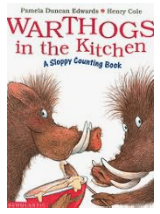
Warthogs in the Kitchen; a sloppy counting book, Pamela Duncan Edwards

            What happens when warthogs cook?  A fun counting book with some messy results.

Materials

  • Bowl, measuring cups
  • Ingredients to make play Dough
  • Cupcake pan
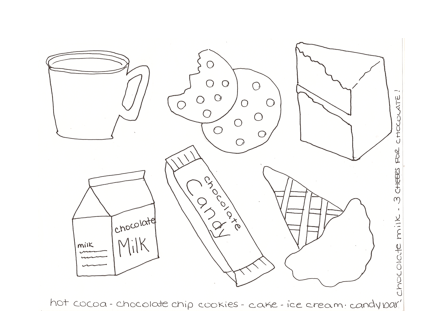
  • Chocolate graph pictures
  • A leftover plate from your last meal, scraped well but not cleaned.
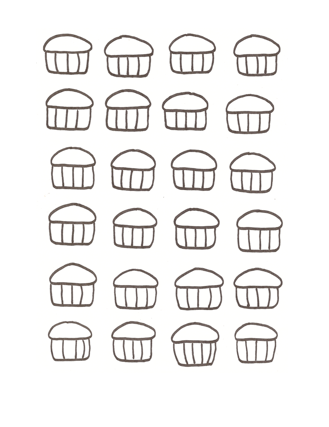
  • Cupcakes for a number chart – 5-10 per page
  • 1/2 paper plate per child

Vocabulary

  •  Hooves (where people have hands and feet, some animals have hooves.  Hooves are hard.  Animals like horses, pigs, deer and warthogs)
  • Invisible Germs (teeny tiny little living thing that is so small you can not even see it, but it can make you sick!)

Before Reading the Book 

            Bring the scraped plate to the group.  Ask the children why they think it is important to use clean plates, cups, and utensils when they eat.  Explain that using dirty plates could make them sick.  Invisible germs hide on plates and can grow into mold and bacteria which are not healthy for people.  Tell the children that you are going to do an experiment to see if any invisible germs are on the plate.  Tape the plate up high on the wall where the children can see it but not touch it.  Leave it there for several days.  Explain that it is really important to always wash your hands and dinnerware before you eat so you do not get sick.  Explain too that it is just as important to make sure you get all the soap off because eating soap can give you diarrhea.

Physical Health & Development/Health Status & Practices; builds awareness and ability to follow basic health and safety rules such as fire safety, traffic and pedestrian safety, and responding appropriately to potentially harmful objects, substances, and activities.

Reading the Book

            Tell the children that today’s story is about some warthogs in the kitchen. Look at the cover; can the children guess what they are doing in the kitchen?  Introduce the book.  When you get to the page where the warthog is washing his hands, nod and tell the children that that is one smart warthog. As you turn each page, stop and point to the number on the page and say the number. As you continue to read, ask the children questions that go along with each page.

Literacy/Book Knowledge & Appreciation; shows growing interest and involvement in listening to and discussing a variety of fiction, non-fiction, and poetry. AND Mathematics/Number & Operations; begins to associate number concepts, vocabulary, quantities, and written numerals in meaningful ways.

After Reading the book

            Ask the children if they ever get to help their parent cook in the kitchen.  Pretend to make cupcakes with the children by acting out different parts of the story.  Remind them that the warthogs put pickles into their cupcakes, what else should we add?  As the children think of things respond with an enthusiastic EW! Or yummy!

Approaches to Learning/Reasoning & Problem-Solving; develops increasing ability to find more that one solution to a question, task, or problem.

Discovery

            Find a play dough recipe that you like and will be able to do at school with the children.  Make play dough and then use with rolling pins and cookie cutters to make cookies.

Science/Scientific Knowledge; shows increased awareness and beginning understanding of changes in materials and cause-effect relationships.

Music and Movement

            Sing This is the Way We Bake a Cake, to This is the Way. https://www.youtube.com/watch?v=o0e1_rV_oms

This is the way we bake a cake, bake a cake, bake a cake

This is the way we bake a cake so yummy for our tummy.

First we have to wash our hands, wash or hands, wash our hands

First we have to wash our hands so yummy for our tummy.

This is the way we bake a cake, bake a cake, bake a cake

This is the way we bake a cake so yummy for our tummy.

Next we have to measure the flour…

Then we have to scoop the butter…

Next we have to break the eggs…

Don’t forget to add the pickle…

Last it goes in the oven…

Creative Arts/Music; participates with increasing interest and enjoyment in a variety of music activities, including listening, singing, finger plays, games, and performances.

            Teach the children the Mexican chant, Chocolate.  Often children drink chocolate milk and stir it with a molinillo.  During the chorus of the chant have the children rub their hands together and pretend to stir the chocolate.  Do the chorus several times, each time faster while the children rub their hands together faster.

            Uno, dos, tres Cho!                                One, two three Cho!

            Uno, dos, tres Co!                                   One, two, three Co!

            Uno, dos, tres La!                                   One, two, three, La!

            Uno, dos, tres Te!                                   One, two, three, Te!

            Chocolate, chocolate!                           Chocolate, chocolate!

            Bate, bate, chocolate!                           Stir, stir, the chocolate!

            Bate, bate, bate, bate                            Stir, stir, stir, stir

            Bate, bate, chocolate!                           Stir, stir, chocolate!     

Mathematics/Number & Operations; develops increasing ability to count in sequence to 10 and beyond.                

Blocks

            Ask the children to try to build a table and put all the plastic people around it for snack.  (Pretend that this person is me, this is Kerry, this is Roger, and which one will be you)?

Creative Arts/Dramatic PLay; participates in a variety of dramatic play activities that become more extended and complex. AND Physical Health & development/Fine Motor Skills;grows in hand-eye coordination in building with blocks, putting together puzzles, reproducing shapes and patterns , and using scissors.

Art;

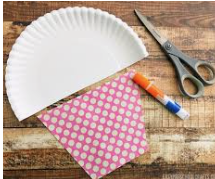
        Tell the children that you are going to be making cupcakes. Show them a finished pattern without any design (see resources). Give each child a half a paper plate and have them decorate as you choose (I like puff paintand sequins).    When the paper plate is dry, help the children assemble it onto the cupcake bottom.

Creative Arts/Art; gains ability in using different art media and materials in a variety of ways for creative expression and representation.

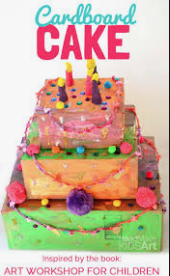
Make a large class cake out of varying sized boxes. See resources. (I have not tried this but it looks like it could be a fun art activity, especially if you could do the painting on the playground and assembly in the classroom once the paint was dry).

Library and Writing

            Write a letter of thanks to your school cook.  Have the children draw pictures of their favorite meal, themselves eating, or the cook. 

Literacy/Early Writing; develops an understanding that writing is a way of communicating for a variety of purposes.

Sand and Water

            Add some of your dramatic dishes to soapy water for dishwashing play. Do not forget the towels for drying.

Creative Arts/Dramatic PLay; participates in a variety of dramatic play activities that become more extended and complex.

Dramatic Play

            Add aprons, or use scarves as apron and pretend to do some baking.  Add measuring cups and cupcake pan.

Creative Arts/Dramatic PLay; participates in a variety of dramatic play activities that become more extended and complex.

Math and Manipulatives

            Tell the children that they are going to be making number graphs. On a large piece of paper write the numbers 1-10 down the side.  Give the children each enough pages of cupcakes to color and add the appropriate amount beside the number. Young children can work together to make, older children might enjoy making their own number graph.

Mathematics/Number & Operations; begins to associate number concepts, vocabulary, quantities, and written numeral in meaningful ways.

Outdoor Play

            Dampen the sand or some dirt and let the children make sand/mud cakes. As they play, ask them what ingredients they put into their cake, it smells good, may I try a piece when it is finished baking?

Creative Arts/Dramatic PLay; shows growing creativity and imagination in using materials and in assuming different roles in dramatic play situations.

Transitions

            Ask each child to come up and mark on the graph which kind of chocolate they like best.  Later you can look at the graph together and talk about what has the most responses and the least.

Literacy/Early Writing; progresses from using scribbles, shapes, or pictures to represent ideas, to using letter-like symbols, to copying or writing familiar words such as their own name. AND Mathematics/Number & Operations; begins to use language to compare numbers of objects with terms such as more, less, greater than, fewer, and equal.

Resources


cakes for math & Manipulatives
This look like a fun group project

Where Does The Butterfly Go When It Rains? by May Garelick

            What a wonderful question this title is.  Follow along as the author tells where other animals go when it rains, but where does the butterfly go when it rains?

Materials

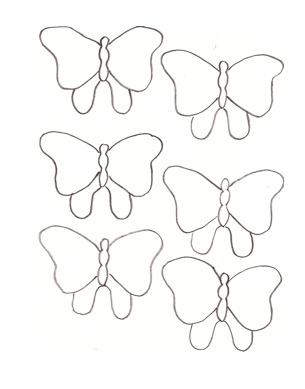
  •             Butterfly match game/patterns
  • Butterfly wings (sold at Dollar Store)
  • 8 one to two in paint brushes and buckets

Vocabulary

  •             Hide ( to move out of sight or to be blocked from view)

Before Reading the Story

            Talk about where and what people do when it is raining outside.  Make sure to touch on the safety of going inside when there is thunder.  Talk about how after the rain there are puddles, does anyone like to play in the puddles?  Ask the children if they know what an umbrella is, have they ever used one?  Ask the children if they know where animals might go when it rains (my cat runs under Mommy’s car, the cow goes to the barn)  Introduce the story and ask it as a question, Where do the butterflies go when it rains?

Science/Scientific Knowledge; expands knowledge of and abilities to observe, describe, and discuss the natural world, materials, living things, and natural processes. AND Physical Health & Development/Health Status & Practices; builds awareness and ability to follow basic health and safety rules such as fire safety, traffic and pedestrian safety,, and responding appropriately to potentially harmful objects, substances, and activities.

Reading the Story

After you ask the question, “Where does the butterfly go in the rain’? Give the children a few seconds to respond before you turn the page. If no one responds, shrug your shoulders and continue reading. If someone does respond say “I don’t know, let’s keep reading”.

Language Development/Listening & Understanding; demonstrates increasing ability to attend to and understand conversations, stories, songs, and poems.

After Reading the Story

            Cut out a small butterfly shape from a manila file.  Cut out a triangle, circle, square, and rectangle from colored paper that is big enough for the butterfly to be able to hide under without being seen.  Have a child hide their eyes.  Place the butterfly under one of the shapes.  The child then opens their eyes and guesses which shape the butterfly is under.  Make sure to have the child name the shape that he thinks the butterfly is under.  Then let that child hide the butterfly while another child guesses.

Mathematics/Geometry & Spatial Sense; begins to recognize, describe, compare, and name common shapes, their parts, and attributes.

Discovery

If you have butterflies already at your center, put out orange slices and water to attract them to a window close to your science center. Check out this web site for more info about making butterfly feeder. https://insteading.com/blog/how-to-attract-butterflies/

Science/Scientific Knowledge; expands knowledge of and abilities to observe, describe, and discuss the natural world, materials, living things, and natural processes.

Music and Movement

            Teach the children the counting rhyme, La Mariposa

            Uno, dos tres, cuatro, cinco                       One, two, three, four, five

            Cogi una mariposa de un brinco.                I caught a butterfly.

            Seis, siete, ocho, nueve, diez                     Six, seven, eight, nine, ten

            La solte brincando otra vez                        Then I let him go again.

Mathematics/Number & Operations; develops ability to count in sequence to 10 and beyond.

Play the piano piece, Butterfly in the Rain and let your children dance and move to the music. https://www.youtube.com/watch?v=lVXmtckavDQ

Creative Arts/Movement; expresses through movement and dancing what is felt and heard in various musical tempos and styles.

Blocks

            Put out a few paper butterflies, or draw several small ones on a manila folder and cut out.  As the children build structures they can hide the butterflies within or on the structure.  Then ask you or another child to come and find them. Older children might like to cut out their own butterfly to hide.

Physical Health & Development/Fine Motor Skills; grows in hand-eye coordination in building with blocks, putting together puzzles, reproducing shapes and patterns, stringing beads, and using scissors.

Art

            Give each child a clean manila folder.  Have them dab small amounts of paint onto one side.  Fold the other side over and press with their hands.  Open back up and let it dry.  When it is dry, refold it and then draw a butterfly pattern on one side.  Older children can cut these out but the teacher will have to cut for younger children.  Cut both sides together.  If your center allows, hang the butterflies from the ceiling with the painted side facing the floor.

Give each child a white coffee filter and tell them to color it with water soluble markers. When they have finished coloring the entire coffee filter have them use a squirt bottle to spray their coffee filter 3 times. This will cause the marker to run and the colors to melt into each other. Use a clothespin for the body and put half the coffee filter through to make wings.

Creative Arts/Art; gains ability in using different art media and materials in a variety of ways for creative expression and representation.

Sand and Water

            Put sand in the table today and hide magnet letters in it.  The children can scoop and sift in search of the letters.  Make an alphabet chart and as the children find the letters, they can match them to the chart.

Literacy/Alphabet Knowledge; identifies at least 10 letters of the alphabet, especially those in their name.

Library and Writing

On the bottom of each piece of drawing paper write; If I were a butterfly I would hide from the rain _______. Read this sentence to the children and then ask them to illustrate it. You can collect all the pictures and make a book, Where Would We Butterflies Hide From the Rain?

Approaches to Learning/Reasoning & Problem Solving; develops increasing ability to find more than one solution to a question, task, or problem. AND Literacy/Early Writing; begins to represent stories and experiences through pictures, dictation, and in play.

Dramatic Play

Many Dollar Store sell butterfly or fairy wings in theri toy department. If your center has a budget, ask them to purchase enough so that everyone in the dramatic center can have a pair of wings to wear.

Math and Manipulatives

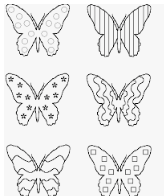
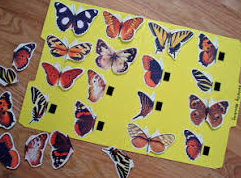
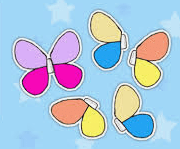
            Make a butterfly pattern matching game.  Make two copies of each butterfly pattern, cut, color and cover with contact paper.  The children then match the butterfly’s that are the same.

Mathematics/Patterns & Measurement; shows increasing abilities to match, sort, put in series, and regroup objects according to one or two attributes such as shape or size.

Outdoor Play

Give the children the large paint brushes and buckets filled with water. Show them ow to paint the building, the sidewalk, and the tree. If you have a lot of cement, challenge the children to write thier names with the water before it evaporates.

Literacy/Early Writing; experiments with growing variety of writing tools and materials, such as markers, crayons, and computer. AND Approaches to Learning/Initiative & Curiosity; chooses to participate in an increasing variety of tasks, activities, projects, and experiences.

Transitions

On pieces of paper write 2 and 3 step directions. Put the pieces of paper into a bowl. The children take turns pulling one out and then must follow the instructions. (Put your hands on your head and hop forward 3 hops, Tell your neighbor hello, clap your hands and then turn around. Jump 2 times and touch your toes. Jump 2 times, clap your hands 2 times, and turn around. Nod your head yes then shake your head no. Jump and turn 4 times. Etc.).

Language Development/Listening & Understanding; shows progress in understanding and following simple and multiple-step directions.

for making butterfly matching game
ideas for butterfly matching game

It Looks like Spilt Milk, by Charles G. Shaw

            This book will help young children begin to look up into the sky and be more aware of what is floating over head.

Materials

  • Peep-hole folder (a manila folder that has a one inch hole cut out of it).  Pictures to put behind the peep-hole.
  • Ivory Snow Flakes or shaving crème
  • 3 pieces of blue poster board
  • 3 bags of white cotton balls

Vocabulary

  • Symmetrical (when two sides are the same)

Before Reading the Story

            Bring your peep-hole file to the rug time.  Tell the children that you are going to play a game called Picture Riddle.  They are going to have to guess what you have a picture of by looking through a little hole.  Take a picture (pictures should be large enough that only a part of it shows through the hole) and place it inside the file so that a clue of the whole picture can be seen through the one inch hole.  Ask the children if they can guess what it is.  Move the picture around a little bit so that the children can see different parts of the picture. The children should only be able to see the bit of picture that peeps through the one inch hole.  Let the children guess.  Do several pictures.  Tell the children that today’s story is like a riddle too, that they will have to guess what the picture is.

Approaches to Learning/Reasoning & Problem Solving; grows in recognizing and solving problems through active exploration, including trial and error, and interactions and discussions with peers and adults.

Reading the Story

            As you turn each page read, “Sometimes it looked like” and then stop and let the children see if they can fill in the answer.  Shake your head no each time you say “but it wasn’t a …”

Approaches to Learning/Reasoning & Problem Solving; develops increasing abilities to classify, compare, and contrast objects, events, and experiences.

After Reading the Story

            Bring a dry erase board to the group or several pieces of paper.  Tell the children that you are going to play another picture riddle game called Guess What I Am Drawing.  Begin by drawing a familiar shape or letter.  Then embellish it to turn it into something else. (A square can become a house, the letter B can become a butterfly).  Let the children guess what you are drawing. Or start with the square and ask the children to help guide your drawing. (It’s a square but what else could it turn into? Now it’s a house, I can turn it into a fire station…).

Approaches to Learning/Reasoning & problem Solving; develops increasing ability to find more than one solution to a question, task, or problem.

Discovery

            Work in small groups to create 3 cloud information posters.  On each poster draw a simple house about 2/3 down the poster board.  On the first one write; Cumulus Clouds-soft and fluffy, good weather below.  On the 2nd one write; Cirrus Clouds-wispy and light, the weather is changing.  On the third one write; Cumulonimbus Clouds-thick and black, rain is on its way!  Now have the children use the cottons balls to make the correct clouds for each poster.  You might want to have a child or two gently stroke black paint on to the cumulonimbus cloud. When you are finished with the posters, hang them up somewhere where you can easily see them and talk about them (near the lunch table, near the door to line up for outside) throughout the week.

Science/Scientific Knowledge; expands knowledge of and abilities to observe, describe, and discuss the natural world, materials, living tings, and natural processes.

Music and Movement

            Sing Did You Ever See A Cloud?  Sung to the tune of Did You Ever See a Lassie. https://www.youtube.com/watch?v=nxscqqheBdQ

Did you ever see a cloud, a cloud, a cloud,

Did you ever see a cloud float this way and that?

Float this way and that way,

Float this way and that way.

Did you ever see a cloud float this way and that?

(make up two movements to go with your song. Let the children help make up movements)

Creative Arts/Movement; shows growth in moving in time to different patterns of beat and rhythm in music.

Give each child a scarf to move to the music with. Tell them that the scarf is their cloud. Can they move their cloud above their head, low near the ground, twirling through the sky, moving all together, moving alone.

Mathematics/Geometry & Spatial Sense; builds an increasing understanding of directionality, order, and positions of objects, and words such as up, down, over, top, under, bottom, inside, outside, in front, behind.

Blocks

            Explain to the children that symmetrical means that both sides are the same.  Talk briefly about how our bodies are symmetrical. If you cut it in half, both would have an eye, ear, shoulder, arm, leg, etc.. Show the children how to build a symmetrical structure by placing blocks on one side exactly like those on the other.  Encourage the children to work in pairs and continue to build on your symmetrical structure.

Language Development/Speaking & Communicating; uses an increasingly complex and varied spoken language.

Art

            Let the children draw their own Guess what I am drawing pictures.  Put yours out to show and encourage them to make different ones.  For older children you can encourage them to use letters (you might have to draw the initial letter onto the page) and then they can draw around it.

Literacy/Alphabet Knowledge; shows progress in associating names of letters with their shapes and sounds.

Tell the children that today you are going to make symmetrical clouds.  Symmetrical means both sides are the same.  Ask the children if they can think of anything that is symmetrical (their bodies, a butterfly, an apple).  Give each child a large piece of blue construction paper.  Have them fold the paper in half.  On one half place a spoonful of white paint.  Fold the paper back over and use the palm of the child’s hand to flatten/squish the paint.  Open up and let the child decide if they would like to add more paint.  Continue the process.  When the child is finished, have them tell you what they think it looks like and write it on the bottom of the painting. When these are dry, you could make your own class book or bulletin board, “It looked like spilt milk”.

Literacy/Early Writing; begins to represent stories and experiences through pictures, dictation, and in play.

Sand and Water

            Whip up Ivory Snow Flakes and water into a fluffy consistency and let the children use in the table today.  Or if your center allows, shaving crème. Give the children plastic forks and spoons.

Social & Emotional Development/Self-Control; demonstrates increasing capacity to follow rules and routines and use materials purposefully, safetly, and respectfully.

Library and Writing

            Draw a sun onto a piece of paper.  Make 10-26 clouds from paper large enough so that they will all cover the sun shape.  On each cloud write a letter that you are working on with the children.  Have the children take turns searching for the cloud that you call out.  (Kerry, can you find the cloud with the letter K on it?).  As they identify the clouds they can pick them up off the sun until the sun is shining out alone.

Literacy/Alphabet Knowledge; identifies at least 10 letters of the alphabet, especially those in their name.

Dramatic Play

Explain to the children that you want them to use their imagination today while they are in the dramatic center. Pay attention to what they choose to play and the roles that each child takes. Is it truely imaginative or did they use the equipment in the most standard way?

Creative Arts/Dramatic Play; shows growing creativity and imagination in using materials and in assuming diffrent roles in dramatic play situations. AND Social & Emotional Development/Cooperation; develops increasing abilities to gove and take in interactions; to take turns in games or using materials; and to interact without being overly submissive or directive.

Math and Manipulatives

     On a large piece of paper, trace around objects from your classroom (a small block, a toy car, a plastic spoon from dramatics kitchen, etc.. Try to trace one or two objects from every center onto the paper. Put the items into a basket and have the children match them. For older children to make more difficult, trace a pencil and then put three different sized ones into the basket. Trace a kitchen set plate and put two different sized ones into the basket. The children must find the correct items and lay them over the shapes you have drawn onto the paper.   

Mathematics/Geometry & Spatial Sense; begins to be able to determine whether or not two shapes are the same size and shape.     

Outdoor Play

            Bring out a blanket and watch the clouds float by.  Do you see anything up there?  Make sure to use cloud words as you help the children describe (fluffy, wispy, bumpy, layered, billowed, thick, and piled. 

Language Development/Speaking & Communicating; uses an increasingly complex and varied vocabulary. AND Approaches to Learning/Initiative & Curiosity; approaches tasks and activities with increased flexibility, imagination, and inventiveness.

Transitions

           Do animal walks. Have the children pick an animal to act out on their way to the next activity.  (It looked like Kerry but it was really a soft furry cat, It looked like Roger but it was really an enormous stomping elephant).

Approaches to Learning/Initiative & Curiosity; approaches tasks and activities with increased flexibility, imagination, and inventiveness. AND Physical Health & Development/Gross Motor Skills; shows increasing levels of proficiency, control, and balance in walking, climbing, running, jumping, hopping, skipping, marching, and galloping.

Resources