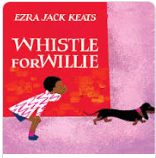
Whistle for Willie, by Ezra Jack Keats

            Peter wants to be able to whistle.  He practices and practices and practices.  This book is a good example of the idea that practice makes perfect or if at first you don’t succeed, try and try again.

Materials

  • One paper plate per child.
  • A bright light that will make shadows on the wall
  • Several sponges cut into one-inch pieces and attached to a clip clothes pin.
  • Dachshund dog page for length or sorting

Vocabulary

  •  Proud (to feel pleased with yourself)
  •  Pride (to feel pleased or proud of yourself)
  •  Whistle (to make a sound by blowing through your lips)
  •  Whirl (to spin around and around)
  • Shadow (a darkened shape of something made by bright light, like the sun)

Before Reading the Story

            Ask the children if they know how to whistle.  Let them experiment.  Talk to them about how you have to try and try and try.  That to keep trying is called practice.  Explain to the children that something’s take lots of practice. Introduce the story by stating that today’s story is about a little boy named Peter who really wanted to be able to whistle.  Can you guess what he did (he practiced)?  Have the children repeat the motto; practice makes perfect.

Language Development/Listening & Understanding; demonstrates increasing ability to attend to and understand conversations, stories, songs, and poems.

Reading the Story

            As you go along, let the children try to whistle with Peter.

Literacy/Book Knowledge & Appreciation; shows growing interest and involvement in listening to and discussing a variety of fiction, non-fiction, and poetry.

After Reading the Story

            Ask the children how they think Peter felt after he finally learned to whistle (happy, proud, special)? Ask them if they have ever practiced and practiced something and then finally learned how to do it.  Did it make them feel proud? (I learned to ride my bike without trainer wheels on it.  I can write my name but I couldn’t when I was three, I can almost make my bed)  Write a list of the children’s ideas.

Social & Emotional Development/Self-Concept; demonstrates growing confidence in a range of abilities and expresses pride in accomplishments.

Discovery

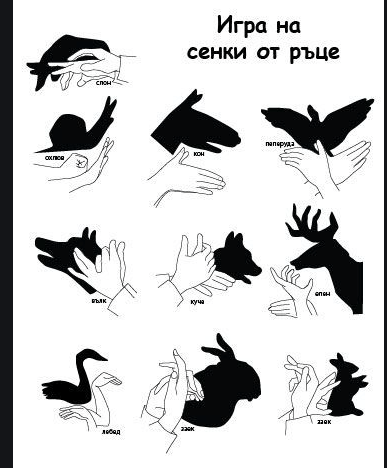
            Find a place in your school where the children can easily see and make shadows.  Show the children that their shadow does what they do although the shape of it might be different.  Let the children experiment with shadows and shadow play.

Science/Scientific Skills & Methods; begins to use senses and a variety of tools and simple measuring devices to gather information, investigate materials, and observe processes and relationships.

Music and Movement

Do the following poem with the children.

I’m whirling, I’m twirling, I’m whirling all around

Faster and faster then I sit upon the ground.

I’m whirling, I’m twirling. I’m whirling all around

Slower and slower them I sit upon the ground.

Language Development/Listening & Understanding; shows progress in understanding and following simple and multiple-step directions.

            Practice whistling!

Approaches to Learning/Engagement & Persistence; grows in abilities to persist in and complete a variety of tasks, activities, projects, and experiences.

Bring in a whistle. Explain to the children that when you blow the whistle they are to walk forward. When you blow it again, they are to walk backward. Do this several times and see if they are able to follow the directions. Or blow once to jump and twice to skip, etc..

Language Development/Listening & Understanding; shows progress in understanding and following simple and multiple-step directions.

Blocks

Depending upon the size of the blocks in your center, encourage the children to build a structure that the can hide inside of or a structures that a people/animal manipulatives can hide inside of. As you go over to check on the children play Teacher Says. Teacher says hide inside your structure. Teacher says stand beside your structure. Teacher says make your body lower than your structure. Teacher says hide behind your structure.

Mathematics/Geometry & Spatial Sense; builds increasing understanding of directionality, order, and positions of objects, and words such as up, down, over, under, top, bottom, inside, outside, in front, behind.

Art

            Show the children how to print by using a sponge.  Pinch a piece pf sponge with the clip clothespin. SHow the children how to dip the sponge into paint and then print (up and down, up and down) across their paper or around the edges. This will get some of the same effect as the illustrations in the book.

Creative Arts/Art; gains ability in using different art media and materials in a variety of ways for creative expression and representation.

Library and Writing

            Explain to the children that you are going to make an I Am Proud book.  Have the children review things that they have done that make them feel happy and pleased with themselves.  Ask them to draw what their face looks like when they are proud onto the paper plate.  On the back of each plate write what makes them proud.  Punch holes in the plates and attach together with a piece of yarn. (My Mom let me feed my brother said Kerry, I did my own seatbelt yesterday said Tammie, I buttoned all my buttons, even the little one said Roger)

Social & Emotional Development/Self-Concept; demonstrates growing confidence in a range of abilities and expresses pride in accomplishments.

Sand and Water

Dramatic Play

            Remind the children that in the story Peter wanted to feel grown-up so he put on his father’s hat.  Ask the children what clothes in your dramatic center could make them feel grown up?  Encourage them to try the clothes on. Challenge them to do their own buttons, zippers, velcro, and snaps.

Physical Health & Development/Health Status & Practices; shows growing independence in hygiene, nutrition, and personal care when eating, dressing, washing hands, brushing teeth, and toileting.

Math and Manipulatives

Cut out the dashund dogs and challenge the children to arrange them from shortest to longest. Or cut out several of each length dog and sort them.

Mathematics/Patterns & Measurement; shows growth in matching, sorting, putting in series, and regroup objects according to one or two attributes such as shape or size.

Outdoor Play

If you have any whistle or whistle slides (think Dollar Store) bring them in for the children to enjoy.

            Take colored chalk outside and let the children color on the sidewalk.  Can they write their name? Can they draw various shapes? If you do not have a place to use colored chalk, try writing in the dirt with sticks.

Literacy/Early Writing; experiments with a growing variety of writing tools and materials, such as pencils, crayons, and computers.

In the story there was a girl jumping rope.  For older children encourage them to practice this skill.

Physical Health & Development/Gross Motor Skills; shows increasing levels of proficiency, control, and balance in walking, climbing, running, jumping, hopping, skipping, and galloping.

Transitions

            As each child leaves the group, ask them to try to whistle. After their attempt, remind them that practice makes perfect.

Approaches to Learning/Engagement & Persistence; grows in abilities to persist in and complete a variety of tasks, activities, projects, and experiences.

Resources
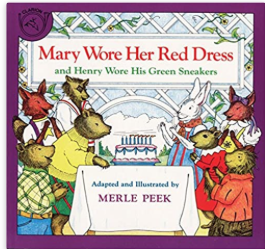
Mary Wore Her Red Dress, by Merle Peek

            Today is Mary’s birthday and her friends are coming to help her celebrate.  Sing your way through this folk song and name colors and articles of clothing along the way.

Materials

  • Pictures of articles of clothing
  • M&M’s or jelly beans for math
  • Swatches of various fabrics, two of each
  • Box of birthday candles/silk flowers
  • Birthday party supplies, crepe paper, wrapping paper, hats, etc..

Vocabulary

  • Sneakers (gym shoes)
  • Bandana (a scarf that you can wear on your head or around your neck)

Before Reading the Story

Talk to the children about their birthdays. Who is the next in your classroom to have a birthday? Who was the last birthday? How many children are 4 and will turn 5? How many are 5 and will turn 6? Let the children share with you any birthday experiences that they choose. (When it was my birthday I had a pink cake. I got a scooter for my birthday).

Language Development/Speaking & Communicating; progresses iin abilities to initiate and respond appropriately in conversation and discussions with peers and adults.

Reading the Story

            First time through, sing the story.  https://www.youtube.com/watch?v=N284P3zpL_4. As you turn to the next page, ask the children if they can name the color.

Language Development/Speaking & Communicating; uses an increasing complex and varied spoken vocabulary. AND Language Development/Listening & Understanding; demonstrates increasing ability to attend to and understand conversations, stories, songs, and poems.

After Reading the Story

Second time, go back through the story and this time read the pictures with the children.  On each page let the children talk about what they see. (What kind of animal is Mary?  Where is she?  What is she doing?  Why is she walking across that log?  What is on her head?  What do you think is inside the box?)  Allow plenty of time for the children to discuss and share their party experiences with one another.

Literacy/Book Knowledge & Appreciation; demonstrates progress in abilities to retell and dictate stories from books and past experiences; too act out stories in dramatic play; and to predict what will happen next in a story.

Discovery

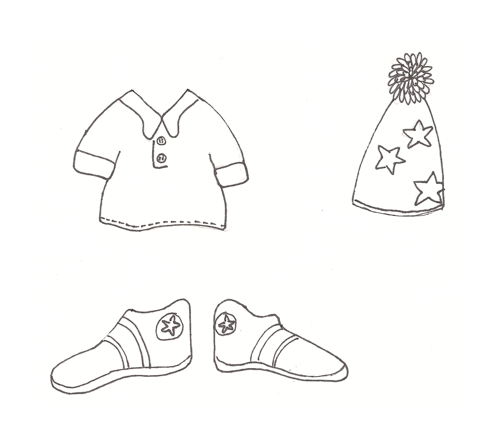
            Make several copies of the clothing and color them.  Put a piece of tape on the back or make them into flannel board pieces.  On an index card write the colors that you made the clothes (blue=shirt) and color the card to correspond.  Now hold up a color card and ask a child to find the piece of clothing that matches the color.  The children can match color words to colored clothing. Ask them to name the article of clothing.

Mathematics/Patterns & Measurement; shows increasing abilities to match, sort, put in a series, and regroup objects according to one or two attributes such as color, shape, or size.

Bring in swatches of various types of fabrics. Talk about the textures and patterns that the fabric have. Let the children match the two pieces of fabric that are the same.

Mathematics/Patterns & Measurement; shows increasing abilities to match, sort, put in a series, and regroup objects according to one or two attributes such as color, shape, or size.

Music and Movement

        Put on the song This is a Song About Color by Hap Palmer and follow the directions. https://www.youtube.com/watch?v=4v-nocdm20g

Language Development/Listening & Understanding; shows progress in understanding and following simple and multiple-step directions.

           Use the tune of the story today and sing about the children in your classroom. Go around the circle and ask each child to name one article of clothing that they are wearing today. Sing about it. While you are singing, clap to the beat of the song. What other movements can you do to the beat of the song? (Sean is wearing his cowboy boots, cowboy boots, cowboy boots. Sean is wearing his cowboy boots all day long. Ryan is wearing his dinosaur shirt…).

Social & Emotional Development/Self-Concept; begins to develop and express awareness of self in terms of specific abilities, characterstics, and preferences.

            Sing any song you have about colors, for example, The Rainbow Song. Have the children point to any colors that they might be wearing.

Red and yellow and pink and green,

Purple and orange and blue, black, brown and white

I can sing a rainbow, sing a rainbow, sing a rainbow too.

Language Development/Listening & Understanding; demonstrates increasing ability to attend to and understand conversations, stories, songs, and poems.

            Sing the Happy Birthday Song.

Creative Arts/Music; participates with increasing interest and enjoyment in a variety of music activities, including listening, singing, finger plays, games, and performances.

Blocks

            In the story Mary is crossing a log-bridge.  Challenge the children to make bridges (balance beam) today that they can walk across or their cars can drive across.

Physical Health & Development/Gross Motor Skills; shows increasing levels of proficiency, control, and balance in walking, climbing, running, jumping, hopping, skipping, marching, and galloping.

Art

            Put large balloon shapes at the easel and let the children paint the balloons.  When they dry they can be hung up together with yarn to look like balloon strings. Hang near your birthday chart.

Physical Health & Development/Fine Motor Skills; progresses in abilities to use writing, drawing, and art tools, including pencils, markers, chalk, paint brushes, and various types of technology.

Library and Writing

            Copy the clothing page to a large format and let the children choose which they choose to color.  After they color their clothing article, ask them to describe it.   Underneath it write _____ wore her _____all day long (Kerry wore her green and white striped sweater all day long).  Put these together and make a classroom book that the children can learn to sing.

Literacy/Early Writing; begins to represent stories and experieinces through pictures, dictation, and in play.

Sand and Water

            Dampen the sand add birthday candles and silk flowers. Let the children be a birthday bakery and design cakes.

Creative Arts/Dramatic Play; participates in a variety of dramatic play activities that become more extended and complex.

Dramatic Play;

            Add birthday party materials; crepe paper, birthday hats, gift bags, wrapping paper.  Let the children play birthday party.

Creative Arts/Dramatic Play; participates in a variety of dramatic play activities that become more extended and complex.

Math and Manipulatives

            This would be a fun day to do M&M math activities or jelly bean math.

Mathematics/Number & Operations; begins to use language to compare numbers of objects with terms such as more, less, greater than, fewer, equal to.

            Make three sets of each clothing article.  Color one that corresponds with the story and color 2 that do not.  Ask the child, can you remember what color shirt, dress, shoes, were in the story? Put out the book and the articles of clothing and show the children how to look up the answers.

Literacy/Book Knowledge & Appreciation; shows growing interest in reading related activities, such as asking to have a favorite book read; choosing to look at books; asking to take books hoe; and engaging in pretend reading with other children.

Outdoor Play

            Have the children all line up on one side of the playground.  Tell them the object of the game is to be the first to the other side of the playground but you have to follow the directions to get there.  Call out different colors and actions.  If the child is wearing the color, they may do the action. (If you are wearing red take 5 giant steps, if you are wearing green take 3 skips).

Language Development/Listening & Understanding; shows progress in understanding and following simple and multiple-step directions. AND Social & Emotional Development/Self-Control; demonstrates increasing capacity to follow rules and routines and use materials purposefully, safely, and respectfully.

Transitions

            Play I Spy as the children head to the next activity.  (I spy a child who is wearing a red shirt with yellow stripes, I spy a child who is wearing black shoes with a white laces)

Approaches to Learning/Reasoning & Problem Solving; grows in recognizing and solving problems through active exploration, including trial and error, and interactions and discussions with peers and adults.

Mr. Gumpy’s Outing, by John Burningham

            Mr. Gumpy owns a boat.  One day Mr. Gumpy was going out for a boat ride and it seemed like everybody wanted to come with.  Watch what happens when a boat full of animals and people  is crowded and on the river.

Materials

  • Several Life preservers if available
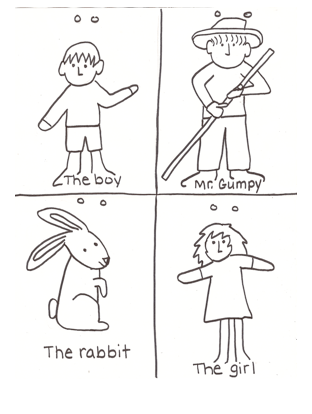
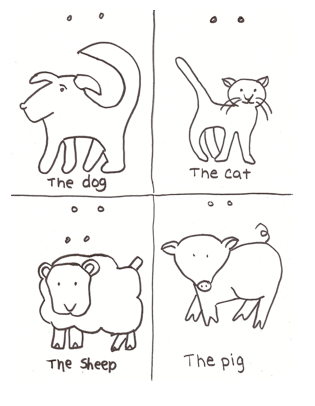
  • Chest plate to represent Gumpy, boy, girl, rabbit,Cat, dog, pig, sheep, chicken, cow, goat
  • Roll of tin foil

Vocabulary

  • River (a long channel or stream of water that flows to a lake or the ocean)
  • Squabble (to fuss at or bicker with someone)
  • Muck about (to mess around with or poke nose into someone else’s business).
  • Bleating (the sound sheep make)
  • Trample (to step on)
  • Float ( it stays on the top of the water)
  •  Sink ( it goes to the bottom of the water)

Before reading the Story

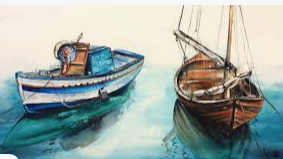
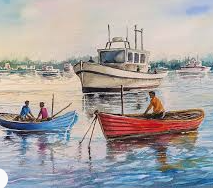
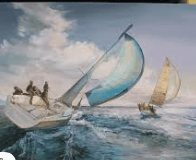
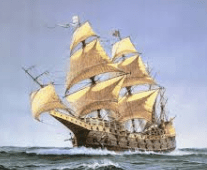
            Hold up the cover of the book and ask the children if they know what everyone is sitting in (boat)? Ask the children if they have ever been in a boat?  Where do you use a boat, what do you need to wear in a boat and what do you do in a boat?  Bring in several pictures of kinds of boats to name and discuss with the children. Hang the boats on the wall. Give each child a slip of paper with their name on it and have them tape it beneath their favorite boat.

Mathematics/Patterns & Measurement; begins to make comparisons between several objects based on a single attribute.

Reading the Story

As you read, whenever Mr. Gumpy is asked if someone can come along, answer shaking your head. When you get to the page where it says, “For a little while they all went along happily, read until it says the children squabbled and then stop and ask the children if they can guess what is going to happen?

Literacy/Book Knowledge & Appreciation; demonstrates progress in abilities to retell and dictate stories from books and experiences; to act out stories in dramatic play; and to predict what will happen next in a story.

After reading the Story

            Go through the story one more time and have the children act it out with you.  The teacher can be Mr. Gumpy and the children can be the other characters (put on the picture mantels so everyone knows what part each person is playing).  Make sure that they help you figure out how to act out mucking about and squabbling.

Literacy/Book Knowledge & Appreciation; demonstrates progress in abilities to retell and dictate stories from books and experiences; to act out stories in dramatic play; and to predict what will happen next in a story.

Discovery

            Add a large bowl or bucket of water to the center.  Put out a variety of small classroom objects that the children can experiment with to see if they will sink or they will float.  Have them sort them accordingly. 

Science/Scientific Skills & Methods; begins to participate in simple investigations to test observations, discuss & draw conclusions, and form generalizations. AND Mathematics/Patterns & Measurement; begins to make comparisons between several objects based on a single attribute.

Music and Movement

            Sing Row, Row, Row Your Boat with the children and act out different ways you can row the boat individually or with a partner.  https://www.youtube.com/watch?v=WphumMGa7Ms Think of a variety of ways to row the boat.

Social & Emotional Development/Self-Control; develops growing understanding of how their actions affect others and begins to accept consequences of their actions.

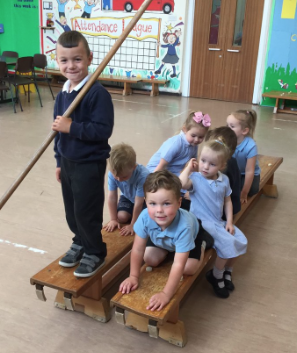
            Mr Gumpy’s boat is a long narrow punt type boat that you must push with a pole.  Have the children stand and row or punt to the left, the right, the left, the right.

Blocks

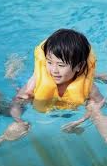
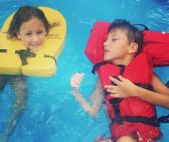
            If you are lucky enough to have access to several life preservers, bring them in for the children to put on and practice buckling and unbuckling. If you do not have access to life preservers, hang up the pictures of people wearing life preservers. Explain to the children that it is the law to wear them if you are in a boat on the water. Encourage the children to make a boat out of the blocks.

Physical Health & Development/Fine Motor Skills; grows in hand-eye coordination in building with blocks, putting together puzzles, preproducing shapes and patterns, stringing beads, and using scissors. AND Physical Health & Development/Health Status & Practices; builds awareness and ability to follow basic health and safety rules a such as fire safety, traffic and pedestrian safety, and responding appropriately to potentially harmful objects, substances, and activities.

Art

            Give the children squares of tin foil and ask them to see if they can make a boat that will float in the water table.  Will their boat hold bear counters?  Mr. Gumpy would be so pleased.

Creative Arts/Art; begins to understand and share opinions about artistic products and experiences. AND Mathematics/Number & Operations; begins t make one-to-one correspondence in counting objects and matching matching groups of objects.

Library and Writing

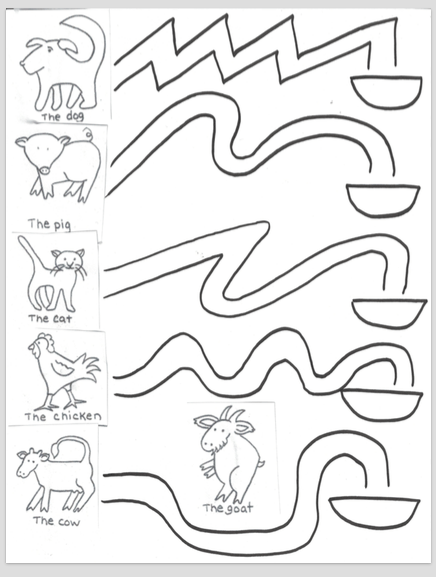
Make a copy of the Mr. Gumpy path pages for each child. Can they follow the path and stay inside the lines?

Literacy/Early Writing; experiments with a growing variety of writing tools and materials, such as pencils, crayons, and computers.

Sand and water

            Put water into the table today and boats to float.  If you have no boats, use plastic Tupperware containers.  Challenge the children to see how many counting bears they can put into the boat/Tupperware before it tips.

Mathematics/Number & Operations; begins to associate number concepts, vocabulary, quantities, and written numerals in meaningful ways.

Dramatic Play

Make a set of character medallions for the children to retell the story in dramatic play.

Literacy/Book Knowledge & Appreciation; demonstrates progress in abilities to retell and dictate stories from books and experiences; to act out stories in dramatic play; and to predict what will happen next in a story. AND Social & Emotional Development/Cooperation; develops increasing abilities to give and take in interactions; to take turns in games and using materials; and to interact without being overly submissive or directive.

Math and Manipulatives

            Make a simple boat shape that is just big enough for three counters of choice.  Mark a “river” on the table using 2 pieces of masking tape.  Give the children 10 counters and tell them that they have to get them all across the river.  How many times will the boat have to go back and forth to get 10 counters across?  Remember that one counter has to stay in the boat to steer.  Walk the children through the steps to figure out how many times the boat has to go back and forth across the water.

Mathematics/Number & Operations; demonstrates increasing interest and awareness of numbers and counting as a means for solving problems and determining quantity.

Outdoor Play

Encourage the children to work together to build a river in the sand box. When they are finished, let them pour water into the river. What happens(evaporation)? Can the children saturate the sand enough to have it fill with water? Try this in the dirt, is it easier or harder?

Science/Scientific Methods & Skills; begins to participate in simple investigations to test observations, discuss and draw conclusions, and form generalizations.

Put out a balance beam on the playground and have the children practice walking it forward, backward, sliding side -to-side, etc.. Play a game that if you fall off then you fall into the water.

Physical Health & Development/Gross Motor Skills; chows increasing levels of proficiency, control, and balance walking, climbing, running, jumping, hopping, skipping, marching, and galloping.

Transitions

            Can you name an animal that was on the boat?  Pretend to swim to the next activity.  Can you name some more farm animals?

Approaches to Leatning/Reasoning & Problem Solving; develops increasing abilities to classify, compare, and contrast objects, events, and experiences.

Resources
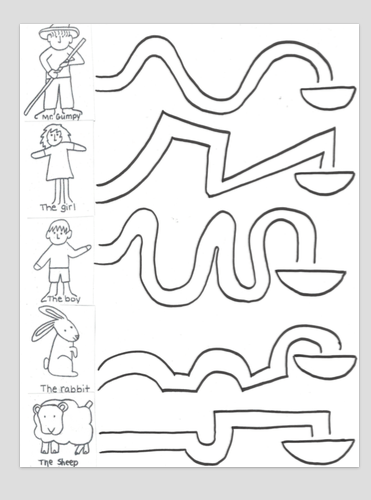
Can the children draw a line inside the pathway from a character to the boat?
Boats for discussion
Life preserver pictures for discussion
boat ideas for blocks or dramatic play