Johnny Appleseed, by Steven Kellogg

            September 26th, is the birthday of Johnny Appleseed.  This is a great time of year to introduce the children to this folk hero and to have fun with apples.

Materials


  • Apple for cutting or tracing the words    
  • Several varieties of apples for the children to try
  • Small White paper plate per child.
  • Shades of red, yellow, and green tissue paper.
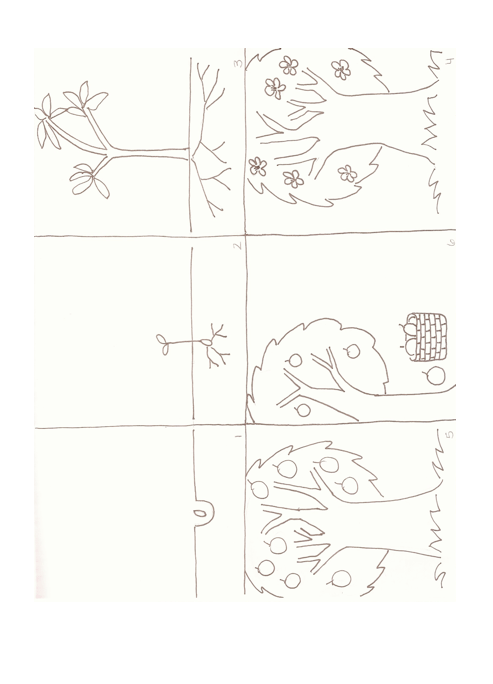
  • Apple tree growth cycle
  • Apple trees for blocks

Vocabulary

  • Apple varieties of those being used in your taste testing
  • Sapling (a seedling, in this case a tiny apple tree)
  • Respectful (showing care and thoughtfulness)
  • Boisterous (loud and noisy)

Before Reading the Story

            Bring an apple to the rug and ask the children to guess what shape is inside the apple.  After the children have guessed, cut the apple in half and show them the star shape that the seeds make.  Tell them that there is a star inside every apple.  Count the seeds.  There are always 5 seeds inside an apple and they make the shape of a star.  Ask the children to repeat back how many seeds are in an apple? What shape do the seeds make? Tell the children that today’s story is about an apple star named Johnny Appleseed.  He is an apple star because he planted apples all over the United States for people to enjoy.

Science/Scientific Knowledge; expands knowledge of and abilities to observe, describe, and discuss the natural world, ,materials, living things, and natural processes.

Reading the Story

After reading a page, stop and talk about it if you feel your children are getting lost. This story is more difficult for younger preschool children but is a good introduction into an American Historical figure (social studies) and fun to do in the fall when apples are always fresh and in season.

Language Development/Listening & Understanding; understands an increasingly complex and varied vocabulary. AND Language Development/Listening & Understanding; demonstrates increasing ability to attend to and understand conversations, stories, songs, and poems.

After Reading the Story

            Talk about how Johnny was respectful of nature.  Ask the children if they know what respectful means.  Talk about ways that the children are respectful of nature. (I don’t step on the bugs when they are on the playground.  I only smell the flowers and not pick them, I don’t take the leaves off the bushes cause the bush needs leaves).  Talk about how the children show concern and thoughtfulness towards one another and the school environment. (I am nice to her when she plays with me, I throw the paper in the garbage and not the floor).

Social & Emotional Development/Self-Control; develops growing understanding of how their actions affect others and begins to accept the consequences for their actions.

Discovery

            Appleseed growth cycle cards.  Can the children put them in 1-6 order?

Science/Scientific Knowledge; expands knowledge of and abilities to observe, describe, and discuss the natural world, materials, living things, and natural processes.

            Put out apples and plastic knives for the children to dissect and use their senses to discover apples.  How does the apple feel, taste, smell, sound when you bite it?

Science/Scientific Skills & Methods; begins to participate in simple investigations to test observations, discuss and draw conclusions, and form generalizations.

Music and Movement

            Teach the children the following poems,

Eat an apple

Save the Core

Plant the Seeds

And grow some more!

Science/Scientific Knowledge; shows increased awareness and beginning understanding of changes in materials and cause-effect relationships.

________________________________________

Way up high in the apple tree,

Two red apples smiled down on me.

I shook the tree as hard as I could,

Down fell the apples and they were good!

Language Development/Listening & Understanding; demonstrates increasing ability to attend to and understand conversations, stories, songs, and poems.

Sing, I like to eat apples and bananas. https://www.youtube.com/watch?v=r5WLXZspD1M

Literacy/Phonological Awareness; shows increasing ability to discriminate and identify sounds in spoken language.

Blocks

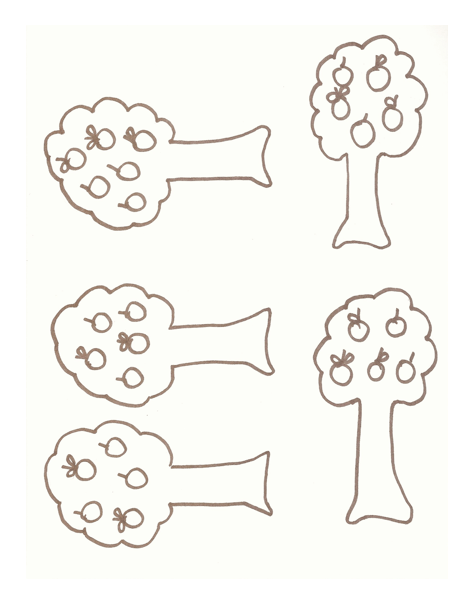
            Tape simple apple trees to rectangular blocks and encourage the children to make rows and patterns.

Mathematics/Patterns & Measurement; enhances abilities to recognize, duplicate, and extend simple patterns using a variety of materials.

Art

            Give each child a white paper plate.  Use small squares of tissue paper and glue to collage.  When it is dry, add a stem and leaf to make an apple shape. Encourage the child completely fill in the paper plate with tissue paper squares?

Creative Arts/Art;progresses in abilities to create drawings, paintings, models, and other creations that are detailed, creative, or realistic.

Library and Writing

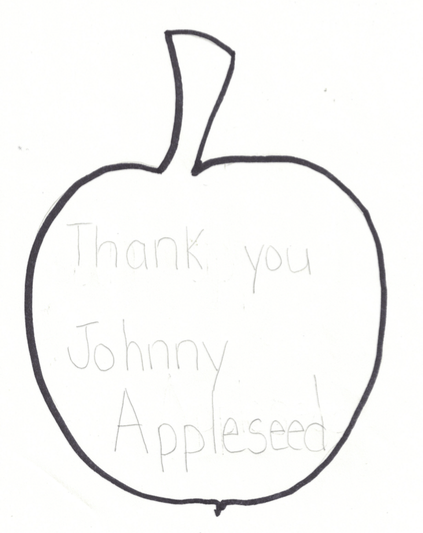
            Give each child an apple shape. Ask them to cut out the apple along the dark line and then use markers to go over the light lines to write, thank you Johnny Appleseed.

Physical Health & Development/Fine Motor Skills; grows in hand-eye coordination in building with blocks, putting together puzzles, reproducing shapes and patterns, stringing beads, and using scissors. AND Physical Health & Development/Fine Motor Skills; progresses in abilities to use writing, drawing, and art tools; including pencils, markers, chalk, paint brushes, and various types of technology.

Sand and Water

Put dirt in the table today along with unifix cubes. The children can pretend that the unifix cubes are apple seeds and plant them. Then they can dig for the seeds and collect them by color. How many red unifix cubes did you find? How many green?

Mathematics/Number & Operations; begins to use one-to-one correspondence in counting objects and matching groups of objects.

Dramatic Play

Math and Manipulatives

            Make s simple tree picture on a large sheet of construction paper for each child who will play the game.  3-4 children at a time is a good number.  Give each child a pile of 15 red dots/ apples.  The children take turns tossing a dice and then putting that number of apples/dots onto their tree.  The first child to get 15 onto their tree is the winner.

Mathematics/Number & Operations; begins to associate number concepts, vocabulary, and quantities, and written numerals in meaningful ways.

Outdoor Play

            Let the children dig small holes around the playground or in the sand box and pretend to plant seeds.

Physical Health & Development/Health Status & Practices; progresses in physical growth, strength, stamina, and flexibility.

            Look for seeds on the playground.  If you find seeds, collect them and bring them in to the discovery center. Can the children identify what kinds of seeds they are?

Science/Scientific Skills & Methods; developers growing abilities to collect, describe, and record information through a variety of means, including discussion, drawings, maps, and charts.

Transitions

            Bring in several kinds of apples.  Let the children each try a small piece of each and then graph the one that they liked best.

Science/Scientific Skills & Methods; developers growing abilities to collect, describe, and record information through a variety of means, including discussion, drawings, maps, and charts. AND Social & Emotional Development/Self-Concepts; begins to develop and express awareness of self in terms of specific abilities, characteristics, and preferences.

Resources
Make 4-5 sets of copies and color the apples red, yellow, and green. Use in blocks to make apple tree patterns.

Mrs. Wishy-Washy’s Farm, by Joy Crowley

            What happens to the farm animals when they decide they no longer want to be bathed and run away from Mrs. Wishy-Washy? 

Materials

  • Picture of a washing tub
  • Bubble Solution/ 1 cup water, 2 Tablespoons Joy dish soap, 1 Tablespoon glycerine
  • Bubble Blowers/pipe cleaners, straws, berry basket, spools, small pvc piping
  • Bucket or large container

Vocabulary

  • Scrub (to be bathed)
  • Stampede (when animals or people rush headlong somewhere).
  • Anxious (feeling nervous)

Before Reading the Story

            Begin a conversation about when you go somewhere new or very different how it can make you feel anxious or nervous.  Remind the children about their first days at school, remember when you did not feel like you knew what you were supposed to do or where you were supposed to go?  What did you do, who helped you feel better?  Explain that today’s story is about some animals that run away from the farm and go to the city.  The animals have never been to the city before and find that it makes them nervous and confused. Ask, “I wonder what will happen”? and leave a beat to see if any child has an idea.

Literacy/Book Knowledge & Appreciation; demonstrates progress in abilities to retell and dictate stories from books and experiences; to act out stories in dramatic play; to predict what will happen next in a story. AND Language Development/Speaking & Communicating; develops increasing abilities to understand and use language to communicate information, experiences, ideas, feelings, opinions, needs, questions; and for other varied purposes.

Reading the Story

            When you get to the part where the animals run away, ask the children if they can tell how Mrs. Wishy-Washy must feel.  Were the animals nice to her?  Why did they want to run away?  What could they have done instead?  When you get to the page where the animals are in jail and hear the chug, chug, chug of the old farm truck; stop and ask the children what they think will happen next.

Literacy/Book Knowledge & Appreciation; demonstrates progress in abilities to retell and dictate stories from books and experiences; to act out stories in dramatic play; to predict what will happen next in a story.

After Reading the Story

            Play slippery soap with the children.  It is similar to Simon Says except that each child is given a paper towel and the caller calls out body parts to be washed.  Slippery soap says wash your leg, Slippery soap says wash your wrist, behind your ear, under your chin.

Language Development/Listening & Understanding; shows progress in understanding and following simple and multiple-step directions.

Discovery

            Put out bubbles and blowers today and let the children make bubbles. If you do not have a lot of bubble blowers, you can make simple ones out of pipe cleaners.

Science/Scientific Skills & Methods; begins to participate in simple investigations to test observations, discuss and draw conclusions, and form generalizations.

Music and Movement

            Put on this video song and have the children sing and dance to the song, I Took a Bath in a Washing Machine https://www.youtube.com/watch?v=65Moz_FSkRw

            Sing This is The Way We… https://www.youtube.com/watch?v=o0e1_rV_oms

This the way I wash myself, wash myself, wash myself

This is the way I wash myself to make me nice and clean.

This is the way I wash my face.

This is the way I brush my teeth.

This is the way I wash my hands.

Physical Health & Development/Health Status & Practices; shows growing independence in hygiene, nutrition, and personal care when eating, dressing, washing hands, brushing teeth , and toileting.

Blocks

            Encourage the children to sort any animals in the center by farm animals and non-farm animals.

Mathematics/Patterns & Measurement; shows increasing abilities to match, sort, put in a series, and regroup objects according to one or two attributes such as color, shape, or size.

Art

            Finger paint today!  Can the children write their name in the finger paints? Are they able to draw shapes as you call them out?

Mathematics/Geometry & Spatial Sense; progresses in ability to put together and take shapes apart. AND Literacy/Early Writing; progresses from using scribbles, shapes, or pictures to represent ideas, to using letter-like symbols, to copying or writing familiar words such as their own name.

Library and Writing

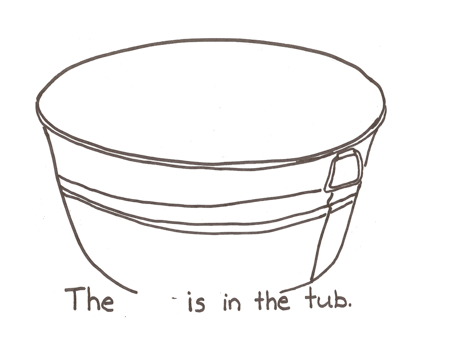
            Give each child a paper with the washing tub on it.  Ask the children to draw a picture of a farm animal in the tub.  Underneath write, The _______ is in the tub. Put them all together and make a classroom Washy Book.

Literacy/Early Writing; begins to represent stories and experiences through pictures, dictation, and in play.

Sand and Water

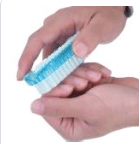
            Let the children wash baby dolls or plastic farm animals in bubble water.  Add scrub brushes (tooth brushes, nail brushes). 

Physical Health & Development/Health Status & Practices; shows growing independence in hygiene, nutrition, and personal care when eating, dressing, washing hands, brushing teeth , and toileting. AND Creative Arts/Dramatic Play; shows growing creativity and imagination in using materials and in assuming different roles in dramatic play situations.

Dramatic Play

            Add any old slippers and aprons that you might have to share.  Bring in a bucket and any stuffed animals you might have.  The children can pretend to be Mrs. Wishy-Washy.

Creative Arts/Dramatic Play; participates in a variety of dramatic play activities that become more extended and complex.

Math and Manipulatives

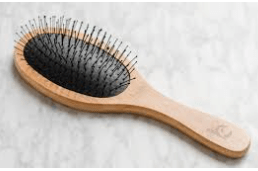
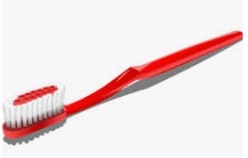
Put out pictures (or the real objects) of various brushes and tools. Give a simple definition and see if the child is able to identify the correct tools. (You use this to scrub your teeth clean, you use this to get the knots out of your hair, you use this to cut paper).

Approaches to Learning/Reasoning & Problem Solving; develops increasing abilities to classify, compare, and contrast objects, events, and experiences.

Outdoor Play

            Have the children dig a hole in the dirt and add water to make mud play. Let them dig a hole and then carry buckets of water to fill it. As the water evaporates into the soil, mud play! Talk about what is happening to the water that is poured into a dry hole. Will the same thing happen to a hole that is already wet down? In the sand?

Science/Scientific Skills & Methods; begins to participate in simple investigations to test observations, discuss and draw conclusions, and form generalizations.

Transitions

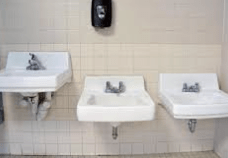
            As the children wash their hands throughout the day make sure that they are using good hand washing techniques.  As they scrub the bubbles have them repeat wishy-washy, wishy-washy, wishy-washy.

Physical Health & Development/Health Status & Practices; shows growing independence in hygiene, nutrition, and personal care when eating, dressing, washing hands, brushing teeth , and toileting.

Resources

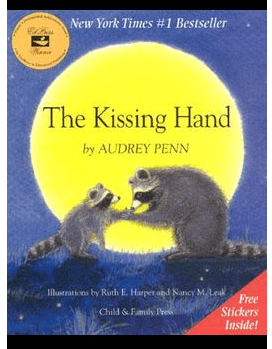
The Kissing Hand, by Audrey Penn

            Chester was about to begin his first day of school and he was scared.  See how his mother helps him to overcome his fears in a gentle loving way.

Materials

  • Lots of small pre-cut hearts
  • Manila file

Vocabulary

  • Raccoon (A small ring-tailed animal that sleeps during the day and comes out at night)
  • Nocturnal (All animals that sleep mostly during the day and come out at night to eat and play)

Before Reading the Story

            If this is the first week of school you can introduce the book by saying you know it feels kind of scary right now at school. But you will soon have lots of new friends.  Talk about things that you will be doing at school in the near future (later we will get to go out on the playground and ride the bicycles, after breakfast we can get out play dough).  Tell the children that they are all being very brave and that it will be ok.  Let them know that you are there to make them feel safe and to have fun.

Social & Emotional Development/Social Relationships; demonstrates increasing comfort in talking with and accepting guidance and directions from a range of familiar adults.

            If you are reading this book at any other time, talk about how sometimes we do things that feel scary but after we do them we know that it was not so hard.  Ask the children to try to think of examples (I rode my bike with no trainer wheels and I fell, I climbed to the top of the big slide, I ate that food on my plate, I slept in the room all by myself).  Tell the children each time that they were brave.

Social & Emotional Development/Self-Concept; demonstrates growing confidence in a range of abilities and expresses pride in accomplishments.

Reading the Story

            On the page where Chester’s Mother shows him what a kissing hand is, stop and kiss your own hand and then when she tells him how to rub it on his cheek, do on yours. Encourage the children to follow your example.

Language Development/Listening & Understanding; demonstrates increasing ability to attend to and understand conversations, stories, songs, and poems.

After Reading the Story

            Turn to the last page with all the animals in the tree.  Tell the children that this is Chester’s school, have you ever seen a school like this?  Ask them if they can tell what time it is?  Can you name some of the nocturnal animals in the picture? 

Science/Scientific Knowledge; develops a growing awareness of ideas and language related to the attribute of time and temperature.

Discovery

            In the story, Chester used his mouth for kissing his mother’s hand.  What other things do we use our mouth for?  Put mirrors in the center so the children can look at their mouths.  Help the children name the parts of the mouth (teeth, gum, tongue, lips)? 

Science/Scientific Skills & Methods; begins to use senses and a variety of tools and simple measuring devices to gather information, investigate materials, and observe processes and relationships. AND Language & Development/Speaking & Communicating; uses an increasingly complex and varied spoken language.

Music and Movement

Teach the children the song, I’m Thinking of a Name.  On individual pieces of paper, write each child’s name.  Hold up one name at a time and cover all but the first letter of the name with another piece of paper.

I’m Thinking of a Name (sung to All Around the Mulberry Bush)https://www.youtube.com/watch?v=FTgxW32ie5E

I’m thinking of a name that starts with _____,

Starts with _______, Starts with ________.

I’m thinking of a name that starts with _____.

Do you know the name?

(slowly pull the paper across the letters to reveal the name.  As you pull, pronounce the letter sounds as you go)

Literacy/Early Writing; develops an understanding that writing is a way of communicating for a variety of purposes. AND Literacy/Alphabet Knowledge; increases ability to notice the beginning letters of familiar words.

Blocks

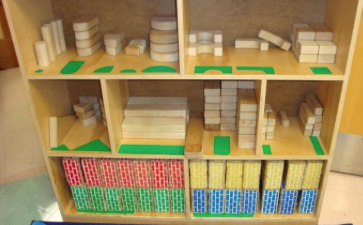
Make markings on the shelves to show the children how to put the blocks away neatly. Explain that when Chester, and they, were new at school, they also had to learn where and how to put the toys away. Encourage the children to pull out the blocks and carefully put them back according to their shapes and sizes.

Literacy/Early Writing; develops an understanding that writing is a way of communicating for a variety of purposes. AND Mathematics/’Geometry & Spatial Sense; shows growth in matching, sorting, putting in series, and regrouping objects according to one or two attributes such as shape or size.

Art

            Let the children use stamp pads and make handprints onto a large piece of paper.  Cut out hearts that they can then glue to the palm of each hand.  Older children can trace around a heart shape and cut it out themselves. Label the pictures ‘The heart is you.  The hand is me.  It says I love my family”.  Have the children look carefully at their hand print.  Note the lines and patterns that make up your hand print.

Physical Health & Development/Fine Motor Skills; develops growing strength, dexterity, and control needed to use tools such as scissors, paper punch, stapler, and hammer. AND Science/Scientific Skills & Methods; develops increased ability to observe and discuss common properties, differences and comparisons, and form generalizations.

Sand and Water

            Dampened sand.  Show the children how to make sand castles and hand prints in the damp sand.

Physical Health & Development/Fine Motor Skills; develops growing strength, dexterity, and control needed to use tools such as scissors, paper punch, stapler, and hammer.

Library and Writing

            On a manila file cut out a heart shape.  The children can then trace around the heart, cut it out and write their name on it.

Physical Health & Development/Fine Motor Skills; develops growing strength, dexterity, and control needed to use tools such as scissors, paper punch, stapler, and hammer. AND Literacy/Early Writing; progresses from scribbles, shapes, or pictures to represent ideas, to using letter-like symbols, to copying or writing familiar words such as their own name.

Dramatic Play

            Bring in ‘school supplies’ (pencils, paper, lunchbox, book sack, three ring binder). Encourage the children to play school and to do writing.

Literacy/Early Writing; experiments with a growing variety of writing tools and materials, such as pencils, crayons, and computers.

Math and Manipulatives

            On a piece of paper write each child’s name.  Cut out many small hearts from construction paper.  Ask the children to glue a heart underneath each letter of their name.  Ask the children to count their hearts to see how many letters are in their name.  You can graph these on the wall by the number of letters in each child’s name.  Who has the least, which has the most?

Language Development/Listening & Understanding; shows progress in understanding and following simple and multiple-step directions. AND Mathematics/Number & Operations; begins to associate number concepts, vocabulary, quantities, and written numerals in meaningful ways.

Outdoor Play

            Tell the children to pretend that they are walking to school.  Can you walk very fast?  Can you walk backwards, in a curved line, zigzag line, on your tiptoes?  Can you skip to school or gallop?

Physical Health & Development/Gross Motor Skills;shows increased levels of proficiency, control, and balance in walking, climbing, running, jumping, hopping, skipping, marching, and galloping.

Transitions

Play I’m Thinking of a Child. Say I’m thinking of a child who has red hair and is wearing yoga pants and a T-shirt with letters on it. Let the children guess. If the children are just learning names, you could say,”Yes, I was thinking og Jenny”.

Social & Emotional Development/Social Relationships; shows progress in developing friendships with peers.

Resources

Shelves are labeled to keep blocks neat and in order.