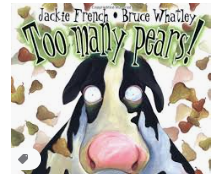
Too Many Pears! by Jackie French

            This is a book to teach children about fruit, especially pears.  Pamela the cow just can’t seem to get enough pears.  This is a fun book to help the children try to problem solve how to stop Pamela from eating all the pears!

Materials

  •  Several pears and a plastic knife to cut.
  •  Pretty bowl
  • Bag of pom poms, several tongs/tweezers, and bowls
  • Several Place setting pictures with parts cut out separately
  • Model for outside jumping game, see resources

Vocabulary

  •  Orchard (a place where fruit and or nut trees grow.)

Before Reading the Story

            Begin a discussion about favorite foods.  Ask the children what happens if they eat too much food (I throw up, my belly gets hurting, I burp really, really loud).  Show and read the children the cover of the book.  Ask them how they think Pamela is feeling, why?

Language Development/Speaking & Understanding; develops increasing abilities to understand and use language to communicate information, experiences, ideas, feelings, opinions, needs, questions, ; and for other varied purposes. AND Social & Emotional Development/Self-Concept; begins to develop and express awareness of self in terms of specific abilities, characteristics, and preferences.

Slowly read the cover of the book sounding out the words.  Watch to see if any children are able to recognize beginning letters and their sounds.

Literacy/Phonological Awareness; shows growing awareness of beginning and ending sounds in words.

Reading the Story

            Stop when you get to the page where Pamela is tied to a tree.  Ask the children to help think of ways to keep Pamela from eating all the pears.  Write their ideas down on chart paper.

Literacy/Book Knowledge & Appreciation; demonstrates progress in abilities to retell and dictate stories from books and experiences; to act out stories in dramatic play; and to predict what will happen next in a story.

After Reading the Story

            Bring in a pear so that the children can try a small piece.  Make a graph that shows I like pears/I do not like pears.  The children can write their name on the corresponding side after they taste the pear.  After all the children have put their name on the pear graph, ask them if more or less children liked the pears.  How many children in total said they liked pears?

Mathematics/Patterns & Measurement; begins to make comparisons between several objects based on one or two attributes. AND Literacy/Early Writing; progresses from using scribbles, shapes, or pictures to represent ideas, to using letter-like symbols, to copying and writing familiar words such as their own name.

Discovery

            While you are preparing a pear for the children to taste test, pass one around so that the children may smell it and feel it.  Open it up and show the children the seeds inside.  Are there a lot of seeds or just a few?  What color are they?  Bring in two different kinds of pears, are they the same inside?

Science/Scientific Skills & Methods; begins to use senses and a variety of tools and simple measuring devices to gather information, investigate materials, and observe processes and relationships

Music and Movement

            Do the Pear poem with the children.  As you say the poem make up simple actions for the children to do.

Way up high in the pear tree,

Two yellow pears smiled down on me.

So I shook that tree as hard as I could

And down fell the pears and were they good!

Language Development/Listening & Understanding; demonstrates increasing ability to attend to and understand conversations, stories, songs, and poems.

            Sing Where Oh Where Are All the Children, to https://www.youtube.com/watch?v=NsZ6RS67oAY

Where oh where are all the children,

Where oh where are all the children?

Where oh where are all the children,

Way down yonder in the pear orchard.


Picking pears, put them in the basket,

Picking pears, put them in the basket.

Picking pears, put them in the basket

Way do yonder in the pear orchard.

(Do other fruits and vegies. My class liked cutting broccoli, pulling carrots, digging potatoes, picking up watermelon, etc.).

Creative Arts/Music; participates with increasing interest and enjoyment in a variety of music activities, including listening, singing, finger plays, games, and performances. AND Approaches to Learning/Reasoning & Problem Solving; develops increasing abilities to classify, compare, and contrast objects, events, and experiences.

Blocks

            Attach 5-10 yellow pear shapes, orange orange shapes, and red apple shapes to blocks and ask the children to sort by kinds or make a pattern. 

Mathematics/Patterns & Measurement; enhances abilities to recognize, duplicate, and extend simple patterns using a variety of materials.

Art

            Cut out large fruit shapes and put them at the easel for the children to paint.

Physical Health & Development/Fine Motor Skills; progresses in abilities to use writing, drawing, and art tools, including pencils, markers, chalk, paint brushes, and various types of technology.

Library and Writing

            Give each child a cow shape.  Ask them to glue it too the paper and draw a picture about their idea to stop Pamela.  Dictate.  Use the chart paper from rug time to review and get the children started.

Literacy/Early Writing; begins to represent stories and experiences through pictures, dictation, and in play.

Sand and Water

Pour the pom poms into the table and set out the tongs and several bowls or ice cube trays. The children use the tongs to pickup the pom poms and sort them by color.

Mathematics/Patterns & Measurement; shows increasing abilities to match, sort, put in a series, and regroup objects according to one or two attributes such as color, shape, or size. AND Physical Health & Development/Fine Motor Skills; develops growing strength, dexterity, and control needed to use tools such as scissors, paper punch, stapler, and hammer.

Dramatic Play

            Put all the plastic fruits into a large bowl today and put it out on the kitchen table.  As the children play in dramatics today, ask them if they can name all the fruits in the bowl.  Do they know where the fruits grow, a tree, a vine, or a plant?

Science/Scientific Knowledge; expands knowledge of and abilities to observe, describe, and discuss the natural world, materials, living things, and natural processes.

Math and Manipulatives

Make several place setting pictures and cut each piece out individually (fork, spoon, knife, and plate). Tell the child that they are pretending a friend is coming to eat with them. How many place setting do you need to make? Remind them that they need to set one for themselves also. How many place settings do you need if two friends were coming over? Have the child fix the place settings making sure each gets all the parts.

Mathematics/Number & Operations; begins to use one-to-one correspondences in counting objects and matching groups of objects.

Outdoor Play

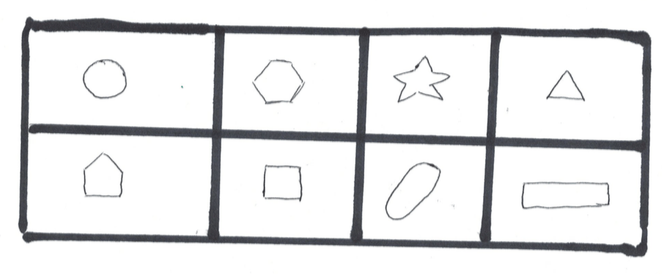
Draw the jumping board on the cement using chalk. Instead of filling in with shapes, fill it in with simple pictures of fruits and vegies. Have a child stand at one end and name a fruit/vegie on the jumping board. The child jumps onto the correct square. Try naming 2-3 at a time and see if the child can jump from square to square in the correct order.

Language Development/Listening & Understanding; shows progress in understanding and following simple and multiple-step directions.

Transitions

Hold up a piece of plastic food from the dramatic center and ask a child to name it. Ask them if they can make the first sound in the word. Ask them if they can clap out the syllables of the word.

Literacy/Phonological Awareness; shows growing awareness of the beginning and ending sounds in words. AND Literacy/Phonological Awareness; shows growing ability to hear and discriminate separate syllables in words.

Resources

cut out each utensil separately. Make 3-5 sets
Draw simple fruits and vegies into each square for jumping

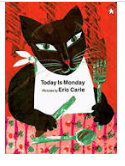
Today is Monday, by Eric Carle

            This is a fun book to help children learn the days of the week.  It can be put to song for added enjoyment. https://www.youtube.com/watch?v=vKejkbxg-KE

Materials

  •             Oil pastels

Vocabulary

  •             Week (a 7 day period that usually begins on Monday).

Before Reading the Story

            Talk about your class calendar.  Ask the children if they can tell you what a week is.  Find an event on your calendar and count how many more weeks until you are there. (In 2 weeks we are going to visit the library).  Tell the children that the story today is about the days of the week.  Ask the children if they can name the days, point to the calendar as they name.

Mathematics/Number & Operation; demonstrates increasing interest and awareness of numbers and counting as a means for solving problems and determining quantities. AND Mathematics/Patterns & Measurement; shows progress in using standard and non-standard measures for length and area of objects.

Reading the Story

            Stop on each page and have the children name the animal on the page and any features they may know about it. (The bird/pelican has a big mouth to catch the fish in).

Science/Scientific Knowledge; expands knowledge of and abilities to observe, describe, and discuss the natural world, materials, living things, and natural processes.

After Reading the Story

            Who can remember what the porcupine ate?  How about the elephant? 

Literacy/Book Knowledge & Appreciation; demonstrates progress in abilities to retell and dictate stories from books and experiences; to act out stories in dramatic play; and to predict what will happen next in a story.

Discovery

            While eating meals today, discuss with the children what you are eating, where it comes from, and any other form of the product.  (We are eating pizza today.  Did you know that cheese comes from cows?  And the dough of the pizza is a kind of bread.  See this red sauce, guess what this is made from?). 

Science/Scientific Knowledge; expands knowledge of and abilities to observe, describe, and discuss the natural world, materials, living things, and natural processes. AND Science/Scientific Knowledge; shows increased awareness and beginning understanding of changes of materials and cause-effect relationships.

Music and Movement

            Sing the Days of the Week song. https://www.youtube.com/watch?v=3tx0rvuXIRg&list=PL23kAfsAb8s1DlveAZNkdDdam7A427kgM

Mathematics/Patterns & Measurement; shows progress in using standard and non-standard measures for length and area of objects.

            Sing I Love to Eat Apples and Bananas. https://www.youtube.com/watch?v=a4AOHOdJ1Bk

I love to eat, I love to eat, I love to eat

Apples and bananas.

I love to eat, I love to eat, I love to eat

Apples and bananas.

(Each verse sing all the vowels in the same long A, short A, long E, short E, etc)

Literacy/Phonological Awareness; shows increasing ability to discriminate and identify sounds in spoken language

            Sing Aiken Drum https://www.youtube.com/watch?v=KcC4_km61aU

There was a man that lived on the moon, lived on the moon, lived on the moon.

There was a man that lived on the moon and his name was Aiken Drum.

And he played upon the guitar, the guitar, the guitar,

He played upon the guitar and his name was Aiken Drum.

Well his hat was made of (child names a food type), of ___, of ____

His hat was made of _____ and his name was Aiken Drum.

Continue to name clothing articles and foods.  Sing the chorus in between and have the children pretend to strum a guitar. 

Approaches to Learning/Reasoning & Problem Solving; develops increasing ability to find more than one solution to a question, task, or problem.

Blocks

            Make a road and add several trucks.  If you do not have large trucks, shoeboxes will work.    Encourage the children to build a grocery store.  The children can use the trucks to deliver foods to the stores. 

Social & Emotional Development/Knowledge of Families & Communities; develops growing awareness of jobs and what is required to perform them. AND Creative Arts/Dramatic Play; shows growing creativity and imagination in using materials and in assuming different roles in dramatic play situations.

Art

            Ask the children what their favorite food is or a food that they might like to draw.  Let them use oil pastels to draw.  Afterwards show them how to use watercolors to wash over their drawings.  Let dry and then cut out and mount on dark paper to make the colors stand out.  (I have drawn simple vegies and fruits for the children with black marker for them to decorate with the oil pastels).

Creative Ars/Art; gains ability to use different art media and materials in a variety of ways for creative expression and representation. AND Social & Emotional Development/Self-Concept; begins to develop and express awareness of self in terms of specific abilities, characteristics, and preferences.

Writing and Library

            Use the calendar to count days in a week, Mondays in the month, or how many days to number 10?  Can the children recognize any of the numbers?  Can they copy or write any of the numbers on paper? 

Mathematics/Number & Operations; Begins to associate number concepts, vocabulary, quantities, and written numerals in meaningful ways. AND Literacy/Early Writing; experiments with a growing variety of tools and materials, such as pencils, crayons, and computers.

Sand and Water

            Put water and some bubbles in the table today along with dishes for the children to wash.  Add a bucket for rinse water and several towels for drying. Tell the children what a good job they have done making the dishes squeaky clean.

Social & Emotional Development/Cooperation; increases abilities to sustain interactions with peers by helping, sharing, and discussion.

Dramatic Play

            It’s a good day to do some real or pretend cooking. 

Creative Arts/Dramatic PLay; participates in a variety of dramatic play activities that become more extended and complex. AND Approaches to Learning/Initiative & Curiosity; approaches tasks and activities with increased flexibility, imagination, and inventiveness.

Math and Manipulatives

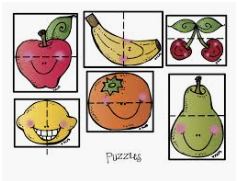
            Any food puzzles that you have.  Or make some by taking pictures of food and cutting into halves and quarters for the children to reassemble. 

Mathematics/Geometry & Spatial Sense; progresses in ability to put together and take apart shapes. AND Physical Health & Development/Fine Motor Skills; grows in hand-eye coordination in building with blocks, putting together puzzles, reproducing shapes and patterns, stinging beads, and using scissors.

Outdoors

            Play categories.  The teacher names a category and the children must think up appropriate responses.  This can be done to go down the slide, around the path on the bicycle, or any other activity that requires a line. (Name foods that are good for breakfast, name foods that have to be kept in the refrigerator, name foods we eat at school). 

Mathematics/Patterns & Measurement; shows increasing abilities to match, sort, put in a series, and regroup objects according to one or two attributes such as shape or size. AND Approaches to Learning/Reasoning & Problem Solving; develops increasing abilities to classify, compare, and contrast objects, events, and experiences.

Transitions

            As the children move to the next activity, have them think of foods that begin with a certain letter (name foods that begin with the letter H; hamburger, humus, happy meal, ham sandwich, hot sauce/M; mashed potatoes, mustard, marshmallow).  For younger children they could think of their favorite food and then help them recognize the letter that it starts with. 

Literacy/Phonological Awareness; associates sounds with written words, such as awareness that different words begin with the same sound. AND Literacy/Alphabet Knowledge; shows progress in associating the names of letters with their shapes and sounds.

Resources

Make food puzzles from labels, pictures, or your own creative self

            Dear Parent-Today we read a story about eating different foods on different days of the week.  You can extend this story by asking your child to suggest a food to eat on Monday night or Tuesday morning for breakfast.  Talk with them about different kinds of foods.  What did you eat for lunch today at school?  What is your favorite flavor of popsicle? 

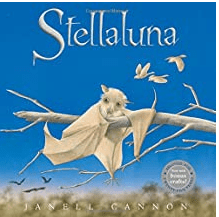
Stellaluna, by Janell Cannon

            When little Stellaluna gets separated from her mother, what will become of her?  This story tells about how two very different animals become friends and take care of each other.

Materials

  •  Several pictures or books about bats.
  •  Animals of Nighttime and Daytime
  • Mango
  • Toilet paper tube per child (optional art activity)

Vocabulary

  •   Sultry ( hot and humid)
  •   Clambered ( to climb something and not be very good at it)
  •   Escape ( to get away from something)
  •  Symmetrical (where both halves are the same )

Before Reading the Book

            Show the back cover of the book and ask anyone if they can guess what kind of animal these are?  If a child says birds, point to the moon and say birds fly during the day.  If no one knows, tell them these are bats.  They fly at night.  Ask the children if they know anything about bats and record any information that they share. 

Science/Scientific Knowledge; expands knowledge of and abilities to observe, describe, and discuss the natural world, living things, materials, and natural processes. AND Approaches to Learning/Initiative & Curiosity; grows in eagerness to learn about and discuss a growing range of topics, ides, and tasks.

While Reading the Story

            As you read, note how bats and the birds are different and alike.

Science/Scientific Knowledge; expands knowledge of and abilities to observe, describe, and discuss the natural world, living things, materials, and natural processes.

After Reading the Story

            What do you think might have happened to Stellaluna if she had not made friends with the birds?  Ask many friendship related questions.  Do you and your friend always have to do the same things?  (Sometimes Kerry wants to color but I want to do puzzles). Do you and your friend have any things that are different? (Kerry likes peanut butter but I don’t).  Are there some people that you don’t know very well that you think you could be friends with?  (Next to my house there is a baby that I like to talk to but she can’t talk back to me). 

Social & Emotional Development;progresses in responding sympathetically to peers who are in need, upset, hurt, or angry; and in expressing empathy and caring for others. AND Literacy/Book Knowledge & Appreciation; shows growing interest and involvement in listening to and discussing a variety of fiction and non-fiction and poetry.

Discovery

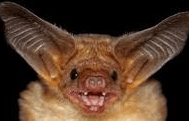
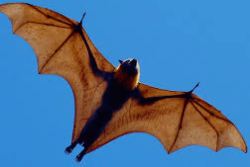
            Bring in pictures of real bats to discuss with the children.  The back page of the books has Bat Facts. 

Science/Scientific Knowledge; expands knowledge of and abilities to observe, describe, and discuss the natural world, living things, materials, and natural processes.

Bring in a mango for the children to taste. Make a graph of those who like mango and those who do not like mango.

Mathematics/Patterns & Measurement; begins to make comparisons between several objects based on a single attribute.

Music and Movement

            Tell the children that you are going to sing a song about opposites. Explain that opposites are a person or thing that is totally different from someone or something else. Sing Everything I Always Say– to the tune of Pop Goes the Weasel https://nurseryrhymescollections.com/lyrics/pop-goes-the-weasel.html

Everything I always say,                          

You always say the opposite.                      

When I say ____,  You say ____.

(Use opposites in-out, up-down, day-night, happy-sad, yummy-blucky)

Language Development/Speaking & Communicating; uses an increasingly complex and varied vocabulary.

Blocks

  Show the children how to make a “bat” using a block in the center and making the wings exactly the same on either side.  Explain that when both sides are exactly alike it is called symmetrical.  Tell the children that a body is mostly symmetrical, a butterfly, and car. That a square shape and a circle are also symmetrical.   Ask them if they can build other symmetrical structures.

     Language Development/Speaking & Communicating; uses an increasingly complex and varied vocabulary. AND Mathematics/Geometry & Spatial Sense; progresses in ability to put together and take shapes apart.

Art

            Give each child a piece of construction paper and ask them to fold it in half.  After they have folded it in half, have them open it back up and pour a tablespoon of paint onto one side of the paper.  Close the paper back up and have the child use the side of his hand to rub the paint about.  Open up and there will be a symmetrical design on their paper.  Add another color if they like.  Can they tell you what it looks like? 

Creative Arts/Art; begins to understand and share opinions about artistic products and experiences.

Make toilet paper bats and hang them from the ceiling. (See resources)

Sand and Water

            Fill the table with mud.  Add grass clippings.  Allow the children to mix it all together and pack into bowls.  These will be bird nests.  Put them out into the sun to dry.  The children can find small stones to make eggs.  You can add a paint station so the children can paint the eggs to go in their nests.

Approaches to Learning/Engagement & Persistence; grows in abilities to persist in and complete a variety of tasks, activities, and experiences.

Library and Writing

            On an index card write the letters AT.  Tell the children that this makes the “at” sound like in bat.  Give them magnetic letters and ask them if they can make the new sounds by putting the magnet letter in front of the AT index card.  For children who are not familiar with blending words, begin with the letters B-C-F-H-M-P-R-S. 

Literacy/Phonological Awareness; shows growing awareness of beginning and ending sounds of words. AND Literacy/ Alphabet Knowledge; shows progress in associating the names of letters with their shapes and sounds.

Dramatic Play

            Today is a good day for Parent and Child play.  Include food so the parent can feed their children. 

Creative Arts/Dramatic Play; participates in a variety of dramatic play activities that become more extended and complex.

Math and Manipulatives

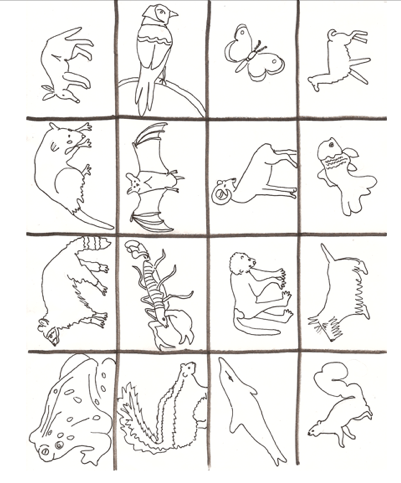
            Make a copy of the Nighttime and Daytime animal page.  Make a copy of the animals and cut them out.  Cover all with contact paper.  Put the animal pictures into a small basket and ask the children to sort them by animals that come out at night and animals that we see during the day. 

Mathematics/ Patterns & Measurement; shows increasing abilities to match, sort, putting in series, and regrouping objects according to one or two attributes. AND Approaches to Learning/Reasoning & Problem Solving; develops increasing abilities to classify, compare, and contrast objects, events, and experiences.

Outdoor Play

            Play Bats and Owl.  This is really tag with a twist.  The person who is “it” is the owl.  The other players are the bats.  To make it more real, give the bats each a scarf to use as their wings.  The owl tries to tag the bats.  When he/she catches one, the bat becomes the owl and the owl becomes the bat.

Physical Health & Development/Gross Motor Skills; shows increasing levels of proficiency, control, and balance in walking, climbing, running, jumping,hopping, skipping, marching, and galloping.

Transitions

            As you call a child off to the next activity, ask him to invite a friend to join him/her in the activity. 

Social & Emotional Development/Social Relationships; shows progress in developing friendships with peers.

Resources

Dear Parents-Today we read a book about two friends.  Ask your child to tell you about his day.  Whom did he play with, what did they do? 

Use poster board for the wings. Once assembled have the children paint their bat black or brown.

Bat Facts

  • Farmers like bats because they eat insects off their plants so they do not need to use as much pesticide which saves farmers lots of money.
  • Bats help pollinate fruits and flowers by dropping the seeds onto the ground.
  • Bats can fly up to 60 miles per hour, as fast as a car!
  • Bats love to eat mosquitoes.
  • Bats are nocturnal, they sleep during the day and come out at night.
  • Some bats carry a sickness called rabies so you should NEVER touch a bat.