We’re Going on a Bear Hunt, by Michael Rosen

            Children of all ages like to go on a bear hunt.  Follow this families adventure as they swish, splash, squelch, stumble, and hooo there way in search of a bear.  Be brave!

Materials

  •  Binoculars
  • Pictures of real bears
  • Alphabet bingo cards -add letters to the frames provided
  • Teddy Graham cookies
  •  Bears about 4-5 inches tall
  •   Several teddy bears
  • Bucket of dirt

Vocabulary

  •             Adventure ( a trip or an experience)
  •             Brave (to not be scared, even if it’s something kind of scary)
  •             Gloomy (dark and cold looking)

Before Reading the Story

            Ask the children if they know what it means to be brave.  Let them share any acts of bravery they might have done (when it was thundering I had to be brave cause my sister was crying, I rode my bike without training wheels, I swim in the lake, Ms. K picked up the worm!)

Language Development/Speaking & Communicating;uses an increasingly complex and varied vocabulary. AND Approaches to Learning/Reasoning & problem Solving; develops increasing abilities to classify, compare, and contrast objects, events, and experiences.

Reading the Story

            Show the children the cover of the book.  Read the cover and ask if anyone has ever been on a bear hunt before?  Where would you look for a bear?  What will happen when you find a bear?  As you read the story, show the children how to make the sound actions with their hands.

Literacy/Book Knowledge & Appreciation; demonstrates progress in abilities to retell and dictate stories from books and experiences; to act out stories in dramatic play; and predict what will happen next in a story.

After Reading the Story

            Ask the children if they would like to go on a bear hunt.  Move about your classroom following the theme of the book.  Let the children help tell what you might encounter along the way and how you will have to move (a big tree, we have to climb it, a giant mountain we have to climb it, a tall bridge we have to go across it)

Literacy/Book Knowledge & Appreciation; demonstrates progress in abilities to retell and dictate stories from books and experiences; to act out stories in dramatic play; and predict what will happen next in a story.

Discovery

            Add a pictures of bears, a Teddy Bear, and binoculars to the center. If the children do not know how to use binoculars, show them by looking out the window. If you can, put a teddy bear outside for the children to focus on with the binoculars.

Science/Scientific Skills & Methods; begins to use a variety of tools and simple measuring devices to gather information, investigate materials, and observe processes and relationships.

Music and Movement

            Make enough bear cards for all the children to have one.  On each card write an action (jump over the block, jump around the table, crawl under the table, and walk backwards across the rug); Hide the cards about the room .  Tell the children that they are going to go on a bear hunt.  Everyone must find one bear card and then meet at a designated spot.  When everyone is gathered, read the directions on each bear and have the children do the action.  Make sure that you write your directions to include one preposition.  Let everyone do the actions if they like.

Language Development/Listening & Understanding; shows progress in understanding and following simple and multiple-step directions. AND Mathematics/Geometry & Spatial Sense; builds increasing understanding of directionality, order, and prepositions of objects, and words such as up, down, over, under, top, bottom, inside, outside, in front, and behind.

Teach your children Teddy Bear, Teddy Bear. Have the children do the actions as you repeat the poem.

Teddy bear teddy bear turn around

Teddy bear teddy bear touch the ground

Teddy bear teddy bear tie your shoe

Teddy bear teddy bear that will do

Language Development/Listening & Understanding; shows progress in understanding and following simple and multiple-step directions.

Blocks

            Build a cave for a bear.  Add several small teddy bears to the center.

Creative Arts/Dramatic Play; shows growing creativity and imagination in using materials and in assuming different roles in dramatic play situations.

Art

            Draw a picture of your family going on a bear hunt.  Don’t forget to add the bear!

Physical Health & Development/Fine Motor Skills; progresses in abilities to use writing, drawing, and art tools, including pencils, markers, chalk, paint brushes, and various types of technology.

Library and Writing

            Play alphabet bingo with the children.  Use Teddy Graham cookies for markers.  Have each child play until they fill their card, then they can eat the bears.

Literacy/Alphabet Knowledge; shows progress in associating the names of letters with their shapes and sounds.

Sand and Water

            Make mud to put in the table.  Does it really go squelch?  How does it feel?

Science/Scientific Skills & Methods; begins to use senses and a variety of tools and simple measuring devices to gather information, investigate materials, and observe processes and relationships.

Dramatic Play

            Put a scarf or sheer curtain over the table and pretend that it’s a bear cave.

Creative Arts/Dramatic Play; shows growing creativity and imagination in using materials and in assuming different roles in dramatic play situations.

Math and Manipulatives

            If you have teddy bear counters, put them out for the children to sort and count.

Mathematics/Patterns & Measurements; shows increasing abilities to match, sort, put in a series, and regroup objects according to one or two attributes such as shape or size.

Outdoor Play

            Play Are You Sleeping Mr. Bear?  Choose one child to be the bear.  The bear gets in the middle of the circle and pretends to sleep.  Everyone else holds hands and makes a big circle around Mr. Bear.  Quietly the children in the circle ask, “Are you sleeping Mr. Bear?” and take a step closer.  Mr. Bear continues to sleep.  The children ask again getting closer.  Continue until Mr. Bear lets out a huge ROAR and tries to grab a child while all run away shrieking.  Let the children take turns being Mr. Bear.

Physical Health & Development/Health Status & Practices; participates actively in games, outdoor play, and other forms of exercise to enhance physical fitness.

Transitions

            As the children go to the next activity, have them do one of the actions from the story.

Literacy/Book Knowledge & Appreciation; demonstrates progress in abilities to retell and dictate stories from books and experiences; to act out stories in dramatic play; and predict what will happen next in a story.

make bears 4-5 inches large and use to write action words upon
This is a group of 4 BINGO boards. Write a letter in each square. Make all the boards slightly different.

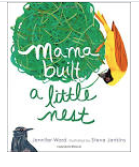
Mama Built a Little Nest, by Jennifer Ward

This book explores the many different kinds of nests that birds build.

Materials

Bird feeder with bird seed

Bird nest in a ziplock bag

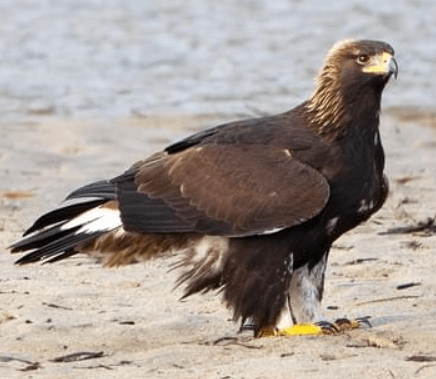
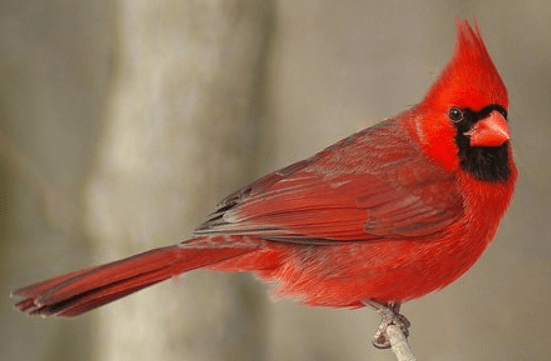
Picture of three birds from the story.

2 toilet paper tubes per child

assorted stickers or assorted colored tape

tongs or clothes pins that pinch open and close

24 pack of paper or plastic cups

bag of colored feather

Pipe cleaners cut into a variety of sizes to represent worms

Vocabulary

  • Ornithology  (the study of birds)
  • Sturdy (strong)
  • Cavity Nest (built by woodpeckers, a hole in a tree.  Kind of like a cavity in your tooth, a hole in your tooth)
  • Craggy (rocky rough cliff edge)
  • Burrow ( a hole in the ground used for a home)
  • Talons (the eagles claws or nails)

Before Reading the Story

Hold up cover of book and read title.  Guess what story about.  Ask the children what they think the big green ball is for? Ask children to share any knowledge they have about bird nests. (how are they built, what is a nest used for, where do you find nests). As the children talk about what they know about nests and birds, write their responses on a large piece of paper to pin to the wall. Make a KWL chart with the children. K=what we know about the subject, W= what we want to know about the subject, L= what we learned after reading/investigating about the subject.

Science/Scientific Knowledge; expands knowledge of and ability to observe, describe, and discuss the natural world, materials, living things, and natural processes.

Reading the Story

Stop and talk about the different birds, especially those that live in your area. When you get to the 2nd to last page (robins outside the window) ask the children what the author means when she says that they have a nest of their very own?

Language Development/Listening & Understanding; demonstrates increasing ability to attend to and understand conversations, stories, songs, anad poems.

After Reading the Story

Ask the children to share with you some of the facts that they learned about nests. On a third piece of paper write their responses. Hang on the wall with the other two sheets.

Literacy/Early Writing; develops understanding that writing is a way of communicating for a variety of purposes. AND Science/Scientific Knowledge; expands knowledge of and ability to observe, describe, and discuss the natural world, materials, living things, and natural processes.

Discovery

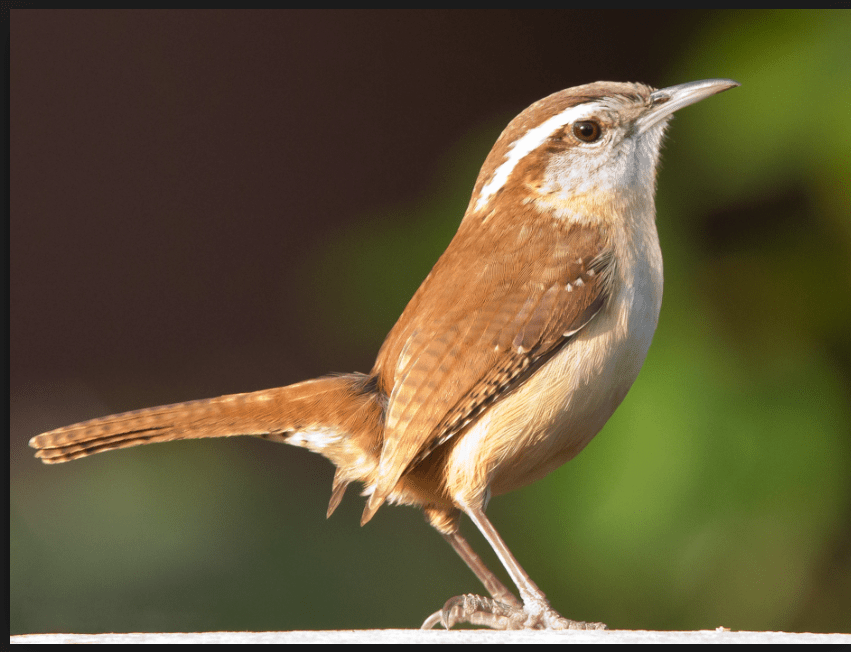
Tape the picture of the three different birds to the wall. Have a discussion with the children how they are alike and how they are different.

Mathematics/Patterns & Measurement; begins to make comparisons between several objects based on a single attribute.

If you are lucky enough to have a bird nest you can bring in to share with the children .  Put it in a ziplock bag so that it does not get torn apart or if there are any small bugs in the nest, they do not get into your classroom.

Science/Scientific Skills & Methods; begins to use senses and a variety of tools and simple measuring devices to gather informations, investigate materials, observe processes and relationships.

 Add a bird identification book and a birdfeeder where the children can easily view it.

Science/Scientific Skills & Methods; begins to use senses and a variety of tools and simple measuring devices to gather informations, investigate materials, observe processes and relationships. AND Literacy/ Print Awareness & Concepts; develops growing understanding of different functions of forms of print such as signs, letters, newspapers, lists, messages, and menus.

Tape two toilet paper tubes together to make binoculars.  Punch two holes in of the ends to add string to go around neck.  Give the children stickers or bits of colored tape to decorate their binoculars.

Music and Movement

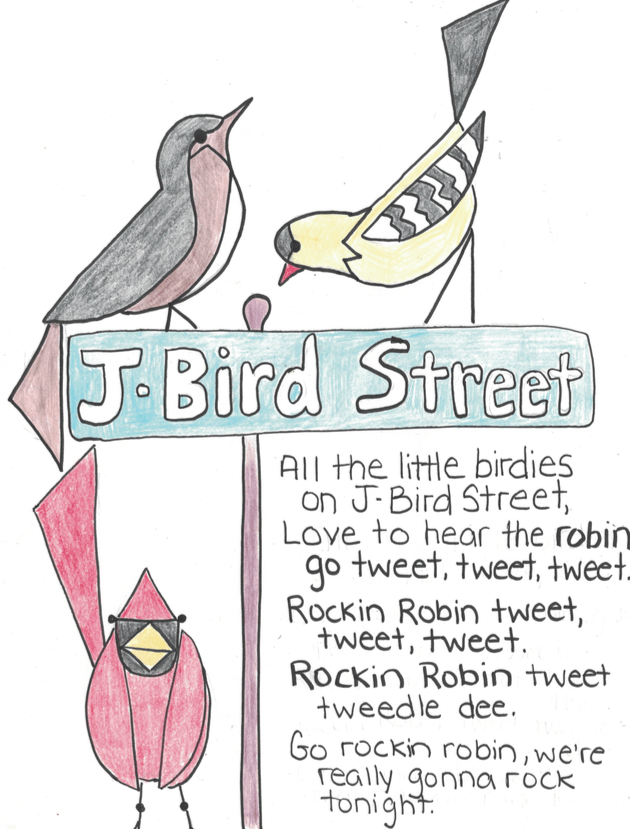
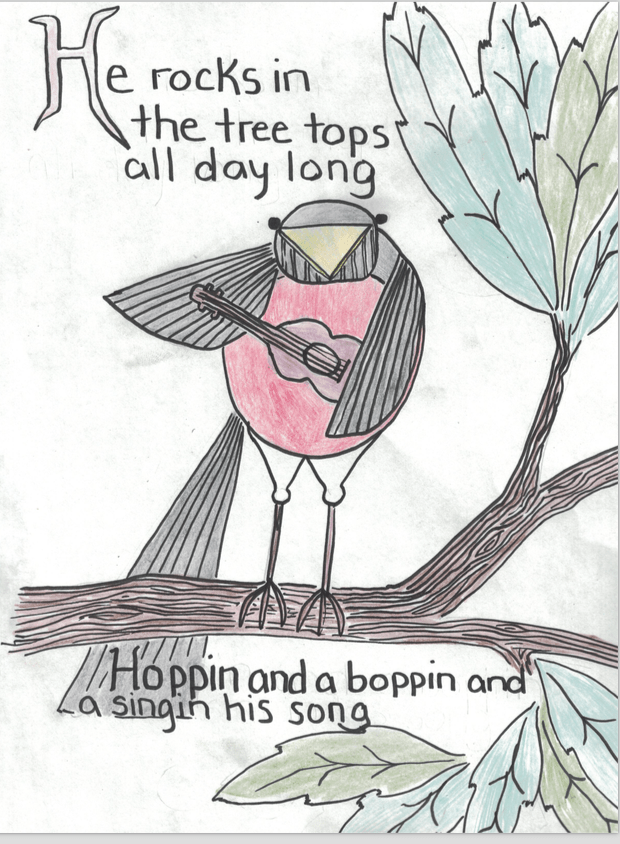
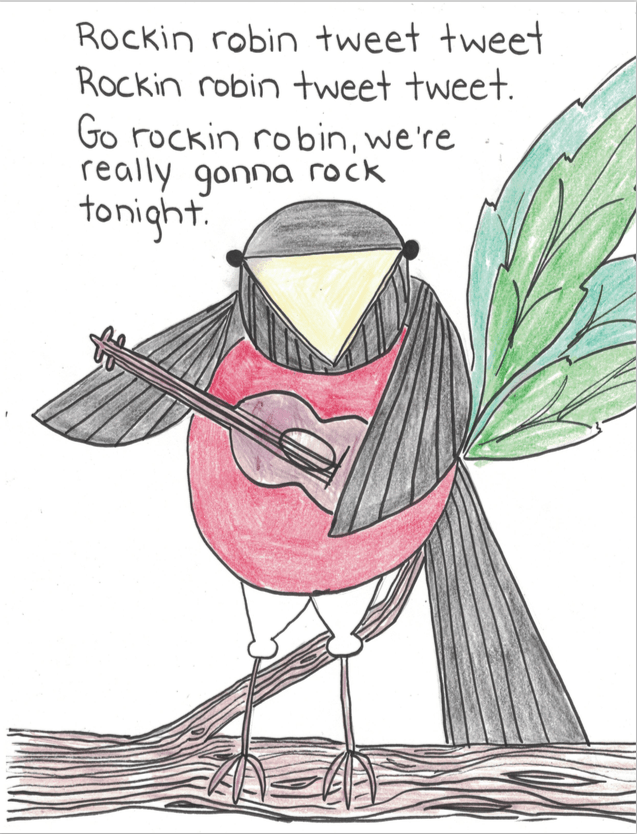
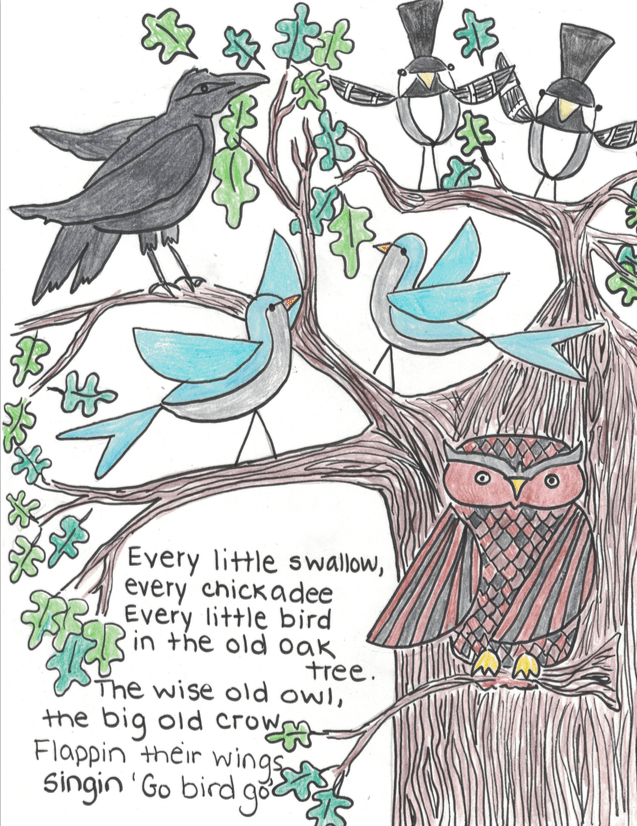
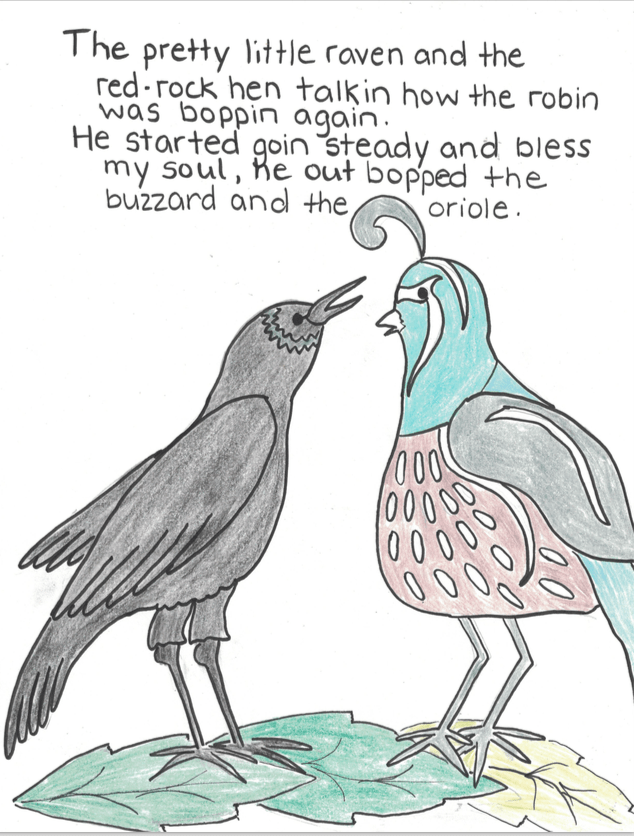
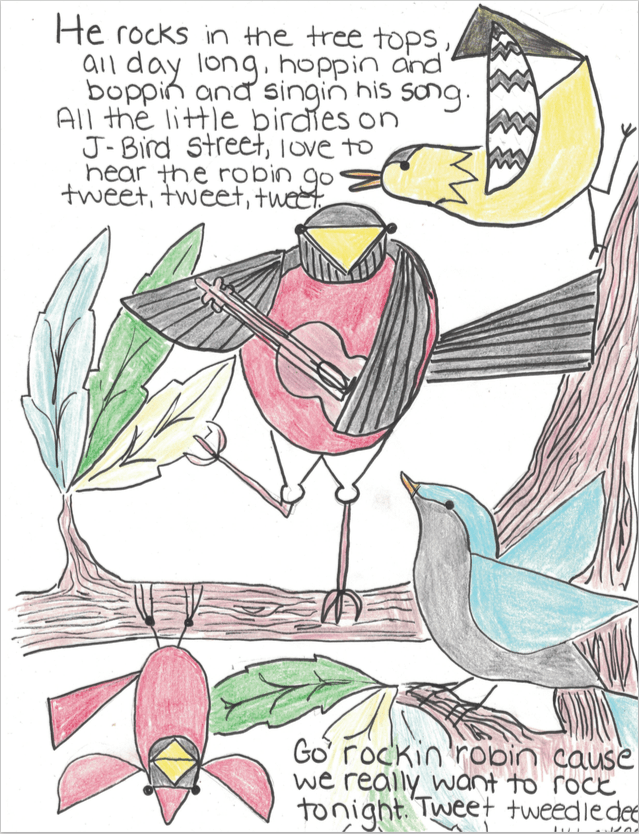
Put together the Rockin Robin Booklet and sing along. https://www.youtube.com/watch?v=z-OteAgvINc

Literacy/Book Knowledge & Appreciation; shows growing interest and involvement in listening to and discussing a variety of fiction and non-fiction books, and poetry.

Sing and act out the movements to The Bird Song. Sing it to the tune of Here We Go Round the Mulberry Bush.

This is the way we scratch for worms, scratch for worms, scratch for worms.
This is the way we scratch for worms so early in the morning.

This is the way we peck our food, peck our food, peck our food.
This is the way we peck our food so early in the morning.

This is the way we sit on our eggs, sit on our eggs, sit on our eggs.
This is the way we sit on our eggs so early in the morning.

This is the way we flap our wings, flap our wings, flap our wings.
This is the way we flap our wings so early in the morning.

This is the way we fly away, fly away

Creative Arts/Music; participates with increasing interest and enjoyment in a variety of music activities, including listening, swinging, finger plays, games, and performances.

Do the finger play Two Little Blackbirds. https://www.youtube.com/watch?v=gjv5Jwgsn7I

Language Development/Listening & Understanding; understands an increasingly complex and varied vocabulary.

Blocks

Add the cups to the center today.  Show the children how to stack them upside down one on top of the edge of two to make a pyramid.  Or to stack them bottom to top to bottom to top.  Both of these building activities take patience and good hand-eye coordination.

Physical Health & Development/Fine Motor Skills; grows in hand-eye coordination in building with blocks, putting together puzzles, reproducing shapes and patterns, stringing beads, and using scissors. AND Approaches to Learning/Engagement & Persistence; grows in abilities to persist in and complete a variety of tasks, activities, projects, and experiences.

Art

Make nests with playdough (Pinch pot).  Can the children roll small balls to be the eggs?

Creative Arts/Art; progresses in abilities to create drawings, paintings, models, and other art creations that are more detailed, creative, or realistic. AND Physical Health & Development;Fine Motor Skills; develops growing strength, dexterity, and control needed to use tools such as scissors, paper punch, stapler, hammer.

If your school has a petty fund, make bagel bird feeders.

To make one bird feeder, you will need:
1 day old bagel, lard, birdseed, string or ribbon for hanging

Spread the lard on the bagel.
Roll the bagel in the birdseed. (Or you may place the bagel in a gallon sized zipper bag that contains birdseed; shake the bag to coat the bagel.)
Tie ribbon or string through the hole of the bagel to hang the bagel. One of the good things about this bird feeder is that the birds can eat the whole thing!

Language Development/Listening & Understanding; shows progress in understanding and following simple and multiple-step directions.

Sand and Water

In the sensory table add mud, bits of play dough, twigs, grasses, bits of yarn, thread, small pebbles, etc.. Explain to the children that today they are going to be birds and challenge them to build a nest. Give each child a pair of tweezers or tongs and explain that birds can only use their beaks (tweezers) and feet (hands) to build their nest.

Science/Scientific Skills & Methods; begins to participate in simple investigations to test observations, discuss and draw conclusions, and form generalizations.

Library and Writing

Add bird identification book to center.  Encourage the children to learn the name of one or two familiar birds to your area.

Science/Scientific Skills & Methods; begins to use senses and a variety of tools and simple measuring devices to gather informations, investigate materials, observe processes and relationships. AND Literacy/ Print Awareness & Concepts; develops growing understanding of different functions of forms of print such as signs, letters, newspapers, lists, messages, and menus.

Dramatic Play

Encourage the children to pretend to be birds. Bring in several boxes big enough for the children to be able to sit in. To your center add; pipe cleaner worms, plastic Easter eggs, beaks made from sentence strips.

Creative Arts/ Dramatic Play; shows growing creativity and imagination in using materials and in assuming different roles in dramatic play situations.

Math and Manipulatives

Ahead of time, take pieces of pipecleaner and bend into worms. Think of size and /or colors that the children can sort by. Use tongs or tweezers to practice fine motor skills and pretend that you’re a bird gathering food with its beak! For older children you might try using colored feathers.

Physical Health & Development/Fine Motor Skills; develops growing strength, dexterity, and control needed to use tools such as scissors, paper punch, stapler, hammer. AND Mathematics/Patterns & Measurement; shows increasing ability to match, sort, put in a series, and regroup objects according to one or two attributes such as shape or size.

Outdoor Play

If you are lucky enough to have pine trees that drop their needles ,or do this activity in the fall when the leaves are dropping, have the children rake needles/leaves into a pile and then use to make a bird nest with them being the birds.

Creative Arts/ Dramatic Play; shows growing creativity and imagination in using materials and in assuming different roles in dramatic play situations. AND Social & Emotional Development/Knowledge of Families & Communities; develops growing awareness of jobs and what is required to perform them.

Transitions

Ahead of time cut out and hide egg shapes around the classroom.  Let the children go on an egg hunt.  Have the children count how many eggs they found within the allotted time.

Mathematics/Number & Operations; begins to make use of one-to-one correspondence in counting objects and matching groups of objects. AND Approaches to Learning/Engagement & Persistence; shows growing capacity to maintain concentration over time on a task, question, set of directions or interactions, despite distractions and interruptions.

Resources
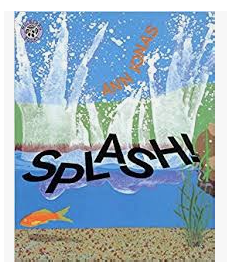
Splash!, By Ann Jonas

This book offers a fun way to add and subtract objects one to ten

Materials

  • 10 objects when dropped into water will make a small splash (small blocks, crayons,
  • Several sponges
  • 10 paper plates with a number written on it 1-10
  • Stickers of pond animals or a bingo dauber

Vocabulary

  • Pond (a small body of water with different animals and plants that live in or beside it).
  • Habitat (environments or homes where different animals live)

Before Reading the Story

Talk about habitats (environments or homes where different kinds of animals live).  Ask the children if they know who lives in a forest environment?  A jungle environment?  A desert environment?  A pond environment?  Tell them that today’s story is about animals that live in a pond environment.  Introduce the story.

Science/Scientific Knowledge; expands knowledge of and abilities to observe describe, and discuss the natural world, materials, living things, and natural processes.

Reading the Story

Stop and count how many are in the pond on each page.

Mathematics/Number & Operations; develops increasing ability to count in sequence to 10 and beyond.

After Reading the Story

Who can remember what happened to the dog in the story?  Why do you think the cat was mad?

Literacy/Book Knowledge & Appreciation; demonstrates progress in abilities to retell and dictate stories from books and experiences; to act out stories in dramatic play; and to predict what will happen next in a story. AND Language Development/Speaking & Communicating; develops increasing abilities to understand and use language to communicate information, experiences, ideas, feelings, opinions, needs questions; and for other varied purposes.

Discovery

If you are fortunate to have a pond nearby, collect a large container (clean mayonnaise jar) of the water.  Try to get some of the mud, scum, and any water insects.  Put this into the center with magnifying glasses so the children can observe and talk about their observations. Encourage the children to draw their observations on paper. Dictate any observations/discussions that take place.

Science/Scientific Skills & Methods; develops growing abilities to collect, describe, and record information through a variety of means, including discussion, drawings, maps, and charts.

Music and Movement

Play in the pond on the bank. Mark off an area large enough for all the children to be able to comfortably jump inside of. Use the edge of a carpet or chalk/tape to make a ‘pond’. Have all the children stand on the outside of the pond. Explain that they are on the bank (where the land meets the water). Tell them that when you say, “In the pond” everyone is to jump inside the area. Practice a couple of times saying “In the pond” or “On the bank”. The children jump accordingly. After they have gotten good, speed up your calling or call on the bank two times in a row, etc.. This is a listening game, can they follow the directions?

Language Development/Listening & Understanding; shows progress in understanding and following simple and multiple-step directions.

Teach the children the song, Swimming swimming in the swimming hole. https://www.youtube.com/watch?v=c15F0h0fyoo. Make motions to go with the song.

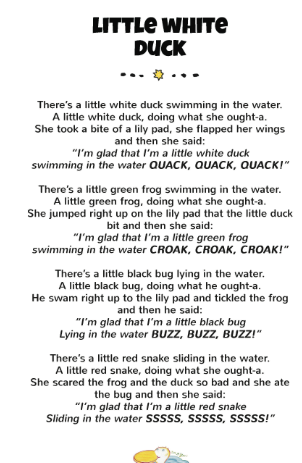
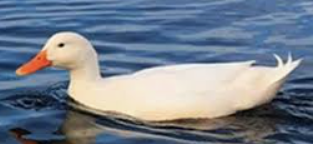
There’s a little white duck. https://www.youtube.com/watch?v=Y57RWhz76y8

Here is My Turtle…Finger play
Here is my turtle,  ( Form fist and extend thumb.)
He lives in a shell.  (Put thumb inside fist.)
He like his home
Very well.  (Nod head) He pokes his head out    (Pop out thumb.)
When he wants to eat.   (Circle thumb around.)
And pulls it back in
When he wants to sleep.  (Put thumb back inside fist)

1,2,3,4,5, (Hold up fingers as you count) I caught a fish alive (point to self) 6,7,8,9,10 (hold up fingers as you count) Then I threw him back again.  (pretend to throw) What made you let him go? (shrug shoulders) Because he bit my finger so! (make a scowl face) Which finger did he bite? The little pinky on the right. (hold up right pinkie and kiss it)

Approaches to Learning/Initiative & Curiosity; chooses to participate in a variety of tasks and activities AND Creative Arts/Music; participates with increasing interest and enjoyment in a variety of music activities, including listening, singing, finger plays, games, and performances.

Blocks

Tell the children that they can pretend to be frogs jumping from lily pad to lily pad today.  Have them use the blocks to make a pond that goes around the edge of the center.  Spread the paper plates marked 1-10 within the pond.  Show the children how to jump from 1 to 2, 2 to 3, etc. to 10.  Mix the plates up in the center and begin again.

Mathematics/Number & Operations; begins to associate number concepts, vocabulary, quantities, and written numerals in meaningful ways.

Art

Paint with watercolors today.

Creative Arts/Art; gains ability in using different art media and materials in a variety of ways for creative expression and representation.

Sand and Water

Fill the table with water and give the children objects that they can drop in.  As they drop the items ask them to count for you.  How many did you drop? Now drop one more, how many are in the water now?

Mathematics/Number & Operations; begins to use one-to-one correspondence in counting objects and matching groups of objects.

Add items that will make a splash sound such as; watering can, water wheel and squirt bottles to the water table today. Can the children find any other items in the classroom that will make a splashing sound? Which one sounds louder? Why do you think that?

Science/Scientific Skills & Methods; begins to participate in simple investigations to test observations, discuss and draw conclusions, and form generalizations.

Library and Writing

Help the children make a number chart today. Going down the left side of a piece of paper write the numbers 1-10.  Give the children stickers to put the appropriate number beside each number.  If you do not have stickers, use a bingo dauber or something similar.

Mathematics/Number & Operations; begins to use one-to-one correspondence in counting objects and matching groups of objects.

Dramatic Play

Encourage the children to set the table for four, three, or two.  Do they understand how many plates they need?  Can they add all the utensils that are needed for setting a table?  Do they know where to put the plate, cup, spoon, etc?

Mathematics/Number & Operations; begins to use one-to-one correspondence in counting objects and matching groups of objects. AND Mathematics/Number & Operations; begins to use language to compare numbers of objects with terms such as more, less, greater than, fewer, equal to.

Math and Manipulatives

Trace and cut out ten turtles. Color them green and number them one through ten.  Cut out spots for on the turtle’s back and color them brown.  Have the children add correct number of spots to turtles back.

Mathematics/Number & Operations; begins to use one-to-one correspondence in counting objects and matching groups of objects.

Outdoor Play

Fill a bucket up with water and give the children sponges to throw at a target such as a large piece of cardboard or  a hula hoop hung on the fence.

Physical Health & Development/Gross Motor Skills; demonstrates increasing abilities to coordinate movements in throwing, catching, kicking, bouncing balls, and using a slide and swing.

Mud play. Have the children dig a hole in the ground and then add water. Let the children continue to make the hole bigger adding more water. After the hole is a good size, let them make mud pies!

Physical Health & Development/Health Status & Practices; participates actively in games, outdoor play, and other forms of exercise that enhance physical fitness. AND Science/Scientific Skills & Methods; begins to use senses and a variety of tools and simple measuring devices to gather information, investigate materials, and observe processes and relationships.

Transitions

On a dry-erase board or a chalkboard write/draw 3 letters, 3 numbers, 3 shapes, and 3 words.  Ask a child to come up and use a dry erase marker to circle a number, a letter, or a word.  Continue giving each child a turn to circle a letter, a number, a shape, or a word.  Were they able to tell which one was what?

Literacy/Print Awareness & Concepts; recognizes a word as a unit of print, or awareness that letters are grouped to form words, and that words are separated by spaces. AND Literacy/Alphabet Knowledge; knows that letters of the alphabet are a special category of visual graphics that can be individually named.

Resources