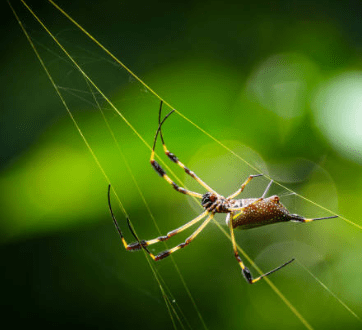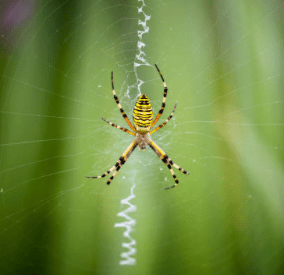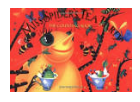
Miss Spider’s Tea Party, the counting book, by David Kirk

            Miss Spider is lonely.  She can not understand why none of the insects want to come to her tea party?  Count the insects as they meet Miss Spider.

Materials

  • Pitcher and about 4-6 decaffeinated fruit tea bags.
  • Crepe paper
  • A spider hung from a string ( this can be stuffed, rubber, or paper)
  • Camera

Vocabulary

  • To dash off (to run off quickly)
  • Tea party ( a party where you drink tea and eat sweets)

Before Reading the Story

            Hang a large piece of paper where all the children can see it.  Ask the children to see if they can guess what you are drawing.  Draw a simple spider on the paper.  When the children have guessed spider, have them count the eight legs with you.  Tell the children that it has to have 8 legs to be a spider. Now draw another spider but only put on 5 legs.  Ask the children if this is a spider?  (No because it only has 5 legs)  Add 3 more.  Do this several times making another spider with 8 legs and two more with more or less legs.  How many legs does a spider have to have?  Tell the children that our story today is about a spider.

Mathematics/Number & Operations; begins to make one-to-one correspondence in counting objects and matching groups of objects. AND Science/Scientific Knowledge; expands knowledge of and abilities to observe, describe, and discuss the natural world, materials, living things, and natural processes.

Reading the Story

            Make sure to take time to let the children help count the insects on each page.

Mathematics/Number & Operations; begins to make one-to-one correspondence in counting objects and matching groups of objects.

On the children the page where Miss Spider is wiping her tears (Miss Spider sobbed, “They’ve all dashed off”).  Ask them why they think all the insects dashed off? (Because spiders eat insects). 

Social & Emotional Development/Social Relationships; progresses in responding sympathetically to peers who are in need, upset, hurt, or angry; and in expressing empathy to others.

After Reading the Story

            Hold up the cover of the book and ask the children did Miss Spider want to eat the insects? (No, she wanted to have a party/tea with them).   Ask have the children ever been to a party?  What kinds of things do you do at a party?    How do you feel when you get to go to a party? (happy, it’s fun, I like to go). 

Literacy/Book Knowledge & Appreciation; demonstrates progress in abilities to retell and dictate stories from books and experiences; to act out stories in dramatic play; and to predict what will happen next in a story. AND Language Development/Speaking & Communicating; develops increasing abilities to understand and use language to communicate information, experiences, ideas, feelings, opinions, needs, questions; and for other varied purposes.

Discovery

            Make sun tea.  Bring in a pitcher and several bags of decaffeinated fruit tea.  Put the tea bags in a full pitcher of water and place in the sun.  Observe it throughout the day as the tea gets darker.  Chill before drinking.  Serve with cookies for afternoon snack.

Science/Scientific Skills & Methods; develops increased ability to observe and discuss common properties, differences, and comparisons among objects and materials.

            If you know of any spider web around your school, let the children observe it.  Remind them though to not touch spiders as many bite!

Science/Scientific Skills & Methods; develops increased ability to observe and discuss common properties, differences, and comparisons among objects and materials.

Music and Movement

            Put a pillow out in the center of the circle.  Have a child sit on the pillow and recite the poem, Little Miss Muffit.  Let the children take turns being Miss Muffit or Mr Muffit.  When you get to the part about along came a spider that sat down beside, change to include in front of, behind, and on top of. (dangle a spider prop from a string)

Little Miss/Mr Muffit

Sat on his tuffit/pillow

Eating her/his cottage cheese.

Along came a spider

And sat down (beside) her/him

And frightened Miss/Mr Muffit away.

Language Development/Listening & Understanding; demonstrates increasing ability to attend to and understand conversations, stories, songs, and poems. AND Mathematics/Geometry & Spatial Sense; builds an increasing understanding of directionality, order, and positions of objects, and words such as up, down, over, under, top, bottom, inside, outside, in front and behind.

Blocks

            Ask the children how many legs does a spider have? (8)  Show me something you can build with 8 blocks.

Mathematics/Number & Operations; begins to make one-to-one correspondence in counting objects and matching groups of objects.

Art

            Make spiders out of play dough or clay.  Have the children roll balls out of play dough.  Put out pipe cleaners that have been cut into 1 inch and 2 inch lengths.  Let the children insert the legs into their spiders and put to the side to dry.  When the dough is dry the children can paint their spiders.

Creative Arts/Art; progresses in abilities to create, drawings, paintings, models, and other creations that are more detailed, creative, or realistic.

Library and Writing

            Remind the children why Miss Spider was sad in the story (no one would come to her party because they were afraid she would eat them).   Ask what did Miss Spider really want to do?  (Have them come for a tea party).  Ask the children what kinds of things they like to do with their friends?  If you have a camera available, you could take pictures of each child doing things they like with their school friends and make it into a class book. If you do not have a camera, encourage the chhildren to draw their friends.

Social & Emotional Development/Social Relationships; shows progress in developing relationships with peers.

Sand and Water

            Bring in grass cuttings from the playground or home.  Also add several sticks, stumps, and rocks.  Add plastic insects to the table.  Let the children arrange an insect habitat.

Science/Scientific Skills & Methods; begins to use senses and a variety of tools and simple measuring devices to gather information, investigate materials, and observe processes and relationships. AND Creative Arts/Dramatic Play; participates in a variety of dramatic play activities that become more extended and complex.

Dramatic Play

            Hang some crepe paper and encourage the children to have a party.

Creative Arts/Dramatic Play; participates in a variety of dramatic play activities that become more extended and complex.

Math and Manipulatives

            Give each child a piece of paper.  Ask them to fold the paper in half.  On one side help them write Spider and on the other help them write Insect.  Remind the children that main character in the story was a spider.  How many legs does a spider have? (8).  Have the children draw a spider on the side of the paper that says spider.  Ask them if they know the scientific name for all the other bugs in the story (insects).  Tell the children that all insects have 6 legs.  Have the children draw an insect on the side of the page that says insect.  Encourage the children to write the numbers 8 and 6 on the corresponding sides of the page.

Mathematics/Number & Operations; begins to make one-to-one correspondence in counting objects and matching groups of objects. AND Literacy/Early Writing; begins to represent stories and experiences through pictures, dictation, and in play.

Outdoor Play

            Bring some crepe paper outside and give the children 3 foot sections and show them how to weave it in and out through the fence.

Physical Health & Development/Fine Motor Skills; grows in hand-eye coordination in building with blocks, putting together puzzles, reproducing shapes and patterns, stringing beads, and using scissors.

Transitions

            Ask the children how many legs a spider has?  See if you can get to your next destination in 8 steps.  If not keep counting until you get there.  Ask the next child how many legs an insect has?  Have them count their steps.  Then have all the children count their steps to the next place they are going.

Mathematics/Number & Operations; develops increasing ability to count to 10 and beyond.

Resources

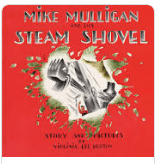
Mike Mulligan and His Steam Shovel, by Virginia Lee Burton

                  Mike Mulligan and Mary Ann have worked together for a very long time.  Now people are saying that Mary Ann is too old to work.  Mike Mulligan and Mary Ann set out to prove that they can still do the work of any modern machine.  Will they be able to?  What will happen to Mary Ann if they fail?  This classic story tells of a faithful friendship with a happy ending.

Materials

  •                   A book about construction and earth moving machines.
  •                   Construction plans for 4 simple structures.
  •                   Cookie sheet
  •                   One very strong magnet
  •                   Graph paper

Vocabulary

  • Steam Shovel (an earth moving machine that digs great big holes)
  • Cellar (an underground room.  Sometimes called a basement)
  • Corner (the place where two borders or lines come together)

Before Reading the Story

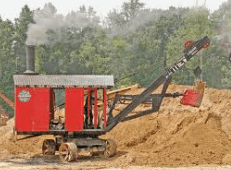
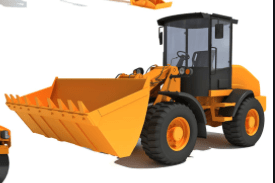
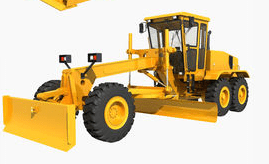
                  Share pictures of construction sites and the kinds of vehicles/machinery that is used on a construction site.  As you look at the pictures, talk to the children about how each piece has a special job to do.  Look at the pictures and notice the size of the equipment, the kinds of wheels each has, and if the children can guess how the machine is used (for scooping, digging, rolling, carrying away debris).    Introduce the story by showing the children a picture of a real steam shovel and a modern shovel.

Literacy/Book Knowledge & Appreciation; shows growing interest and involvement in listening to and discussing a variety of fiction and non-fiction and poetry. 

 Reading the Story

                  Before you begin reading hang a piece of paper on the wall where everyone can see it.  Have a marker handy so that when you get to the parts of the story where MM and MA cut a corner, you can draw their progress.  On page 15 stop and ask the children what they think will happen to Mary Ann.  When you get to page 20, ask the children if they think MM and MA will be able to dig a cellar in just one day.  As you get to the pages where MM and MA make a new corner, have the children repeat Go Mike Mulligan Go!  On page 37 ask the children “How will MM and MA get out?  What do you think will happen?”

Literacy/Book Knowledge & Appreciation; demonstrates progress in abilities to retell and dictate stories from books and experiences; to act out stories in dramatic play; and to predict what will happen next in a story.

After Reading the Story

                  Point out the paper on the wall with the four corners nice and square.  Ask the children if they can name the shape.  Play a shape game with the children. Cut out the Mary Ann steam shovel and cut out 4-6 shapes that you are working on with you children large enough to cover the steam shovel.  The children can then take turns hiding the steam shovel under a shape and guessing which shape it is under by naming the shape.  You can add another teaching concept by making each shape a different color.  The guesser must then guess by naming the shape and the color (Is it under the red circle?).

Mathematics/Geometry & Spatial Sense; begins to recognize, describe, compare, and name common shapes, their parts and attributes.

Discovery

                  Magnet play today.  Take a large cookie sheet and tape some blocks to the ends to make a table with the cookie sheet being the top.  Put magnet marbles or small nuts and washers on top of the cookie sheet.  Put the strong magnet under the cookie sheet and show the children how dragging the magnet from underneath will cause the items on top to move.  You could also add a piece of paper and a small bit of paint so that when you drag the marbles/nuts, it makes marks upon the paper.

Science/Scientific Skills & Methods; begins to use senses and a variety of tools and simple measuring devices to gather information, investigate materials, and observe processes and relationships.

Music and Movement

                  Circle, Triangle, or Square by Hap Palmer https://www.youtube.com/watch?v=dWtLONv826Y

Mathematics/Geometry & Spatial Sense; begins to recognize, describe, compare, and name common shapes, their parts and attributes.

                  In the story MM and MA dig faster and faster.  Put on music that moves to different tempos and let the children dance or move accordingly.

Creative Arts/Movement; shows growth in moving to different patterns of beat and rhythm of music.

                   Play In and Out the Windows.    Have the children hold hands and make a circle with their arms up in the air.  Choose one person to step into the center of the circle.  As the children sing the verse, In and Out the Windows the child moves under arms and around and through the circle.  At the end of the verse another child goes into the center of the circle and the first child comes out and helps form the circle.  https://www.youtube.com/watch?v=MibnLIXnLcE

Go in and out the windows,

Go in and out the windows,

 Go in and out the windows,

Now go and pick a friend.

Social & Emotional Development/Cooperation; develops increasing abilities to give and take in interactions; to take turns in games and using materials; and to interact without being overly submissive or directive.

Blocks

                  Add any construction vehicles you might have.  Add hard hats and construction plans for a building.  Trace around blocks to make simple blueprints for the children to copy building or use the ones included.

Mathematics/Geometry & Spatial Sense; progresses in ability to take shapes apart and put them back together again.

Art

                  Give each child a piece of graph paper and colored pencils.  Encourage them to make various sizes of squares.  After they color the squares they can cut them out and glue to a large piece of paper.

Literacy/Early Writing; experiments with a growing variety of writing tools and materials, such as pencils, crayons, and computers.

Writing and Library

                  In the story, MM and MA made nice straight corners as they dug their building.  Have the children trace around shapes and letters today.  Practice drawing nice straight corners when possible and then talk about the corners and help the children count how many they see on each of their tracings.

Literacy/Early Writing; experiments with a growing variety of writing tools and materials, such as pencils, crayons, and computers. AND Mathematics/Geometry & Spatial Sense; begins to recognize, describe, compare, and name common shapes, their parts and attributes.

Dramatic Play

                  In the story MM and MA worked together to dig a cellar for the town hall.  It was a hard job.  Give the children damp rags today and ask them to tackle the job of cleaning the dramatic play center.  Talk about working together to make sure that all of the items are put away in their correct space.  They can use the damp rags to wash the shelves, dishes, and furniture.  Make sure to thank them when they are finished for a job well done.

Social & Emotional Development/Knowledge of Families & Communities; develops a growing awareness of jobs and what is required to perform them.

Math and Manipulatives

                  Encourage the children to build houses today using Duplo’s, small cubes, dominos etc.  Use words to describe the parts of the house/building.  (Wall, roof, window, door)

Physical Health & Development/Fine Motor Skills; grows in hand-eye coordination in building with blocks, putting together puzzles, reproducing shapes and patterns, stringing beads, and using scissors.

Outdoors Play

                  Encourage the children to use the buckets and large trucks to pretend to be working a construction sight.  Add hard hats if you have any available.  They can pretend to dig out a foundation or build a tall building/mountain from the sand. If you do not have large trucks, the children could wash the bicycles and other riding toys.

Creative Arts/ Dramatic Play; participates in a variety if dramatic play activities that become more extended or complex.

Transitions

                  As the children go to the next activity ask them if they can name things that have wheels.  List their responses onto a piece of paper.  When they run out of wheeled objects, ask them to name something that can be square or another shape that you are working on.

Approaches to Learning/Reasoning & problem Solving; develops increasing ability to find more than one solution to a question, task, or problem.

Resources

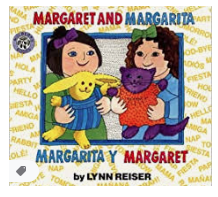
Margaret and Margarita, Margarita y Margaret, by Lynn Reisner

            Margaret and Margarita both go to the park to play.  They find each other there but they do not speak the same language.  How will they play, what will they do?

Materials

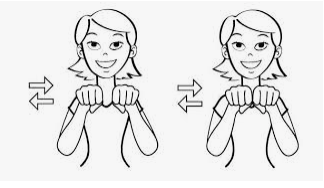
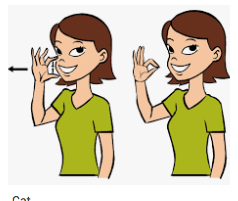
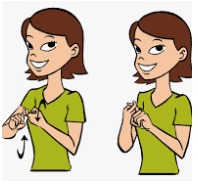
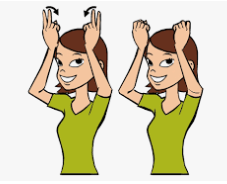
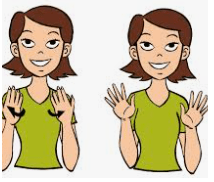
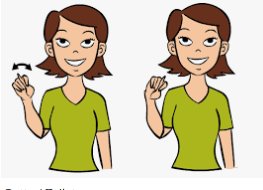
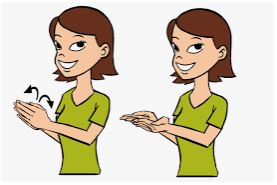
  •  Copy of sign language words for friend, cat, shoe, and rabbit
  •  Camera
  • Picture of every child in the classroom, one of the teacher’s and also a group picture.

Vocabulary

  • Park (a place for people to go that has a playground, paths, trees, and a bench to sit on and relax).
  • Communicate (talking to someone even if you don’t use spoken words)

Before reading the Story

            Tell the children that not everyone speaks the same language.  If you have children of various languages in the classroom, talk about who knows what language.  Discuss the various ways to say hello.  Talk about how even if you do not speak the same language, people can still communicate using their bodies and their faces.  Use gestures only to communicate tired, hungry, I don’t want to, and play with me.  See if the children can guess what you are trying to say.  See if the children can find ways to communicate these ideas. Introduce the story by explaining that the two girls in the story do not speak the same language. Ask the children if they think the two girls will be able to become friends, why/why not? Let’s find out what happens.

Approaches to Learning/Initiative & Curiosity; grows in eagerness to learn about and discuss a growing range of topics, ideas, and tasks.

Reading the Story

            This story is best read by two people, one being the Margaret side of the page and one being the Margarita side of the page. If there are not two people available, use two different voices or puppets to tell the story.

After Reading the Story

            Start a discussion on how you can show friendship to someone that might speak another language.  Learn how to say friend in all the languages of your classroom.  After you discussion on friendship, have the children recite the poem Friends, P. Schillar after you.     

Friends know how to care,

How to take turns,

And how to share.

Friends know that it’s quite true,

If you’re kind to others,

They’ll be kind to you!

Language Development/Speaking & Communicating; progresses in abilities to initiate and respond appropriately in conversation and discussions with peers and adults.

Discovery

            If you have a school camera, let the children each take three pictures of children in the classroom.  Print these out and mount to the wall. (Our friends at work and play). Just a note; when we did this we also got pictures of feet, tables, etc.. Note that some children will have more experiences working a camera/phone camera than others.

Science/Scientific Skills & Methods; develops growing abilities to collect, describe, and record information through a variety of means, including discussion, drawings, maps, and charts. AND Approaches to Learning/Engagement & Persistence; demonstrates increasing ability to set goals and develop and follow through on plans.

Music and Movement

            Teach your children a traditional Spanish/Mexican finger play like Cinco Amiguitos.

(Hold up five fingers on one hand).

Cinco amiguitos                                                  The Little Friends

(Wiggle all 5 fingers at once)

Estos son cinco amiguitos                                  There were five little friends

(Wiggle little finger)

El más chiquito compró’ un huevito.               This one bought an egg.

(Wiggle ring finger)

Este lo cocinco’.                                                    This one boiled it.

(Wiggle middle finger)

Este lo pelo’.                                                    This one peeled it.

(Wiggle pointer finger)

Este le puso sal.                                                 This one sprinkled salt on it.

(Wiggle thumb)

Y este pícaro gordito !Se lo comió’!                  And this little chubby one ate it!

(adapted by B.J. irby and R. Lara-Alecio)

Language Development/Listening & Understanding; demonstrates increasing ability to attend to and understand conversations, stories, songs, and poems.

            Put on music with rhythms and beats from other countries for the children to dance and move to.

Creative Arts/Movement; expresses through movement and dancing what is felt and heard in various musical tempos and styles.

Blocks

            Tape of a 2 foot by 2 foot square on the floor of block center.  Encourage the children to work together and build cooperatively within the small space.

Social & Emotional Development/Cooperation; shows increasing abilities to use compromise and discussion in working, playing, and resolving conflicts with peers.

Art    

            Put a large piece of easel paper on the easel.  Put out only two primary colors of paint.  Invite two children to work together to paint.  Each child has one color and as they work they will make a third color.  Call these friendship paintings.  You could write; Kerry and Roger made blue together.

Social & Emotional Development/Cooperation; shows increasing abilities to use compromise and discussion in working, playing, and resolving conflicts with peers. AND Science/Scientific Skills & Methods; begins to participate in simple investigations to test observations, discuss and draw conclusions, and form generalizations.

Sand and water

Many parks have a sand pit. Put sand in the table today along with buckets and scoopers. Remind the children that the sand needs to stay in the table as sand on the floor is slippery.

Social & Emotional Development/Self-Control; demonstrates increasing capacity to follow rules and routines and use materials purposefully, safely, and respectfully.

Library and Writing

            On an index card draw a picture of a shoe.  Write shoe in one color and zapitos in another color.  Do the same for rabbit-conjejita ,cat-gatita, and friends-amigas.  Encourage the children to copy the letters and write the words.  With the children practice learning the words.  If you program is bi-lingual, introduce sign language to the children.

Literacy/Early Writing; progresses from scribbling, shapes, or pictures to represent ideas, to using letter-like symbols, to copying or writing familiar words such as their own name.

            Make a classroom book.  This is similar set up to Bill Martin Jr’s book Brown Bear, Brown Bear. On a piece of paper, write Ms. (your name), Ms. (your name) who do you see? Glue your picture to the page.  On the next page write I see _____ smiling at me!  On the bottom of this page write _____ ______ who do you see?  Let the child pick the next picture to put in the book.  Continue to the last child has been picked and then write I see all my friends smiling at me!  Amigos!

Approaches to Learning/Initiative & Curiosity; chooses to participate in an increasing variety of tasks and activities.

Dramatic Play

            Encourage the children to use body language to speak to each other in the center today.  Communicate that you are hungry and then thank you for the food. 

Approaches to Learning/Initiative & Curiosity; approaches tasks and activities with increased flexibility, imagination, and inventiveness.

Math and Manipulatives

            Play a graphing game.  Make two bases (2 towels, tables, or hoola hoops lying on floor).  Ask the children questions with either or answers and have them move to the appropriate space.  If you like cats, go to the red towel, if you do not like cats go to the blue towel.  If you are wearing shorts go to the red towel, if you are not wearing shorts go to the blue towel.  If you go to the park stand on the red towel, if you have not gone to the park stand on the blue towel. If you are a boy stand to the red towel, if you are a girl stand on the blue towel. After each question have the children count off, which group has the most?

Language Development/Listening & Understanding; shows progress in understanding and following simple and multiple-step directions.

Outdoor Play

            Bring out a bell or instrument that makes a loud sound.  Tell the children that when they hear the bell they are to begin walking around but they can not touch another child.  When they hear the bell the next time, they are to stop.  Do this several times and then tell the children when they hear the bell, to all start walking to the fence but no touching.  Walk to the tree, etc.  When they can walk to a specific area without touching have the children try to do the same by running, skipping, hopping, and rolling.  Remember no touching.

Language Development/Listening & Understanding; shows progress in understanding and following simple and multiple-step directions.

Transitions

Teacher names a child and then asks, “Who can tell me something that makes this child a good friend”? Allow one or two children to respond. If no child responds, the teacher tells why the child is a good friend. (Marko always smiles and says hello when he comes into the school. Marko goes on his mat and looks at books at nap and does not bother other children who are trying to sleep. Marko let’s you boys help him build in the block center).

Social & Emotional Development/Social Relationships; shows progress in developing relationships with peers.

Resources

shoe
cat
friends
rabbit
I’m done
bathroom
book