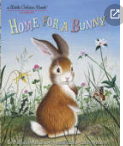
Home for a Bunny, by Margaret Wise Brown

            It is spring time and Bunny is looking for a home somewhere under something.  Along the way he meets several animals but none have a home for a bunny.  Finally he meets another bunny and together they find the perfect home for bunnies.

Materials

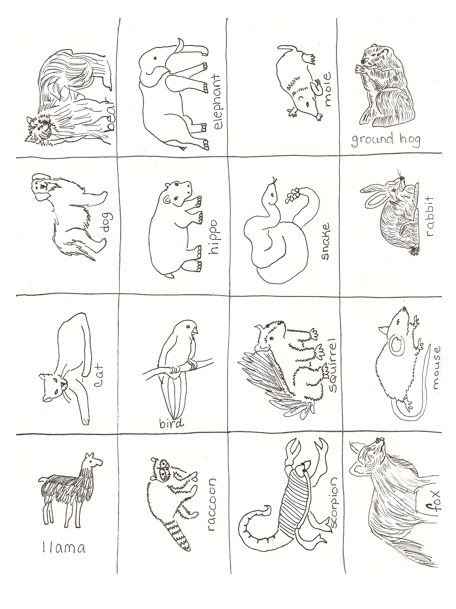
  • 10-12 animal pictures who live under and above the ground
  • Cotton balls
  • Rabbit shape

Vocabulary

  • Bunny (another name for a rabbit)
  • Habitat (the different kinds of places that animals live)
  • Bog (a wet grassy place near a pond)
  • Burrow (a tunnel underground where rabbits and other animals live)

Before Reading the Story

           Ask the children if they know what a bunny is.  Show them the cover of the book and read the title.  Ask them if they know where a good place for a bunny to live is.  Tell the children that bunnies usually sleep all day in their burrows and then come out at night.  Bunnies can sit so quietly that they hardly move at all.  Ask the children if they can sit as still as a bunny.

Science/Scientific Knowledge; expands knowledge of and abilities to observe, describe, and discuss the natural world, materials, living things, and natural processes. AND Language Development/Speaking & Communicating; develops increasing abilities to understand and use language to communicate information, experiences, ideas, feelings, opinions, needs, questions, and for other varied purposes.

Reading the Story

After Reading the Story

            Talk about the different homes in the story and who lived in them (a tree, a bog, a log).  Ask the children where people live (in a house, an apartment, a trailer).   Ask what kinds of things you find in a people house. 

Language Development/Speaking & Communicating; develops increasing abilities to understand and use language to communicate information, experiences, ideas, feelings, opinions, needs, questions, and for other varied purposes.

Discovery

            Sort animals by those that live under the ground and those that live above the ground.

Mathematics/Patterns & Measurement; shows growth in matching, sorting, putting in a series, and regrouping objects according to one or two attributes such as color, shape, or size.

Music and Movement

            Teach the children the finger play, Here is a Bunny

Here is a bunny with ears so funny                          Hold up 2 fingers like a peace sign

And here is his hole in the ground                          Make a circle with your other hand

When a noise he hears, he pricks up his ears             Stretch bunny ears on hand

And jumps in his hole in the ground                       Put bunny hand through circle hand

Language Development/Listening & Understanding; demonstrates increasing ability to attend to and understand conversations, stories, songs, and poems.

           Put on some music and do the Bunny Hop https://www.youtube.com/watch?v=UgLL_q5FMCU

Left foot out, left foot out

Right foot out, right foot out

Jump forward, Jump backwards

Jump forward three times.

Creative Arts/Movement; shows growth in moving in time to different patterns of beats and rhythm in music.

Blocks

           Challenge the children to make bunny tunnels/burrows.

Approaches to Learning/Initiative & Curiosity; approaches tasks and activities with increased flexibility, imagination, and inventiveness.

Art

           Cut out simple bunny shape.  Put watered glue into bowls and add paint brushes.  The children paint the glue onto the bunny shape and then pull cotton balls apart to decorate.

Language Development/Listening & Understanding; shows progress in understanding and following simple and multiple-step directions. AND Creative Arts/Art; develops growing abilities to plan, work independently, and demonstrate care and persistence in a variety of art projects.

Library and Writing

            Ask the children to draw their home.  When they are finished, write their address on a piece of paper and encourage them to copy the numbers.  The teacher can help write the street name.

Social & Emotional Development/Knowledge of Families & Communities; develops ability to identify personal characteristics, including gender and family composition. AND Mathematics/Number & Operations; begins to associate number concepts, vocabulary, quantities, and written numerals in meaningful ways.

Sand and Water

            Add dampened sand to the table and dig bunny holes.

Approaches to Learning/Initiative & Curiosity; approaches tasks and activities with increased flexibility, imagination, and inventiveness.

Dramatic Play

            House play today.  This would be a good day to let the children use rags and water to clean the shelves and make the dramatic play area clean and a perfect home for children.

Social & Emotional Development/Self-Concept; develops growing capacity for independence in a range of activities, routines, and tasks.

Math and Manipulatives

            Let the children build with small blocks or Legos and make homes.  Put out small people or animals that they can put inside their homes.

Approaches to Learning/Reasoning & Problem Solving; develops increasing ability to find more than one solution to a question, task, or problem. AND Physical Health & Development/Fine Motor Skills; grows in hand-eye coordination in building with blocks, putting together puzzles, reproducing shapes and patterns, stringing beads, and using scissors.

Outdoor Play

           Play bunny tag on the playground.  The children hop on all fours like rabbits.  Put hoola hoops on the ground and the children can hop into their bunny holes where they are safe and can not be caught.

Physical Health & Development/Health Status & Practices; progresses in physical growth, strength, stamina, and flexibility.

Transitions

            Play I’m thinking of an animal. (I’m thinking of an animal that lives in a barn and gives us milk to drink.  I’m thinking of an animal that lives in the trees of the jungle and eats bananas and swings from its tail.)

Language Development/Listening & Understanding; demonstrates increasing ability to attend to and understand conversations, stories, songs, and poems.

Resources
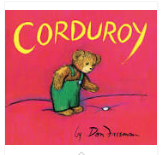
Corduroy, by Don Freeman

This is the story about a lost button and friendship. A Teddy Bear searches through a department store to find his lost button and ends up finding a new friend.

Materials

  •   Large button shape and small corduroy bear for hiding game
  •   A variety of buttons
  •   Oil pastels and watercolors

Vocabulary

  •   Overalls (pants with an attached bib on the front)
  •   Escalator (moving staircase)
  •   Palace (where the king and queen live)
  •   Admire (to look at something you think is beautiful)

Before reading the Story

Talk about friendship.  How can you tell that someone is your friend?  What can you do for your friend if they are feeling sad? How does it make you feel when someone wants to be your friend?  What should you do if you want to be someone’s friend?

Social & Emotional Development/Social Relationships; progresses in responding sympathetically to peers who are in need, upset, hurt, or angry; and in expressing empathy or caring for others.  AND Language Development/Speaking & Understanding; progresses in abilities to initiate and respond appropriately in conversation and discussions with peers and adults.

Reading the Story

Make sure to use voice modulation to express the different emotions that Corduroy experiences.  Make the expressions on your face also so the children can see.

Social & Emotional Development/Social Relationships; progresses in responding sympathetically to peers who are in need, upset, hurt, or angry; and in expressing empathy or caring for others.

After Reading the Story

Check on your clothing and see who is wearing a button. Who is wearing the most buttons? Who is wearing a snap, a zipper, a hook, a buckle?  As you look for various items, talk about what they are used for.  Can you think of something else that has a button on it, a zipper, etc..  (My Mom’s purse has a zipper, my jacket has a zipper, my folder has a snap).

Science/Scientific Knowledge; expands knowledge of and abilities to observe, describe, and discuss the natural world, materials, living things, and natural processes.  AND Language Development/Listening & Understanding; demonstrates increasing ability to attend to and understand conversations, stories, songs, and poems.

Discovery

Bring in a button collection that the children can look at and sort by various attributes.

Mathematics/Geometry & Spatial Sense; shows growth in matching, sorting, putting in a series, and regrouping objects according to one or two attributes such as color, size, or shape.

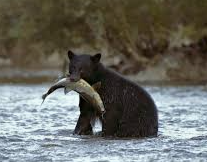
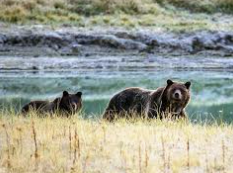
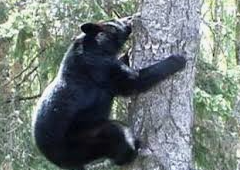
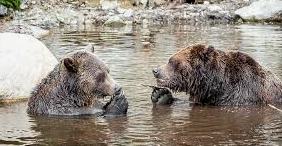
  Bring in pictures of real bears.  Let the children look at these and use them for discussion.  Can they tell about where bears live, what they like to eat, etc.?

Science/Scientific Knowledge; expands knowledge if and abilities ti observe, describe, and discuss the natural world, materials, living things, and natural processes.  AND  Approaches to Learning/Initiative & Curiosity; grows in eagerness to learn about and discuss a growing range of topics, ideas, and tasks.

Music and Movement

The Bear Went Over the Mountainhttps://www.youtube.com/watch?v=QAW2GSwUnNo

The bear went over the mountain
To see what he could see.
The bear went over the mountain
To see what he could see.
And all that he could see
Was the other side of the mountain
Was all that he could see.

Creative Arts/Music; participates with increasing interest and enjoyment in a variety of music activities, including listening, singing, finger plays, games, and performances.

Blocks

Add doll furniture and let the children build a department store with a furniture area.  Can you make an upstairs and a downstairs?  How can you make the stairs or the escalator? 

Approaches to Learning/Engagement & Persistence; grows in abilities to persist in and complete a variety of tasks and activities.

Add Teddy Bear counters; can you put a bear under the table, on the table, behind the table,etc..

Mathematics/Geometry & Spatial Sense; builds an increasing understanding of directionality, order, and positions of objects, and words such as up  down, over, under,top, bottom, inside, outside, in front, behind.

Art

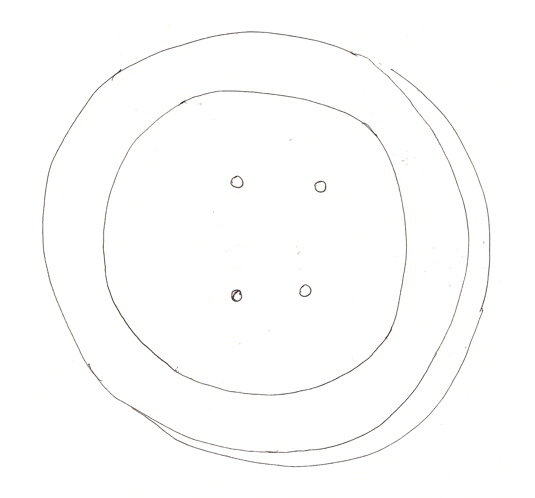
Give each child a large round circle in light colored paper.  Let them color their buttons using oil pastels.  When they are finished coloring their button, they can do a watercolor wash over it.  This causes the oil pastel to sort of pop through and can make a very lovely effect.  

Creative Arts/ Art; begins to understand and share opinions about artistic products and experiences.

Library and Writing

Ask the children to draw a picture of where Corduroy’s button might be hiding.  After they have drawn the picture they can glue a small button (round circle) onto their picture.  Make sure to write their dictation underneath.  (The button was under the chair.  The button was in the grass next to the flower)

Literacy/Book Knowledge & Appreciation; shows growing interest in reading-related activities, such as asking to have a favorite book read; choosing to look at books; drawing pictures based on stories; asking to take a book home; going to the library; and engaging in pretend-reading with other children.

Sand and Water

Put sand in the table today and add either buttons, counting bears, or another small item that the children can scoop, count, and sort.

Mathematics/Geometry & Spatial Sense; shows growth in matching, sorting, putting in a series, and regrouping objects according to one or two attributes such as color, size, or shape.

Dramatic Play

Add clothes that have buttons.  Encourage the children to practice buttoning and unbuttoning.

Physical Health & Development/Health Status & Practices; shows growing independence in hygiene, nutrition, and personal care when eating, dressing, washing hands, brushing teeth, and toileting.  AND Physical Health & Development/Fine Motor Skills; grows in hand-eye coordination in building with blocks, putting together puzzles, reproducing shapes and patterns, stringing beads, and using scissors.

Math and Manipulatives

Play, Where’s Corduroy?  Cut out and color the large button.  Make 4-6 depending on how well your children know their colors. Each button should be colored a color that your children are working on.  Have the children take turns hiding their eyes and put the bear under one of the buttons.  The child whose turn it is must guess where Corduroy is by naming the color.  You can also play this game by making shape buttons or buttons with 1-6 dots on them.

Language Development/Speaking & Communicating; uses an increasingly complex and varied vocabulary.

Outdoor Play

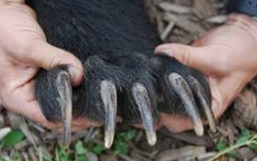
 Pretend that you are bears.  Use your long claws to scratch a tree trunk.  Pretend the climber is a tree to sit in.  Throw balls and pretend that you are catching fish.  Find a place to crawl under like a cave.  Growl loud and try walking on all fours (hand and feet), not hands and knees.

Creative Arts/Dramatic Play; participates in a variety of dramatic play activities that become more extended and complex.

Transitions

Ask the children to tell you or show you how they would feel if…, they lost something, like a button.  They were alone in the department store at night, someone said they wanted to be their friend, they fell down and bumped their head, your mother said you could not have something you really, really, wanted.  You got to buy a special toy at the store.

Language Development/Speaking & Communicating; develops increasing abilities to understand and use language to communicate informations, experiences, ideas, feelings, opinions, needs, questions; and for other varied purposes.

Resources

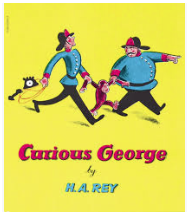
Curious George, by H.A. Rey

Children everywhere have fallen in love with this curious little monkey and his adventures.  This is the first book in the series.  Read as George leaves the jungle and is introduced to the Man in the Yellow Hat. 

Materials

  •  An instrument that can go quickly up and down the scales such as a                                  (keyboard, whistle slide, xylophone)

Vocabulary

  •  Curious (always wanting to know about things)
  •  Deck (the floor across the front of a boat)
  •  Fascinated (very curious)

Before Reading the Story

On the page where George lands on the telephone pole, stop and let the children see if they can find the man with the yellow hat.  Ask them what they think will happen next?

Literacy/Book Knowledge & Appreciation;  demonstrates progress in abilities to retell and dictate stories from books and experiences; to act out stories in dramatic play; and to predict what will happen next in a story.

After Reading the Story

 Ask the children if they remember why George was sent to prison (he made a false call to the fire department).  Talk to the children about the telephone.  It is not a toy but is used to call and talk to people.  Explain to the children when we call 911.  Let the children practice dialing 911.

Physical Health & Development/Health Status & Practices; builds awareness and ability to follow basic health and safety rules such as fire safety, traffic and pedestrian safety, and responding appropriately  to potentially harmful objects, substances, and activities.

Discovery

Bring in a globe or map and show the children where Africa is.  Bring in some pictures of  animals in their jungle habitat.  Explain that monkeys live in jungles.

Language Development/Listening & Understanding; demonstrates increasing ability to attend to and understand conversations, stories, songs, and poems.  AND Social & Emotional Development/Knowledge of Families & Communities; begins to express and understand concepts and language of geography in the contexts of the classroom, home, and community.

Music and Movement

 Play Up and Down with the children.  Explain to the children that if the instrument goes up the scale, they are to stand up.  If the instrument slides down the scale, they are to move down.  Use varying speeds and amounts of up and down. The children must listen and then act accordingly.

Creative Arts/Movement; expresses through movement and dancing what is felt and heard in various musical tempos and styles.

Blocks

Encourage the children to build stairs to add to their block structures.

Approaches to Learning/Engagement & Persistence; demonstrates increasing ability to set goals and develop and follow through on plans.

Art

Show the children how to trace around a small circular object on construction paper.  After they have traced several circular shapes onto a variety of colors, encourage them to cut them out and glue them to a piece of light blue paper. They can then add “strings” by drawing lines and make a balloon collage.

Physical Health & Development/Fine Motor Skills; progresses in abilities to use writing, drawing, and art tools, including pencils, markers, chalk, paint brushes, and various types of technology.  AND Physical Health & Development/Fine Motor SKills; develops growing strength, dexterity, and control needed to use tools such as scissors, paper punch, stapler, and hammer.

Library and Writing;

M is for Monkey.  What other words can the children think of that start with the letter M?  Make a list of the words that the children come up with.

Literacy/Phonological Awareness; shows growing awareness of beginning and ending sounds in words.

Sand and Water

Add spray bottles to the water today.  The children can aim at something in the water table and spray it.  Or attach a target to the wall behind the table for the children to practice aiming and spraying.

Physical Health & Development/Fine Motor Skills; grows in hand-eye coordination in building with blocks, putting together puzzles, reproducing shapes and patterns, stringing beads, and using scissors.

Dramatic Play

Bring in a straw hat and a monkey stuffed animal or puppet if you have one.  The children can then make their own Curious George adventure.

Literacy/Book Knowledge & Appreciation;  demonstrates progress in abilities to retell and dictate stories from books and experiences; to act out stories in dramatic play; and to predict what will happen next in a story.

Math and Manipulatives

Curious George wanted a red balloon but grabbed all of them instead.  Sort something by colors.  Put all the red in this pile, all the yellow here, and the purple over here.

Mathematics/Patterns & Measurement; shows increasing abilities to match, sort, put in a series, and regroup objects according to one or two attributes such as shape or size.

Outdoor Play

Practice walking a balance beam.  If you do not have something like a balance beam that you can walk, draw a line about 10 feet long with a piece of chalk.  Encourage the children to walk the line, jump, slide, walk backwards. 

Physical Health & Development/Gross Motor Skills; shows increasing levels of proficiency, control, nad balance in walking, climbing, running, jumping, hopping, skipping, marching, and galloping.

Transitions

Ask the children questions about the story as they go off to the next activity.  (Who brought George home from Africa?  Who did George call on the telephone?  How did George get away from the prison?).

Literacy/Book Knowledge & Appreciation;  demonstrates progress in abilities to retell and dictate stories from books and experiences; to act out stories in dramatic play; and to predict what will happen next in a story.