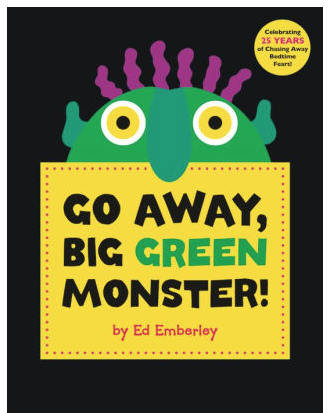
Go Away Big Green Monster! by Ed Emberley

            This fun book makes learning facial parts and colors easy.  This book can easily be made into a flannel board story for the children to enjoy over and over.

Materials

  • Paper plate per child
  • Styrofoam cup per child
  • Potting soil and a handful of grass seed per child.
  • Multiple colors of sidewalk chalk

Vocabulary

  • Imagination (to be able to see or think up things that are not really true or real)

Before Reading the Story

            Ask the children if they know what the word “imagination” means.  Talk about how sometimes we imagine things that are not really true or real.  Sometimes we might imagine that we are a superhero or a doctor but we are just pretending.  Sometimes we imagine scary things like monsters under the bed.  Let the children talk about some of their imaginary thoughts.  If the children do not begin their own talk, help them out by telling your own story (I used to imagine that there were snakes under my bed at night). 

Language Development/Speaking & Communicating; develops increasing abilities to understand and use language to communicate information, experiences, ideas, feelings, opinions, needs, questions; and for other varied purposes.

Reading the Story

            Have the children help with the line “Go away big green monster!”

Literacy/Book Knowledge & Appreciation; shows growing interest in reading-related activities, such as asking to have a favorite book rea; choosing to look at books; drawing pictures based on stories; asking to take a book home; going to the library; and engaging in pretend-reading with other children.

After Reading the Story

            Play Big Green Monster says….  Touch your two long legs, your triangle shaped nose, your round knees, your two pointy elbows etc..

Language Development/Listening & Understanding; understands an increasingly complex and varied vocabulary.

Discovery

            Give each child a Styrofoam cup that they can draw a monster face on.  Then let the children fill it with potting soil and add some grass seed on top.  When the grass begins to grow, they will have their own monster heads to take home.  Observe and record how long it takes for the grass seed to grow.

Science/Scientific Skills & Methods; develops growing abilities to collect, describe, and record information through a variety of means, including discussion, drawings, maps, and charts.

Music and Movement

            Teach the children the Scary Eyes poem.

See these big and scary eyes,

It’s a really big surprise

BOO!

Touch fingers to thumb to make two small circles. Put these by your eyes and say the poem slowly. At Boo! pop hands open.

Approaches to Learning/Initiative & Curiosity; chooses to participate in an increasing variety of tasks and activities.

            Sing I’ve Got Two Eyes https://www.youtube.com/watch?v=fyMRGeT_SRI

I’ve got two eyes, one two. 

They’re both the same size, one two

I’ve got two eyes and they’re both the same size.

I’ve got two ears, one two

They help me hear, one, two

I’ve got two ears and they help me hear.

I’ve got two hands to wave good-bye

I’ve got two arms to swing up high

I’ve got two knees as round as you please

I’ve got feet to walk down the street.

Mathematics/Number & Operations; begins to associate number concepts, vocabulary, quantities, and written numerals in meaningful ways.

            Sing Head, Shoulders, Knees and Toes. https://www.youtube.com/watch?v=h4eueDYPTIg

Physical Health & Development/Health Status & Practices; participates actively in games, outdoor play, and other forms of exercise that enhance physical fitness.

Blocks

            Ask the children if they can build a house that is very dark inside.  Encourage them to include a door so that you can see how dark it is inside.

Approaches to Learning/Engagement & Persistence; demonstrates increasing ability to set goals and develop and follow through on plans.

Art

            Put out green finger paint.  Challenge the children to make a big green monster face.

Creative Arts/Art; progresses in abilities to create drawings, paintings, models, and other art creations that are more detailed, creative, or realistic.

            Let the children paint a paper plate to be a monster head.  When it dries they can collage on the face.  Show them how to punch holes with a hole puncher across the top and use yarn or pipe cleaners for hair.  Have many colors of paper available for the children to cut out eyes, mouths, and noses.

Physical Health & Development/Fine Motor Skills; develops growing strength, dexterity, and control needed to use tools such as scissors, paper punch, stapler, and hammer.

Library and Writing

            Encourage the children to dictate and illustrate any monster story or dream story that they would like to share.

Literacy/Book Knowledge & Appreciation; demonstrates progress in abilities to retell and dictate stories from books and experiences; to act out stories in dramatic play; and to predict what will happen next in a story.

Sand and Water

            Add cornstarch and a small bit of water to the table today.  Explain to the children that sometimes it may appear to be one way but really it is not (The cornstarch looks like you should be able to pick it up but when you do it melts into and off of your hand). https://www.stevespanglerscience.com/lab/experiments/quicksand-goo/

Science/Scientific Skills & Methods; begins to use senses and a variety of tools and simple measuring devices to gather information, investigate materials, and observe processes and relationships.

Dramatic Play

            Put out dress ups of community helpers or ones that encourage the children to use their imaginations to be someone that they are not.

Creative Arts/Dramatic Play; shows growing creativity and imagination in using materials and in assuming different roles in dramatic play situations.

Math and Manipulatives

           Encourage the children to use any manipulative toy/s that you have that encourage them to sort by colors.

Mathematics/Geometry & Spatial Sense; shows growth in matching, sorting, putting in a series, and regrouping objects according to one or two attributes such as color, shape, or size.

Outdoor Play

On the cement draw circles about six inches round. Have the children each color a circle using a variety of colors of chalk. When the circles are all colored in, have the children start at one end and jump from circle to circle naming the colors as they go.

Approaches to Learning/Initiative & Curiosity; chooses to participate in an increasing variety of tasks, activities, projects, and experiences.

Transitions

            As the children move to the next activity ask them to show you a body part they have two of, one of, many of, ten of or a body part that is big, small, on their front, on their back, etc.

Mathematics/Number & Operations; begins to make use of one-to-one correspondence in counting objects and matching groups of objects.

Resources
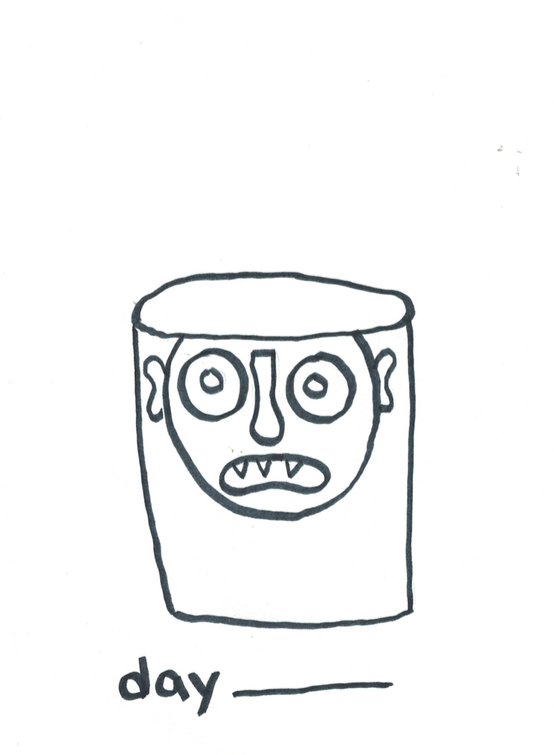
Use for charting grass growth

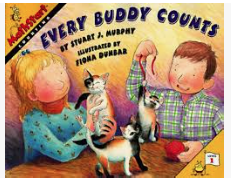
Every Buddy Counts, by Stuart J. Murphy

            What do you do when you wake up feeling lonely, crummy, yucky, and sad?  Count your friends and you will feel better!  This is a nice counting book to share with your children.

Materials

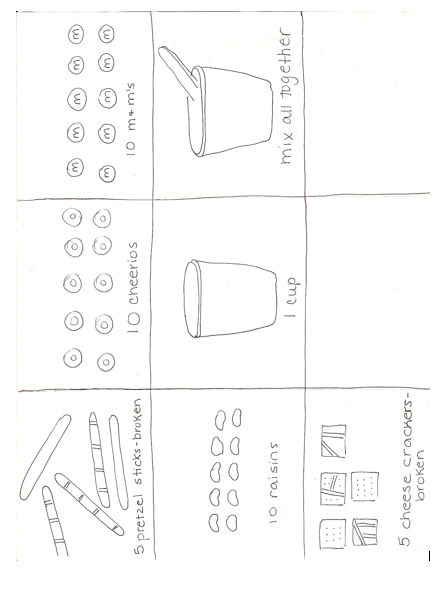
  • Rebus Gorp recipe cards
  • Gorp ingredients for the class
  • Dice

Vocabulary

  • More and less

Before Reading the Story

           Do several fingerplays or songs that require some counting (5 Little Ducks, 1,2,3,4,5 I Caught a Fish Alive).

Mathematics/Number & Operations; develops increasing ability to count in sequence to 10 and beyond.

Reading the Story

            As you read the book, stop and have the children help count (Example; On the page for 7, count the aunts and uncles and the cars.  Are there more people or more cars?  On the eight page after counting the playmates, ask what the girl is holding in her hand, What is it used for?)

Literacy/Book Knowledge & Appreciation; shows growing interest and involvement in listening to and discussing a variety of fiction and non-fiction and poetry. AND Mathematics/Number & Operations; begins to make use of one-to-one correspondence in counting objects and matching groups of objects.

After Reading the Story

            Bring in a dice.  Take turns rolling the dice and having the children count how many dots.  Then let the child choose a movement for everyone to do that many times. (Kerry you rolled 3.  Kerry wants to do 3 kicks, everybody kick and count 1,2,3.)

Mathematics/Number & Operations; begins to make use of one-to-one correspondence in counting objects and matching groups of objects. AND Physical Health & Development/Health Status & Practices; participates actively in games, outdoor play, and other forms of exercise that enhance physical fitness.

Discovery

            Make gorp using the rebus cards to count out ingredients.

Literacy/Print Awareness & Concepts; develops growing understanding of different functions of forms of print such as signs, letters, newspapers, lists, messages, and menus. AND Mathematics/Number & Operations; begins to make use of one-to-one correspondence in counting objects and matching groups of objects.

Music and Movement

            Have the children start in a squatting position and begin to count 1-10.  As they count, they begin to stand up slowly until they get to 10 and are on tip toe with hands in the air.  Now start a 10 and work down to 1 getting smaller and smaller as they count.

Mathematics/Number & Operations; develops increasing ability to count in sequence to 10 and beyond.

            Teach the children the finger play 1,2,3,4,5 I Caught a Fish Alive.

           1,2,3,4,5                                    Hold up fingers as you count

           I caught a fish alive                      Point towards yourself

           6, 7, 8,9,10                                Hold up fingers as you count

           Then I threw him back again!    Pretend to throw fish

           What made you let him go?         Shrug shoulders up

           Because he bit my finger so!        Hands on hips with mad face

           Which finger did he bite?             Look of  surprise

           The little pinkie on the right        Hold up little pinkie and look sad

Language Development/Listening & Understanding; demonstrates increasing ability to attend to and understand conversations, stories, songs, and poems.

Blocks

          Challenge the children to make a set of stairs using 10 blocks.  What else can you make using only 10 blocks?

Approaches to Learning/Reasoning & Problem Solving; develops increasing ability to find more than one solution to a question, task, or problem.

Art

            Have the children trace around their hands, or they can trace around their friends hands.  Encourage them to embellish their hands with fingernails, rings, and bracelets or watches at the wrist.  When they are finished decorating their hands, show them how to write the numbers 1-10 and put a number above each finger.

Literacy/Early Writing; experiments with a growing variety of writing tools and materials, such as pencils, crayons, and computers. AND Mathematics/Number & Operations; begins to associate number concepts, vocabulary, quantities, and written numerals in meaningful ways.

Library and Writing

            Put out a variety of flannel board shapes and let the children make patterns or count.

Mathematics/Patterns & Measurements; enhances abilities to recognize, duplicate, and extend simple patterns using a variety of materials.

Sand and Water

            Put sand or water in the table.  Ask the children to use a measuring cup and count how many scoops it takes to fill a bowl.  Use several size measuring cups and a variety of containers to fill.  Which containers hold the most?  Which container holds the least?

Mathematics/Number & Operations; begins to use language to compare numbers of objects with terms such as more, less, greater than, fewer, equal to.

Math and Manipulatives

            Make a counting book with the children.  Give each child a paper with a number on it.  The children can draw or cut out pictures of objects to represent their number.  Do numbers 1-10.

Mathematics/Number & Operations; begins to make use of one-to-one correspondence in counting objects and matching groups of objects.

Dramatic Play

            Have the children set the table for two, three, and four.  They will have to count to make sure they have enough dishes and silverware.

Mathematics/Number & Operations; begins to make use of one-to-one correspondence in counting objects and matching groups of objects.

Outdoor Play

           Play Mother-May-I?  All the children stand at one side of the area.  The children take turns asking “Mother may I take (3) (jumps)?  Mother then says yes, or no you may only take (2) jumps.  The children work their way across to the other side of the play yard counting different movements. (Slides, tippy toe walks, giant steps, skips, jumps, twirls).

Mathematics/Number & Operations; begins to make use of one-to-one correspondence in counting objects and matching groups of objects. AND Physical Health & Development/Gross Motor Skills; shows increasing levels of proficiency, control, and balance in walking, climbing, running, jumping, hopping, skipping, marching, and galloping.

Transitions

            Have the children count how many steps it takes to get from point A to point B.

Mathematics/Number & Operations; demonstrates increasing interest and awareness of numbers and counting as a means for solving problems and determining quantity.

Cut out and put into order for children to follow recipe for Gorp

Knuffle Bunny; a Cautionary Tale, by Mo Williems

A trip to the Laundromat ends in disaster as Trixie looses her beloved Knuffle Bunny.  Will she be able to find it?

Materials

A laundry basket or box

Facial expression cards

1 Small Knuffle bunnies and a role of masking tape

Knuffle bunny collage parts

Vocabulary

  • Laundromat (a place where you go to do your laundry if you do not have a washer at home)
  • Boneless (floppy like a wet noodle)

Before Reading the Story

Ask the children if they ever help their parents do chores at home. Give them a moment to talk about any experiences they might have. (I put the forks next to all the plates, I help take care of my baby, I put my toys away in the closet). Ask the children if they have ever helped with the laundry? If some say “yes”, ask if they do the laundry at home or at the special laundry washing place? Ask if they know the name (laundromat). Have all the children repeat this name. Explain that the story today is about a little girl who was helping her Daddy do the laundry at the laundromat. Let’s find out what happens, introduce the book.

Reading the Story

When you get to the page where Trixie realized something, stop and ask the children what they think Trixie realized.  When you get to the page where her Daddy says, “That’s right, we’re going home” stop and look at Trixie’s face.  Ask the children how they think Trixie is feeling right now?  Notice Dad’s face as Trixie continues her temper tantrum.

Language Development/Speaking & Communicating; develops increasing abilities to understand and use language to communicate information, experiences, ideas, feelings, opinions, needs, questions, and for other varied purposes. AND Literacy/Book Knowledge & Appreciation;demonstrates progress in abilities to retell and dictate stories from book sand experiences; to act out stories in dramatic play; and to predict what will happen next in a story.

After Reading the Story

Talk to the children about when they were little how they did not have the words to tell people what they wanted but now they are big and can use their words to tell what they need, or if they are having a problem.  Remind them that now they are big and they know how to use their words to tell what they want or need. Ask them what they should do if they are having a problem? Go over your strategies for problem-solving in the classroom.

Social & Emotional Development/Self Control; shows progress in expressing feelings, needs, and opinions in difficult situations and conflicts without harming themselves, others, or property.

Discovery

Put a globe or map of the United States into your center. Add a state map and a local map (can be found at a realtor’s office). On each map mark where your school is approximately located. Are there any geographical markers near your area such as mountains, rivers, or ocean that you can point out to the children?

Social & Emotional Development/Knowledge of Families & Communities; begins to express and understand concepts and language of geography in the contexts of the classroom, home, and community.

Music and Movement

Remind the children that in the story Trixie went boneless. Do they remember what boneless means? Ask them to demonstrate boneless. Tell them the opposite of boneless is rigid. Ask them if they can show you what ridgid would look like. Play Boneless/Rigid by calling them out and the children act out the appropriate definition.

Language Development/Listening & Understanding; understands an increasingly complex and varied vocabulary.

The Washing Machine song is a fun song to let your children dance to.

Creative Arts/Movement; expresses through movement and dancing what is felt and heard in various musical tempos and styles.

Blocks

Make a map on the floor (with chalk-it will erase out of the carpet), with tape, or on a large piece of butcher paper.  Encourage the children to build a community with homes, stores, a school, etc.

Social & Emotional Development/Knowledge of Families & Communities; begins to express and understand concepts and language of geography in the contexts of the classroom, home, and community. AND Physical Health & Development/Fine Motor Skills; grows in hand-eye coordination in building with blocks, putting together puzzles, reproducing shapes and patterns, stringing beads, and using scissors.

Art

Make a knuffle bunny collage using circle and ovals

Sand and Water;

Put water and a little soap intot he table today along with doll clothes.  Children can pretend that they are the Laundromat.  Hang a string over the table with clothes pins

Library and Writing;

Encourage the children to recall Trixies path to the Laundromat or draw a picture of your house with as many details as you can think of.

Encourage the children to make a map of from your classroom to the playground or another part of your center.  Or, have them draw a map of how to get to school.  What do you pass?

Dramatic Play;

Put the laundry basket or boxes into the center and let the children practice folding and hanging the dress up clothes.  Sort by what you wear on your feet, head, legs, body.

Math and Manipulatives;

Play memory match with the facial cards of Trixie

Outdoor Play;

 Play where’s the knuffle bunny?

Transitions;

Ask do you have a washer and dryer at home or do you go to the laundry mat?  Have them write their name ofn the correct side of the graph