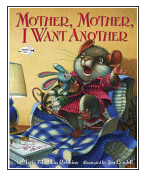
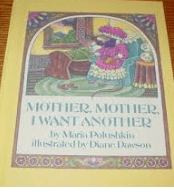
Mother, Mother, I Want Another, by Maria Polushkin

    Mother Mouse is tucking her baby into bed.  Baby mouse begins to cry, I want another, Mother.  Another Mother!  Find out what Mrs. Mouse does and how she and baby mouse resolve this issue.

Materials

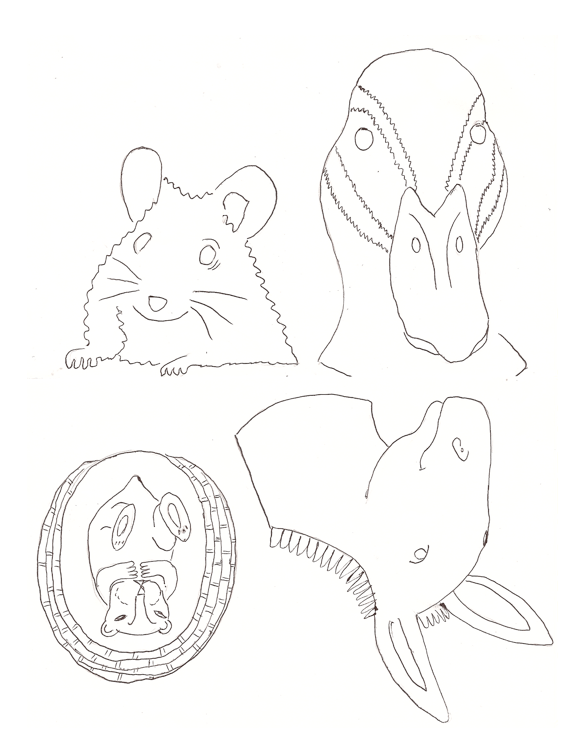
  • Mask of Mrs. Mouse, baby mouse, Mrs Duck, Mrs. Frog, Mrs. Pig, and Mrs Donkey
  • A variety of plastic foods or toys that have a varied number of syllables (corn, apple, carrot, pineapple, celery, pear)
  • Magazines with pictures of mothers and babies
  • Box of cornstarch

Vocabulary

  • Fret ( to be upset and cry)    

Before Reading the Story

Talk to the children about their bedtime rituals. Does anyone read them a story? Does anyone kiss them good-night?

Language Development/Speaking & Communicating; develops increasing abilities to understand and use language to communicate information, experiences, ideas, feelings, opinions, needs, questions; and for other varied purposes

Reading the Story

            Sing the Mother animal’s responses to baby mouse. 

After Reading the Story

            Tell the children that in the story, mother mouse went to find what she thought her baby wanted.  Ask the children what baby mouse really wanted?  Ask the children if they have ever had an experience like baby mouse, what did they do, what did their parent do?  Explain that when we don’t use our words or talk in full sentences, people do not always know what we want. 

Language Development/Speaking & Communicating; progresses in abilities to initiate and respond appropriately in conversation and discussions with peers and adults.

Discovery

            Tell the children that you are going to play a game with them about not using your words correctly.  Put out a variety of plastic foods.  Explain that you are going to ask them to guess which one you want by grunting the food name.  They will have to try to guess which one you want by counting the syllables of the word.  Practice counting syllables in the children’s names before you begin.(apple=grunt, grunt /pineapple=grunt,grunt,grunt).  After they guess correctly have all the children name the food item and then clap out its syllables.

Literacy/Phonological Awareness; shows growing ability to hear and discriminate separate syllables in words.

Music and Movement

            Sing Good Night Baby, to tune Good Night Ladies . https://www.youtube.com/watch?v=fMruF_CLrqM

Good night baby, good night baby,

Good night baby, it’s time to go to sleep

AGAIN!

Creative Arts/Music; participates with increasing interest and enjoyment in a variety of music activities, including listening, singing, finger plays, games, and performances.

Blocks

            Challenge the children to make a bed that they can sleep in. How will you figure out if it is long enough? How will you form the base? What blocks will you need to use?

Approaches to Learning/Initiative & Curiosity; approaches tasks and activities with increased flexibility, imagination, and inventiveness.

Art

            Use magazines and ask the children to cut out pictures of babies and mothers.  These can be both human and animals.  Draw a line down a piece of poster board and have the children glue the babies on one side and the mothers on the other.

Physical Health & Development/Fine Motor Skills; grows in hand-eye coordination in building with blocks, putting together puzzles, reproducing shapes and patterns, stringing beads, and using scissors. AND Mathematics/ Patterns & Measurement; shows increasing abilities to match, sort, put in a series, and regrouping objects according to one or two attributes such as shape or size.

Sand and Water

Try something different in the water table today. Add a box of cornstarch and slowly add water. The mixture will become solid in the bottom of your water table but when you pick it up, it will liquify and slip through your fingers. Show the children how to let it become a solid and use their finger to write their name. Them pick it up and let it ooze through their fingers.

Science/Scientific Skills & Methods; begins to use senses and a variety of tools and simple measuring devices to gather information, investigate materials, and observe processes and relationships. AND Literacy/ Early Writing; experiments with a growing variety of writing tools and materials. such as pencils, crayons, and computer.

Library and Writing

            Encourage the children to think of other animals that might come and sing to baby mouse.  What might these other animals say and bring to baby mouse?  Have the children illustrate and write their responses.  (Meow, I will bring you milk. Don’t cry baby mouse I will bring you a piece of cake).

Literacy/Print Awareness & Concepts; shows increasing awareness of print in the classroom, home, and community settings.

Math and Manipulatives

            Ask the child to give you two or three objects (chain link, counter bears).  When they give them to you say “I want another, now how many do I have”?  Continue this as the child gives you another and counts, note if they understand adding one more and how high they can count.  For older children you can say I want two more, now how many do I have?

Mathematics/Number & Operations; develops increases abilities to combine, separate and name “how many” concrete objects.

Dramatic Play

            This is a fun story to act out   Make the Mother masks and attach to a sentence strip.

Literacy/Book Knowledge & Appreciation; demonstrates progress ub abilities to retell and dictate stories from books and experiences; to act out stories in dramatic play; and to predict what will happen next in a story.

Outdoor Play

Play Mouse Tag. The teacher starts off as ‘the cat’ and chases the mice trying to catch them. Have a tree or a climber be the mouse hole or safe place. If a “mouse” is caught then they become a cat and help catch other mice.

Social & Emotional Development/Cooperation; shows increasing abilities to use compromise and discussion in working, playing, and resolving conflicts with peers.

Transitions

Ask each child to tell you something that their Mother does that makes them feel special and loved. (My Mom makes me chocolate milk, My Mom hugs me and tickles me)

Social & Emotional Development/Knowledge of Families & Communities; develops ability to identify personal characteristics, including gender and family composition.
Kiss it Better, by Hiawyn Oran

            It is amazing what a kiss and a Band-Aid can do to heal a hurt.

Materials

  • Lots of band-aids (the more the merrier. I found the children liked opening and applying bandaids with this book).
  • Piece of paper large enough to trace a child
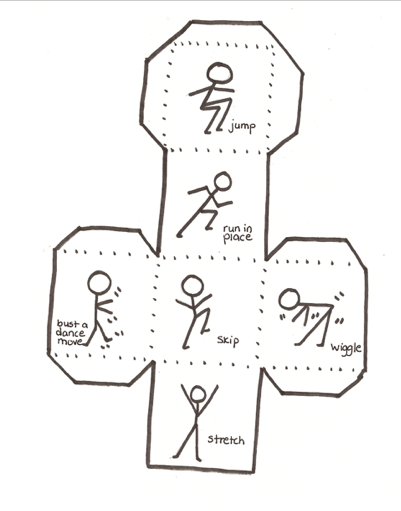
  • Make a dice for transition (see resources)

Vocabulary

Before Reading the Story

            Come to the rug time wearing a band-aid.  Tell the children a story about how it happened.  Ask them if they have ever worn a band-aid?  What do they think band-aids do?  Let the children talk about their experiences about being hurt or sick while at home.  What did they do, who did they tell, what did their parent do, did they have to go to the doctor?

Language Development/Speaking & Communicating; develops increasing abilities to understand and use language to communicate information, experiences, ideas, feelings, opinions, needs, questions; and for other varied purposes.

Reading the Story

Read the story with sympathetic emotions and point out to the children, “look, can you tell how Little Bear is feeling”? Let the children talk about each sad experience that Little Bear goes through if they choose. When you get to the part where Big Bear is upset, ask the children what they think Little Bear will do?

Social & Emotional Development/Social Relationships; progresses in responding sympathetically to peers who are in need, upset, hurt, or angry; and in expressing empathy or caring for others. AND Literacy/Book Knowledge & Appreciation; demonstrates ability to retell and dictate stories from book sand experiences; to act out stories in dramatic play; and to perdict what will happen next in a story.

After Reading the Story

            Trace around one child in the classroom before hand.  Tape the child’s body shape to the wall.  Give each child a band-aid and have them open it.  Go around the circle naming body parts.  The children then attach their band-aid to the body part that they were assigned (Kerry can you put your band-aid on the knee, Roger can you put your band-aid on the neck. Include body parts such as knuckles, ear lob, nostril, spine, ankle, heel, etc). 

Science/Scientific Knowledge; expands knowledge if and respect for their bodies and the environment. AND Language Development/Listening & Understanding; understands and increasingly complex and varied vocabulary.

Discovery

            This would be a good day to practice proper hand washing and body washing technique.  Explain to the children that when they fall and bleed that the area must be washed well to help fight any dirt or germs that might have gotten into the cut.  Let the children practice washing their hands and also any other body part that they would like to pretend was cut; water, soap, rinse, dry, apply a band-aid.

Physical Health & Development/Health Status & Practices; shows growing independence in hygiene, nutrition, and personal care when eating, dressing, washing hands, brushing teeth, and toileting.

Music and Movement

            Play Simon Says with the children. 

Language Development/Listening & Understanding; understands and increasingly complex and varied vocabulary.

Sing the Hokey Pokey https://www.youtube.com/watch?v=4EnaAFyrcQM or Looby Loo https://www.youtube.com/watch?v=pwcA_xjw8vs.  Use songs and movements that make children aware of body parts and their names.

Science/Scientific Knowledge; expands knowledge if and respect for their bodies and the environment.

            Sing We’re Gonna Wash Those Germs Right Off Of Our Hands, sung to the chorus of I’m Gonna Wash That Man Right Out Of My Hair. https://www.youtube.com/watch?v=Zzu8ZxBHMWk

We’re gonna wash those germs right off of our hands,

We’re gonna wash those germs right off of our hands,

We’re gonna wash those germs right off of our hands,

And keep them nice and clean.

Physical Health & Development/Health Status & Practices; builds awareness and ability to follow basic health and safety rules such as fire safety, traffic and pedestrian safety. and responding appropriately to potentially harmful objects, substances, and activities.

Use body parts to make simple patterns for the children to follow (clap, jump, clap, jump or tippy toes, touch the ground, turn around, tippy toes, touch the ground, turn around).

Mathematics/Patterns & Measurement; enhances abilities to recognize, duplicate, and extend simple patterns using a variety of materials.

Blocks

            Bring paper and red writing materials to the center and show the children how to make a cross shape with red marker.  Tell them that this is the universal sign for first aid.  Let them build a hospital and attach their red crosses.  Bring in a toy ambulance if you have one.

Social & Emotional Development/Knowledge of Families & Communities; develops growing awareness of jobs and what is required to perform them. AND Literacy/Early Writing; experiments with a growing variety of writing tools and materials, such as pencils, crayons, and computers.

Art

            Give each child 5-7 band-aids and have them attach them to a piece of colored paper.  Paint over the band-aids.  When the paint is dry, peel the band-aids off the paper. Can the children predict what will happen?

Creative Arts/Art;develops growing abilities to plan, work independently, and demonstrate care and persistence in a variety of art projects. AND Science/Scientific Skills & Methods; begins to describe and discuss predictions, explanations, and generalizations, based on past experiences.

Sand and Water

            Remind the children if they are wearing a band-aid on their hands, that they should not play in the water as it will fall of when it gets wet. And you do not want any germs to get into their cut or their cut to get into the water.

Physical Health & Development/Health Status & Practices; builds awareness and ability to follow basic health and safety rules such as fire safety, traffic and pedestrian safety. and responding appropriately to potentially harmful objects, substances, and activities.

Library and Writing

            Have the children draw a picture of a person.  Give each child a band-aid to attach to their picture.  Ask the child how who the person is and why they had to have a band-aid? (My Mom got cut with the knife; I fell off my bicycle and hurt my knee).

Literacy/Early Writing; begins to represent stories and experiences through pictures, dictation, and in play.

Dramatic Play

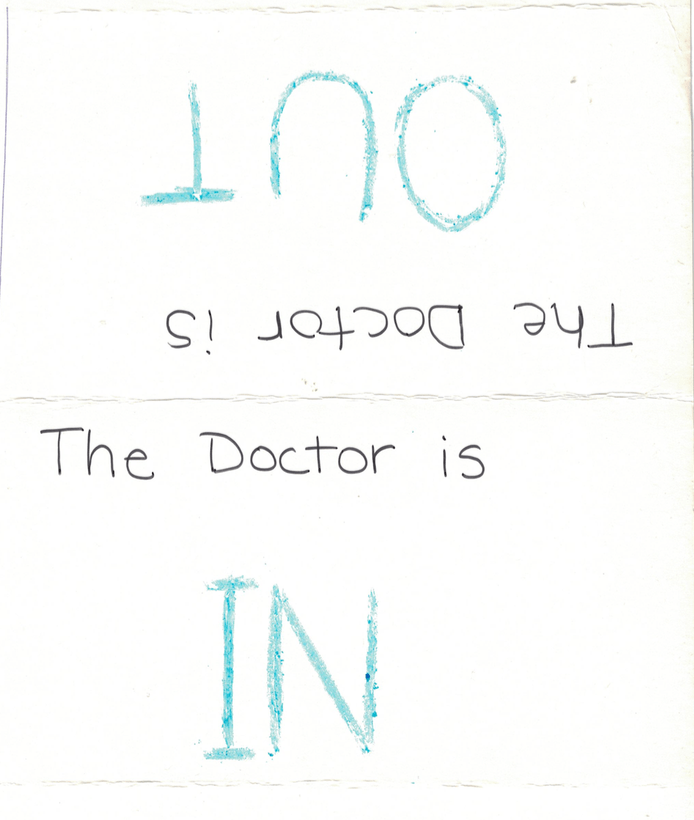
            If you have any Doctor’s office equipment put it out in the center today along with more bandaids and bandages!

Social & Emotional Development/Cooperation; increaseses abiliities to sustain interactions with peers by helping, sharing, and discussion.

Math and Manipulatives

            Put out sequencing cards for the children to put in order and talk about what comes first, next, and last. If you do not have sequencing cards, The Wiseowlfactory website has some that you can copy and print. https://www.thewiseowlfactory.com/sequencing-cards-and-color-matching-for-pre-k-k-1-free-pdfs/.

Mathematics/Patterns & Measurement; shows increasing abilities to match, sort, put in a series, and regroup objects according to one or two attributes such as shape or size. Literacy/Book Knowledge & Appreciation; demonstrates progress in abilities to retell and dictate stories from books and experiences; to act out stories in dramatic play; and to predict what will happen next in a story.

Outdoor Play

            Play Elbow-Elbow.  Every child finds a partner.  The caller calls out a body part and the children must touch them together (elbow to elbow, forehead to forehead, toe to toe).  Let the children take turns being the caller.

Social & Emotional Development/Cooperation; develops increasing abilities to give and take in interactions; to take turns in games or using materials; and to interact without being overly submissive or directive. AND Science/Scientific Knowledge; expands knowledge of and respect for their bodies and the environment.

Transitions

            Let the children take turns rolling the movement dice and following the actions as they line up or go to the next activity.

Literacy/Early Writing; develops understanding that writing is a way of communicating for a variety of purposes. AND Language Development/Listening & Understanding; shows progress in understanding and following simple and multiple-step directions.

Resources

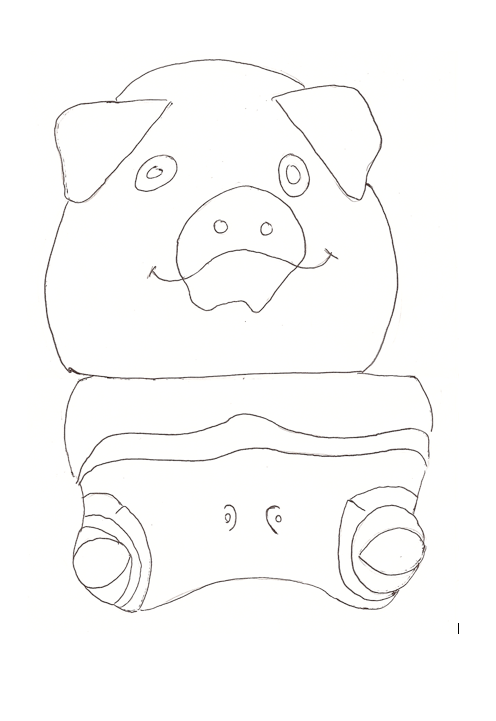
dice for transitions. Cut solid lines and fold dotted lines, tape to make a cube.
Make on cardboard for the dramatic center today.

Katy No-Pocket, by Emmy Payne

            Kangaroos carry their young in front pockets on their bodies.  What is to become of Katy’s son Freddy when she has no way to carry him?

Materials

  • Pocket chart or hanging shoe holder.
  • Animals from the story and several others that begin with the same letter
  • Picture of a kangaroo with a pocket and a baby
  • Pocket shape
  • Several long scarves

Vocabulary

  • Awfully (extremely) really big hops
  • Enormous (another word for really big)
  • Cross (angry or crabby)
  • Carpenter (a person who uses tools to build houses and things of wood)

Before Reading the Story

            Hold up the picture of the kangaroo and ask the children if they know what kind of an animal this is?  Ask them if they can see the baby kangaroo?  Explain that the mother kangaroo has a special pocket in her stomach to carry the baby kangaroo.  Read the title of the book.  Ask the children what they can guess what the problem is in the story (the mother has no way to carry her baby).  Ask them if they can think of a way to help the mother kangaroo to carry her baby.  Have the children look at their clothing and count the number of pockets that they are wearing.  Show the children the front of the book and re-read the title and begin.

Literacy/Book Knowledge & Appreciation; demonstrates progress in abilities to retell and dictate stories from books and experiences; to act out stories in dramatic play; amnd to predict what will happen next in a story. AND Mathematics/Number & Operations; begins toi use one-to-one correspondence is counting objects and matching groups of objects.

Reading the Story

As you read, pay attention to the different feelings that the animals are experiencing. Let the children talk about them.

Language Development/Speaking & Understanding; develops increaing abilities to understand and use language to communicate information, experiences, ideas, feelings, opinions, needs, questions; and for other varied purposes.

After Reading the Story

            Use the pocket chart and put an animal into each pocket.  Ask the children if they can guess which animal is hiding in each pocket by listening to you make the sounds.  Sss-nake/snake, cro-co-d-ile/crocodile.  As the children guess the animals, pull them out of the pockets so they can see them.

Literacy/Phonological Awareness; shows growing ability to hear and discrimainate separate syllables in words.

Discovery

            Bring in pictures or books of real animal adults and babies for the children to look at, compare, and discuss. Do the babies look like the adults?

Science/Scientific Knowledge; expands knowledge of and abilities to observe, describe, and discuss the natural world, materials, living things, and natural processes.

Music and Movement

            Finger play, Kangaroo.

 Jump, jump, jump goes the Kangaroo                    

(jump fist up and down)

I thought there was one, but now I see two              

( Hold up one finger, then two fingers)

The mother takes her baby along in a pouch            

(put thumb inside palm of other hand)

 Where he can nap like a baby on a couch.

  (open palm and lay thumb across)

Language Development/Listening & Understanding; demonstrates increasing ability to attend to and understand conversations, stories, songs, and poems.

            Sing,  I’ve Got Something in My Pocket.       https://www.youtube.com/watch?v=MkO7UKUBXUY

I’ve got something in my pocket,

That belongs across my face.

I keep it very close at hand

In this most convenient place.

I’m sure you will not guess it

If you guess a long, long while

So I’ll take it out and put it on,

It’s a great big happy smile!

Language Development/Listening & Understanding; demonstrates increasing ability to attend to and understand conversations, stories, songs, and poems.

Blocks

            In the story the carpenter who helped Katy carried many tools.  Add a carpenters apron or tool belt and tools for the children to build.

Creative Arts/ Dramatic PLay; participates in a variety of dramatic play activities that become more extended and complex.

Art

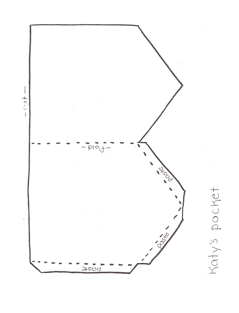
            Give each child a pocket shape that they can cut out and decorate.  They can then cut out pictures from magazines and put them in their pockets.  (My children like to cut out pictures from toy magazines).

Physical Health & Development/Fine Motor Skills; grows in hand-eye coordination in building with blocks, putting together puzzles, reproducing shapes and patterns, stringing beads, and using scissors.

Library and Writing

            Color and cut out the animals from the story.  On the pocket chart attach the letters that correspond. (L,T,C,B for lion, turtle, crocodile, and bird).  Have the children match the animal to the correct letter/letter sound.

Literacy/Phonological Awareness; shows growing awareness of beginning and ending sounds of words. AND Literacy/Alphabet Knowledge; increases in ability to notice the beginning letters in familiar words.

Sand and Water

Dramatic Play

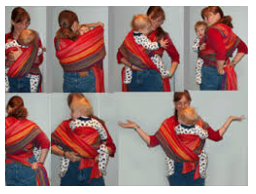
            Add several aprons with pockets.  (Ask your local home improvement store for donations) Or… Explain to the children that many mothers use or make baby carriers to help hold their babies. Show the children how to take a large scarf and turn it into a carrier for their baby dolls.

Approaches to Learning/Initiative & Curiosity; chooses to participate in a variety of tasks and activities.

Math and Manipulatives

            Copy the kangaroo picture onto a manila file and punch holes all around to make a lacing board.

Physical Health & Development/Fine Motor Skills; grows in hand-eye coordination in building with blocks, doing puzzles, reproducing shapes and patterns, stringing beads, and using scissors.

Outdoor Play

            Explain to the children that kangaroos are really good jumpers and can jump over 10 feet in one jump.  Let the children pretend to be kangaroos and measure their jumping abilities.  Measure and record, standing broad jumps and running long jumps.

Mathematics/Pattern & Measurements; shows progress in using stand and non-standard measures for length and area of objects. AND Physical Health & Development/Gross Motor Skills; shows increasing levels of proficiency, control, and balance in walking, climbing, running, jumping, hopping, skipping, marching, and galloping.

Transitions

            As the children go off to the next activity ask them to name something that could fit in their pocket or as the teacher ask them if something could fit in their pocket. (Could a tree fit in your pocket?  Could a penny fit in your pocket?  Could an apple fit in your pocket?)

Mathematics/Patterns & Measurement; begins to make comparisons between several objects based on a single attribute. AND Language Development/Listening & Understanding; demonstrates increasing ability to attend to and understand conversations, stories, songs, and poems.

fold along dotted lines and glue
tying a scarf to hold a baby