Goodnight Moon, by Margaret Wise Brown

            Now it’s time to go to bed.   Mother rabbit helps her little bunny settle her head, saying goodnight to things in the home feeling safe for a cozy nights sleep.

Materials

  •   Several flashlights
  •  Alphabet line
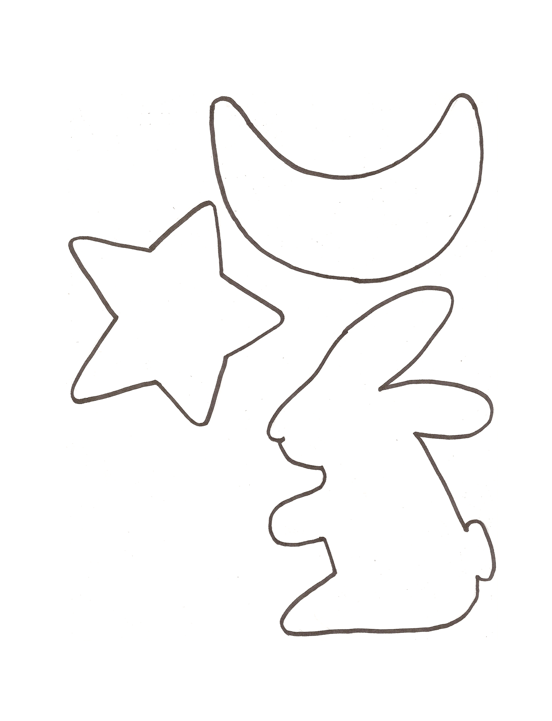
  •  Star, moon, and rabbit shape for tracing onto manila file
  • Oil pastels

Vocabulary

Before reading the story

            Open the book to the first page.  Ask the children if they can guess what the story is about.  Can you tell what time of day it is?  Where is the bunny?  Stretch and yawn.  Turn to the cover of the book and tell the children the book is titled, Goodnight moon.  Ask them if they can see where the moon is.

Science/Scientific Knowledge; develops growing awareness of ideas and language related to attributes of time and temperature.

Reading the book

            Read the book in a soft soothing voice.  Point to each object as you read the goodnight_____ and let the children help name the objects.

Language Development/Speaking & Communicating; uses an increasingly complex and varies spoken language.

After Reading the Story;

            Ask the children how night time is different from day time?  What types of activities do you do during the day?  What kinds of activities do you do at night?  How do you know when it is time for bed?  What gives us light in the day time?  What gives us light in the night?  What kinds of things are in your bedroom?

Science/Scientific Knowledge; develops growing awareness of ideas and language related to attributes of time and temperature.

Discovery

            Put several flashlights into the center.  What can you find that the flashlight can shine through (color paddles, your shirt, paper, a plastic lid, etc)?  Does the flashlight shine through a book, a toy car?

Science/Scientific Skills & Methods; develops increased ability to observe and discuss common properties, differences, and comparisons among objects and materials.

Music and Movement

            Sing Hey Diddle Diddle, The Cat and The  Fiddle. https://www.youtube.com/watch?v=caRuhprYlOQ

Teach the children the following poem with hand actions.

These fingers are so sleepy,                                 Point to hand

It’s time they went to bed.

First you little finger, Fold down pinkie finger

Tuck in your little head.                                      

Ring man, now it’s your turn                               Fold down ring finger

Now tall man great                                              Fold down middle finger

Pointer finger hurry                                              Fold down pointer finger

Because it’s getting late!

Let’s see, are you all tucked in?

No, there’s still one to come.

 Move over pointer finger,

Make room for stubby thumb                             Fold in thumb

            Author Unknown

Creative Arts/Music; participates with increasing interest and enjoyment in a variety of music activities, including listening, singing, finger plays, games, and performances.

Blocks

            Use the blocks to make rooms of a house.  Add doll furniture and small people.

Social & Emotional Development/Knowledge of Families & Communities; begins to express and understand concepts and language of geography in the contexts of the classroom, home, and community.

Art

Let the children draw with oil pastels onto white construction paper. When they are finished, wash over theri drawing with watercolors in a dark night type color. Using watercolors over oil pastels make the colors pop and give a night time effect. Encourage the children to draw something in their bedroom. You can then write,”Lee says good night stuffed elmo” and make a book with each child saying good night to what they have drawn on the paper.

Literacy/Early Writing; begins to represent stories and experiences trough pictures, dictation, and in play. AND Creative Arts/Art; gains ability on using different art media and materials in a variety of ways for creative expression and representation.

   Sand and Water

            Put magnetic alphabet letters into the sand.  Encourage the children to dig for the letters and match them to an alphabet line. Make a simple Alphabet line by tracing the magnet letters onto a piece of sentence strip. Cover with contact paper if you want it to last for multiple uses.

Literacy/Alphabet Knowledge; kn ows that letters of the alphabet are a special category of visual graphics that can be individually named.

Library and Writing

Trace around the star, moon and rabbit shapes onto a manilla file and cut them out. SHow the children how to use the manilla folder shapes to trace around onto paper. Encourage the children to practice cutting out the shapes with scissors.

 Literacy/Early Writing; experiments with a growing number of writing tools and materials, such as pencils, crayons, and computers. AND Physical Health & development/Fine Motor Skills; develops strength, dexterity, and coordination needed to use tools such as scissors, paper punch, stapler, andhammer.

Dramatic Play

            Encourage a child to be the mother bunny.  She says good night to an object in the dramatic center and the baby bunnies repeat.

Literacy/Book Knowledge & Appreciation; demonstrates progress in abilities to retell and dictate stories from books and experiences; to act out stories in dramatic play; and to predict what will happen next in a story.

Math and Manipilatives

Use the link to get a free bingo game download for Goodnight Moon. https://littlelearninglane.com/2016/07/01/goodnight-moon-freebies/

Outdoors

As the children play on the slide or other equipment that requires going one at a time, play Categories. As each child prepares to go down the slide, they must name something from a category specified by the teacher. (EXample= name a stuffed animal you have at home, name a food you eat for breakfast, name something that you do in the night, name something you wear).

Approaches to Learning/Reasoning & problem Solving; develops increasing ability to find more than one solution to a question, task, or problem.

Transitions

Play I’m Thinking Of… Describe something in the room and see if the children can guess what it is. “I’m thinking of something that is made of wood and is in the dramatic center. We can pretend to cook meals on it and a real one gets hot”.

Resources

for tracing and cutting

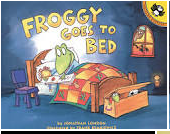
Froggy Goes to Bed, by Jonathan London

            It’s time for Froggy to go to bed but first he must prepare.  Froggy has so many things to do will he ever get to sleep?  This is a fun story to help children recall nightly rituals of their own.

Materials

  • Quilt pattern and many one-inch squares
  • Non-breakable mirrors

Vocabulary

  • Routine (schedule of events from one time to another, lunch to nap time)
  • Quilt (a blanket with a pattern design on it)

Before reading the story

            Ask the children if they know what a routine is?  Tell the children that routine means the schedule or practices of things that they do every day or night.  Can they think of any routines that they do?  Remind them about your classroom schedule, or your lunch routine.  Show the cover of the book and tell them this is the story about Froggy’s bedtime routine.  Ask them if they have any bedtime routines.  Write them down on a large sheet of paper.

Social & Emotional Development/Self-Concept; develops growing capacity for independence in a range of activities, routines, and tasks.

Reading the Story

Read with a soft soothing voice.

After Reading the Story

            Take back out your large sheet of paper that the children told their night time routines and compare them to Froggy’s. (Kerry said that she brushes her teeth before she goes to bed and so does Froggy).  Highlight all the similarities between the story and the children’s bedtime routines.

Literacy/Book Knowledge & Appreciation; shows growing interest and involvement in listening to and discussing a variety of fiction and non-fiction books, and poetry.

Discovery

            Put out mirrors so when the children brush their teeth today they can look at their teeth to see if they got them pearly white.  Today would be a good day to put out any teeth that you might have (pictures or real) as well as a large set of teeth that the children can examine with magnifying glasses.

Physical Health & Development/Health Status & Practices; shows growing independence in hygiene, nutrition, and personal care when eating, washing hands, brushing teeth, or toileting.

Music and Movement

            Take the children’s list of bedtime routines and sing them to the tune of This is the Way.    This is the way we wash our face, wash our face, wash our face.  This is the way we wash our face when it’s time for bed. https://www.youtube.com/watch?v=4XLQpRI_wOQ

       Put on the video, Rubber Duckie https://www.youtube.com/watch?v=Mh85R-S-dh8, and let the children dance.

Blocks

Art

            Cut out pictures of food you like to eat and glue to a paper plate, a bedtime snack.  Add a picture  of a fly or two for fun.

Social & Emotional Development/Self-Concept; begins to develop and express awareness of self in terms of specific abilities, characteristics, or preferences.

Sand and Water

            Fill the table with water and bubbles.  Add rubber animals or hard baby dolls to pretend it is bathtime. Add a washcloth for the children to wash the animals/dolls and a towel for drying.

Physical Health & Development/Health Status & Practices; shows growing independence in hygiene, nutrition, and personal care when eating, washing hands, brushing teeth, or toileting.

Library and Writing

            Talk to the children about the part of the day between lunch and nap.  What are your classroom routines?  Have the children help illustrate these events and make a classroom book titled, Children, It’s Time to Nap.  On the bottom of each page write “but first we need to_________”.

Social & Emotional Development/Self-Concept; develops growing capacity for independence in a range of activities, routines, and tasks.

Dramatic Play

            Act out bedtime routines.  Remind the children to think about the things that Froggy had to do before he fell asleep.

Literacy/Book Knowledge & Appreciation; demonstrates abilities to retell and dictate stories from books and experiences; to act out stories in dramatic play; and to predict what will happen next in a story.

Math and Manipulatives

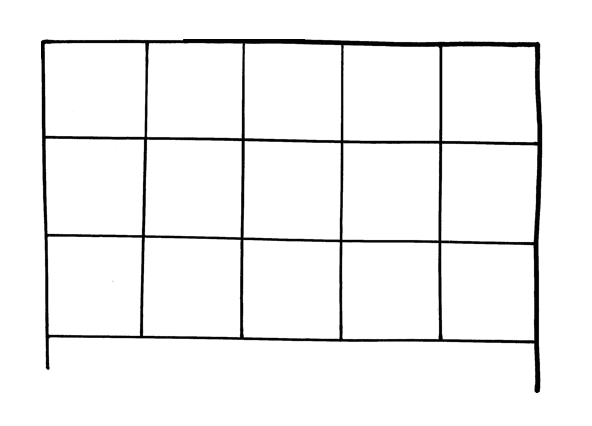
            Make several copies of the quilt grid.  Cover with contact paper.  Cut out many 1 – inch squares from assorted papers (construction, wrapping, foiled,etc)  Cover these with contact paper also.  Show the children how to make simple patterns ABABAB to fill the paper.  For younger children you might have to make a sample that they can copy the first time. 

Mathematics/Patterns & Measurement; enhances abilities to recognize, duplicate, and extend simple patterns using a variety of materials.

Outdoor Play

            If you have a parachute you can tell the children to lay on the ground and put their bodies under with only their head exposed for sleep.  You can have them take turns running under the covers/parachute.  Hop across to the other side like a frog.

Language Development/Listening & Understanding; shows progress in understanding and following simple and multiple step directions.

Transitions

            Shout out child’s name as their cue to go to the next activity.  KERRY!  Or K-E-R-R-Y!!!!!  go and find a center.

Literacy/Alphabet Knowledge; shows progress in associating the names of letters with their shape and sounds.

Resources

Make several sets and use these for patterns making with older children.
Use this to make patterns upon

Kitten’s First Moon, by Kevin Henkes

This is the story about a kitten who just wants a bowl of milk. This a sweet story told in a simple manner which makes it a favorite to many.

Materials

  • Toilet paper tubes, about 6-8 for a class
  • Cat stuffed animal/s and shoe box for each
  • Cut out circles in small, medium, and large sizes.

Vocabulary

  • Full moon (when the moon is like a circle in the night sky it is called a full moon)
  • Moon phases (full moon, half moon, quarter moon, cat’s claw)

Before Reading the Story

Draw a circle on your dry erase board and tell the children that you are thinking of something that is round like a circle and can sometimes be seen in the sky.  Let them try to guess what you are thinking of. Talk about how the moon comes out at night and the sun comes out during the day. Show the children the Phases of the Moon photo and ask them if they can guess which is called a full moon. Point and show them. Name the other moon types. Hold up the cover of the book and read the title. Show the children the picture of the full moon.

Science/Scientific Knowledge; expands knowledge of and abilities to observe, describe, and discuss the natural world, materials, living things, and natural processes.

Reading the Story

Have the children repeat, “Poor Kitten!” in the appropriate spots. 

Language Development/Listening & Understanding; demonstrates increasing ability to attend to and understand conversations, stories, songs, and poems.

When kitten thinks that thing in the sky is a bowl of milk, ask the children if they know what it really is?  Look at Kittens face when she opens her mouth and licks, bugs.  Ask the children what they think Kitten might be thinking?  Why do you think Kitten was scared when she climbed so high in the tree?

Literacy/Book Knowledge & Appreciation; shows growing involvement in listening to and discussing a variety of fiction and non-fiction books. AND Language Development/Speaking & Communicating; develops increasing abilities to understand and use language to communicate information, experiences, ideas, feelings, opinions, needs, questions; and for other various purposes.

After Reading the Story

Ask who, what, where ,when , why questions.

Who is the story about?  What was the kitten trying to get to?  Where did she see the bowl of milk?  When does the story take place?  Why was she scared?  Where does milk come from?  What shape is the full moon?  Kitten thought the moon looked like a bowl of milk, what does the moon look like to you?  What are some things that kitten sees in the night?  What are some ways that kitten tried to goet to the moon?

Language Development/Speaking & Communicating; develops increasing abilities to understand and use language to communicate information, experiences, ideas, feelings, opinions, needs, questions; and for other various purposes. AND Literacy/Book Knowledge & Appreciation; demonstrates progress in ability to retell and dictate stories from books and experiences; to act out stories in dramatic play; and to predict what will happen next in a story.

Discovery

Put out pictures of day and night for the children to sort.

Mathematics/Patterns & Measurement; shows increasing abilities to match, sort, put in a series, and regroup objects according to one or two attributes. AND Science/Scientific Knowledge; develops growing awareness of ideas and language related to attributes of time and temperature.

Put out the picture of the Cycles of the Moon and ask the children if they can recall the different names for each phase.

Science/Scientific Knowledge; expands knowledge of and abilities to observe, describe, and discuss the natural world, materials, living things, and natural processes.

Music and Movement

Pretend to be Kitten and follow some of her actions.   Close your eyes, stretch your neck, open your mouth, stick out your tongue, lick your finger, wiggle your bottom, spring forward, tumble onto the floor, run in place (to the tree), climb a tree, reach up high, leap, leap across the pond, go back to home, drink your bowl of milk.

Literacy/Book Knowledge & Appreciation; demonstrates progress in ability to retell and dictate stories from books and experiences; to act out stories in dramatic play; and to predict what will happen next in a story.

Teach the children the song, 10 Little Kittens. Make 10 kittens and use them to help sing the song. On your dry erase board draw a tree and a chair. https://www.youtube.com/watch?v=84hel7_NTSE Once the children are comfortable with the song, they can help move kittens from the tree to the chair.

Creative Arts/Music; participates with increasing interest and enjoyment in a variety of music activities, including listening, singing, finger plays, games, and performances.

Blocks

Encourage the children to build tall, to the moon but not past their shoulders if using wooden blocks.  How many high can they build before their tower falls over? 

Physical Health & Development/Fine Motor Skills; grows in hand-eye coordination in building with blocks, putting together puzzles, reproducing patterns and shapes, stringing beads, and using scissors. AND Mathematics/Number & Operations; begins to make use of one-to-one correspondence in counting objects and matching groups of objects.

Art

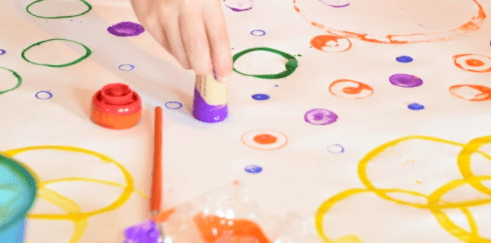
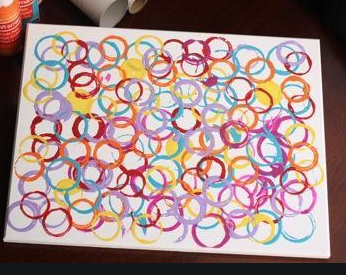
Ask the children if they can remember the shape of the moon in the story (circle). Tell them that today you are going to do circle art. Cut toilet paper tubes in half and put out small plates of paints. The children can dip the toilet tube in the paint and make circles on their paper by moving their hand up and down, up and down. Add anything else you may have in your class that will print circles.

Physical Health & Development/Fine Motor Skills; develops in strength, dexterity, and control needed to use tools such as scissors, paper punch, stapler, hammer.

Sand and Water

Bowls of various sizes and measuring cups.  How many 1 cups does it take to fill the bowl?  Which bowl holds more liquid? 

Mathematics/Geometry & Spatial Sense; begins to determine whether or not two shapes are the same size and shape. AND Science/Scientific Skills & Methods; begins to use senses and a variety of tools and simple measuring devices to gather information, investigate materials, and observe processes and relationships.

Library and Writing

Give the children white chalk and black construction paper to use to practice writing their name on.

Literacy/Early Writing; progresses from scribbles, shapes, or pictures to represent ideas, to using letter-like symbols, to copying or writing familiar words such as their own name.

Dramatic Play

Add any stuffed cats and shoe boxes that you might have. If you do not have stuffed cats, encourage the children to become cats. Put out some night time themed supplies such as blankets, small lamp, box beds, and encourage the children to carry out the theme.

Creative Arts/Dramatic Play; participates in a variety of dramatic play activities that become more extended and complex.

Math and Manipulatives

Go on a circle hunt about the room.

Mathematics/Geometry & Spatial Sense; begins to recognize, describe, compare, and name common shapes, their parts and attributes.

Put out all the circles that you cut out. Have the children sort them by small, medium, large. Have the children line them up by color and size.

Mathematics/Geometry & Spatial Sense; shows growth in matching, putting in a series, and regrouping objects according to one or two attributes such as color, shape, or size.

Outdoor Play

In the story the kitten climbed a tree to get closer to the moon.  If you have a climbing apparatus on playground, pretend that you are the kitten climbing high to reach the moon.

Literacy/Book Knowledge & Appreciation; demonstrates progress in ability to retell and dictate stories from books and experiences; to act out stories in dramatic play; and to predict what will happen next in a story.

Transitions

Give each child a picture of a cat or one of the circles that you cut out for Math & Manipulatives. Have each child near a chair. Ask them to put their kitten on the chair, under the chair, next to the chair, etc..

Mathematics/Geometry & Spatial Sense; builds an increasing understanding of directionality, order, and positions of objects, and words such as up, down, over, under, top, bottom, inside, outside, in front, behind.

Resources