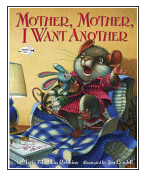
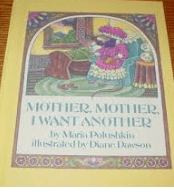
Mother, Mother, I Want Another, by Maria Polushkin

    Mother Mouse is tucking her baby into bed.  Baby mouse begins to cry, I want another, Mother.  Another Mother!  Find out what Mrs. Mouse does and how she and baby mouse resolve this issue.

Materials

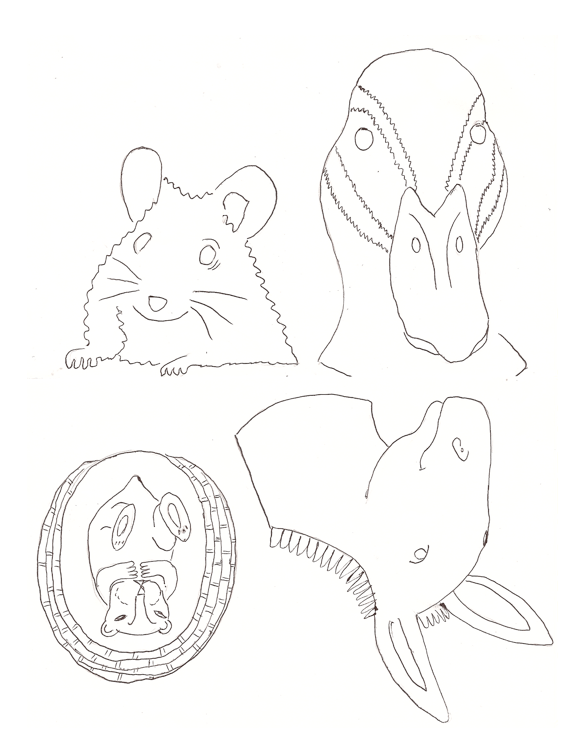
  • Mask of Mrs. Mouse, baby mouse, Mrs Duck, Mrs. Frog, Mrs. Pig, and Mrs Donkey
  • A variety of plastic foods or toys that have a varied number of syllables (corn, apple, carrot, pineapple, celery, pear)
  • Magazines with pictures of mothers and babies
  • Box of cornstarch

Vocabulary

  • Fret ( to be upset and cry)    

Before Reading the Story

Talk to the children about their bedtime rituals. Does anyone read them a story? Does anyone kiss them good-night?

Language Development/Speaking & Communicating; develops increasing abilities to understand and use language to communicate information, experiences, ideas, feelings, opinions, needs, questions; and for other varied purposes

Reading the Story

            Sing the Mother animal’s responses to baby mouse. 

After Reading the Story

            Tell the children that in the story, mother mouse went to find what she thought her baby wanted.  Ask the children what baby mouse really wanted?  Ask the children if they have ever had an experience like baby mouse, what did they do, what did their parent do?  Explain that when we don’t use our words or talk in full sentences, people do not always know what we want. 

Language Development/Speaking & Communicating; progresses in abilities to initiate and respond appropriately in conversation and discussions with peers and adults.

Discovery

            Tell the children that you are going to play a game with them about not using your words correctly.  Put out a variety of plastic foods.  Explain that you are going to ask them to guess which one you want by grunting the food name.  They will have to try to guess which one you want by counting the syllables of the word.  Practice counting syllables in the children’s names before you begin.(apple=grunt, grunt /pineapple=grunt,grunt,grunt).  After they guess correctly have all the children name the food item and then clap out its syllables.

Literacy/Phonological Awareness; shows growing ability to hear and discriminate separate syllables in words.

Music and Movement

            Sing Good Night Baby, to tune Good Night Ladies . https://www.youtube.com/watch?v=fMruF_CLrqM

Good night baby, good night baby,

Good night baby, it’s time to go to sleep

AGAIN!

Creative Arts/Music; participates with increasing interest and enjoyment in a variety of music activities, including listening, singing, finger plays, games, and performances.

Blocks

            Challenge the children to make a bed that they can sleep in. How will you figure out if it is long enough? How will you form the base? What blocks will you need to use?

Approaches to Learning/Initiative & Curiosity; approaches tasks and activities with increased flexibility, imagination, and inventiveness.

Art

            Use magazines and ask the children to cut out pictures of babies and mothers.  These can be both human and animals.  Draw a line down a piece of poster board and have the children glue the babies on one side and the mothers on the other.

Physical Health & Development/Fine Motor Skills; grows in hand-eye coordination in building with blocks, putting together puzzles, reproducing shapes and patterns, stringing beads, and using scissors. AND Mathematics/ Patterns & Measurement; shows increasing abilities to match, sort, put in a series, and regrouping objects according to one or two attributes such as shape or size.

Sand and Water

Try something different in the water table today. Add a box of cornstarch and slowly add water. The mixture will become solid in the bottom of your water table but when you pick it up, it will liquify and slip through your fingers. Show the children how to let it become a solid and use their finger to write their name. Them pick it up and let it ooze through their fingers.

Science/Scientific Skills & Methods; begins to use senses and a variety of tools and simple measuring devices to gather information, investigate materials, and observe processes and relationships. AND Literacy/ Early Writing; experiments with a growing variety of writing tools and materials. such as pencils, crayons, and computer.

Library and Writing

            Encourage the children to think of other animals that might come and sing to baby mouse.  What might these other animals say and bring to baby mouse?  Have the children illustrate and write their responses.  (Meow, I will bring you milk. Don’t cry baby mouse I will bring you a piece of cake).

Literacy/Print Awareness & Concepts; shows increasing awareness of print in the classroom, home, and community settings.

Math and Manipulatives

            Ask the child to give you two or three objects (chain link, counter bears).  When they give them to you say “I want another, now how many do I have”?  Continue this as the child gives you another and counts, note if they understand adding one more and how high they can count.  For older children you can say I want two more, now how many do I have?

Mathematics/Number & Operations; develops increases abilities to combine, separate and name “how many” concrete objects.

Dramatic Play

            This is a fun story to act out   Make the Mother masks and attach to a sentence strip.

Literacy/Book Knowledge & Appreciation; demonstrates progress ub abilities to retell and dictate stories from books and experiences; to act out stories in dramatic play; and to predict what will happen next in a story.

Outdoor Play

Play Mouse Tag. The teacher starts off as ‘the cat’ and chases the mice trying to catch them. Have a tree or a climber be the mouse hole or safe place. If a “mouse” is caught then they become a cat and help catch other mice.

Social & Emotional Development/Cooperation; shows increasing abilities to use compromise and discussion in working, playing, and resolving conflicts with peers.

Transitions

Ask each child to tell you something that their Mother does that makes them feel special and loved. (My Mom makes me chocolate milk, My Mom hugs me and tickles me)

Social & Emotional Development/Knowledge of Families & Communities; develops ability to identify personal characteristics, including gender and family composition.
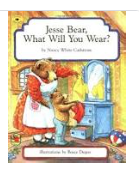
Jesse Bear, What Will You Wear? by Nancy White Carlstrom

Materials

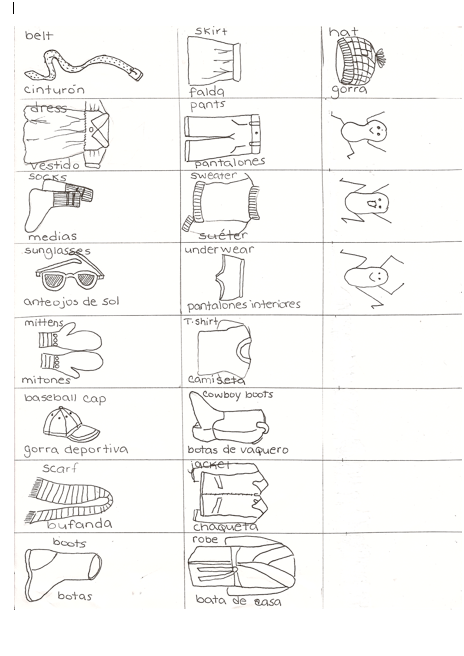
  •         Pictures of a variety of clothes to make a jumping bean game
  •          One paper plate per child.

Vocabulary

Before Reading the Story

            Talk to the children about the clothing that they are wearing.   Does the time of year affect the clothing that the children are wearing?  Is anyone wearing their favorite article of clothing or their favorite color?  Did the children wear outer clothing to school today, why?  Ask the children if they ever get to pick out their clothes to wear to school? Look at the cover of the book and read the title.  Ask the children if they can guess which shirt Jesse Bear will pick to wear.

Language Development/Speaking & Communicating; develops increasing abilities to understand and use language to communicate information, experiences, ideas, feelings, opinions, needs, questions; and for other varied purposes. AND Social & Emotional Development/Self Concept; begins to develop and express awareness self in terms of specific abilities, characteristics, and preferences.

Reading the Story

            As you read through the pages, stop and let the children talk about what is happening on each page and what name articles of clothing that they see.

Literacy/Book Knowledge & Appreciation; shows growing interest and involvement in listening to and discussing a variety of fiction, non-fiction books, and poetry.

After Reading the Story

            After reading the story, talk to the children about some of the different items of clothes that are worn for night and day.  Then teach the children to play Jumping Bean.  To play, cut out the clothing items and glue them to strips of cardboard.  Put all the strips of cardboard into an envelope cut in half so the clothing pictures are inside the envelope.  Also include several jumping beans.  The children take turns pulling out a cardboard strip and naming the item of clothing.  If they pull out a bean they shout Jumping Bean! And everyone then jumps up and down.  The play continues until all the cardboard strips have been picked.

Approaches to Learning/Initiative & Curiosity; chooses to participate in an increasing variety of tasks and activities.

Discovery

            Put out bubble blowing supplies either commercial or home made.  Experiment with different kinds of blowers.  Do different shaped blowers make different shaped bubbles? What happens when you touch a bubble with a dry hand versus a wet hand? How hard must you blow to make one big bubble? Many small bubbles?

Science/Scientific Skills & Methods; begins to use senses and a variety of tools and simple measuring devices to gather information, investigate materials, and observe processes and relationships.

Music and Movement

            Jessie Bear wears pants that dance.  Put on some music and let the children dance.  Pretend that your pants make you dance until the music stoops and then you freeze.

Creative Arts/Movement; expresses through movement and dancing what is felt and heard in various musical tempos and styles.

            Sing Rhyming Words Sound the Same to first 4 stanzas of The Mexican Hat Dance. https://www.youtube.com/watch?v=q-Rqdgna3Yw

Rhyming words sound the same, rhyming words sound the same

Rhyming words sound the same, rhyming words sound the same.

(chanted) Can you think of a word that rhymes with red, pants, rose, chair, etc?

Literacy/Phonological Awareness; progresses in recognizing matching sounds and rhymes in familiar words, games, songs, stories, and poems.

Do the poem Teddy Bear, Teddy Bear but change it to Jesse Bear, Jesse Bear.

Jesse Bear, Jesse Bear turn around

Jesse Bear, Jesse Bear touch the ground.

Jesse Bear, Jesse Bear touch your shoe

Jesse Bear, Jesse bear show me blue.

Jesse Bear, Jesse Bear stretch up high

Jesse Bear, Jesse Bear touch the sky.

Language Development/Listening & Understanding; shows progress in understanding and following simple and multiple-step directions.

Blocks

            If you have colored blocks put them out today and encourage the children to talk about the colors as they build.

Language Development/Speaking & Communicating; develops increasing abilities to understand and use language to communicate information, experiences, ideas, feelings, opinions, needs, questions; and vfor other varied purposes.

Art

            In the story Jessie Bear eats a variety of foods for lunch.  Let the children cut out food pictures and glue them to a paper plate.

Physical Health & Development/Fine Motor Skills; grows in hand-eye coordination in building with blocks, putting together puzzles, reproducing shapes and patterns, stringing beads, and using scissors.

Library and Writing

            Use flannel board dressing dolls or find a set on the internet (look up paper dolls) and make for the children to use. https://www.designeatrepeat.com/printable-paper-dolls/ After the child has dressed the doll, talk about the names of the clothing items, the colors, what one usually does wearing that type of clothing.

Language Development/Speaking & Communicating; develops increasing abilities to understand and use language to communicate information, experiences, ideas, feelings, opinions, needs, questions; and for other varied purposes.

Sand and Water

            Add water and dish soap. Give the children egg beaters and/or hand whippers to make the bubbles form.

Science/Scientific Skills & Methods; begins to use senses and a variety of tools and simple measuring devices to gather information, investigate materials, and observe processes and relationships.

Dramatic Play

            Encourage the children to play using night rituals and morning rituals as their theme.

Creative Arts/Dramatic Play; shows growing creativity and imagination in using materials and in assuming different roles in dramatic play situations.

Math and Manipulatives

            Play a graphing game with your children.  Make a large X on the floor using masking tape.  Explain to the children that you are going to become a human graph.  Ask all the children who are wearing Velcro shoes to stand in one area, all those wearing tie shoes to stand in another, and those with buckles.  Which has the most?  Now have the children move and divide by long sleeves, short sleeves, sleeveless or shirts with letters, shirts with pictures, and shirts that are solid.  Continue in this manner naming different ways to graph clothing articles and seeing which has most and least.

Mathematics/Number & Operations; begins to make use of one-to-one correspondence in counting objects and matching groups of objects. AND begins to use language to compare numbers of objects with terms such as more, less, greater than, fewer, equal to.

Outdoor Play

            Digging in the sand today with a shovel and hand. Can the children work together to make a giant moutain?

Physical Health & Development/Health Status & practices; participates actively in games, outdoor play, and other forms of exercise that enhance physical fitness. AND Social & Emotional Development/Cooperation; shows increasing abilities to use compromise and discussion in working, playing, and resolving conflict with peers.

Transitions

            Ask the children to name an item of clothing that they would wear on their foot, their head, when it is cold, when it is hot, at bedtime, in the day time, on special occasions, etc.

Approaches to Learning/Reasoning & Problem Solving; develops increasing ability to find more than one solution to a question, task, or problem.

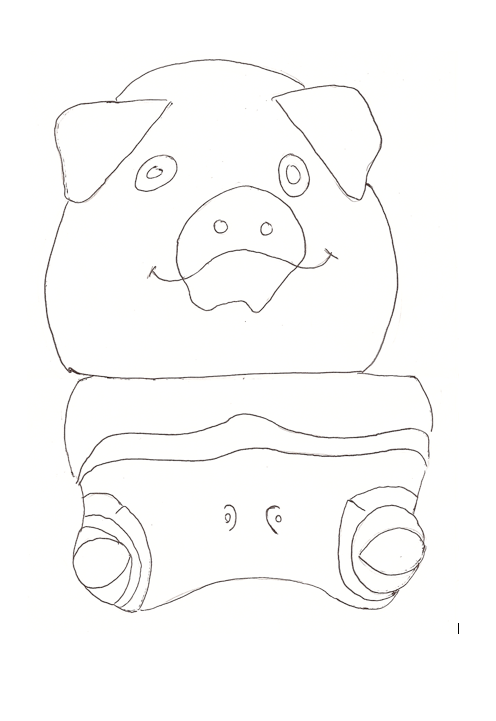
cut and use for jumping beans game

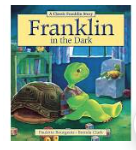
Franklin in the Dark, by Paulette Bourgeois

            Franklin turtle is afraid of being in small dark places.  How will he ever get into his shell to sleep?  In this story Franklin finds out that lots of other animals have fears also and learns how to be brave.

Materials

  • A shoe box with a 2 inch hole cut out of one end
  • Flashlight
  • Paper plate per child.
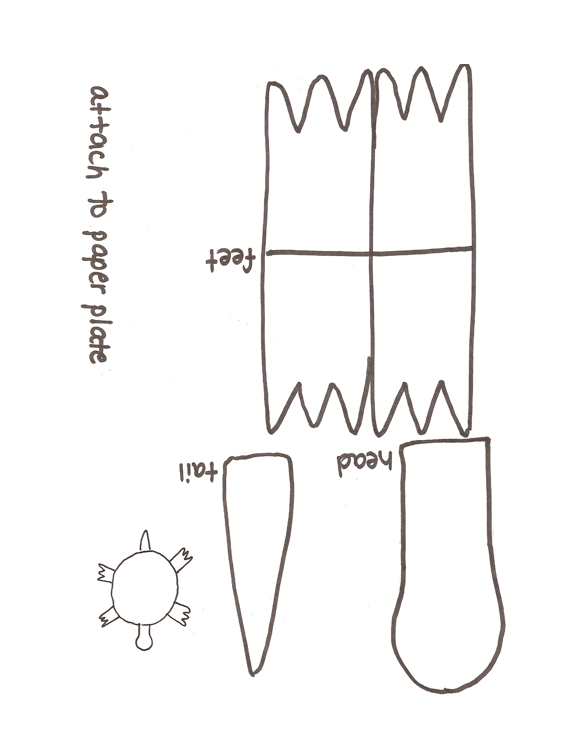
  • Head, feet, tail pattern
  • Scavenger Hunt cards
  • Scarf or cloth napkin per child
  • Yarn cut into 12 inch pieces, 4 per child.

Vocabulary

  • Brave (to show courage when you have to do something really scary or hard)
  • Afraid (to be frightened or scared of something)

Before Reading the Story

            Look at the front cover with the children; ask the children how they think Franklin is feeling, why?  Say, “I always thought turtles were supposed to be in their shell, I wonder why Franklin is not?”  Let the children respond.

Language Development/Listening & Understanding; demonstrates increasing ability to attend to and understand conversations, stories, songs, and poems.

While Reading the Story

            As you turn the pages that show the duck, the lion, the bird, and the bear, stop and ask the children, “why do you think the duck is wearing water wings?  The lion is wearing earmuffs, the bird is wearing a parachute, and the bear is wearing a snowsuit?”

Language Development/Speaking & Communicating; develops increasing abilities to understand and use language to communicate information, experiences, ideas, feelings, opinions, needs, questions; and for other varied purposes.

When you get to the page where Franklin goes to bed and says Goodnight, ask the children how do you think Franklin solved his fear of small dark places? 

Approaches to Learning/Reasoning & Problem Solving; develops increasing ability to find more than one solution to a question, task, or problem. AND Literacy/Book Knowledge & Appreciation; demonstrates progress in abilities to retell and dictate stories from books and experiences; to act out stories in dramatic play; and to predict what will happen next in a story.

After Reading the Story

            Tell the children about one time that you were scared and what you did to help you be brave.  Allow the children to share ways that they have been brave.

Language Development/Speaking & Communicating; develops increasing abilities to understand and use language to communicate information, experiences, ideas, feelings, opinions, needs, questions; and for other varied purposes. AND Social & Emotional Development/Self-Concept; demonstrates growing confidence in a range of abilities and expresses pride in accomplishments.

Discovery

            Have the children take turns putting classroom objects in the shoe box with a hole at one end.  Another child can then take a flashlight and look in the hole and name the object.  Can you see what is in there?  Can you name the color that you see?  How many legs do you see on the animal?  What kind of person-helper do you see in the box?

Science/Scientific Skills & Methods; begins to use senses and a variety of tools and simple measuring devices to gather information, investigate materials, and observe processes and relationships.

Music and Movement

            Explain to the children that you are going to try to act out different feelings while moving.  Ask the children if they can move like they are afraid.  Ask them to try to move like they are angry, sad, excited, tired, surprised.  There is no right way to do this; it is all about experimenting with movement and feelings.  If you like, give each child a scarf to help them act out with.

Creative Arts/Movement; expresses through movement and dancing what is felt and heard in various musical tempos and styles. AND Approaches to Learning/Reasoning & Problem Solving; develops increasing ability to find more than one solution to a question, task, or problem.

            Sing If You’re Happy and You Know It.  Try different verses using a variety of emotions; scared, angry, brave.

Approaches to Learning/Reasoning & problem Solving; develops increasing abilities to classify, compare, and contrast objects, events, and experiences.

Blocks;

            Challenge the children to make a ‘dark space’. Congratulate them on any structure they make that has an enclosed space that could be dark.

Approaches to Learning/Reasoning & Problem Solving; develops increasing ability to find more than one solution to a question, task, or problem.

Art;

            Make turtles out of paper plates.  Show the children how to draw lines that divide the plate into quarters or eighths.  Encourage them to color each section a different color or to make a pattern.  Give each child a page with the head, feet, and tail.  Older children can cut these out themselves.  Glue these onto the bottom of the decorated paper plate. 

Physical Health & Development/Fine Motor Skills; grows in hand-eye coordination in building with blocks, putting together puzzles, reproducing shapes and patterns, stringing beads, and using scissors.

Sand and Water

            Do a float and sink activity.

Science/Scientific Skills & Methods; begins to participate in simple investigations to test observations, discuss and draw conclusions, and form generalizations.

Library and Writing

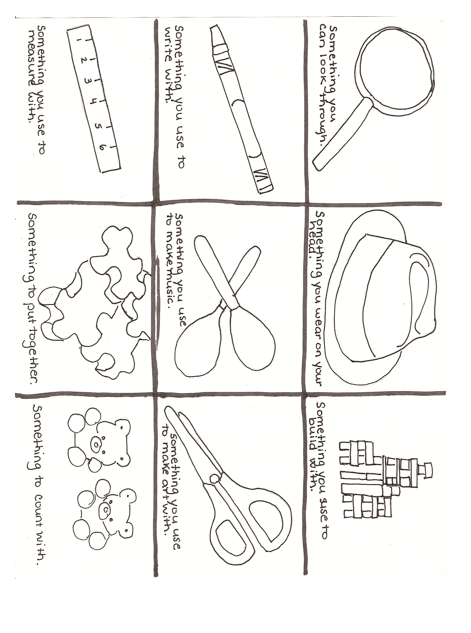
            Make a scavenger game to play with your children.  Use the cards provided and have the children find objects that fit into each category. 

Approaches to Learning/Engagement & Persistence; shows growing capacity to maintain concentration over time on a a task, question, set of directions or interactions, despite distractions and interruptions. AND Approaches to Learning/Reasoning & Problem Solving; develops increasing ability to find more than one solution to a question, task, or problem.

Dramatic Play

            Encourage the children to put on the dress ups like the bear in the story, practice buttoning, zipping, and Velcro. 

Physical Health & Development/;Fine Motor Skills; develops growing strength, dexterity, and control needed to use tools such as scissors, paper punch, stapler, and hammer. AND Social & Emotional Development/Self-Concept; develops growing capacity for independence in a range of activities, routines, and tasks.

Math and Manipulatives

            Tell the children that they can make parachutes like the bird wore in the story.  Give each child a scarf or cloth napkin and show them how to tie a knot with the yarn to each corner.  How many corners are there?  How many pieces of yarn will you need?  After they tie the corners, they can take the four loose ends and tie them around a rubber animal or person.  Take them outside and see if they work.

Mathematics/Number & Operations; begins to use one-to-one correspondence in counting objects and matching groups of objects. AND Physical Health & Development/;Fine Motor Skills; develops growing strength, dexterity, and control needed to use tools such as scissors, paper punch, stapler, and hammer.

Outdoors Play

            Let the children use wagons that they can push, and pull (like Franklin pulled his shell)

Physical Health & Development/Health Status & practices; progresses in physical growth, strength, stamina, and flexibility.

Transitions

Ask the children if they can remember what Franklin was afraid of? What were the other animals afraid of? What can you do if you are afraid?

Literacy/Book Knowledge & Appreciation; demonstrates progress in abilities to retell and dictate stories from book s and experiences; to act out stories in dramatic play; and to predict what will happen next in a story.

Resources