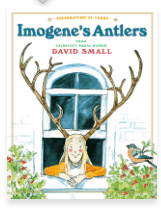
Imogene’s Antlers, by David Small

            What happens when Imogene wakes up one morning with antlers on her head?  This funny story will have children thinking of all the things they could do if they suddenly developed an animal body part.

Materials

  • Several different sized popsicle sticks or twigs
  • Head shape
  • Bag of birdseed
  • Pipe cleaners
  • Several hats and ribbon or crepe paper

Vocabulary

  • Milliner (someone who makes hats)

Before Reading the Story

            Ask the children if they ever thought what it would be like if they could be an animal.  What animal would they like to be and why?  Show the children the cover of the book and introduce.  Ask them if they can think of any problems that Imogene might have with her antlers.  What could you do if you had antlers?

Approaches to Learning/Reasoning & Problem Solving; develops increasing ability to find more than one solution to a question, task, or problem.

Reading the Story

            As you read the story, stop on the page where Imogene’s mother faints. Ask the children why they think Imogene’s mother faints (She can not believe her daughter has antlers)! What do you think is going to happen? What would you do if you woke up and had antlers on your head?

Approaches to Learning/Reasoning & problem Solving; develops increasing abilities to classify, compare, and contrast objects, events, and experiences. AND Literacy & Book Knowledge; demonstrates progress in abilities to retell and dictate stories from books and experiences; to act out stories in dramatic play; and to predict what will happen next in a story.

After Reading the Story

            Show the children several peephole pictures of animals to see if they can guess what each animal is. (Make a peep hole by cutting a one-inch circle in a manilla file. Put a picture behind it and move it around. Can the children guess what the picture is by just looking through the small hole)?

Approaches to Learning/Reasoning & Problem Solving; grows in recognizing and solving problems through active exploration, including trial and error; and interactions and discussions with peers and adults.

Discovery

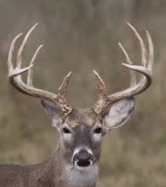
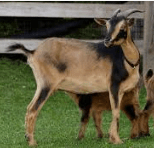
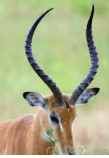
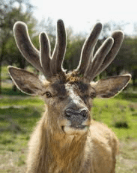
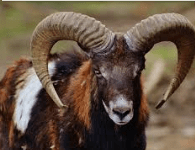
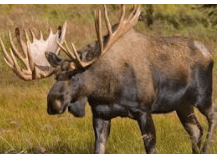
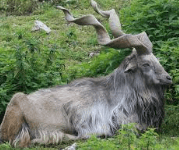
            Bring in pictures of animals with antlers and horns.  If you are lucky perhaps you know someone who will let you borrow some antlers, horns, skulls for the children to explore.

Science/Scientific Skills & Methods; develops increased ability to observe and discuss common properties, differences, and comparisons among objects and materials.

Music and Movement

            Sadly I know no songs that would go along with this book , so make it children’s choice day!

Social & Emotional Development/Self-Concept; begins to develop and express awareness of self in terms of specific abilities, characteristics,and preferences. AND Approaches to Learning/Initiative & Curiosity; develops increased ability to make independent choices.

Sing, If You’re Happy and You Know It but doing actions.

If you’re happy and you know it jump up and down

If you’re happy and you know it jump up and down.

If you’re happy and you know,

Your body will show it.

If you’re happy and you know it jump up and down.

(turn around, touch your toes, take a big leap, squat down low, etc.).

Physical Health & Development/Gross Motor Skills; shows increasing levels of proficiency, control, and balance walking, slimbing, running, jumping, hopping, skipping, marching, and galloping.

Blocks

            Add animals to the blocks.  As the children play, encourage them to talk about the different animal attributes.

Science/Scientific Skills & Methods; develops increased ability to observe and discuss common properties, differences, and comparisons among objects and materials.

Art

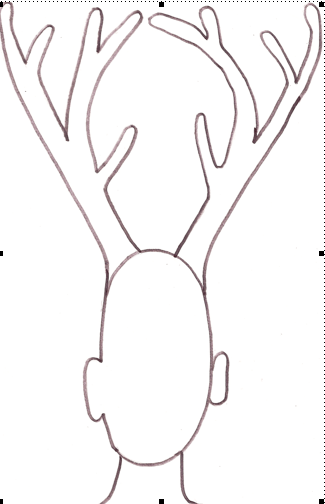
            Give the children a head page and Popsicle sticks.  They can draw the face and put popsicle stick/twig antlers on top using glue.

Creative Arts/Art; gains ability in using different art media and materials in a variety of ways for creative expression and representation.

Sand and Water

            Fill the table with birdseed (very soothing sound and can be used later to fill a bird feeder by your science window).  Give the children things for scooping and pouring. Ask the children if they can remember what Imogene fed the birds? Remind the children to keep the seed in the table as birdseed on the floor can be slippery.

Social & Emotional Development/Self-Control; demonstrates increasing capacity to follow rules and routines and use materials purposely, safely, and respectfully.

Library and Writing

            Ask the children to illustrate the following.  If I had _____I could_____!  (If I had wings I could fly, If I had a tail I could wag it hello).

Approaches to Learning/Reasoning & Problem Solving; develops increasing ability to find more than one solution to a question, task, or problem.

Dramatic Play

            Bring hats and ribbon into the center and be milliners.

Literacy/Book Knowledge & Appreciation; demonstrates progress in abilities to retell stories from books and experiences; to act out stories in dramatic play; and to predict what will happen next in a story.

Math and Manipulatives

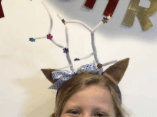
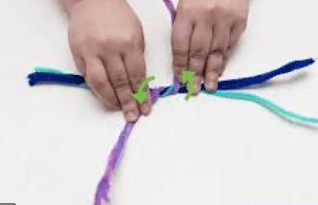
            Give the children 2 pipe cleaners to practice twisting together, like a candy cane.  The teacher can then help twist several together to make antlers. These can be attached to a sentence strip for wearing.

Physical Health & Development/Fine Motor Skills; develops growing strength, dexterity, and control needed to use tools such as scissors, paper punch, stapler, and hammer.

Outdoor Play

Play a ring toss game by having children try to toss hula hoops over a box or street cone. (Remember in the story how Imogene had donuts on her antlers? Let’s pretend that the hula hoop is a giant donut and see if we can get it to land on the cone/antler).

Physical Health & Development/Gross Motor Skills; demonstrates increasing abilities to coordinate movements in throwing, catching, kicking, bouncing balls, and in using the swing and slide.

Transitions

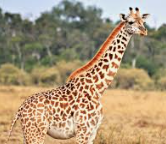
            Do animal riddles with the children. I’m thinking of an animal that has… (spots all over its body and a very long neck and legs.  It eats leaves from the tops of the trees)

Approaches to Learning/Reasoning & problem Solving; develops increasing abilities to classify, compare, and contrast objects, events, and experiences

Resources

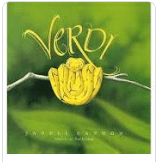
Verdi, by Janell Cannon

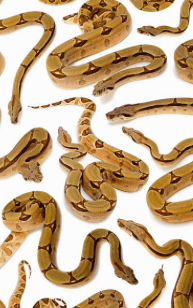
            Verdi is a young python snake who can not understand why the older snakes do not want to have fun and play with him.  He decides he will never get old even though his body grows and changes. 

Materials

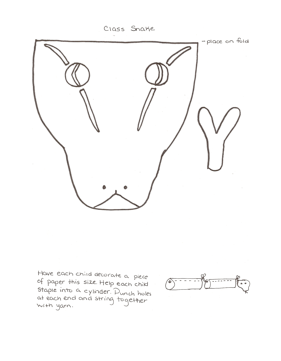
  • Snakehead
  • Alphabet sort board and letters/those with tails, those without tails
  • Pattern cards for any manipulative you have
  • Plastic Easter eggs
  • Plastic snakes, rubber fishing worms or strips of thick yarn

Vocabulary

  • Zigzag (\/\/\/\/\/\/\/\/\/\/)
  • Jungle ( Like a woods/forest but really hot and wet)
  • Fidgeting ( wiggling )
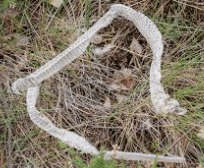
  • Molt (loosing of a snakes skin)
  • Plummeting ( falling fast from something high)

Before Reading the Story

            Show the front cover and tell the children that the story to today is about a snake.  Ask the children what they know about snakes.  Begin a list that you can add on to as the children learn more about snakes.   Tell the children that many people are afraid of snakes but snakes also help people.  The eat mice and rats. 

Science/Scientific Knowledge; expands knowledge of and abilities to observe, describe, and discuss the natural world, materials, living things, and natural processes. AND Language Development/Speaking & Understanding; develops increasing abilities to understand and use language to communicate information, experiences, ideas, feelings, opinions, needs, questions; and for other varied purposes.

Reading the Story

            Read the title and introduce the book. Tell the children that the story is about a kind of snake called a python snake.  Pythons live in the jungle which is like a really hot and wet forest/woods.

Literacy/Book Knowledge & Appreciation; progresses in how to handle and care for book; knowing to view books one page at a time in sequence from front to back; and understanding that a book has a title, author, and illustrator.

After Reading the Story

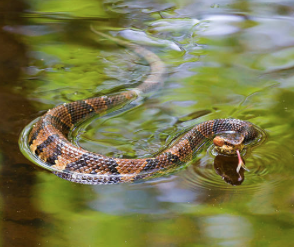
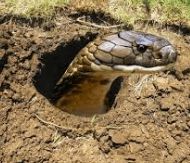
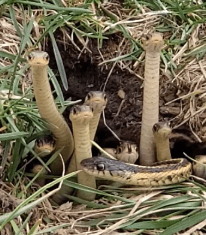
            Ask if the children learned anything new about snakes, add these to your list.  Find several pictures about snakes that live in your area.  Talk about snakes and snake safety (Snakes will bite if you get too close.  Some snakes are poisonous and can make you really, really sick. Never try to pick up a snake, move away slowly if you see a snake on the ground).  It is important to talk to the children about how to be safe around a snake but not frighten them. 

Physical Health & Development/Health Status & Practices; builds awareness and ability to follow basic health and safety rules such as fire safety, traffic and pedestrian safety, and responding appropriately to potentially harmful objects, substances, and activities.

Discovery

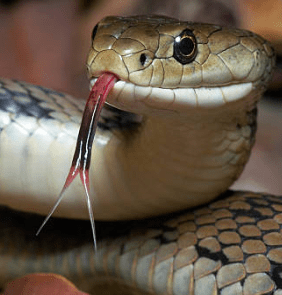
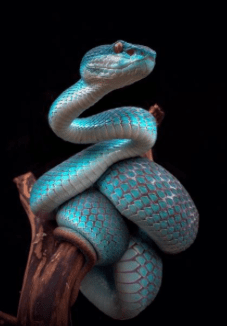
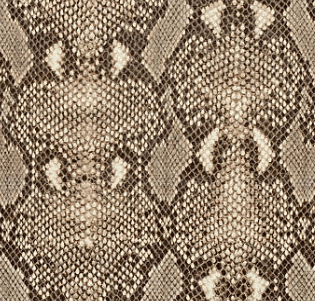
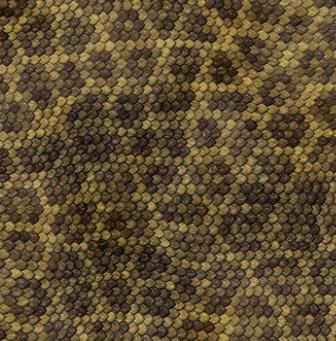
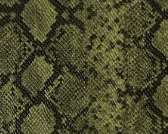
            If you’re lucky, a forest ranger, park, might have a snake skin that you can borrow.  Put out with a magnifying glass.  Bring books and pictures of real snakes for the children to examine. Help the children to notice all the patterns on snake skins.

Science/Scientific Skills & Methods; develops increased ability to observe and discuss common properties, differences and comparisons among objects and materials.

Music and Movement

Down in the Grass

Down in the grass, curled up in a heap,

Lies a big snake, fast asleep.

When he hears the grasses blow,

He moves his body to and fro,

Up and down, in and out,

See him slowly move about!

Now his jaws are open so-

Snap!  He bit my finger! Owh!

Use one arm resting on a table or leg to represent the snake.  Make his head by touching the thumb to the fingertip.  Act out.

Creative Arts/Music; participates with increasing interest and enjoyment in a variety of music activities, including listening, singing, finger plays, games, and performances.

Tell the children that moving like a snake takes strong muscles.  Have the children pull their arms inside their shirts and lay down on their stomach.  Tell them to pretend to be snakes and try to move forward, no feet allowed!  Have them try to lift their heads and shoulders up and forward to look around.  Being a snake takes strong muscles!

Physical Health & Development/Health Status & Practices; participates actively in games, outdoor play, and other forms of exercise that enhance physical fitness.

Blocks

            Show the children how to make a pattern using blocks (square, rectangle, square, rectangle or triangle, triangle, rectangle, triangle, triangle, rectangle).  Ask them to make it long like a snake.

Mathematics/Patterns & Measurement; enhances abilities to recognize, duplicate, and extend simple patterns using a variety of materials.

Art

            Tell the children that you are going to make a class snake and need their help. Give each child a piece of yellow or green construction paper.  Let them decorate it.  Help each child staple their paper into a cylinder.  Punch a hole at each end of the cylinder.  String these all together to make a long snake.  Cut out the snake head and attach at one end.  Hang your snake from the ceiling.  (We used alphabet stamps to decorate and also pattern rollers with paint).

Creative Arts/Art; begins to understand and share opinions about artist products and experiences.

Sand and Water

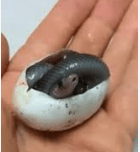
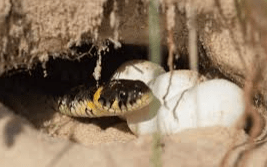
            Explain to the children that Snakes lay eggs and make nests in the dirt. Add sand or dirt into the table along with plastic Easter eggs and rubber snakes.  Rubber fishing worms could be used as snakes (take the hooks out).  Hang a picture of a snake nest on the wall for the children to see while they play.

Science/Scientific Skills & Methods; develops growing abilities to collect, describe, and record information through a variety of means, including discussion, drawing, maps, and chart.

Library and Writing

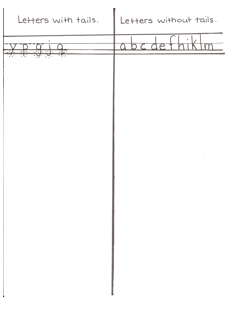
            Show the children the alphabet sorting board.  Let them use the copies of letters or magnet letters to sort letters with tails and those without.

Literacy/Alphabet Knowledge; shows progress in associating names of letters with their shapes and sounds.

Dramatic Play

Math and Manipulatives

            Put out pattern cards and manipulatives for the children to follow and make patterns. If you do not have patterns cards you can easily make these by representing a color pattern using circles or square the same color as your manipulative toy. (counting bears, rubber butterflies, unifix cubes, one-inch squares, etc.).

Mathematics/Patterns & Measurement; enhances abilities to recognize, duplicate, and extend simple patterns using a variety of materials.

Outdoor

            Play snake.  Have all the children hold hands.  The teacher should be the leader first to help the children get used to moving as a group.  While holding hands, begin to walk around the playground.  Weave in and out of equipment, trees, and each other. Explain to the children that they are going to have to walk slowly and stay in line for the snake to not be broken.

Social & Emotional Development/Self-Control; develops a growing understanding how their actions affect others and begins to accept the consequences of their actions.

Transitions

Remind the children that in the story, Verdi changed from a little boa constrictor into a big boa constrictor. Ask the children tho think of things that they can do now that they are bigger that they could not do when they were little. (I can ride my bike, I can get dressed all by myself, I can write my letters, I can jump from the climber).

Social & Emotional Development/Self-Concept; Begins to develop and express awareness of self in terms of specific abilities, characteristics, and preferences.

Resources


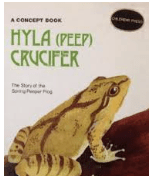
Hyla (Peep) Crucifer, the story of the spring peeper frog, by Carol Cornelius

            This is a fiction book that talks of the Hyla frog, one that you might see near your home in the spring.  It gives information about frogs that you can easily share with the children.

Materials

  •  frog outlines
  •  Pictures of several animals using camouflage to hide.
  • 10 flies
  • Paper plates
  • Frog head
  • Tiddlywinks or poker chips
  • Green playdough and two googly eyes per child

Vocabulary

  • Drifted (to float)
  • Gills (as lungs are to people, gills are to fish)
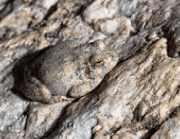
  • Camouflage (a way that animals can hide from other animals by blending into their environment/their surroundings).

Before Reading the Story

            Cut out 1 inch squares from different colors of paper.  Cut out 2 per child.  Hide these about the room placing the colored square upon an object that is the same color.  When the children gather for rug tell them that you just learned a really big word that you want to teach them.  Tell them the word is “camouflage” and ask if anyone thinks they might know what it means?  Bring in some pictures of animals that are camouflaged and show them to the children.  Show the children several of the one inch squares that you cut out.  Tell them that you have hidden the squares around the room and they are camouflaged.  Remember that camouflaged means that they are hiding on a color just like them.  Let the children know that they are each to go and find one camouflaged square and bring it back to the rug.  As they bring them back, ask them what color they found and where they found it.

Approaches to Learning/Engagement & Persistence; grows in abilities to persist in and complete a variety of tasks and activities.

Reading the Story

            As you read, remind the children that a Hyla Peeper frog is really only about an inch long. Show them how small an inch is.  Ask them why they think the illustrator drew the frog so big? (So we could see him good)

Approaches to Learning/Reasoning & problem-Solving; grows in recognizing and solving problems through active exploration, including trial and error, and interactions and discussions with peers and adults.

After Reading the Story

            Go back through the pages and ask the children to tell you what they remember about the Hyla frog and his life.  Use the book as a guide.  Write down the children’s responses and hang it on the wall with several of the children’s writing experiences.

Literacy/Book Knowledge & Appreciation; shows growing interest and involvement in listening to and discussing a variety of fiction, non-fiction, and poetry.

Discovery

            In the story, the tadpole used to breathe under the water like a fish but as he got older he started to breath through his lungs.  Have the children put their hands on their chest and breathe in and out, then feel their lungs fill up with air. 

Science/Scientific Knowledge; expands knowledge of and respect for their bodies and the environment.

Music and movement;

            Sing Peep Peep Went the Little Green Frog https://music.youtube.com/watch?v=EbM70ouxrc8&list=RDAMVMEbM70ouxrc8

Peep, peep went the little green frog one day

Peep, peep went the little green frog.

Peep. Peep went the little green frog one day

And his eyes went peep, peep too.

            Do 5 Little Speckled Frogs.  Have the children hold up 5 fingers and then do the actions with the poem. https://music.youtube.com/watch?v=HhVi4IQRMtY&list=RDAMVMHhVi4IQRMtY

5 Little speckled frogs, sitting on a speckled log

Eating the most delicious bugs, yum, yum

One jumped into the pool, where it was nice and cool

Then there were 4 more speckled frogs

Glub, glub.

Creative Arts/Music; participates with increasing interest and enjoyment in a variety of music activities, including listening, singing, finger plays, games, and performances.

            Put a bunch of paper plates all over the floor.  Turn on some lively music and let the children become frogs and jump from leaf/plate to leaf (or lily pads).

Physical Health & Development/Gross Motor Skills; shows increasing levels of proficiency, control, and balance in walking, slimbing, running, jumping, hopping, skipping, marching, and galloping.

Blocks

            Have the children make a small pond with the blocks.  Give them tidily winks or poker chips and show them how to pop them to make them jump (take one and scrape across the edge of another that is lying on a flat surface.  It will jump!  Can you get them to jump into the pond?  

Physical Health & Development/Fine Motor Skills; develops growing strength, dexterity, and control needed to use tools such as scissors, paper punch, stapler, and hammer.

Art

Give the children green play dough and googly eyes. Show them how to roll a ball of playdough to make the frog’s’ body. Give them googly eyes and encourage them to add legs and design to their bodies (I have given the children a straw to make ‘dots’ on the frog and a pencil to make ‘stripes’).

Creative Arts/Art; progresses in abilities to create drawings, paintings, models, and other art creations that are more detailed, creative, or realistic.

Library and Writing

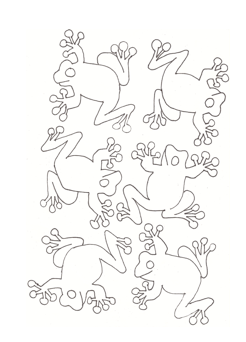
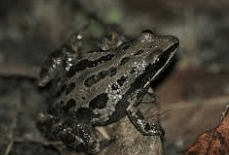
            The hyla frog has an X on its back.  Give each child a copy of the page with the 6 frogs on it and ask them to draw an X on each frogs back.

Literacy/Alphabet Knowledge; shows progress in associating the names of letters with their shape and sound. AND Language Development/Listening & Understanding; shows progress in understanding and following simple and multiple-step directions.

Sand and Water

            Water play, pouring and scooping.

Physical Health & Development/Fine Motor Skills; grows in hand-eye coordination in building with blocks, putting together puzzles, reproducing shapes and patterns, stringing beads and using scissors.

Dramatic Play

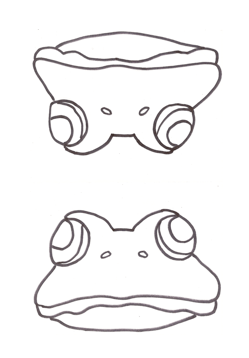
            Have the children cut out the frog head and make a mask/hat out of it by attaching it to a sentence strip around their head.  The children can wear their frog heads as they hop and jump about the classroom to music.

Creative Arts/Dramatic Play; shows growing creativity and imagination in using materials and in assuming different roles in dramatic play situations. AND Physical Health & Development/Fine Motor Skills; grows in hand-eye coordination in building with blocks, putting together puzzles, reproducing shapes and patterns, stringing beads and using scissors.

Math and Manipulatives

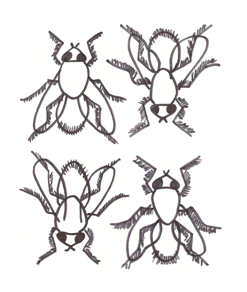
            Play Flies for Lunch.  Cut out a set of flies per child and spread them out on the table.   Write the numbers 1-5 on the fly backs. Give each child a piece of contact paper 1 inch by 6 inches.  Show them how to flap their “sticky tongue” down on the table and pick up a fly.  Call out numbers and see if they can catch the correct fly.

Mathematics/Number & Operations; begins to associate number concepts, vocabulary, quantities, and written numerals in meaningful ways.

Outdoor Play

            Have the children take turns getting into a crouching position and doing a frog leap.  Make a starting line and then mark the ground where they jump.  See who is the jumpiest frog.  Try having the children do standing long jumps and running broad jumps also.

Physical Health & Development/Gross Motor Skills; shows increasing levels of proficiency, control, and balance in walking, climbing, running, jumping, hopping, skipping, marching, and galloping.

Transitions

As the children move to the next activity have them do different kinds of hops or jumps. Can you hop on one foot to line up? Find a partner and jump to line up. Hop in a circle and then line up. Jump backwards to line up.

Physical Health & Development/Gross Motor Skills; shows increasing levels of proficiency, control, and balance in walking, climbing, running, jumping, hopping, skipping, marching, and galloping.

Resources
enlarge to use for dramatic play
write numbers on the backs of flies to use in manipulatives.
Give each child a page of 6 frogs to practice making the letter X on the backs
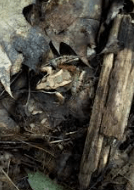
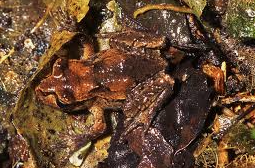
These frogs all camouflage into their pond environments