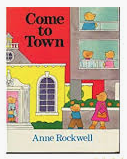
Come to Town, by Anne Rockwell

Follow the bears as they go to town.  This is a great talking through book about what goes on in the different buildings around town.

Materials

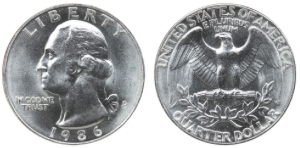
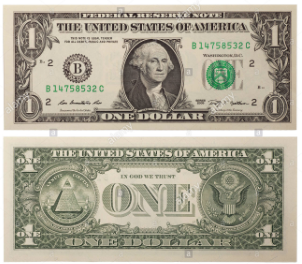
  •    Picture of penny, nickel, dime, quarter, and dollar bill
  •    10 pennies, 2 nickels, 1 dime
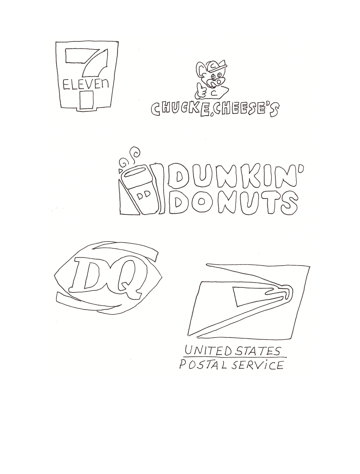
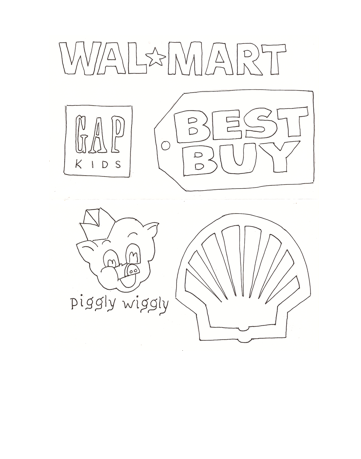
  •    Store Labels
  •    2 pictures of shape buildings
  •    Pictures of storefronts and items they might sell.

Vocabulary

  •   Town (This is where all the buildings are that people go to during the day).

Before Reading the Story

Turn to the page that says “Morning has come to town”.   Ask the children if they know what town means.  Help the children define it by using your town as the example.  Ask the children what kinds of buildings are in their town? If they cannot answer, ask them if they ever go to the bank, library, grocery store, department store, fish store, etc.

Social & Emotional Development/Knowledge of Families & Communities; begins to express and understand concepts and language of geography in the contexts of the classroom, home, and community.

Reading the Story

Take your time on the pages that describe what is going on in the buildings.  Let the children take turns describing something that they see.

Language Development/Speaking & Communicating;develops increasing abilities to understand and use language to communicate information, experiences, ideas, feelings, opinions, needs, questions; and for other varied purposes.

After Reading the Story      

Tell the children that town is where all the stores are. Ask the children to help you make a list of all the kinds of buildings that are in your town and that they might go

Language Development/Speaking & Communicating;develops increasing abilities to understand and use language to communicate information, experiences, ideas, feelings, opinions, needs, questions; and for other varied purposes.  AND Social & Emotional Development/Knowledge of Families & Communities; begins to express and understand concepts and language of geography in the contexts of the classroom, home, and community.

Discovery

 Explain to the children that many people get to town by driving in their car or taking public transportation.  Talk about how most land transportation has wheels and wheels roll.  Ask the children if they can recall what shape wheels are (round, circle),  Ask the children if they think a rectangle block would roll (no, because  it is not round).  Show the children how a cylinder block is round like a wheel.  Ask them if they think it will roll?  Invite the children to collect objects in the room that they think will roll.  Make a small ramp using a piece of cardboard and let the children experiment finding objects that will roll and not roll.

Science/Scientific Skills & Methods; begins to participate in simple investigations to test observations, discuss and draw conclusions, and form generalizations.

Music and Movement

Sing or chant, I’ve Got a Penny

I’ve got a penny, I’ve got a penny

I’ve got a penny shiny and new

I’m going to by all kinds of _______

That’s what I’m going to do.

Also sing nickel, dime, quarter, and dollar

(Give each child a piece of money.  When you sing the song see if they can name the piece of money that they have and also what they would buy.)

Approaches to Learning/Reasoning & Problem Solving; develops increasing ability to find more than one solution to a question, tsdk, or problem.  AND Creative Arts/Music; participates with increasing  interest and enjoyment in a variety of music activities, including listening, singing, finger plays, games, and performances.

Chant One a Penny

One a penny, Two a penny, Three a penny, more

Four a penny, Five a penny

That makes a nickel for the store

Six a penny, Seven a penny, Eight a penny more

Nine a penny, Ten a penny

Now that’s a dime for the store!

(As you do this poem, hold up pennies until you get to 5 then replace with a nickel.  Continue adding pennies to the nickel until you get to ten and replace with a dime.  Count out five pennies and ask the children what this is equal to.  Then count out ten pennies and ask them what it is equal to (2 nickels or a dime)

Mathematics/Number & Operations; develops increased abilities to combine, separate, and name “how many” concrete objects.  AND Mathematics/Number & Operations; begins to associate number concepts, vocabulary, quantities, and written numerals in meaningful ways.

Blocks

Put tape on familiar store labels and let the children build a town.  Have them tape on the store names to label each building in town.

Approaches to Learning/Engagement & Persistence; demonstrates increasing ability to set goals and develop and follow through on plans.

Art

Contact over the building shapes pages.  Show the children how to use the play dough to cover the shapes of the buildings.  They can roll it out or pinch it on.  You can also make letters for them to cover. 

Physical Health & Development/Fine Motor Skills; develops strength, dexterity, and control ineeded to use tools such as scissors, paper punch, stapler, andhammer.

Sand and Water

Place play coin money in the table with sand.  The children sift through the sand and find the coins.  Put a cupcake tin near the center with a penny, nickel, dime, and quarter glued to the bottom.  The children find the coins and put them into the correct tin.

Mathematics/Geometry & Spatial Sense; begins to determine whether or not two shapes are the same size and shape.

Library and Writing

            Make two sets of the store labels and glue them to index cards.  These then can be used to make a memory matching game.  TUrn all the cards upside down.  The children take turns picking up two cards.  If they ar a match they get to keep them.  If they are not a match, the cards get put back in their place upside down and the next child takes a turn.

Social & Emotional Development/Cooperation; develops increasing abilities to give and take in interactions; tpo take turns in games and in using materials; and to interact without being overly submissive or directive.  AND Mathematics/Patterns & Measurement; shows increasing abilities to match, sort, put in a series, and regroup  objects according to one or two attributes such as color, shape, or size.

Dramatic Play

 Add an office prop box (briefcase, clip board, pencil and paper, old calendars and memo books, calculator, paperclips, stapler, computer keyboard and phone.

Creative Arts/Dramatic Play; participates in a variety of dramatic play experiences that become more extended and complex.  AND Physical Health & Development/Fine Motor Skills; develops strength, dexterity, and control ineeded to use tools such as scissors, paper punch, stapler, andhammer.  AND Literacy/Early Writing; experiments with a growing variety of writing tools and materials, such as crayons, pencils, and computers.

Math and Manipulatives

Match the store to the items that belong in them game. Make a copy of the pages, cover them with contact paper and have the children match the items that belong in each store.

Mathematics/Patterns & Measurement; shows increasing abilities to match, sort, put in a series, and regroup  objects according to one or two attributes such as color, shape, or size.  AND Social & Emotional Development/Knowledge of Families & Communities; develops growing awareness of jobs and what is required to perform them.

Outdoor Play

Tell the children that you are going to act out a story with them.  Pretend to get up and dressed, eat breakfast etc.  Now it is time to go to town.  Get in your car, put on your seatbelt, turn the key and drive.  When in town, decide what stores you are going to (Kerry you go to McDonald’s and get everyone French fries, Roger you go to the hardware store and buy a hammer, etc).  Gather everyone back; ask them if they can remember what they bought.  All get in the car and head back home.

Creative Arts/Dramatic PLay; participates in a variety of dramatic play activities that become more extended and complex.  AND Approaches to Learning/Engagement & Persistence; shows growing capacity to maintain concentration over time on a task, question, set of directions or interactions, despite distractions and interruptions.

Transitions

Ask each child if they know what their parent does for work.  List these on a piece of paper.  (Alison’s Mom is a teacher.  Ryan’s Dad works for the cable company.  Paula’s Mom is an artist.  Sean’s Mom makes books.  Raven’s Mom is a Mom).

Social & Emotional Development/Knowledge of Families & Communities; progresses in understanding similarities and respecting differences among people such as genders, race, special needs, culture, language, and family structures.  AND  Language Development/Speaking & Communicating; develops increasing abilities to understand and use language to communicate information, experiences, ideas, feelings, opinions, needs, questions,; and for varied other purposes.

Resources
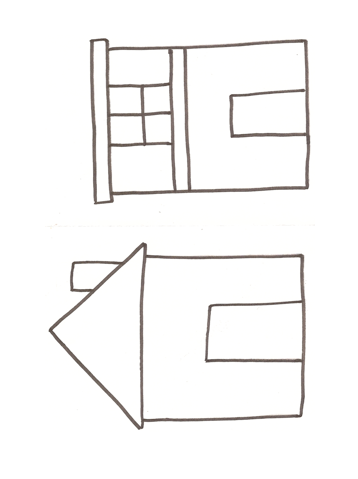
to use with play dough

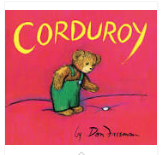
Corduroy, by Don Freeman

This is the story about a lost button and friendship. A Teddy Bear searches through a department store to find his lost button and ends up finding a new friend.

Materials

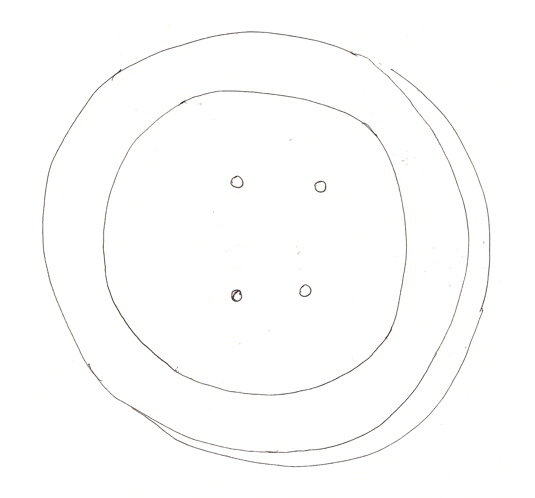
  •   Large button shape and small corduroy bear for hiding game
  •   A variety of buttons
  •   Oil pastels and watercolors

Vocabulary

  •   Overalls (pants with an attached bib on the front)
  •   Escalator (moving staircase)
  •   Palace (where the king and queen live)
  •   Admire (to look at something you think is beautiful)

Before reading the Story

Talk about friendship.  How can you tell that someone is your friend?  What can you do for your friend if they are feeling sad? How does it make you feel when someone wants to be your friend?  What should you do if you want to be someone’s friend?

Social & Emotional Development/Social Relationships; progresses in responding sympathetically to peers who are in need, upset, hurt, or angry; and in expressing empathy or caring for others.  AND Language Development/Speaking & Understanding; progresses in abilities to initiate and respond appropriately in conversation and discussions with peers and adults.

Reading the Story

Make sure to use voice modulation to express the different emotions that Corduroy experiences.  Make the expressions on your face also so the children can see.

Social & Emotional Development/Social Relationships; progresses in responding sympathetically to peers who are in need, upset, hurt, or angry; and in expressing empathy or caring for others.

After Reading the Story

Check on your clothing and see who is wearing a button. Who is wearing the most buttons? Who is wearing a snap, a zipper, a hook, a buckle?  As you look for various items, talk about what they are used for.  Can you think of something else that has a button on it, a zipper, etc..  (My Mom’s purse has a zipper, my jacket has a zipper, my folder has a snap).

Science/Scientific Knowledge; expands knowledge of and abilities to observe, describe, and discuss the natural world, materials, living things, and natural processes.  AND Language Development/Listening & Understanding; demonstrates increasing ability to attend to and understand conversations, stories, songs, and poems.

Discovery

Bring in a button collection that the children can look at and sort by various attributes.

Mathematics/Geometry & Spatial Sense; shows growth in matching, sorting, putting in a series, and regrouping objects according to one or two attributes such as color, size, or shape.

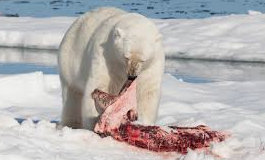
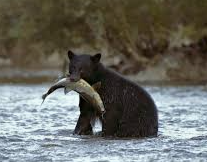
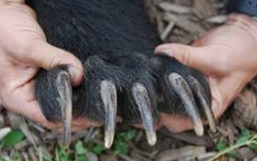
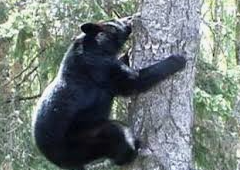
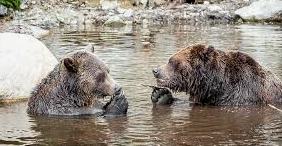
  Bring in pictures of real bears.  Let the children look at these and use them for discussion.  Can they tell about where bears live, what they like to eat, etc.?

Science/Scientific Knowledge; expands knowledge if and abilities ti observe, describe, and discuss the natural world, materials, living things, and natural processes.  AND  Approaches to Learning/Initiative & Curiosity; grows in eagerness to learn about and discuss a growing range of topics, ideas, and tasks.

Music and Movement

The Bear Went Over the Mountainhttps://www.youtube.com/watch?v=QAW2GSwUnNo

The bear went over the mountain
To see what he could see.
The bear went over the mountain
To see what he could see.
And all that he could see
Was the other side of the mountain
Was all that he could see.

Creative Arts/Music; participates with increasing interest and enjoyment in a variety of music activities, including listening, singing, finger plays, games, and performances.

Blocks

Add doll furniture and let the children build a department store with a furniture area.  Can you make an upstairs and a downstairs?  How can you make the stairs or the escalator? 

Approaches to Learning/Engagement & Persistence; grows in abilities to persist in and complete a variety of tasks and activities.

Add Teddy Bear counters; can you put a bear under the table, on the table, behind the table,etc..

Mathematics/Geometry & Spatial Sense; builds an increasing understanding of directionality, order, and positions of objects, and words such as up  down, over, under,top, bottom, inside, outside, in front, behind.

Art

Give each child a large round circle in light colored paper.  Let them color their buttons using oil pastels.  When they are finished coloring their button, they can do a watercolor wash over it.  This causes the oil pastel to sort of pop through and can make a very lovely effect.  

Creative Arts/ Art; begins to understand and share opinions about artistic products and experiences.

Library and Writing

Ask the children to draw a picture of where Corduroy’s button might be hiding.  After they have drawn the picture they can glue a small button (round circle) onto their picture.  Make sure to write their dictation underneath.  (The button was under the chair.  The button was in the grass next to the flower)

Literacy/Book Knowledge & Appreciation; shows growing interest in reading-related activities, such as asking to have a favorite book read; choosing to look at books; drawing pictures based on stories; asking to take a book home; going to the library; and engaging in pretend-reading with other children.

Sand and Water

Put sand in the table today and add either buttons, counting bears, or another small item that the children can scoop, count, and sort.

Mathematics/Geometry & Spatial Sense; shows growth in matching, sorting, putting in a series, and regrouping objects according to one or two attributes such as color, size, or shape.

Dramatic Play

Add clothes that have buttons.  Encourage the children to practice buttoning and unbuttoning.

Physical Health & Development/Health Status & Practices; shows growing independence in hygiene, nutrition, and personal care when eating, dressing, washing hands, brushing teeth, and toileting.  AND Physical Health & Development/Fine Motor Skills; grows in hand-eye coordination in building with blocks, putting together puzzles, reproducing shapes and patterns, stringing beads, and using scissors.

Math and Manipulatives

Play, Where’s Corduroy?  Cut out and color the large button.  Make 4-6 depending on how well your children know their colors. Each button should be colored a color that your children are working on.  Have the children take turns hiding their eyes and put the bear under one of the buttons.  The child whose turn it is must guess where Corduroy is by naming the color.  You can also play this game by making shape buttons or buttons with 1-6 dots on them.

Language Development/Speaking & Communicating; uses an increasingly complex and varied vocabulary.

Outdoor Play

 Pretend that you are bears.  Use your long claws to scratch a tree trunk.  Pretend the climber is a tree to sit in.  Throw balls and pretend that you are catching fish.  Find a place to crawl under like a cave.  Growl loud and try walking on all fours (hand and feet), not hands and knees.

Creative Arts/Dramatic Play; participates in a variety of dramatic play activities that become more extended and complex.

Transitions

Ask the children to tell you or show you how they would feel if…, they lost something, like a button.  They were alone in the department store at night, someone said they wanted to be their friend, they fell down and bumped their head, your mother said you could not have something you really, really, wanted.  You got to buy a special toy at the store.

Language Development/Speaking & Communicating; develops increasing abilities to understand and use language to communicate informations, experiences, ideas, feelings, opinions, needs, questions; and for other varied purposes.

Resources
Dentists, by Cecila Minden

 This book answers the Who, What, When, Where, and Why of being a Dentist.  This is a good book to use for further study of Dentists.

Materials

  •  Vinegar
  •  Baking soda
  •  Small bowls
  •  Old toothbrushes
  •  3-4 dirty pennies per child
  •  Camera
  •  Pictures of foods cut from magazines, off the Internet, or from                                                  a nutrition set

Vocabulary

  •  Pediatric (a doctor whose patients are only children)
  •  Cavity (a hole that occurs in your tooth from decay and not                                   brushing)
  • Explorer (the pick like tool that dentists use)
  • Operatory (the special room that you see the dentist in that has his tools)

Before Reading the Story

 Begin a discussion about the many different kinds of jobs that are in your area.  Ask the children what they think they would like to be.  If no one says they want tobe a dentist, ask them if they ever thought that a Dentist would be a good job to have. Ask the children if they know what a dentist does?  Have they ever been to the Dentist?  Let them talk for a moment about their experiences with the dentist.

Social & Emotional Development/Knowledge of Families & Community; develops growing awareness of jobs and what is required to perform them.
Reading the Story

This book has a lot of information that might be too much for preschool-aged children.  Use this to do a picture walk and touch upon highlights on each page. When the book talks about the education needed to be a dentist, make sure to tell the children that they have to continue to work hard at school and let them know that you are proud of them. 

Literacy/Book Knowledge & Appreciation; shows growing interest and involvement  in listening to and discussing a variety of fiction non-fiction and poetry.

After Reading the Story

Go back through the pages with the children asking who, what, where, when, and why questions and see which children are able to answer.  

Literacy/Book Knowledge & Appreciation; demonstrates progress in a bilities to retell and dictate stories from books and experiences; to act out stories in dramatic play; and to predict what will happen next in a story.  AND Physical Health & Development/Health Status & Practices; shows growing independence in hygiene, nutrition, and personal care when eating, dressing, washing hands, brushing teeth, and toileting.

Discovery

Pour a small amount of baking soda and vinegar into several bowls to make a paste like consistency.  Have the children drop 3-4 dirty pennies into the baking soda and vinegar mixture. Show them how to use the toothbrush to scrub the penny.  The combination of baking soda and vinegar will begin to clean the penny.  Talk about how the mixture is like your toothpaste and the penny is like your teeth.  Make the pennies shine. 

Science/Scientific Skills & Methods; begins to participate in simple investigations to test observations, discuss and draw conclusions, and form generalizations.  AND Physical Health & Development/Fine Motor Skills; grows in hand-eye coordination in building with blocks, putting together puzzles, reproducing shapes and patterns, stringing beads, and using scissors.

Music and Movement

Sing The Toothbrush Song to the tune of Mulberry Street.

We use our toothbrush to clean our teeth, clean our teeth, clean our teeth.

We use our toothbrush to clean our teeth after we eat.

Language Development/Listening & Understanding; demonstrates increasing ability to attend to and understand conversations, stories, songs, and poems.

Have the children sit in a circle and put on some lively music.  The children can pass a toothbrush around the circle and when the music stops, the child holding the toothbrush must name something that you use your teeth for.  Expect children to repeat answers, which is o.k. because they are understanding that teeth are important.  If the children cannot think of something that they use their teeth for you can pantomime eating, chewing, talking, smiling, and biting. 

Social & Emotional Development/ Self-Control; develops growing understanding of how their actions affect others and begins to accept the consequences of their actions.  AND Language Development/Speaking & Communicating; develops increasing abilities to understand and use language to communicate information, experiences, ideas, feelings, opinions, needs, questions; and for varied other purposes.

Art

Show the children how to form cubes with play dough by squeezing a ball on the sides and top.  Encourage the children to make a row of play dough cubes and gently stick them together.  Give the children Popsicle sticks or toothpicks and tell them to pretend that these are the “explorer” that the dentist uses.  Poke between the teeth, on top of the teeth, underneath the teeth. 

Language Development/Listening & Understanding; understands an increasingly complex and varied vocabulary.  AND Mathematics/Geometry & Spatial Sense; builds an increasing understanding of directionality, order, and positions of objects, and words such as up, down, over, under, top, bottom, inside, outside, in front, behind.

Library and Writing

Remind the children that Dentists have to be good readers and writers.  On index cards write the word Dentist and tooth.  Encourage the children to copy the words onto a piece of paper.  

Literacy/Early Writing; progresses from using scribbles, shapes, or pictures to represent ideas, to using letter-like symbols, to copying or writing familiar words such as their own name.

Make a book titled, “Whose Teeth?”  Take two pictures of the child.  One will be a picture of the child’s face as he/she is smiling.  The other will be just of the child’s smile so that you can see minimal amount of the face. On the front page put the picture of the smile only and write, “Whose smile?”  On the back of the page put the picture of the child’s smiling face.  Ask the children to tell you something that makes them smile and write it under their picture.  (I smile when my Mom makes me pizza!  I smile when my Grandpa comes to my house). 

Social & Emotional Development; Self-Concept; begins to develop awareness of self in terms of specific  abilities, characteristics, and preferences.

Blocks

Challenge the children to use the blocks to make a letter T for tooth and a letter D for Dentist. Encourage them to try to make letters in their own names.  

Literacy/Alphabet Knowledge; shows progress of associating the names of letters with their shapes and sound.

Dramatic Play

Give the children some of the materials that you use at large group time (dry erase board, flannel board, an attendance sheet, etc.) and let the children play school. 

Social & Emotional Development/Knowledge of Families & Communities; develops awareness of jobs and what is required to perform them.  AND Creative Arts/ Dramatic PLay; participates in a variety of dramatic play activities that become more extended and complex.

Math and Manipulatives

On a piece of paper draw a tooth and give it a happy face.  On another piece of paper draw a tooth and give it a sad face.  Let the children use the pictures of food that you have brought and sort them by food that is good for your teeth on the happy tooth and food that is not good for your teeth on the sad tooth. 

Mathematics/Patterns & Measurement; shows growth in matching, sorting, putting in a series, and regrouping objects according to one or two attributes such as shape or size. AND Physical Health & Development/Health Status & Practices; builds awareness and ability to follow  basic health and safety rules such as fire safety, traffic and pedestrian safety, and responding appropriately  to potentially harmful objects, substances, and activities.

Outdoors

 Look for small rocks on the playground that look kind of like teeth.  Collect them in a bucket.  At the end of your outdoor time, help the children to count the number of ‘teeth’ that you have collected. 

Mathematics/Number & Operations; begins to use one-to-one correspondence in counting objects and matching groups of objects.

Transitions

As children leave to go to the next center, ask them if they think they might like to be a dentist, make a graph of yes and no. 

Literacy/Early Writing; develops understanding that writing is a way of communicating for a variety of purposes.  AND Mathematics/Number & Operations; begins to use language to compare numbers of objects with terms such as more, less, greater than, fewer, equal to.

As the children go to brush their teeth today say the following poem from the Colgate web site.

(Kerry’s)/_______ off the brush his/her teeth

The front, the sides, the back

He’ll/she’ll clean away and move away

The yucky, yucky plaque.

Language Development/Listening & Understanding; demonstrates increasing ability to attend to and understand conversations, stories, songs, and poems.

Dear Parent-

            Today we learned about what it takes to become a Dentist.  Ask your child if they think they would like to become a Dentist.  If they say yes, ask them why.  If the say no, ask them if they know what they would like to become.